August 23, 2026
When the Ground Is Rich but the Wires Run Out
The global race to secure critical minerals and energy security is often framed as a geological contest, one where nations with the largest, highest-grade deposits hold the strategic advantage. Yet beneath the surface of this narrative lies a structural problem that no amount of drilling can solve: the absence of reliable, industrial-scale power infrastructure in the regions where the minerals actually exist. This is the central challenge driving the Canada critical minerals grid infrastructure delay.
Canada sits on some of the world's most significant undeveloped deposits of copper, lithium, nickel, cobalt, and rare earth elements. These materials form the physical backbone of electric vehicles, battery storage systems, wind turbines, and defence electronics. However, across Canada's northern and remote resource regions, the electrical grid was never built to support industrial extraction at scale. That mismatch, between geological abundance and infrastructure reality, is now the defining bottleneck in Canada's critical minerals ambitions.
When big ASX news breaks, our subscribers know first
The Real Bottleneck Isn't Underground, It's Above Ground
For decades, the primary challenge in mining development was finding a deposit worth extracting. Geological surveys, drill programs, resource estimates, and feasibility studies consumed years and hundreds of millions of dollars before a project could move forward. That paradigm has shifted significantly.
According to PDAC conference insights from the Prospectors and Developers Association of Canada 2026 conference, power supply rather than geology has emerged as the dominant constraint on critical mineral mining development across the country. Canada has formally identified copper, lithium, nickel, cobalt, and rare earth elements as priority materials within its energy transition strategy. The deposits exist. The problem is reaching them with adequate power.
Why Remote Deposit Locations Expose a Fundamental Infrastructure Mismatch
Many of Canada's most significant critical mineral deposits sit in precisely the areas where grid infrastructure is weakest or entirely absent. Northern Ontario's Ring of Fire hosts substantial nickel, chromite, and copper mineralisation. Yukon contains copper and critical mineral potential. Nunavut holds deposits largely untouched by industrial extraction. Quebec's lithium belt is advancing through early development stages.
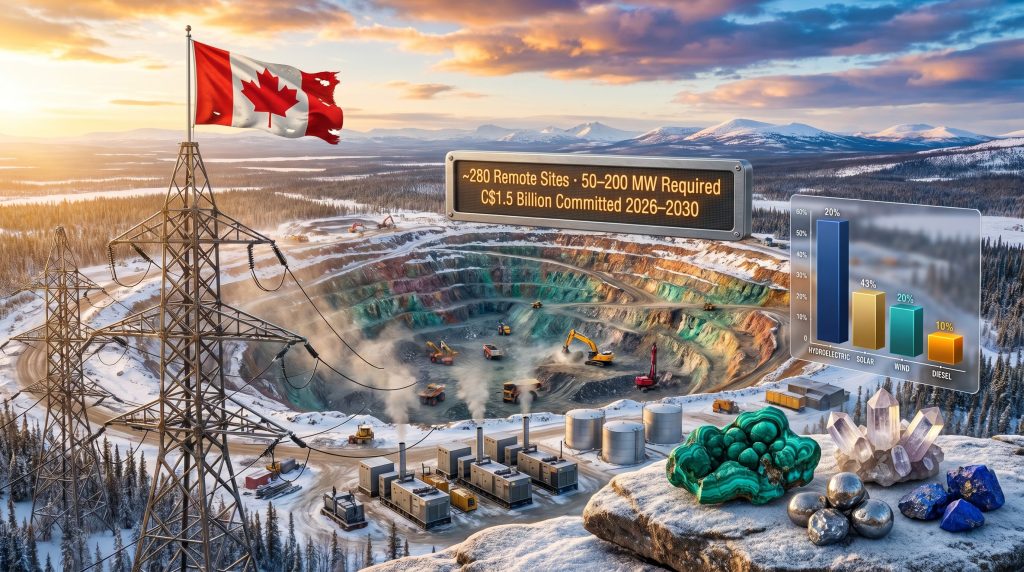
What these regions share is an electricity network designed for residential and small commercial loads, not the sustained, high-intensity power demands of modern mining operations. Large-scale copper and nickel extraction typically requires between 50 and 200 MW of continuous power, a load profile that overwhelms legacy microgrid systems built for communities of a few thousand residents. The fundamental design mismatch between what the grid can deliver and what industrial extraction demands has elevated the Canada critical minerals grid infrastructure delay from a project-level inconvenience to a national strategic problem.
How Severe Is Canada's Grid Infrastructure Gap for Critical Mineral Development?
Federal data reveals the scale of the disconnection problem with considerable precision. Approximately 280 remote communities and sites across Canada are not connected to the main North American electricity grid, relying instead on diesel-based microgrid systems to meet their power needs. Furthermore, as weak grid infrastructure continues to delay critical mineral projects, the national cost of inaction compounds year on year.
The Scale of Grid Disconnection Across Canada's Resource Regions
The following snapshot illustrates the quantitative dimensions of the infrastructure gap:
| Metric | Figure |
|---|---|
| Remote communities and sites off the main North American grid | ~280 |
| Typical continuous power demand for copper/nickel operations | 50–200 MW |
| Yukon total electricity generation (2023) | 559 GWh |
| Yukon installed renewable capacity (2023) | 104 MW |
| Projected doubling of national electricity demand by | 2050 |
Yukon provides a useful case study in the scale of the challenge. The territory's total electricity generation across all sources reached 559 GWh in 2023, with installed renewable capacity of just 104 MW. While hydroelectric power supplies the majority of Yukon's baseline electricity needs, diesel and natural gas generation cannot adequately meet the sustained load requirements that major mining operations demand. This isn't a gap that can be bridged by simply installing more solar panels or connecting a few additional diesel generators.
Why Legacy Electricity Systems Were Never Designed for Industrial-Scale Mining
The electricity infrastructure serving Canada's remote regions was built to serve small, geographically dispersed communities, not resource extraction operations. Mid-20th century grid development in Canada's north reflected population realities: isolated settlements requiring modest, predictable power loads with manageable seasonal variation.
Industrial mining inverts nearly every assumption embedded in these legacy systems. Where community loads peak intermittently and average in single-digit megawatts, mining operations require:
- Continuous, uninterrupted power delivery across multi-decade operational lifespans
- Load profiles measured in tens to hundreds of megawatts
- Redundancy and reliability standards that diesel microgrids cannot consistently achieve
- Capacity to support future processing operations that may substantially increase energy demand over time
Diesel Microgrid Dependency: A Structural Liability in Remote Regions
Diesel-based microgrids powering approximately 280 remote Canadian communities and sites cannot realistically support the 50–200 MW continuous power loads that large-scale copper and nickel extraction operations require, creating a hard ceiling on development without substantial grid intervention.
Diesel generation compounds the infrastructure problem in multiple dimensions. Beyond the raw capacity constraint, diesel-powered operations expose mining projects to fuel price volatility, complex logistics chains for remote fuel delivery, emissions liabilities increasingly incompatible with environmental assessment requirements, and operating costs that erode project economics over time. These are not marginal concerns but structural liabilities that fundamentally alter the risk profile of remote resource development.
What Is the True Cost of Grid Delays on Critical Mineral Project Timelines?
Infrastructure gaps translate directly into project delays, and project delays translate directly into capital destruction. The economic consequences of Canada's grid inadequacy compound across several interconnected dimensions.
Permitting and Regulatory Bottlenecks: A Multi-Year Compounding Problem
Grid infrastructure delays do not operate in isolation from broader regulatory timelines. Federal and provincial environmental reviews frequently extend beyond five years without fixed resolution timelines, creating compounding uncertainty for projects already grappling with infrastructure gaps. Several specific factors amplify these delays:
- Federal and provincial approval frameworks often apply different criteria and timelines to the same project, creating sequential rather than parallel review processes
- Geographic remoteness extends the logistical timeline for transmission infrastructure buildout, independently of regulatory decisions
- Policy uncertainty across electoral cycles affects investor confidence in the duration and reliability of approvals once granted
- Transmission corridor approvals require their own environmental and regulatory assessment processes, adding parallel critical paths to project development timelines
The Capital Gap That Stalls Projects Before They Begin
The financing dynamics of infrastructure-constrained projects create a particularly challenging capital formation problem. When a mining project must independently finance grid-equivalent energy infrastructure before extracting a single tonne of ore, the economics shift fundamentally.
Historically, only around 11% of Canada's mining capital has been directed toward critical minerals demand over the past 25 years, reflecting both geological preferences and infrastructure economics that have consistently favoured more accessible deposits. Projects in remote, grid-disconnected regions face a structural disadvantage in capital competition.
The infrastructure cost burden falling on individual project developers rather than shared public networks creates a specific financing gap. Costs of C$20 to C$30 million commonly emerge between feasibility completion and final investment decision, representing capital required to advance transmission planning, grid connection engineering, and power purchase agreements before construction financing can be secured.
Case Study: Ontario's Ring of Fire
The Ring of Fire in northern Ontario represents the most visible and extensively studied example of Canada's grid-mining dilemma. Estimates suggest that roads and transmission infrastructure alone could require approximately C$2.4 billion in capital investment before any significant extraction activity can begin.
This figure illustrates the scale at which infrastructure costs can dwarf the geological development investment for otherwise viable deposits. Projects in the Ring of Fire cannot realistically proceed without either significant public co-investment in shared infrastructure corridors or project-level financing that would materially impair returns for early investors. Nunavut operations face comparable self-reliance requirements but with even greater geographic isolation amplifying both costs and logistics complexity.
When mining operators must independently finance grid-equivalent infrastructure before a single tonne of ore is extracted, the economics of remote critical mineral development shift dramatically, often making otherwise viable deposits commercially unworkable without government co-investment.
Can Renewable Energy Solve Canada's Remote Mining Power Problem?
The intuitive answer to Canada's remote mining power problem might seem straightforward: deploy renewable energy for mining. Solar and wind capacity has fallen dramatically in cost over the past decade, and Canada's northern regions offer both solar irradiance and wind resources. The reality, however, is considerably more constrained.
The Seasonal Variability Problem: Why Solar and Wind Alone Fall Short in Arctic Conditions
Canada's Arctic and subarctic mining regions present specific renewable energy challenges that differ fundamentally from lower-latitude deployments. Solar irradiance in Canada's far north drops to fewer than four hours of meaningful daylight during winter months, precisely when energy demand for heating and equipment operation peaks. Wind patterns exhibit seasonal variability that cannot be predicted or scheduled around mining production requirements.
The core technical reality is direct: solar and wind output varies significantly by season in Arctic regions, and mining operations require consistent, uninterrupted power delivery year-round. Renewable capacity installed without concurrent investment in storage or backup generation cannot bridge the reliability gap for industrial loads.
The Backup Power Paradox: Renewables Requiring Conventional Support Systems
This creates what might be characterised as a backup power paradox. Installing renewable capacity in remote mining regions without grid interconnection requires parallel investment in conventional backup generation to maintain reliability during low-renewable-output periods. The economic and emissions benefits of renewable deployment are therefore partially offset by the continued requirement for conventional backup capacity.
The following comparison illustrates energy source suitability across the primary options available for remote Canadian mining:
| Energy Source | Reliability for Industrial Mining | Key Limitation in Remote/Arctic Regions |
|---|---|---|
| Hydroelectric | High (where available) | Geographically constrained; expansion limited |
| Solar PV | Moderate | Severe seasonal output variation in northern latitudes |
| Wind | Moderate | Intermittency requires storage or backup systems |
| Diesel Microgrid | High (operational) | Cost-prohibitive at scale; emissions-intensive |
| Grid Transmission Extension | High | Capital-intensive; long lead times |
Hydro Power's Role and Its Regional Limitations
Hydroelectric generation represents the most viable large-scale renewable option for many Canadian mining regions, and it currently supplies the majority of electricity in areas like Yukon where river systems provide adequate flow and head. However, hydroelectric expansion is geographically constrained. Not every mining region sits adjacent to developable hydro resources, and environmental assessment requirements for new hydro infrastructure are among the most demanding in Canada's regulatory system.
The conclusion reached by industry analysts is measured but important: renewable energy can meaningfully reduce diesel dependency in remote mining operations, but it cannot fully substitute for grid-scale reliable power delivery without substantial storage technology deployment or grid interconnection.
What Federal and Provincial Governments Are Doing to Close the Infrastructure Gap
Recognition of the infrastructure gap has gradually translated into policy responses, though the scale of public commitment relative to identified needs remains a subject of ongoing debate.
The First and Last Mile Fund: Targeted Capital Deployment
Federal infrastructure programmes have begun directing capital specifically toward grid development for critical mineral regions. Key commitments include:
- Over C$100 million allocated in March 2026 for Western Canadian grid upgrades
- C$44.2 million directed toward British Columbia's Northwest Transmission Line, supporting operations including the Red Chris mine
- C$1.5 billion committed through the First and Last Mile Fund covering the 2026 to 2030 period
- 33 projects currently supported under the Critical Minerals Infrastructure Fund
These commitments represent meaningful capital deployment, but they must be assessed against the scale of identified needs. The Ring of Fire alone carries an estimated C$2.4 billion infrastructure requirement. The 33 projects currently supported under the Critical Minerals Infrastructure Fund span a national footprint, suggesting per-project allocations that may fall well short of what individual projects in remote regions require.
Accelerated Permitting Reforms and Their Financial Implications
Beyond direct capital commitments, federal policy has targeted the permitting timeline problem. The federal ambition to compress approval timelines toward two-year targets represents a structural reform that, if implemented consistently, could materially improve project economics.
Accelerated permitting is modelled to improve project Net Present Values by 25 to 35%, reflecting the significant capital cost savings from shorter pre-construction periods and earlier first revenue. For capital-intensive infrastructure-dependent projects, this NPV uplift can be the difference between commercial viability and marginal economics.
April 2026 infrastructure approvals, including Enbridge's C$4 billion Sunrise pipeline, have been cited as signals of faster infrastructure decision-making that could be replicated for mineral corridors. However, each project's approval pathway reflects its specific regulatory context, and pipeline approval precedents do not automatically transfer to mining infrastructure decisions.
Interprovincial Grid Connectivity: The Yukon-British Columbia Corridor Proposal
Perhaps the most strategically significant infrastructure proposal under consideration is a grid connection between Yukon and British Columbia's existing transmission network. This interconnection would link Yukon's isolated electricity system to southern grid capacity, enabling industrial loads in Yukon mining regions to draw on grid-scale power without relying on local diesel generation.
International precedents support the logic. Nations that have successfully scaled critical mineral output have consistently co-developed energy and mining infrastructure rather than treating grid investment as a downstream problem. Canada is now actively examining this integrated development model, as evidenced by Canada's $200B clean energy buildout plans, which signal the scale of ambition now required.
Prime Minister Mark Carney has articulated a framework positioning energy infrastructure, critical minerals, investment attraction, and advanced technology as interconnected pillars of national economic strategy. This framing suggests that grid co-investment for mining regions may increasingly be evaluated as strategic national infrastructure rather than solely as a private sector obligation.
The next major ASX story will hit our subscribers first
Which Projects Are Breaking Through Despite Infrastructure Headwinds?
Despite the systemic challenges, specific projects have navigated the infrastructure constraint and reached advanced development milestones.
Canada Nickel's Crawford Project
The Crawford nickel-cobalt project in Ontario has demonstrated a pathway through Canada's infrastructure barriers by securing formal grid connection agreements ahead of construction. The project has received Federal Impact Assessment clearance and executed a grid engineering agreement with Hydro One at Porcupine Station, establishing the technical and contractual framework for industrial-scale power delivery. A summer 2026 permitting milestone is targeted, with construction commencement planned through 2026.
Crawford is notable not only for its scale but for its methodical approach to power infrastructure: securing grid connection agreements as a parallel track to permitting rather than treating power supply as a downstream problem to be solved after approval.
Active Development Snapshot: Canada's Critical Mineral Pipeline
| Metric | Figure |
|---|---|
| Active critical mineral mines in Canada | 56 |
| Projects advancing through federal processes | 14 |
| Critical Minerals Infrastructure Fund projects supported | 33 |
Quebec's Lithium Belt: A Regional Model for Infrastructure Co-Investment
Quebec's developing lithium mineralisation corridor is attracting attention as a potential model for how provincial grid infrastructure and mineral development can advance in coordination. Quebec's existing hydroelectric infrastructure provides a more favourable power supply baseline than many other Canadian mining regions, enabling projects to access grid-connected power without the infrastructure development burden that characterises Ontario's north or Nunavut.
The Quebec experience illustrates a broader principle: regions where grid infrastructure pre-exists or is co-developed alongside mineral extraction consistently achieve faster, more economical project development than regions where developers must independently finance power infrastructure from scratch.
What Must Change for Canada to Compete Globally in Critical Minerals?
The gap between Canada's critical mineral geological endowment and its current development trajectory is not primarily a geological, financial, or regulatory problem in isolation. It is an infrastructure integration problem that requires a coordinated response across all three domains.
Transmission Expansion as a National Strategic Imperative
Expanding transmission capacity into Canada's resource regions must be reconceptualised as national strategic infrastructure investment, comparable in public interest terms to highway networks or port facilities. The current model, where individual mining projects shoulder grid development costs, systematically undervalues the shared national benefit of transmission expansion while overloading individual project economics.
Treating transmission corridors as national infrastructure would enable cost sharing across multiple future resource users, improve financing terms through public balance sheet participation, and accelerate development timelines by separating infrastructure approval processes from individual project approvals.
Integrating Grid Planning Into Mineral Corridor Development From the Outset
The sequential model of mineral deposit identification followed by infrastructure planning followed by regulatory approval consistently produces the multi-year delays that characterise Canada's current development pipeline. Nations that have successfully scaled critical mineral production, including Australia, Chile, and Indonesia, share a structural advantage: energy infrastructure was either pre-existing or deliberately co-developed alongside extraction capacity.
Nations that have successfully scaled critical mineral output share a common structural advantage: energy infrastructure was either pre-existing or co-developed alongside extraction capacity. Canada's path to global competitiveness requires adopting this integrated development model rather than treating grid investment as a downstream problem.
Closing the Capital Gap Through Blended Finance Models
The C$20 to C$30 million financing gaps that routinely emerge between project feasibility and final investment decision reflect a structural mismatch between available capital instruments and the specific risk profile of infrastructure-constrained mining projects. Blended finance models, combining public grants, concessional debt, and private equity with clear risk allocation frameworks, offer a pathway to bridge this gap without requiring full public financing of private resource projects.
The C$1.5 billion committed through the First and Last Mile Fund through 2030 represents meaningful public capital deployment, but against identified needs in regions like the Ring of Fire alone, the quantum falls substantially short of what a fully integrated development model would require. Strengthening critical minerals supply chains at a national level will consequently depend on closing this financing gap systematically, not project by project.
Frequently Asked Questions: Canada Critical Minerals Grid Infrastructure Delay
Why is grid infrastructure a bigger problem than mineral availability for Canadian mining?
Canada has substantial identified critical mineral deposits, but a significant proportion sit in regions where electricity infrastructure was built for small communities rather than industrial extraction. Mining operations require 50 to 200 MW of continuous power, loads that diesel microgrids serving approximately 280 remote Canadian sites cannot support. The geological case for many deposits is strong; it is the infrastructure economics that prevent development from proceeding.
How much power do critical mineral mining operations typically require?
Large-scale copper and nickel operations typically require between 50 and 200 MW of continuous power. This range reflects variation in operation scale, processing complexity, and geographic factors like heating requirements. For context, Yukon's entire 2023 electricity generation was 559 GWh, meaning a single large mining operation could consume a substantial portion of the territory's current generation capacity.
What is the Ring of Fire project and why does it face such significant infrastructure challenges?
The Ring of Fire is a mineralised region in northern Ontario containing significant nickel, chromite, and copper deposits. The region lacks road access and grid electricity, meaning any significant development requires constructing both transport and power infrastructure from scratch. Estimates suggest roads and transmission infrastructure alone could require approximately C$2.4 billion before extraction begins, making infrastructure financing the primary development barrier.
How long do permitting delays typically add to Canadian mining project timelines?
Federal and provincial environmental reviews in Canada have frequently extended beyond five years. Federal reform targets aim to compress this toward two-year timelines, with modelling suggesting that achieving faster approvals could improve project Net Present Values by 25 to 35%.
Is renewable energy sufficient to power remote Canadian mining operations?
Renewable energy can meaningfully reduce diesel dependency but cannot fully replace grid-scale reliable power delivery in isolation. Seasonal solar and wind variability in Arctic and subarctic regions creates reliability gaps during winter months when mining energy demand peaks. Hybrid systems combining renewables with backup generation, storage, or grid interconnection represent the most viable pathway for renewable integration in remote mining operations.
What federal funding programmes exist to support grid development for critical minerals?
Key programmes include the First and Last Mile Fund (C$1.5 billion committed through 2026–2030), the Critical Minerals Infrastructure Fund (supporting 33 projects), and targeted allocations including C$44.2 million for BC's Northwest Transmission Line and over C$100 million for Western Canadian grid upgrades announced in March 2026.
How does Canada's grid infrastructure challenge compare to other major mining nations?
Nations including Australia, Chile, and Indonesia have achieved higher critical mineral development velocity in part because energy infrastructure was either pre-existing in resource regions or co-developed alongside extraction capacity. Canada's current model of project-level infrastructure financing creates an economic barrier that these competitor nations largely avoided through integrated public-private infrastructure development.
Key Takeaways: Canada's Critical Mineral Grid Infrastructure Challenge
- Power supply, not resource availability, has become the defining constraint on the Canada critical minerals grid infrastructure delay
- Approximately 280 remote sites operate on diesel microgrids incapable of supporting industrial-scale extraction requiring 50 to 200 MW of continuous power
- Infrastructure financing gaps of C$20 to C$30 million routinely stall projects between feasibility and construction phases
- Federal programmes have committed over C$1.5 billion through 2030, but capital needs in regions like the Ring of Fire remain substantially unmet
- Accelerated permitting reforms targeting two-year approval timelines could improve project economics by 25 to 35% if implemented consistently
- Renewable energy reduces but cannot eliminate remote mining diesel dependency given Arctic seasonal variability constraints
- Canada's competitive position in global critical mineral supply chains depends on treating grid infrastructure as a strategic national asset rather than a project-level cost burden
- Nations that have successfully scaled critical mineral output share a common structural advantage: energy and mining infrastructure developed in coordination, not sequence
Disclaimer: This article contains forward-looking statements, modelled projections, and third-party estimates regarding project timelines, capital requirements, and policy outcomes. These figures reflect current available information and analyst assessments but are subject to change based on regulatory decisions, market conditions, and project-specific developments. Nothing in this article constitutes financial or investment advice. Readers should conduct independent research and consult qualified advisers before making investment decisions related to mining projects or critical mineral sectors.
Want to Identify the Next Major Critical Minerals Discovery Before the Market Does?
Discovery Alert's proprietary Discovery IQ model delivers real-time alerts the moment significant ASX mineral discoveries — including critical minerals such as copper, nickel, and lithium — are announced, translating complex geological data into clear, actionable investment insights. Explore how historic discoveries have generated substantial returns on Discovery Alert's dedicated discoveries page, and begin your 14-day free trial today to position yourself ahead of the broader market.