June 28, 2026
Canada critical minerals processing represents a transformative opportunity as global supply chains face unprecedented disruptions and strategic resource security becomes paramount. The intersection of abundant geological resources, established mining expertise, and evolving geopolitical dynamics positions Canada at a critical juncture where processing capabilities could determine long-term economic competitiveness and national strategic positioning.
Understanding Canada's Global Processing Position
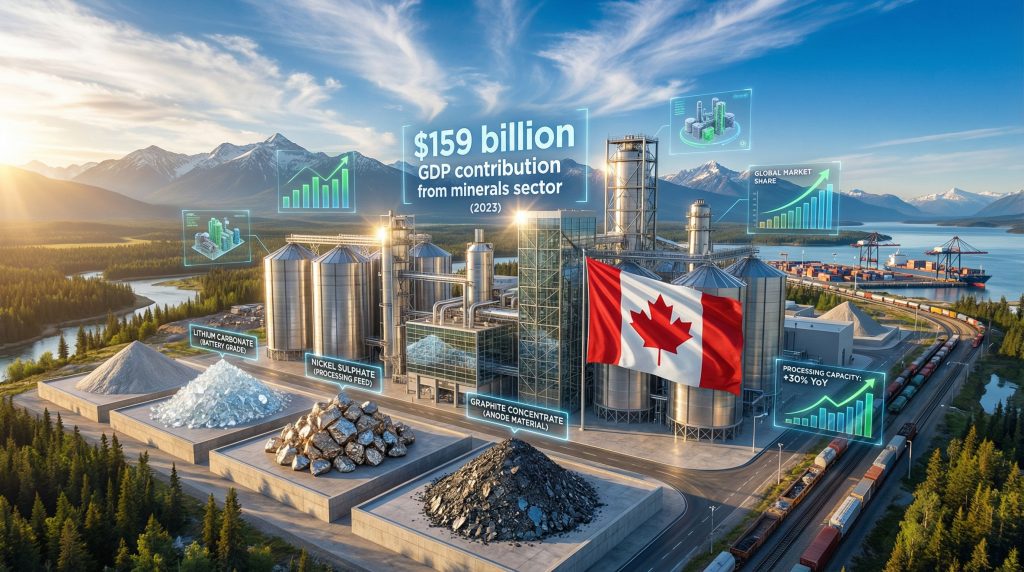
Canada's minerals sector represents a substantial economic foundation, contributing approximately $159 billion to national GDP in 2023 while supporting over 1,095 mining issuers across Toronto exchanges with a combined market capitalisation exceeding $600 billion CAD. This financial scale positions Canada as a dominant force in global mining capital markets, yet the nation's processing capabilities remain disproportionately underdeveloped relative to its extraction capacity.
The federal government has designated 31 critical minerals under its national strategy, spanning battery metals, rare earth elements, and strategic industrial materials. Canada maintains top-five global producer status for uranium, niobium, nickel, and potash, demonstrating significant upstream competitive advantages. However, the transformation of these raw materials into value-added products occurs predominantly outside Canadian borders, representing a systematic loss of potential economic value.
Furthermore, the emergence of critical minerals as strategic national assets has fundamentally altered investment priorities, regulatory frameworks, and competitive dynamics across major mining jurisdictions. Understanding these shifts requires examining the intersection of geological advantages, technological capabilities, capital deployment patterns, and geopolitical considerations.
Provincial Processing Specialisation
Canada's processing potential varies significantly across provincial jurisdictions, with each region offering distinct competitive advantages:
| Province | Primary Strengths | Processing Focus | Infrastructure Assets |
|---|---|---|---|
| Quebec | Lithium, graphite, rare earths | Battery materials integration | Deep-sea ports, rail networks |
| Ontario | Nickel, chromium, graphite | Historical processing expertise | Manufacturing proximity |
| British Columbia | Molybdenum, copper | Industrial minerals | Pacific shipping access |
| Saskatchewan | Copper-zinc, potash | Agricultural and battery metals | Railway infrastructure |
The concentration of processing opportunities within specific provinces reflects both geological endowments and existing infrastructure capabilities. Quebec's emergence as a battery materials hub leverages established transportation networks and proximity to North American manufacturing centres.
Competitive Benchmarking Against Global Leaders
Canada's processing gap becomes apparent when comparing domestic value-add capabilities with major mining nations. Australia processes approximately 65% of its critical minerals domestically before export, while Chile maintains integrated copper processing facilities that capture premium pricing for refined products.
In addition, Canada's current approach of exporting raw materials results in significant value leakage, with industry estimates suggesting annual revenue increases of $12 billion by 2040 through expanded processing capabilities. The technical complexity differential presents both challenges and opportunities for mining industry innovation.
When big ASX news breaks, our subscribers know first
Economic Forces Driving the Processing Gap
The systematic dismantling of Canada's processing capabilities reflects a complex interplay of corporate restructuring, capital allocation decisions, and market dynamics that unfolded over approximately 25 years. The acquisition of major Canadian mining companies including Inco, Falconbridge, and Rio Algom by foreign entities fundamentally altered the nation's mining sector structure.
Capital Requirements and Investment Barriers
Processing facility development demands substantial upfront capital investment, with industry assessments indicating $30 billion needed for domestic demand fulfilment and $65 billion for global market participation over 15 years. These investment requirements reflect several technical and operational complexities:
- Hard rock processing methodologies requiring specialised equipment and metallurgical expertise
- Energy-intensive operations demanding reliable power infrastructure and competitive electricity rates
- Environmental compliance systems meeting stringent Canadian regulatory standards
- Skilled workforce development addressing the erosion of processing expertise through generational turnover
The current "rip and ship" model, whilst requiring lower capital investment, systematically transfers value creation opportunities to international processing facilities. Ontario Energy and Mines Minister Stephen Lecce's characterisation of this approach as "ripping and shipping" reflects growing recognition of the economic opportunity cost.
Market Volatility and Long-Term Planning Challenges
Processing facilities require 3-7 year construction timelines and operational lives extending 15-25 years, making commodity price volatility a material constraint on capital deployment decisions. Unlike mining operations that can adjust production levels based on market conditions, processing facilities operate most efficiently at consistent capacity utilisation rates.
However, the technical complexity of hard rock processing compared to alternative methodologies employed by international competitors adds operational risk premiums that must be factored into investment calculations. Consequently, this complexity also creates potential barriers to entry that could protect Canadian processing investments once established.
Workforce Knowledge Erosion
Canada critical minerals processing gap reflects not merely infrastructure absence but the systematic erosion of metallurgical expertise, process engineering capabilities, and operational experience in downstream activities. The loss of major mining company headquarters eliminated the institutional knowledge centres that historically drove processing technology development.
Rebuilding this expertise requires coordinated investment across educational institutions, technical training programs, and on-site operational experience development. The timeline for workforce capability restoration extends beyond infrastructure construction schedules, necessitating parallel investment in human capital development.
Government Policy Framework Transformation
The establishment of the $3.8 billion Critical Minerals Strategy represents a fundamental shift in federal policy priorities toward value-added processing development. Launched in 2022 and enhanced in 2025, this comprehensive framework employs multiple coordinated policy instruments designed to accelerate processing infrastructure deployment.
Major Projects Office and Regulatory Acceleration
Under Prime Minister Mark Carney's leadership, Canada created a new Major Projects Office specifically targeting critical minerals project acceleration. This institutional innovation addresses historical permitting delays that have extended Canadian project development timelines significantly beyond international benchmarks.
The regulatory acceleration approach represents a departure from traditional environmental assessment procedures that often required 5-7 years for major project approvals. By contrast, Foran Mining's leadership has demonstrated that copper mine development can be completed within five years, suggesting streamlined regulatory processes could substantially reduce time-to-production.
Furthermore, Canada's Critical Minerals Strategy provides comprehensive policy guidance for processing sector development whilst addressing supply chain security considerations.
Canada Growth Fund Co-Investment Strategy
The federally-backed Canada Growth Fund has initiated co-investment programs with several major processing development projects, including:
- Nouveau Monde Graphite in Quebec for battery-grade graphite processing
- Foran Mining in Saskatchewan for copper-zinc processing expansion
- Thompson nickel mine complex in Manitoba for integrated nickel processing
- Canada Nickel Crawford Project for vertically integrated nickel operations
These co-investments serve multiple strategic functions: providing capital to bridge financing gaps, signalling federal commitment to private investors, and establishing precedents for future processing facility development.
Export Development Canada Financing Support
The integration of Export Development Canada debt financing capabilities addresses one of the primary capital constraints facing processing facility development. EDC's mandate expansion to include domestic processing infrastructure represents policy recognition that processing capabilities constitute essential export infrastructure rather than purely domestic industrial development.
This financing mechanism becomes particularly important given the multi-billion dollar capital requirements for comprehensive processing capability development across Canada's designated critical minerals portfolio.
International Partnership Strategies and Market Access
Canada's processing expansion strategy emphasises collaboration with allied nations to reduce supply chain dependency on potentially unreliable jurisdictions whilst enhancing collective resource security. The Joint Action Plan with the United States represents the cornerstone of this bilateral approach, covering supply chain integration and research coordination.
Strategic Alliance Framework Implementation
The US-Canada collaboration extends beyond traditional trade relationships to encompass:
- Supply chain resilience initiatives targeting critical minerals processing capacity
- Technology transfer agreements for advanced processing methodologies
- Joint research and development programs addressing hard rock processing optimisation
- Market access facilitation for Canadian processed materials in US manufacturing sectors
These partnerships provide market certainty that supports long-term capital investment decisions whilst creating economies of scale that improve processing facility economics. The collaboration also enables sharing of technical expertise and operational best practices across similar geological environments.
ESG Standards and Competitive Differentiation
Canada's processing expansion leverages superior environmental, social, and governance standards to differentiate from lower-cost international competitors. The Towards Sustainable Mining program provides third-party verification of operational standards that increasingly influence procurement decisions.
This ESG-focused positioning targets market segments where environmental performance considerations outweigh pure cost minimisation. Premium pricing for responsibly-produced processed materials can offset higher Canadian operational costs whilst supporting long-term market share development.
Moreover, critical mineral processing and defence considerations increasingly influence government procurement strategies across allied nations.
Technology Innovation and Processing Optimisation
The technical challenges associated with Canadian hard rock processing require innovative approaches that differ fundamentally from conventional methodologies employed for alternative ore types. These technological requirements create both investment complexity and potential competitive advantages through proprietary process development.
Battery Metals Processing Technologies
Canadian battery metals processing focuses on several technical priorities, including direct lithium extraction technologies for hard rock spodumene processing. Additional priorities encompass:
- Nickel sulfide processing optimisation leveraging Sudbury region expertise
- Graphite purification systems achieving battery-grade specifications
- Cobalt recovery and refinement from polymetallic ore streams
The development of these processing capabilities requires substantial research and development investment, often involving collaboration between mining companies, technology suppliers, and academic research institutions. The technical complexity creates barriers to entry that could protect Canadian market share once established.
Rare Earth Element Separation Capabilities
Canada's rare earth processing development faces particular technical challenges related to element separation and purification:
| Processing Stage | Technical Challenge | Capital Intensity | Timeline to Commercial |
|---|---|---|---|
| Mineral Concentration | Hard rock crushing and flotation | Moderate | 2-3 years |
| Element Separation | Complex hydrometallurgy | High | 4-6 years |
| Purification and Refining | Precision chemistry | Very High | 5-8 years |
| Magnet Manufacturing | Specialised manufacturing | High | 3-5 years |
The multi-stage processing requirements necessitate integrated facility development rather than standalone operations, increasing both capital requirements and operational complexity. However, successful implementation could establish Canada as a comprehensive rare earth supplier serving North American markets.
Circular Economy and Recycling Integration
Advanced processing facilities incorporate recycling capabilities for end-of-life products, creating additional revenue streams whilst reducing primary material requirements. This circular economy approach becomes increasingly important as electric vehicle adoption accelerates and battery recycling volumes increase.
Recycling integration requires different technical capabilities compared to primary processing, often involving hydrometallurgical recovery from complex waste streams and material separation from mixed inputs.
Major Development Projects and Processing Catalysts
Several large-scale projects represent potential catalysts for broader processing sector development, providing both operational proof-of-concept and infrastructure foundation for expanded capabilities.
Near-Term Processing Infrastructure Development
The current project pipeline includes several strategically important initiatives that demonstrate the potential for lithium industry innovations in processing methodologies:
Nouveau Monde Graphite Quebec Operations: This integrated mining and processing facility targets battery-grade graphite production, leveraging Quebec's established transportation infrastructure and proximity to North American battery manufacturing centres. The project represents a complete value chain approach from extraction through final product delivery.
Canada Nickel Crawford Project: Located in Ontario's established mining region, this development emphasises carbon-neutral nickel processing through innovative metallurgical approaches. The project benefits from existing Sudbury region expertise whilst introducing advanced processing technologies.
Foran Mining Saskatchewan Expansion: The copper-zinc processing facility serves both domestic and international markets, demonstrating the economic viability of integrated processing operations in Canadian jurisdictions.
Thompson Complex Revitalisation: The Manitoba nickel processing infrastructure represents an opportunity to leverage existing facilities and workforce expertise whilst introducing modern processing technologies.
Infrastructure Investment Coordination Requirements
Successful processing expansion demands coordinated investment across multiple infrastructure categories:
- Transportation networks optimised for processed materials rather than raw commodities
- Energy infrastructure providing reliable, competitively-priced power for energy-intensive processing operations
- Digital infrastructure supporting advanced process control systems
- Workforce development facilities addressing specialised skill requirements
The coordination challenge extends beyond individual project development to encompass regional infrastructure planning that supports multiple processing facilities and creates economies of scale for supporting services.
The next major ASX story will hit our subscribers first
Processing Expansion Economic Impact Assessment
Canada critical minerals processing transition from raw material export to domestic processing represents a fundamental economic transformation with implications extending far beyond the mining sector. The potential revenue impact of $12 billion annually by 2040 reflects direct value capture from processing margins.
Employment and Skill Development Implications
Processing facility development creates employment opportunities across multiple skill levels and technical specialisations:
- Metallurgical engineers and process optimisation specialists
- Chemical technicians and quality control personnel
- Equipment operators and maintenance specialists
- Logistics coordinators and supply chain managers
- Environmental compliance and safety personnel
The employment multiplier effects extend to supporting industries including equipment manufacturing, technical services, and specialised transportation. Regional economic development benefits become particularly significant in jurisdictions where mining has historically provided limited secondary employment opportunities.
Technology Development and Intellectual Property Creation
Processing facility development drives innovation in metallurgical technologies, process optimisation, and environmental management systems. Canadian companies developing proprietary processing technologies could capture additional value through technology licensing and equipment export opportunities.
The intellectual property creation aspect becomes strategically important as processing technologies represent potential export products serving international mining operations. This technology development could position Canada as both a processor and technology supplier within global mining markets.
Supply Chain Resilience and Strategic Benefits
Domestic processing capabilities reduce vulnerability to supply chain disruptions whilst providing strategic resource security for Canadian manufacturing industries. Processing expansion also enhances Canada's negotiating position in international trade relationships by reducing dependence on foreign processing facilities.
Furthermore, the development of comprehensive processing capabilities supports copper & uranium investment strategies that enhance North American resource security whilst creating value-added export opportunities.
Implementation Timeline and Development Phases
The transformation of Canada critical minerals processing capabilities requires coordinated development across multiple phases, each building upon previous achievements whilst addressing specific technical and market challenges.
Phase 1: Foundation Building (2025-2027)
The initial development phase focuses on establishing regulatory frameworks, securing capital commitments, and initiating construction of priority processing facilities:
- Major project approvals acceleration through streamlined regulatory processes
- Initial processing facility construction for battery materials and strategic metals
- Workforce training program implementation addressing technical skill requirements
- Infrastructure investment coordination for transportation and energy systems
This phase establishes the operational foundation necessary for subsequent expansion whilst demonstrating commercial viability of Canadian processing operations.
Phase 2: Capacity Expansion (2027-2030)
The second phase emphasises commercial operations launch and supply chain integration optimisation:
- Commercial processing operations initiation for major facility developments
- Supply chain integration between Canadian processors and international customers
- Technology optimisation based on operational experience and performance data
- International market penetration through strategic partnerships and trade relationships
During this phase, Canadian processing capabilities begin capturing significant market share whilst establishing reputation for quality and reliability within international supply chains.
Phase 3: Market Leadership Achievement (2030-2040)
The final phase targets comprehensive value chain integration and global processing hub establishment:
- Full value chain integration from extraction through final product delivery
- Global processing hub status serving North American and allied nation markets
- Technology export capabilities providing processing solutions to international markets
- Circular economy integration incorporating recycling and secondary material processing
By 2040, successful implementation would position Canada as a dominant force in critical minerals processing with capabilities spanning the complete value chain from geological resources through final products.
What Are the Primary Challenges Facing Processing Development?
The transformation to comprehensive processing capabilities faces several significant challenges that require proactive management and strategic mitigation approaches.
Technical and Operational Risk Management
Processing hard rock deposits presents unique technical challenges compared to alternative ore types, requiring specialised equipment, metallurgical expertise, and process optimisation. Risk mitigation strategies include:
- Strategic partnerships with experienced international processing companies
- Technology licensing agreements for proven processing methodologies
- Pilot facility development to validate processing approaches before full-scale implementation
- Workforce development programs rebuilding Canadian processing expertise
Market Development and Customer Acquisition
Creating demand for Canadian-processed materials requires establishing quality standards, building customer relationships, and competing against established global suppliers with cost advantages and market relationships developed over decades.
Market development strategies include:
- Long-term offtake agreements providing revenue certainty for processing facility investment
- Quality certification programs demonstrating superior environmental and social performance
- Strategic customer partnerships with major industrial consumers seeking supply chain diversification
- Premium pricing justification through ESG performance and supply chain reliability
Capital Availability and Investment Risk
The substantial capital requirements for processing facility development create financing challenges, particularly given the long payback periods and commodity price volatility affecting project economics.
Financial risk mitigation approaches:
- Government co-investment programs through the Canada Growth Fund and provincial initiatives
- Export Development Canada financing providing debt capital for strategic projects
- International partnership funding leveraging allied nation investment in supply chain security
- Staged development approaches reducing initial capital requirements and proving commercial viability
The successful transformation of Canada critical minerals processing capabilities requires coordinated execution across technical, market, and financial dimensions whilst maintaining focus on long-term competitive positioning within evolving global supply chains. The opportunity represents both significant economic potential and strategic necessity for maintaining Canada's position as a leading mining nation in an increasingly complex geopolitical environment.
Ready to Capitalise on Canada's Critical Minerals Processing Boom?
Discovery Alert's proprietary Discovery IQ model delivers real-time alerts on significant ASX mineral discoveries, instantly empowering subscribers to identify actionable opportunities in critical minerals and processing companies ahead of the broader market. Understand why historic discoveries can generate substantial returns by exploring Discovery Alert's dedicated discoveries page, showcasing exceptional outcomes from major mineral finds, then begin your 14-day free trial today to position yourself ahead of the market.