
July 26, 2026
Canada's Strategic Energy Transformation Through Global Market Diversification
The global energy landscape faces fundamental restructuring as traditional supply chains encounter unprecedented geopolitical pressures. Resource-rich nations worldwide grapple with concentration risks that decades of infrastructure development have embedded within their economic frameworks. This structural vulnerability becomes particularly acute when examining how geographic proximity and historical trade relationships create dependencies that, while economically rational, expose entire sectors to single-market volatility.
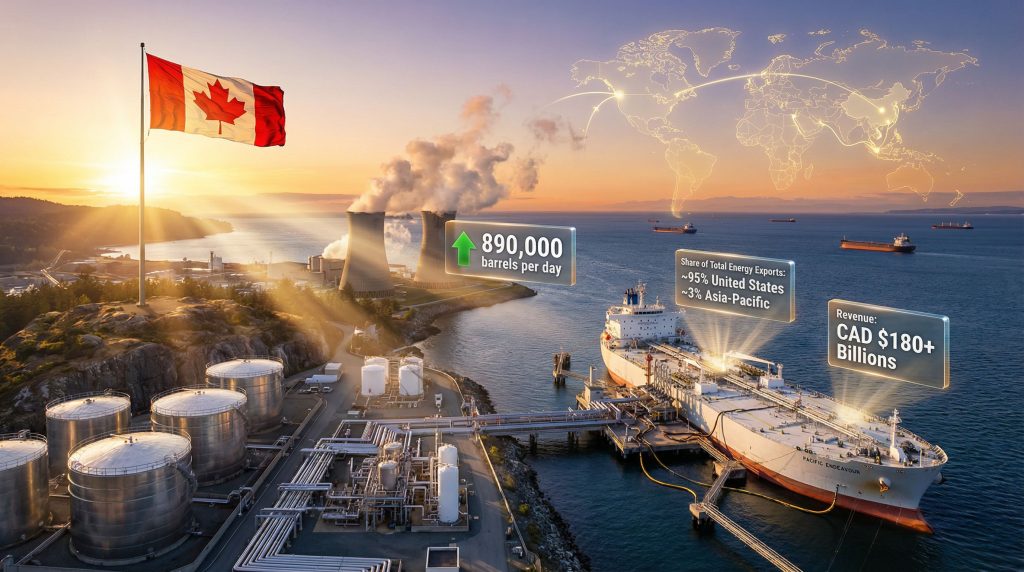
Canada deepens energy ties with China as part of a broader strategy to diversify export markets beyond traditional North American channels. With fossil fuel exports representing approximately 25% of total merchandise exports, the nation's economic foundation rests heavily on energy trade flows that overwhelmingly favour one destination market. This mono-directional trade structure, while historically profitable, creates systemic vulnerabilities that recent international developments have brought into sharp focus.
When big ASX news breaks, our subscribers know first
Understanding Canada's Energy Export Dependency Challenge
Table: Canada's Energy Export Market Distribution (2024)
| Destination | Export Share (%) | Annual Value (CAD Billions) | Risk Assessment |
|---|---|---|---|
| United States | 95+ | $180+ | Critical Concentration |
| Asia-Pacific | 3-5 | $8-12 | Emerging Opportunity |
| Europe | 1-2 | $3-6 | Limited Penetration |
Canada's energy sector demonstrates what economists term "bilateral dependency risk" through its overwhelming reliance on United States markets. This concentration reflects decades of infrastructure investment specifically designed to serve American refineries, particularly in Midwest and Gulf Coast regions. Furthermore, Canada's energy transition challenges compound these structural vulnerabilities as the nation seeks to balance traditional exports with emerging market opportunities.
The Economics of Export Concentration
Several factors explain Canada's energy export concentration:
- Population constraints: Canada's 38-40 million residents cannot absorb domestic production of 2.8-3.2 million barrels per day crude equivalent
- Infrastructure path dependency: Post-WWII pipeline construction prioritised U.S. market access
- Refinery integration: American facilities possess technical specifications aligned with Canadian crude characteristics
- Geographic proximity: Transportation costs favour continental trade flows
The Fraser Institute analysis confirms that oil and gas sectors generate hundreds of billions in revenue while supporting hundreds of thousands of jobs. However, this economic success masks underlying structural vulnerabilities that become apparent during periods of international tension.
Recent Trade Friction Impacts
Current trade dynamics illustrate these vulnerabilities, particularly through U.S. tariffs impact on Canada across multiple sectors:
2025 U.S. Tariff Structure:
- General Canadian goods: 25% tariffs
- Energy products: 10% preferential rate
- Steel and aluminium: Section 232 rates remain active
These measures, justified by the Trump administration as responses to cross-border security concerns, demonstrate how quickly established trade relationships can encounter disruption. Moreover, these tariff impacts on markets extend beyond bilateral trade to influence global investment patterns.
Infrastructure Breakthroughs Enabling Market Diversification
Trans Mountain Expansion: Gateway to Asian Markets
The completion of the Trans Mountain Expansion (TMX) project in May 2024 represents the most significant Canadian pipeline development in recent decades. This infrastructure achievement fundamentally altered Canada's export geography by creating direct access to Pacific markets.
TMX Project Specifications:
- Capacity increase: From 300,000 to 890,000 barrels per day (197% expansion)
- Terminal capability: Up to 34 Aframax tanker loadings monthly
- Crude compatibility: 75% heavy, sour crude optimal for Asian refineries
- Investment scale: $40+ billion project consortium including Shell, Mitsubishi, PetroChina
Technical Advantages for Asian Integration
Canadian crude characteristics align well with Asian refinery capabilities:
Western Canadian Select (WCS) Properties:
- API gravity: 20-22°
- Sulphur content: 3-4% by weight
- Processing requirements: Complex refining with hydrotreating capacity
Major Asian refineries in China, India, and Southeast Asia possess sophisticated processing equipment specifically designed for heavy crude applications. Consequently, this technical compatibility creates natural market opportunities that TMX infrastructure now facilitates.
LNG Infrastructure Development
LNG Canada's Kitimat facility achieved operational status with its first Asian shipment in July 2025. This milestone establishes long-term export capacity targeting growing Asian natural gas demand:
- Annual capacity: 14 million tonnes (fully operational)
- Employment impact: 3,500+ permanent positions, 7,000+ construction jobs
- Export destinations: Primarily China, Japan, South Korea markets
Canada Deepens Energy Ties with China Through Strategic Partnership
January 2026 Bilateral Agreement Framework
Prime Minister Mark Carney's meeting with Chinese President Xi Jinping produced comprehensive energy cooperation agreements spanning conventional and clean energy sectors. This strategic partnership addresses multiple dimensions of bilateral trade beyond traditional commodities.
Conventional Energy Components:
- Crude oil expansion: 50% increase in export volumes to China by 2030
- Natural uranium trade: Leveraging Canada's 13% global production share under IAEA frameworks
- CANDU reactor technology: Small Modular Reactor (SMR) deployment for remote industrial applications
Clean Energy Integration:
- Battery technology ventures: Combining Canadian lithium resources with Chinese manufacturing expertise
- Renewable project collaboration: Solar, wind, and grid-scale energy storage development
- Technology transfer protocols: Structured knowledge-sharing in nuclear and battery technologies
Economic Impact Projections
The agreement anticipates significant cross-sector benefits addressing broader energy transition and security challenges:
Investment Flow Mechanisms:
- Bilateral trade expansion: Potential $3 billion additional annual value
- EV market access: 49,000 Chinese vehicle quota at 6.1% tariff rates
- Supply chain development: Canadian EV manufacturing jobs within three years
- Consumer benefits: 50%+ of EVs under $35,000 within five years
The Canada-China partnership leverages complementary strengths in energy resources and manufacturing capabilities, creating opportunities that extend far beyond traditional commodity trade relationships.
Ministerial Dialogue Structure
The agreement establishes systematic cooperation mechanisms:
- Review cycles: 12-18 month ministerial consultations
- Two-way investment promotion: Reciprocal market access improvements
- Technical collaboration: Joint ventures in emerging energy technologies
Southeast Asian Market Integration Through ASEAN Partnership
Malaysia Cooperation Framework
Canada's October 2025 Letter of Intent with Malaysia builds upon existing relationships through Petronas involvement in LNG Canada operations. This partnership targets multiple energy sectors whilst acknowledging global trade dynamics, including the US–China trade war impact on regional markets:
Collaboration Areas:
- LNG trade expansion: Long-term purchase agreements leveraging Malaysia's 27.8 MTPA capacity
- SMR deployment: Technical expertise for remote industrial zone applications
- Regional distribution: Malaysia positioned as transshipment hub for Southeast Asian markets
ACAFTA Negotiations Progress
The Canada-ASEAN Free Trade Agreement (ACAFTA) targets comprehensive trade liberalisation with the $5 trillion Southeast Asian economic bloc:
Agreement Scope:
- Tariff elimination: Phased reduction across 5,000+ product classifications
- Investment protections: Investor-state dispute settlement mechanisms
- Sensitive sector carve-outs: Dairy products receive protection reflecting domestic considerations
Table: Canada-ASEAN Energy Trade Evolution
| Metric | 2023 Baseline | 2024 Status | 2026 Projection |
|---|---|---|---|
| Oil Exports to Asia (thousand bpd) | 50-75 | 150-200 | 300-400 |
| LNG Shipments (annual) | 0 | 1 | 8-12+ |
| TMX Utilisation Rate (%) | 15 | 45 | 70+ |
| Nuclear Technology Projects | 0 | 2 | 5+ |
Technical Applications for SMR Technology
Small Modular Reactors represent emerging opportunities in specific industrial contexts:
Deployment Applications:
- Remote mining operations requiring continuous thermal energy
- Industrial chemical production (ammonia synthesis, methanol manufacturing)
- Desalination facilities in water-stressed regions
- Distributed generation reducing transmission infrastructure costs
Canadian Technical Advantages:
- AECL expertise in heavy-water reactor design
- Established licensing frameworks through Canadian Nuclear Safety Authority
- Proven safety systems and modular construction methodologies
Comparative Analysis of Global Trade Relationships
Tariff Structure Implications
Recent trade developments reveal strategic positioning across multiple markets:
Current Trade Terms Comparison:
| Trading Partner | General Goods Tariff | Energy Products | Special Provisions |
|---|---|---|---|
| United States | 25% | 10% | Section 232 steel/aluminium rates |
| China | MFN rates | Preferential treatment | 49,000 EV quota at 6.1% |
| ASEAN | Negotiating | Under discussion | Dairy exclusions preserved |
Investment Pattern Transformation
The strategic shift toward Asian markets facilitates multiple capital flow directions:
Canadian Outbound Investment:
- West Coast LNG facility expansion
- Asian market infrastructure development
- Technology transfer joint ventures in clean energy
Asian Inbound Investment:
- EV manufacturing facility establishment in Canada
- Clean energy project financing
- Supply chain integration across battery and renewable sectors
Market Psychology and Risk Management
Canada deepens energy ties with China as part of sophisticated risk management principles:
For Asian Markets:
- Supply security: Reduced Middle East dependency through democratic supplier access
- Price discovery: Alternative benchmarks independent of North American pricing
- Reliability: Stable political relationships supporting long-term contracts
For Canada:
- Market leverage: Reduced single-customer dependency strengthens negotiating positions
- Revenue optimisation: Price discovery across multiple regional markets
- Geopolitical hedge: Diversified customer base reduces political risk exposure
The next major ASX story will hit our subscribers first
Long-Term Structural Implications for Global Energy Trade
Pacific Rim Integration Acceleration
Canada deepens energy ties with China whilst contributing to broader economic realignment patterns:
Resource Flow Restructuring:
- Development of West-to-East energy corridors
- Enhanced Pacific Rim economic integration
- Rebalancing of Atlantic-Pacific trade relationships
Technology Transfer Acceleration:
- Clean energy innovation sharing between developed economies
- Nuclear expertise commercialisation in emerging markets
- Grid modernisation collaboration addressing common challenges
Global Energy Security Enhancement
The diversification creates systemic benefits extending beyond bilateral relationships:
- Supply route multiplication: Reduced single-point-of-failure risks in global energy systems
- Market competition enhancement: Additional suppliers create pricing efficiency
- Geopolitical stability: Reduced dependency concentrations limit leverage imbalances
Future Pathway Scenarios
Several development trajectories appear likely based on current agreements and infrastructure capacity:
Optimistic Scenario (2030):
- Asian markets represent 25-30% of Canadian energy exports
- Bilateral trade with China exceeds $150 billion annually
- ACAFTA completion facilitates seamless Southeast Asian integration
Conservative Scenario:
- Asian market share reaches 15-20% by 2030
- Infrastructure constraints limit expansion pace
- Trade tensions create periodic disruptions requiring navigation
Transformative Scenario:
- Canada emerges as primary non-Middle Eastern supplier to Asia
- Clean energy technology exports rival conventional energy trade
- Pacific energy corridor development catalyses broader economic integration
In addition to these bilateral agreements, industry analysis from Reuters suggests that the reset of Canada-China ties represents a significant shift in international energy diplomacy. Furthermore, The Guardian emphasises how this partnership reflects new global realities in energy trade relationships.
Disclaimer: The analysis presented reflects current agreements and infrastructure capacity as of early 2026. Energy market developments involve inherent uncertainties including geopolitical changes, technological advancement rates, and global economic conditions that may significantly impact projected outcomes.
Investment Considerations: Readers evaluating energy sector opportunities should consider both the diversification benefits and implementation challenges associated with Canada deepens energy ties with China and broader Asian market expansion. Professional financial advice remains essential for specific investment decisions.
Looking to Capitalise on Energy Market Shifts?
Discovery Alert's proprietary Discovery IQ model identifies significant ASX mineral discoveries across energy transition metals and commodities, providing subscribers with instant alerts on companies positioned for market transformation. With Canadian energy diversification creating new global supply chain opportunities, investors need rapid access to actionable intelligence on exploration discoveries that could benefit from these evolving market dynamics.