
May 14, 2026
When Regulatory Reform Becomes a Structural Gamble
Every generation of policymakers inherits a tension that never fully resolves: the friction between the speed markets demand and the caution ecosystems require. Canada is now navigating that tension more aggressively than at any point in recent memory. The Canada federal economic zones proposal unveiled in May 2026 is not a minor policy adjustment. It represents a fundamental reorientation of how industrial development is approved, overseen, and contested in this country, with consequences that will unfold across decades rather than electoral cycles.
Understanding what is genuinely being proposed, what has been deliberately left vague, and what history suggests will follow requires examining the proposal through several lenses simultaneously: legal, environmental, Indigenous rights, and economic. Each lens reveals a different dimension of what is arguably the most consequential regulatory restructuring Canada has attempted since 2012.
When big ASX news breaks, our subscribers know first
What the Canada Federal Economic Zones Proposal Actually Contains
At its core, the Canada federal economic zones proposal creates a new category of designated geography where industrial development can be pre-approved, bypassing individual project-by-project environmental assessments in favour of a single overarching regional assessment. The government has signalled that qualifying zones could encompass energy production and transmission corridors, industrial regions, transportation networks, and telecommunications infrastructure.
The enabling mechanism relies on regional impact assessments, a tool already in use by the Impact Assessment Agency of Canada (IAAC) to evaluate the cumulative effects of development across a defined area. In theory, this approach is not inherently problematic. Regional assessments can provide a more holistic picture of ecological impact than fragmented project reviews. The controversy lies in what happens after a zone is designated: certain projects within it would be pre-approved, subject to conditions, without undergoing standalone environmental scrutiny.
Key structural elements of the proposal include:
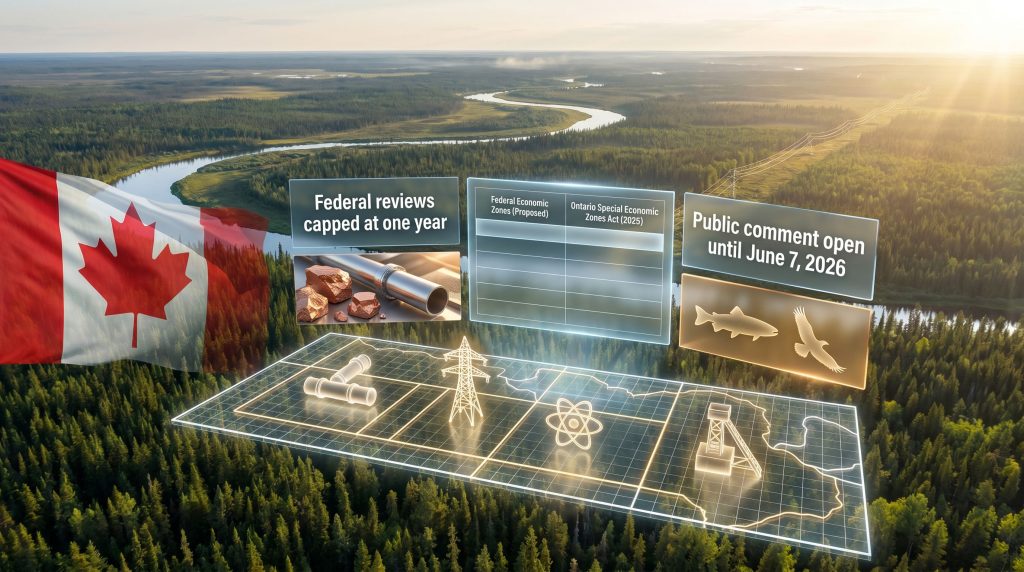
- Federal review decisions for major projects capped at one year once proponent information is deemed complete
- Cross-provincial and international border pipeline assessments shifted from the IAAC to the Canada Energy Regulator (CER)
- Electricity transmission lines and offshore renewable energy projects also moving to the CER
- Nuclear and uranium-related projects remaining with the Canadian Nuclear Safety Commission
- A new Crown consultation hub established within the IAAC to centralise Indigenous engagement
- Ministerial authority to declare major pipelines in the public interest before the CER completes its conditions review
The proposal remains in discussion paper form, with public comment open until June 7, 2026. Formal legislation has not yet been introduced.
The Accountability Shift: From Environment to Natural Resources
One of the less-discussed but structurally significant elements of the proposal is the change in ministerial accountability it creates. Currently, the IAAC reports to the Minister of Environment, Climate Change and Nature. Under the proposed framework, the Canada Energy Regulator, which would absorb jurisdiction over pipelines, transmission lines, and offshore renewables, reports to the Minister of Natural Resources.
This is not merely an administrative reshuffling. The mandate of a natural resources minister is fundamentally oriented toward facilitating resource extraction and infrastructure development. The mandate of an environment minister includes statutory obligations to protect ecological systems and species. Moving assessment authority between these two portfolios changes the institutional culture of review, not just its procedural structure.
The government has attributed current project delays to coordination failures between government departments. However, the IAAC itself has publicly pushed back on this characterisation, stating on its official FAQ page that federal policies do not prevent pipelines, LNG, or oil projects from advancing, and that assessments are grounded in scientific rigour and due diligence.
Furthermore, the broader mining geopolitical landscape is also influencing the pace and direction of these reforms, as Canada responds to shifting global competition for resource development leadership.
This institutional disagreement between the agency conducting assessments and the government proposing to restructure those assessments raises a foundational question: is the proposed reform solving a demonstrated problem, or engineering a preferred outcome?
A Comparison With Ontario's Special Economic Zones Act
The federal proposal does not exist in a vacuum. Ontario enacted Bill 5, establishing the province's own Special Economic Zones Act, on June 5, 2025, creating a legislative precedent roughly twelve months before the federal framework was unveiled. The parallels are substantial, but so are the differences.
| Feature | Federal Economic Zones (Proposed) | Ontario Special Economic Zones Act (2025) |
|---|---|---|
| Enabling mechanism | Regional impact assessments | Cabinet designation |
| Environmental review exemptions | Selective, with stated conditions | Broad, including municipal by-laws |
| Indigenous consultation requirement | Described as a key part of process | Criticised as insufficient by First Nations |
| Legal challenges | Pending legislative introduction | Active constitutional court challenge |
| Scope | National, cross-sector | Provincial, project-specific |
| Current status | Discussion paper, public comment open until June 7, 2026 | Enacted June 5, 2025 |
Ontario Premier Doug Ford initially announced his intention to designate the mineral-rich Ring of Fire as a special economic zone under Bill 5 immediately after its passage. By March 2026, however, Ford indicated he no longer required that mechanism for the region, citing agreements with several, though notably not all, First Nations communities in the area. This reversal is instructive: it suggests that either the legislative tool was less practically necessary than its advocates claimed, or that political realities around Indigenous relationships imposed constraints that the law itself could not resolve.
First Nations have launched a constitutional court challenge against Ontario's law, arguing it fails to meet the standard of Free, Prior and Informed Consent and violates Treaty obligations. That challenge remains active and its outcome may significantly shape how courts view the federal proposal if it reaches similar legal terrain. The Indigenous consultation framework established in other jurisdictions offers a useful point of comparison for evaluating whether the proposed Crown consultation hub will meet constitutional standards.
The Ring of Fire: Where Both Frameworks Converge
The Ring of Fire, located in Ontario's James Bay Lowlands and known to Indigenous peoples as Bakitanaamowin Aki (the Breathing Lands) and Mammamattawa (many rivers coming together), sits at the intersection of both provincial and federal regulatory ambitions. The region holds significant mineral deposits that have attracted sustained development interest, while also containing extensive boreal peatlands with enormous ecological and carbon storage value.
A federal regional assessment of the Ring of Fire is currently underway. An interim report from that assessment process has emphasised the need for environmental monitoring of the area's boreal forest and peatlands, as well as urgent community health infrastructure needs. Ontario's provincial government has been documented as withholding scientific data and funding from that assessment process, and has not been actively participating alongside First Nations and federal representatives conducting the review.
This dynamic illustrates a practical tension at the heart of the federal proposal: the effectiveness of regional assessments as the enabling mechanism for federal economic zones depends on the quality and completeness of the assessment process. If provinces withhold data or refuse participation, the regional assessment on which pre-approval rests becomes incomplete, potentially undermining both the environmental and legal integrity of subsequent development decisions.
Species at Risk and the Jeopardy Test: What Could Change
Understanding the Jeopardy Test
The Species at Risk Act (2002) contains a provision known as the jeopardy test. Under current law, permits cannot be issued for activities affecting a listed species or its critical habitat unless the government determines the activity will not jeopardise that species' survival or recovery. This threshold functions as an absolute constraint rather than a balancing exercise.
The federal proposal would convert this absolute threshold into a discretionary one. The government would gain the authority to exempt specific projects from the jeopardy test, provided a public interest determination is made and the proponent demonstrates they have exhausted all reasonable mitigation options. While the proposal characterises this power as limited with a high threshold, the shift from prohibition to discretion is legally and conceptually significant.
The Provincial Compounding Effect
The federal species protection changes are taking place against an already-deteriorating provincial backdrop. Ontario replaced its Endangered Species Act with the Species Conservation Act in 2025, a transition that removed provincial protection from numerous threatened fish and bird species. Several of these species now rely exclusively on federal protections under the Species at Risk Act.
If both the federal jeopardy test exemption and the Ontario provincial delistings operate simultaneously, some threatened species would have no remaining statutory protection pathway. This compounding effect represents a qualitatively different risk profile than either change in isolation.
Additional proposed changes to species and habitat law include:
- Greater flexibility for Fisheries Act permits affecting fish habitat, with loosened compensation requirements
- Ministerial authority to adjust project assessment conditions in exceptional circumstances
- Power to modify environmental conditions for projects classified as being in the national interest
- Authority to permit early construction activities before final project merits are determined
The next major ASX story will hit our subscribers first
The Voices Opposing the Proposal
Criticism From Within the Liberal Tradition
The proposal has generated unusual opposition from within the governing party's own historical base. Steven Guilbeault, who served as Canada's federal environment minister from 2021 to 2025 and remains a Liberal MP, characterised the Carney proposal as more damaging to environmental law than the changes implemented under former Conservative Prime Minister Stephen Harper, a period that itself produced multiple high-profile Federal Court defeats.
Catherine McKenna, who held the environment minister role from 2015 to 2019, warned that reducing procedural rigour would generate a breakdown of trust and an increase in litigation, producing slower rather than faster outcomes for project proponents. This is not merely a political argument but a practical one grounded in observable patterns: the two most consequential pipeline approval failures in recent Canadian history, Trans Mountain's initial quashing and Northern Gateway's permit overturn, both resulted from courts finding that review processes were procedurally inadequate.
The paradox of speed is a recurring feature of Canadian regulatory history: attempts to accelerate approvals by reducing procedural requirements have repeatedly produced slower outcomes when those decisions are then challenged and overturned in court.
Environmental Law Perspective
Ecojustice, a Canadian environmental law organisation, has described the proposed changes as potentially representing the most significant rollback of environmental protections in a generation. This framing situates the proposal within a long arc of legislative change, arguing that what is being proposed is not incremental reform but a generational recalibration of how Canada balances development and ecological protection. Environmental Defence has similarly raised concerns about these reforms dismantling decades of environmental progress.
Indigenous Rights Concerns
The Assembly of Manitoba Chiefs, representing 63 First Nations in Manitoba, stated that the proposal raises serious concerns about a regulatory model that prioritises development velocity over Treaty obligations, environmental stewardship, and Indigenous consent processes. The proposed Crown consultation hub is intended to centralise Indigenous engagement, but critics argue that centralising consultation does not automatically improve its quality or legal adequacy.
The constitutional requirement for meaningful consultation with Indigenous peoples, as established through decades of Supreme Court precedent, cannot be satisfied by procedural efficiency alone. Courts have consistently held that the duty to consult requires substantive engagement proportionate to the severity of the infringement on Indigenous rights.
Historical Reform Cycles and Why Each Attempt Has Generated Litigation
Canada's regulatory history for major industrial projects follows a recognisable pattern:
- A government concludes that environmental reviews are too slow and business-unfriendly
- Reforms are introduced that expand regulatory authority or reduce procedural requirements
- Projects advance under the new framework
- Courts intervene, finding procedural or constitutional deficiencies
- Projects are delayed or cancelled as a result
- The next government inherits a broken process and begins the cycle again
The Harper-era 2012 reforms attempted to accelerate assessments by shifting more oil and gas oversight to the National Energy Board. That board's review of the Trans Mountain expansion was later found flawed by the Federal Court of Appeal, and the Northern Gateway pipeline's federal permits were separately overturned. The Trudeau government's response, Bill C-69 and its Impact Assessment Act, was then found largely unconstitutional by the Supreme Court of Canada in 2023, forcing revisions in 2024.
The Carney proposal is the latest iteration of this cycle. Consequently, each reform generation has believed it had found the right balance. None has successfully avoided court-driven reversals. Patterns of government intervention in mining and resource sectors similarly suggest that regulatory overreach tends to invite judicial correction.
The Broader Economic Policy Context
The Canada federal economic zones proposal did not emerge in isolation. It forms part of a broader Spring 2026 economic strategy shaped by U.S. tariff pressures and a competitive investment landscape. The government's fiscal positioning includes several complementary instruments:
| Policy Instrument | Details |
|---|---|
| Canada Strong Fund | $25 billion sovereign wealth fund for strategic investment |
| Productivity Super-Deduction | Estimated to generate up to $9 billion in annual economic output |
| Employee Ownership Trust Tax Exemption | Made permanent to support business transition |
| Enhanced R&D Tax Credits | Designed to stimulate innovation-led industrial growth |
| Federal Economic Zones | Regulatory streamlining mechanism to accelerate project timelines |
The Liberals secured a Parliamentary majority following April 2026 byelections and the addition of five floor-crossing MPs to their caucus. This majority significantly changes the legislative arithmetic. The government now has the votes to move the proposal through Parliament without coalition negotiation, meaning the public comment period closing June 7, 2026, and subsequent legislative process represent the primary windows for substantive input.
In addition, the proposal intersects with Australia's critical minerals strategy debates, highlighting how allied nations are wrestling with strikingly similar tensions between development speed and regulatory integrity.
Frequently Asked Questions: Canada Federal Economic Zones Proposal
What is a federal economic zone in Canada?
A designated area where certain industrial developments can receive pre-approval at the federal level, subject to conditions, based on a regional impact assessment rather than individual project reviews.
How are federal economic zones different from regular project approvals?
Standard projects require individual environmental assessments. Inside a federal economic zone, pre-approval under a regional assessment replaces this requirement for qualifying projects.
Will Indigenous communities have a say in where federal economic zones are designated?
The proposal describes Indigenous consultation as a key part of the zone designation process, including on conditions for development within zones. However, critics argue the framework lacks enforceable standards for what constitutes adequate consultation.
Can a project inside a federal economic zone still be challenged in court?
Yes. Pre-approval does not eliminate the possibility of judicial review, particularly on grounds of inadequate Indigenous consultation or constitutional violations.
What is the public comment deadline for the federal economic zones proposal?
Public comments are open until June 7, 2026.
How does this proposal affect the Species at Risk Act?
The proposal would grant the government discretionary power to exempt projects from the jeopardy test, converting an absolute prohibition into a conditional one subject to a public interest determination.
What happens to environmental assessments for pipelines under the new system?
Cross-provincial and international border pipeline assessments would shift from the Impact Assessment Agency of Canada to the Canada Energy Regulator, which reports to the Natural Resources Minister rather than the Environment Minister.
Is this similar to what Ontario did with its Special Economic Zones Act?
The conceptual parallel is strong, though the enabling mechanisms differ. Ontario's framework uses Cabinet designation and grants broad exemptions; the federal proposal uses regional assessments and frames exemptions as conditional. Ontario's law is currently subject to a constitutional court challenge. Similarly, fast-tracked mining permits in the United States offer a comparative international example of how accelerated approvals regimes tend to generate their own legal complications.
The Central Trade-Off That Won't Resolve Itself
The federal economic zones proposal encapsulates a genuine tension that no regulatory framework can fully eliminate. Industrial development, particularly in the energy, mining, and transmission sectors, requires capital certainty and timeline predictability. Environmental and Treaty law requires procedural integrity and substantive engagement. These two imperatives are not inherently incompatible, but the proposed framework attempts to resolve the tension primarily by reducing the latter.
What the historical record consistently demonstrates is that shortcutting procedural requirements rarely produces the investment certainty it promises. Legal challenges convert fast-tracked decisions into decade-long disputes. The projects that survive and get built in Canada tend to be those where the review process, however lengthy, was conducted with sufficient rigour to withstand judicial scrutiny.
The speed vs. integrity trade-off is not a new problem. What is new is the scale at which Canada is now proposing to manage it, and the degree to which both provincial and federal safeguards are being adjusted simultaneously, compressing the redundancy that has historically allowed one layer of protection to compensate when another failed.
Readers seeking ongoing analysis of how this proposal develops through the legislative process can find detailed coverage at thenarwhal.ca, which tracks environmental law, Indigenous rights, and resource sector policy developments across Canada.
This article contains analysis of policy proposals that remain in discussion paper form and have not yet been formally introduced as legislation. Policy details, timelines, and legislative outcomes are subject to change. Nothing in this article constitutes legal or investment advice.
Want To Catch The Next Major Mineral Discovery The Moment It Hits The ASX?
Discovery Alert's proprietary Discovery IQ model delivers real-time alerts on significant ASX mineral discoveries, instantly converting complex mineral data into actionable insights for traders and investors at every experience level — explore the historic returns major discoveries have generated and begin your 14-day free trial today to position yourself ahead of the market.