
May 21, 2026
Understanding the Strategic Nuclear Partnership Framework
The global nuclear energy landscape stands at a pivotal crossroads, where established powers must navigate complex supply chains while emerging economies seek reliable pathways to carbon neutrality. Within this context, bilateral partnerships between resource-rich nations and rapidly industrializing countries have become critical mechanisms for energy security transformation. The strategic alignment between technologically advanced uranium producers and nations pursuing aggressive decarbonization targets represents more than commercial transactions—it embodies a fundamental restructuring of global energy interdependencies, particularly evident in the growing Canada India nuclear energy collaboration.
What Makes Canada an Ideal Nuclear Energy Partner for India?
Canada's positioning as a premier nuclear technology partner stems from multiple convergent advantages that extend far beyond raw uranium reserves. The nation controls approximately 27% of the world's identified uranium resources, concentrated primarily within Saskatchewan's geological formations, creating a foundation for long-term supply security that few competitors can match.
Key Strategic Assets:
- Regulatory Transparency: Canada's nuclear regulatory framework, overseen by the Canadian Nuclear Safety Commission, provides predictable oversight mechanisms that facilitate international cooperation
- CANDU Technology Leadership: Heavy-water reactor systems utilizing natural uranium fuel eliminate enrichment dependencies, reducing proliferation concerns
- Mining Infrastructure Maturity: Established extraction and processing capabilities in Saskatchewan support scalable production increases
- Geopolitical Stability: Democratic governance structures and rule-of-law frameworks minimize supply disruption risks
The CANDU reactor design represents a particularly compelling technological offering, utilizing heavy water as a moderator to achieve capacity factors exceeding 85% in well-maintained facilities. This technology allows the use of natural uranium without enrichment requirements, significantly reducing fuel cycle complexity and costs for importing nations.
Canada's uranium production capacity, representing approximately 12-13% of global output, provides sufficient scale to support major expansion programs while maintaining supply commitments to existing customers. Furthermore, the integration of mine-to-reactor supply chains offers comprehensive fuel cycle support that extends beyond raw material provision.
How Does This Partnership Address India's Energy Security Challenges?
India's energy security imperatives reflect the complex challenges facing major developing economies pursuing rapid industrialization while managing environmental commitments. The nation's current energy portfolio relies on coal for approximately 70% of power generation, creating both carbon emissions concerns and import dependency vulnerabilities that nuclear expansion can directly address.
Critical Energy Security Metrics:
| Energy Source | Current Contribution | Strategic Vulnerabilities | Nuclear Mitigation Potential |
|---|---|---|---|
| Coal | 70% of generation | Import dependency, emissions | Baseload replacement capacity |
| Nuclear | 3% of installed capacity | Fuel supply concentration | Diversified uranium sourcing |
| Renewable | 25% of capacity | Intermittency challenges | Grid stability complement |
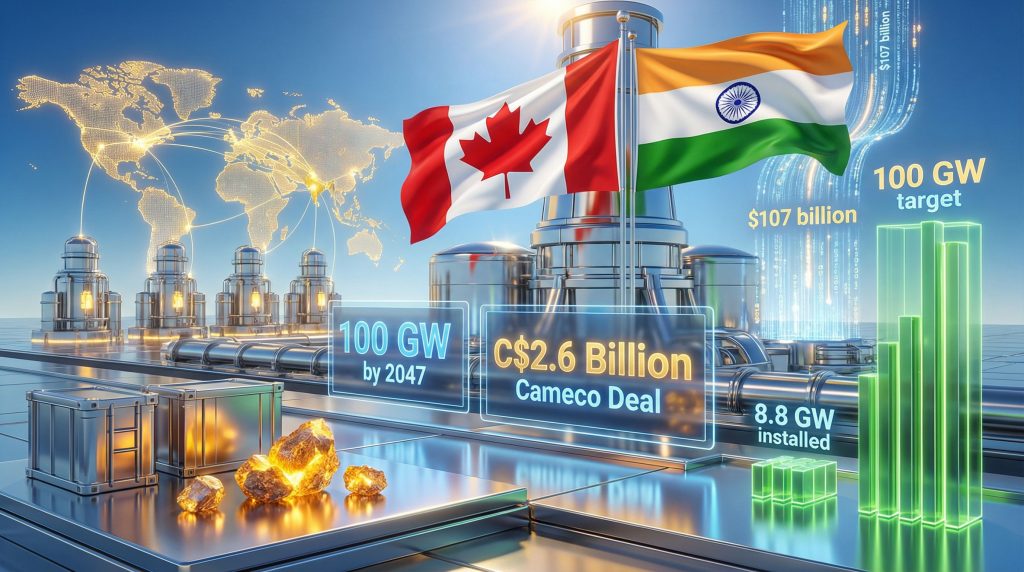
The partnership addresses multiple dimensions of energy security through structured supply arrangements and technology transfer mechanisms. Consequently, India's current 8.8 GW of installed nuclear capacity requires substantial fuel supply expansion to support the government's ambitious capacity targets, making long-term uranium supply agreements essential for program success.
Diversification Benefits:
- Geographic Supply Distribution: Reduced concentration risk from traditional suppliers in Kazakhstan, Australia, and Namibia
- Price Stability Mechanisms: Long-term contracting provides protection against uranium market volatility
- Technology Integration: Access to advanced reactor designs suitable for India's grid requirements
- Industrial Development: Domestic nuclear manufacturing capability enhancement through knowledge transfer
The strategic timing of this partnership reflects broader geopolitical realignments, with Canada seeking to diversify export markets amid evolving trade relationships, while India pursues supply chain resilience in an increasingly uncertain global environment. However, this cooperation coincides with the US uranium import ban which creates additional market dynamics affecting global supply chains.
When big ASX news breaks, our subscribers know first
Analyzing India's Nuclear Capacity Expansion Strategy
What Are the Technical Requirements for India's 100 GW Nuclear Target?
India's nuclear expansion ambitions represent one of the most aggressive civilian atomic energy programs globally, requiring unprecedented scaling of reactor construction, fuel supply, and technical expertise. The transition from 8.8 GW current capacity to 100 GW represents a 1,036% increase that demands comprehensive infrastructure development and supply chain coordination.
Capacity Expansion Analysis:
| Timeline Scenario | Annual Addition Required | Reactor Construction Rate | Technical Feasibility |
|---|---|---|---|
| 2030 Target (4 years) | 23 GW/year | 23+ large reactors annually | Extremely challenging |
| 2047 Target (23 years) | 4 GW/year | 4-5 large reactors annually | Ambitious but achievable |
The C$2.6 billion Cameco uranium supply agreement covering 2027-2035 provides a foundation for fuel security, but the physical requirements for 100 GW operation demand substantial additional contracting. Based on standard reactor fuel consumption rates, this capacity would require approximately 18,000-20,000 tonnes of uranium concentrate annually at full operation.
Infrastructure Development Requirements:
- Site Development: Identification and preparation of 25-30 new reactor sites across multiple states
- Grid Integration: Transmission infrastructure capable of handling 100 GW of additional baseload capacity
- Workforce Development: Training programs for approximately 50,000 additional nuclear specialists
- Manufacturing Scale-up: Domestic reactor component production to reduce import dependencies
India's current reactor fleet includes approximately 22 operational units across various designs and capacity ratings. For instance, achieving the 100 GW target requires not only new construction but also optimization of existing facilities and integration of advanced reactor technologies.
How Will Small Modular Reactors Transform India's Nuclear Landscape?
Small Modular Reactors represent a paradigm shift in nuclear deployment strategy, offering deployment flexibility and reduced capital intensity compared to conventional large-scale facilities. These systems, typically defined as units with electrical output capacity up to 300 MW, provide scalable solutions for distributed power generation and specialized applications.
SMR Strategic Advantages:
- Deployment Flexibility: Suitability for grid-isolated regions and incremental capacity additions
- Construction Timeline: Potential for 3-5 year construction periods versus 10-15 years for large reactors
- Capital Efficiency: Lower upfront investment requirements enabling phased deployment
- Safety Enhancement: Passive cooling systems utilizing natural circulation principles
- Industrial Applications: Process heat provision for desalination, hydrogen production, and manufacturing
The technical specifications of proposed SMR designs incorporate advanced safety features that rely on physics-based passive systems rather than active mechanical components. In addition, these include gravity-driven cooling, natural circulation heat removal, and underground placement for enhanced security.
SMR Deployment Scenarios:
- Phase 1 (2027-2030): Technology demonstration and regulatory approval
- Phase 2 (2030-2035): Commercial deployment in select regions
- Phase 3 (2035-2047): Large-scale manufacturing and distributed installation
However, SMR technology remains largely unproven at commercial scale, with no operational units achieving the projected 3-5 year construction timelines. First-of-a-kind projects have experienced significant schedule delays, requiring careful risk assessment in deployment planning.
Economic Impact Assessment of the Uranium Supply Agreement
What Does the C$2.6 Billion Cameco Deal Mean for Both Economies?
The Cameco Corporation uranium supply agreement represents a landmark transaction that extends far beyond commodity trading, establishing a framework for comprehensive nuclear fuel cycle cooperation. The C$2.6 billion contract value over nine years (2027-2035) provides both price stability and supply security essential for India's nuclear expansion program.
Deal Structure Analysis:
- Annual Average Value: Approximately C$289 million per year
- Delivery Timeline: 2027-2035 (9-year supply window)
- Price Mechanisms: Long-term contracting with likely escalation provisions
- Supply Security: Guaranteed uranium concentrate availability during critical expansion phase
For Canada, this agreement provides revenue diversification amid evolving North American energy markets, while establishing strategic positioning in the rapidly growing Asian nuclear sector. Consequently, Cameco Corporation, as a publicly traded entity (TSX: CCJ, NYSE: CCJ), gains long-term cash flow visibility that supports capital allocation planning and operational stability.
Canadian Economic Benefits:
- Employment Security: Sustained mining operations in Saskatchewan communities
- Export Diversification: Reduced dependency on traditional US market relationships
- Strategic Partnership: Enhanced bilateral trade relationship beyond commodity exports
- Technology Transfer Revenue: Potential licensing opportunities for CANDU technology
Indian Economic Impact:
- Cost Predictability: Protection against uranium price volatility during expansion phase
- Supply Chain Resilience: Diversified supplier base reducing concentration risk
- Industrial Development: Foundation for indigenous nuclear manufacturing capabilities
- Energy Cost Stability: Predictable fuel costs supporting power sector planning
The agreement's timing coincides with global uranium market dynamics characterized by supply constraints and increasing demand from nuclear expansion programs worldwide. This creates favorable positioning for both parties through long-term price discovery mechanisms.
Investment and Financial Architecture Analysis
The broader financial architecture supporting the Canada India nuclear energy collaboration extends substantially beyond uranium supply contracts, encompassing C$107 billion in Canadian pension fund investments in India across multiple sectors. This investment scale represents 30% of Canadian pension fund allocation in the Asia-Pacific region, demonstrating sustained institutional confidence in India's growth trajectory.
Canadian Pension Fund Investment Distribution:
| Investment Category | Current Value (CAD Billion) | Growth Rate | Strategic Focus Areas |
|---|---|---|---|
| Infrastructure | 25-30 | 15-20% annually | Power generation, transmission |
| Manufacturing | 20-25 | 18-22% annually | Industrial development |
| Nuclear Sector | 8-12 | 25-30% annually | Reactor construction, fuel cycle |
| Clean Energy | 15-20 | 20-25% annually | Grid integration, storage |
The scale of pension fund engagement creates natural synergies with nuclear sector development, providing patient capital suitable for long-term infrastructure projects. These investments benefit from sovereign wealth fund treatment under Indian regulatory frameworks, offering preferential terms that enhance project economics.
Financial Mechanisms Supporting Nuclear Development:
- Export Credit Financing: Government-backed financing for reactor construction projects
- Joint Venture Structures: Risk-sharing arrangements for technology development
- Currency Hedging: Protection against exchange rate volatility in multi-year projects
- Performance Guarantees: Credit enhancement for operational milestone achievements
Geopolitical Implications of Nuclear Energy Cooperation
How Does This Partnership Reshape Regional Power Dynamics?
The strategic nuclear partnership between Canada and India occurs within a complex geopolitical environment characterized by shifting alliances, energy security concerns, and competition for influence in the Indo-Pacific region. This cooperation represents more than bilateral energy trade—it embodies a reconfiguration of global nuclear commerce and technology transfer relationships.
Regional Strategic Context:
- China's Nuclear Footprint: Extensive investments in Pakistani nuclear facilities (Karachi K-2 and K-3 reactors) create competitive dynamics
- QUAD Framework Alignment: Cooperation supports broader Quadrilateral Security Dialogue objectives for Indo-Pacific stability
- Middle Eastern Supply Vulnerabilities: Strait of Hormuz transit dependencies motivate supply chain diversification
- AUKUS Technology Sharing: Broader Anglosphere nuclear cooperation framework alignment
The partnership provides India with strategic autonomy in nuclear fuel supply while offering Canada enhanced positioning in rapidly growing Asian energy markets. Furthermore, this bilateral cooperation counters Chinese Belt and Road Initiative influence in South Asian infrastructure development, particularly in the energy sector.
Supply Chain Security Implications:
| Risk Factor | Traditional Sources | Canadian Partnership Benefits |
|---|---|---|
| Geographic Concentration | Kazakhstan (40% of global supply) | Diversified Western supplier |
| Political Stability | Variable across suppliers | Democratic governance framework |
| Transportation Security | Multiple transit routes required | Direct bilateral arrangements |
| Technology Integration | Limited cooperation depth | Comprehensive reactor technology |
The timing of enhanced cooperation reflects broader geopolitical realignments, with both nations seeking to strengthen bilateral relationships amid global uncertainties. As a result of these dynamics, Canada's pivot toward Asian markets coincides with India's pursuit of supply chain resilience in critical energy infrastructure.
What Role Does Critical Minerals Cooperation Play Beyond Uranium?
The comprehensive Memorandum of Understanding on Critical Minerals extends nuclear cooperation into broader strategic materials essential for India's technological and industrial transformation. This encompasses lithium, cobalt, and rare earth elements critical for electric vehicle manufacturing, semiconductor production, and renewable energy infrastructure. Additionally, this partnership supports critical minerals energy security objectives for both nations.
Critical Minerals Strategic Value:
- Lithium Supply Chains: Support for India's electric vehicle ambitions and battery manufacturing capabilities
- Rare Earth Elements: Essential materials for wind turbine magnets, solar panel production, and electronics manufacturing
- Cobalt and Nickel: Battery technology materials supporting energy storage systems
- Strategic Stockpiling: Industrial resilience through diversified supply relationships
Canada's critical minerals potential remains largely underdeveloped, with significant lithium resources in Alberta's brine deposits and hard-rock formations in Ontario and Quebec. The partnership creates incentives for Canadian resource development while providing India with supply security for strategic materials.
Technology Integration Opportunities:
- Processing Technology Transfer: Advanced refining and purification methods
- Joint Exploration Programs: Collaborative resource identification and development
- Value Chain Integration: From raw material extraction to finished component manufacturing
- Research and Development: Joint programs for advanced materials applications
This broader materials cooperation creates a comprehensive framework extending beyond nuclear energy into the full spectrum of clean energy and advanced technology manufacturing. In this context, Canada's energy transition aligns with positioning both nations as leaders in the global energy transition.
Technology Transfer and Innovation Opportunities
How Will Joint Small Modular Reactor Development Proceed?
The collaboration encompasses comprehensive reactor value chain cooperation, including adaptation of Canadian SMR designs for Indian grid requirements and development of indigenous manufacturing capabilities. This technology transfer represents one of the most significant nuclear cooperation agreements in recent decades.
Technology Development Framework:
- Design Adaptation: Modification of Canadian SMR concepts for Indian operational conditions
- Manufacturing Localization: Indigenous production capabilities for reactor components
- Research Collaboration: Joint development programs for advanced reactor technologies
- Intellectual Property Sharing: Framework agreements for commercial technology deployment
Advanced Reactor Technologies Under Development:
| Technology Type | Development Timeline | Capacity Range | Key Applications |
|—|—|—|
| Small Modular Reactors | 2027-2032 | 50-300 MW | Distributed generation, industrial heat |
| Advanced Conventional | 2025-2030 | 600-1200 MW | Baseload power generation |
| Generation IV Designs | 2030-2040 | Variable | Enhanced safety, efficiency |
| Thorium-Based Systems | 2035-2047 | 200-1000 MW | Utilizing India's thorium reserves |
The development program includes passive safety systems utilizing natural physical principles rather than active mechanical components. These systems rely on gravity-driven cooling, natural circulation heat removal, and inherent reactor physics for accident mitigation.
What Advanced Reactor Technologies Are Under Consideration?
Beyond conventional reactor designs, the partnership explores cutting-edge nuclear technologies that could revolutionize power generation efficiency and safety. These include Generation IV reactor concepts with enhanced safety features and thorium-based reactor development leveraging India's substantial thorium reserves.
Advanced Technology Portfolio:
- High-Temperature Gas Reactors: Industrial process heat applications for hydrogen production and petrochemicals
- Fast Breeder Reactors: Enhanced fuel utilization and waste reduction capabilities
- Molten Salt Reactors: Inherent safety features and fuel flexibility
- Integral Reactor Designs: Compact, factory-manufactured units with enhanced safety
India possesses approximately 25% of global thorium reserves, creating unique opportunities for thorium-based reactor development that could provide fuel security advantages over conventional uranium-fueled systems. Moreover, thorium fuel cycles offer enhanced proliferation resistance and reduced long-lived radioactive waste production.
Innovation Cooperation Mechanisms:
- Joint Research Facilities: Shared development laboratories and testing capabilities
- Personnel Exchange Programs: Technical expert sharing and training initiatives
- Intellectual Property Frameworks: Collaborative innovation and commercialization agreements
- Technology Demonstration Projects: Proof-of-concept reactor construction and testing
Market Implications and Competitive Positioning
How Does This Partnership Affect Global Uranium Markets?
The Canada India nuclear energy collaboration agreement creates significant implications for global uranium market dynamics, influencing both price stability and supply chain competition. The long-term contracting approach reduces spot market volatility while establishing benchmark pricing for other major buyers.
Market Impact Analysis:
- Price Stabilization: Long-term contracts reduce spot market volatility from major buyer securing supply
- Supply Chain Competition: Competitive pressure on alternative suppliers including Australia and Kazakhstan
- Investment Confidence: Enhanced financing availability for uranium mining projects globally
- Contract Structure Evolution: Industry movement toward longer-term supply agreements
The C$2.6 billion contract value over nine years represents substantial market share for Cameco while providing price discovery mechanisms for other market participants. Consequently, this creates ripple effects throughout the nuclear fuel cycle, influencing conversion, enrichment, and fabrication service pricing.
Competitive Positioning Effects:
| Market Segment | Traditional Leaders | Partnership Impact |
|---|---|---|
| Uranium Mining | Kazakhstan (40% market share) | Canadian market share expansion |
| Reactor Technology | US, France, Russia, China | Enhanced Canadian competitive position |
| Nuclear Fuel Services | Multiple suppliers | Integrated supply chain advantages |
| SMR Development | Various international competitors | Joint development acceleration |
What Impact Will This Have on India's Energy Mix Transformation?
The nuclear expansion program supported by Canadian cooperation will fundamentally alter India's electricity generation portfolio, accelerating the transition away from coal dependency while providing reliable baseload power for industrial development.
Energy Mix Evolution Projections:
| Energy Source | Current Share | 2030 Projection | 2047 Target |
|---|---|---|---|
| Coal | 70% | 55-60% | 30-35% |
| Nuclear | 3% | 8-10% | 15-20% |
| Renewable | 25% | 30-35% | 45-50% |
| Natural Gas | 2% | 5-7% | 5-8% |
The nuclear capacity expansion provides grid stability enhancement through dispatchable baseload generation that complements variable renewable energy sources. This combination offers optimal decarbonization pathways while maintaining industrial competitiveness through reliable electricity supply.
Industrial Competitiveness Benefits:
- Electricity Cost Stability: Predictable nuclear fuel costs supporting long-term industrial planning
- Carbon Emissions Reduction: Alignment with Paris Agreement commitments and corporate sustainability goals
- Manufacturing Reliability: Consistent power supply for energy-intensive industries
- Export Competitiveness: Low-carbon electricity supporting green product manufacturing
The next major ASX story will hit our subscribers first
Implementation Timeline and Milestone Analysis
What Are the Critical Success Factors for Nuclear Expansion Targets?
The successful implementation of India's nuclear expansion program requires coordinated execution across multiple dimensions, including regulatory framework development, construction project management, and workforce preparation. The timeline presents both opportunities and challenges that require careful risk management.
Phase 1 (2026-2028): Foundation Building
- Regulatory Harmonization: Streamlined approval processes for new reactor construction
- Site Preparation: Environmental assessments and infrastructure development for priority locations
- Supply Chain Establishment: Uranium delivery logistics and processing facility preparation
- Human Capital Development: Training programs for nuclear engineers, technicians, and operators
Phase 2 (2028-2032): Accelerated Deployment
- First SMR Commissioning: Technology demonstration and operational experience development
- Large Reactor Construction: Multiple simultaneous construction projects across different states
- Manufacturing Capability: Indigenous reactor component production scaling
- Grid Integration: Transmission infrastructure expansion to accommodate new generation capacity
Phase 3 (2032-2047): Full-Scale Implementation
- Commercial SMR Deployment: Standardized manufacturing and installation processes
- Advanced Reactor Technology: Next-generation reactor designs entering commercial operation
- Regional Market Development: Nuclear technology export capabilities to neighboring countries
- Complete Fuel Cycle: Indigenous uranium enrichment and fuel fabrication capabilities
Success Metrics and Monitoring:
| Timeline | Capacity Target | Key Milestones | Risk Mitigation |
|---|---|---|---|
| 2030 | 15-20 GW | 5-7 new reactors operational | Accelerated regulatory approval |
| 2035 | 35-45 GW | SMR commercial deployment | Supply chain diversification |
| 2040 | 65-80 GW | Advanced reactor technology | Workforce scaling programs |
| 2047 | 100 GW | Complete target achievement | Comprehensive risk management |
Risk Assessment and Mitigation Strategies
What Challenges Could Derail Nuclear Cooperation Objectives?
The ambitious nuclear expansion program faces multiple risk categories that could impact timeline achievement and cost objectives. Comprehensive risk assessment and mitigation planning are essential for program success.
Primary Risk Categories:
- Regulatory Delays: Environmental clearance processes and safety assessment procedures
- Public Acceptance: Community concerns regarding nuclear safety and waste management
- Technology Transfer Restrictions: Third-party vendor limitations and intellectual property constraints
- Geopolitical Tensions: Bilateral relationship disruptions affecting cooperation agreements
Technical and Operational Risks:
- Construction Delays: Project management challenges and supply chain disruptions
- Cost Overruns: Material price inflation and labor cost escalation
- Technology Performance: First-of-a-kind reactor design challenges and operational issues
- Grid Integration: Power system stability and transmission infrastructure adequacy
Financial and Market Risks:
- Uranium Price Volatility: Market fluctuations affecting fuel cost projections
- Currency Exchange: CAD-INR exchange rate variations impacting contract values
- Financing Availability: Capital market conditions affecting project funding
- Competitive Technology: Alternative energy cost reductions challenging nuclear economics
How Can Both Countries Ensure Partnership Resilience?
Risk mitigation strategies require coordinated approaches addressing both bilateral cooperation frameworks and individual country program management. Diversification, redundancy, and flexibility represent core principles for resilient partnership development.
Partnership Resilience Mechanisms:
- Diversified Supplier Relationships: Multiple uranium suppliers beyond single-source dependence
- Joint Crisis Management: Bilateral protocols for supply disruption response and alternative sourcing
- Regular Strategic Dialogue: Ministerial-level reviews and course correction mechanisms
- Commercial Dispute Resolution: Established arbitration and mediation frameworks for contract disputes
Institutional Strengthening:
- Bilateral Nuclear Commission: Joint oversight body for program coordination and issue resolution
- Technical Working Groups: Subject matter expert collaboration on specific technology and implementation challenges
- Industry Partnership Councils: Private sector engagement and feedback mechanisms
- Academic Cooperation: University research collaboration and student exchange programs
Future Scenarios and Strategic Outcomes
Best-Case Scenario: Transformational Success
Under optimal implementation conditions, the Canada India nuclear energy collaboration could achieve transformational results exceeding original objectives. This scenario assumes successful technology transfer, minimal regulatory delays, and sustained political support in both countries.
Transformational Outcomes:
- Nuclear Capacity Achievement: 80+ GW operational by 2040, exceeding timeline expectations
- Technology Leadership: Joint SMR technology becoming preferred choice for developing nations
- Market Expansion: Export capabilities to Southeast Asian markets generating additional revenue
- Environmental Impact: Carbon emission reductions surpassing Paris Agreement commitments
Economic Multiplier Effects:
- Industrial Development: Nuclear manufacturing clusters creating employment and export opportunities
- Innovation Spillovers: Advanced materials and engineering capabilities benefiting other sectors
- Energy Security: Complete energy independence from geopolitically unstable regions
- Regional Leadership: India becoming regional clean energy technology hub
Moderate Success Scenario: Steady Progress
A more conservative scenario assumes typical infrastructure project challenges with manageable delays and cost increases but ultimate success in achieving core objectives.
Moderate Success Parameters:
- Nuclear Capacity: 60-70 GW achieved by 2045 with some timeline adjustments
- Technology Development: Successful SMR deployment with limited export market penetration
- Industrial Capability: Substantial indigenous nuclear manufacturing capability development
- Environmental Progress: Significant coal displacement supporting climate goals
Challenge Scenario: Implementation Delays
This scenario accounts for significant obstacles including regulatory delays, public acceptance issues, technology challenges, and cost escalations that impact program scope and timeline.
Challenge Scenario Outcomes:
- Capacity Shortfall: 40-50 GW achieved by 2047 due to construction and regulatory delays
- Cost Escalation: Project costs 25-40% above original estimates affecting program economics
- Technology Limitations: SMR deployment delays and performance issues requiring design modifications
- Continued Coal Dependency: Slower decarbonization timeline with extended coal plant operations
Even under challenging conditions, the partnership provides substantial benefits through supply chain diversification, technology development, and bilateral relationship strengthening that create value beyond specific capacity targets.
Strategic Transformation Through Nuclear Partnership
The Canada India nuclear energy collaboration represents a fundamental transformation of both nations' energy security architectures, extending beyond commercial transactions to encompass comprehensive technology sharing, substantial financial commitments, and long-term strategic alignment. This partnership positions India to achieve unprecedented nuclear capacity growth while establishing Canada as a cornerstone supplier in the global clean energy transition.
Transformational Elements:
- Supply Security: Diversified uranium sourcing reducing geopolitical vulnerabilities
- Technology Transfer: Comprehensive reactor technology sharing and indigenous capability development
- Financial Architecture: Large-scale pension fund investments supporting infrastructure development
- Strategic Partnership: Enhanced bilateral relationship extending beyond energy sector cooperation
The success of this collaboration will depend on sustained political commitment across electoral cycles, effective regulatory coordination between Canadian and Indian authorities, and the ability to scale advanced reactor technologies rapidly while managing construction and operational challenges. However, the partnership aligns with broader uranium investment strategies that recognise long-term growth potential.
Global Implications:
The partnership's influence extends far beyond bilateral relations, potentially reshaping global uranium markets, nuclear technology development trajectories, and the pace of decarbonization in major developing economies. Success could establish a template for similar partnerships between resource-rich developed nations and rapidly growing emerging markets. Furthermore, as outlined in recent nuclear energy cooperation agreements, this collaboration demonstrates the evolution of strategic partnerships beyond traditional trade relationships.
For investors, policymakers, and industry participants, this Canada India nuclear energy collaboration represents a case study in strategic energy partnership development that balances commercial objectives with national security considerations, environmental commitments, and technological innovation. The outcomes will significantly influence the global nuclear industry's evolution and the feasibility of nuclear power as a cornerstone technology for climate change mitigation.
Disclaimer: This analysis contains forward-looking projections and assessments based on publicly available information and announced policies. Actual results may vary significantly based on implementation challenges, regulatory changes, market conditions, and geopolitical developments. Nuclear energy investments involve substantial risks including regulatory, technical, and market uncertainties that should be carefully evaluated.
Looking to Capitalise on Nuclear Energy Investment Opportunities?
Discovery Alert's proprietary Discovery IQ model identifies significant ASX uranium and nuclear-related discoveries the moment they're announced, transforming complex mining data into actionable investment insights. With global nuclear partnerships like the Canada-India collaboration driving unprecedented uranium demand, subscribers gain immediate access to major discoveries that could generate substantial returns ahead of broader market recognition. Begin your 14-day free trial today to position yourself at the forefront of the nuclear energy investment boom.