August 6, 2026
The Architecture of a Supply Chain Under Pressure
Nuclear energy quietly powers roughly 10 percent of global electricity generation, yet the uranium feeding those reactors flows through a surprisingly narrow set of corridors. Kazakhstan, Canada, Australia, Namibia, and Niger collectively account for the lion's share of global mine supply. When any one of those corridors narrows, the reverberations travel quickly through fuel procurement desks in Paris, Tokyo, and beyond. Niger revokes French uranium concession at Arlit, and what looks on the surface like a bilateral royalty dispute is, in practice, a structural challenge to the architecture of Western nuclear fuel supply.
Understanding why this matters requires stepping back from the headline and examining the geological, economic, and geopolitical layers beneath it. Furthermore, the broader implications for uranium supply-demand volatility make this a development that extends well beyond West Africa.
When big ASX news breaks, our subscribers know first
Niger's Place in the Global Uranium Equation
Production Scale and Geological Significance
Niger's uranium sector is anchored in the Tim Mersoi Basin in the country's north, a sandstone-hosted geological province that has yielded more than 140,000 tonnes of uranium (tU) from the Arlit mining district alone since production commenced in the late 1960s, according to industry data compiled by the World Nuclear Association. The two flagship operations within that district, SOMAIR at Arlit and the now-closed COMINAK at Akouta, formed the productive backbone of what became one of the longest-running Franco-African industrial partnerships on the continent.
Niger's annual uranium output has fluctuated considerably over recent decades, but during peak production years the country contributed roughly 4 to 7 percent of global mine supply, with output in several years exceeding 3,000 tU according to OECD-NEA and IAEA Red Book assessments. That share places Niger firmly in the category of systemically meaningful supplier rather than marginal player.
Beyond Arlit, the Imouraren deposit represents an even more substantial geological endowment. Pre-development feasibility studies reported an in-situ resource base exceeding 170,000 tU, classifying it among the largest undeveloped uranium deposits on the planet by contained metal. Considering global uranium reserves more broadly, the effective removal of both Arlit and Imouraren from Western-accessible supply is therefore not a rounding error for global uranium markets.
Economic Weight Inside Niger
Uranium's importance to Niger extends well beyond geology. World Bank and IMF country assessments published through the late 2010s and early 2020s consistently characterise uranium as one of Niger's top two or three merchandise export commodities by value, with some years seeing the sector contribute between 25 and 40 percent of total export revenues depending on price cycles and production volumes. In a low-income economy with limited diversification, that degree of concentration means uranium policy decisions carry direct fiscal consequences.
This dependency cuts both ways. It explains why successive Nigerien governments, military and civilian alike, have viewed the terms of foreign uranium concessions as a matter of national economic sovereignty rather than purely commercial arrangement.
A 58-Year Concession Cancelled: The Arlit Revocation in Detail
The Timeline of Escalation
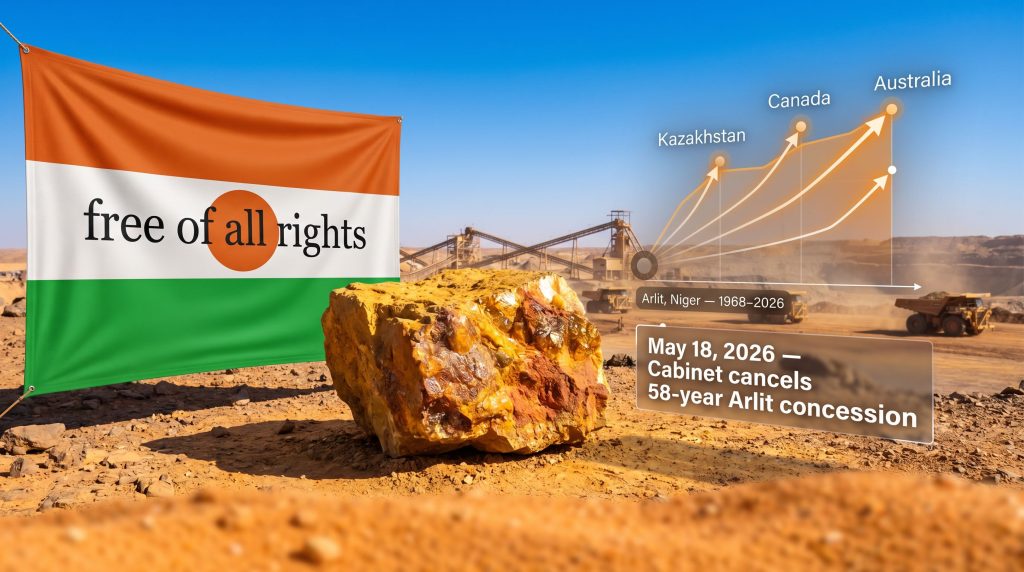
The cancellation of the Arlit concession was formalised at a Cabinet meeting on 18 May 2026, chaired by military head of state Abdourahamane Tchiani. The concession itself traced its origins to 1968, when France's Atomic Energy Commission (CEA) received the original grant, making it one of the longest-standing foreign mining arrangements anywhere on the African continent. Operational responsibility passed to Orano, formerly Areva, as the CEA's commercial successor.
Niger's government cited non-payment of surface royalties on designated portions of the mining perimeter as the legal basis for revocation. The procedural sequence followed Niger's mining code closely:
- A formal royalty payment assessment was issued in April 2025
- A non-compliance notice followed in September 2025
- After no satisfactory resolution was reached within the stipulated deadline, the government exercised its right to cancel the concession in May 2026
In a nationally broadcast statement, Niger's government declared that the state was justified in cancelling the concession and that the affected land had been rendered free of all rights.
The Policy Trajectory: A Structured Escalation
The Arlit revocation did not arrive without precedent. The following table traces the sequence of sovereignty actions Niger has taken since its 2023 political transition:
| Year | Action | Target |
|---|---|---|
| July 2023 | Military transition removes civilian government | Political sovereignty |
| 2024 | Orano's operating licence revoked at Imouraren | Uranium sector |
| April 2025 | Formal royalty assessment issued to Orano | Arlit concession |
| September 2025 | Non-compliance notice issued under mining code | Arlit concession |
| May 18, 2026 | Cabinet formally cancels 58-year concession | Arlit concession |
The Imouraren revocation in 2024 established a clear procedural template. By following the same path at Arlit, Niger's government signalled that its actions are grounded in domestic legal process rather than arbitrary expropriation — a distinction with significant implications for any future international arbitration proceedings.
Environmental Allegations: A Second Front
Beyond the royalty dispute, Nigerien authorities have separately indicated their intention to pursue legal action against Orano over alleged environmental damage and radioactive waste contamination at uranium mining sites. Orano has disputed these characterisations, asserting decades of operational compliance and contesting the legality of asset cancellation.
The combination of regulatory revocation and environmental litigation represents a two-track pressure strategy that substantially complicates any negotiated resolution. Environmental claims, even when contested, can freeze assets in international legal proceedings for years and create reputational overhang that deters third-party investors from moving quickly into reclaimed concessions.
The Alliance of Sahel States: When National Decisions Become Regional Doctrine
Bloc-Level Coordination
Niger does not act in isolation. The Alliance of Sahel States (AES), comprising Niger, Mali, and Burkina Faso following their respective military transitions between 2023 and 2024, has collectively expelled French military forces, terminated bilateral defence agreements, and initiated systematic reviews of foreign commercial arrangements across the bloc.
| Country | Key Action Against French-Linked Interests | Sector |
|---|---|---|
| Niger | Revocation of Orano concessions at Arlit and Imouraren | Uranium mining |
| Mali | Suspension of French military presence; mining licence reviews | Gold and critical minerals |
| Burkina Faso | Expulsion of French troops; reassessment of foreign extractive agreements | Gold mining |
"The synchronised character of AES resource policy shifts is analytically significant. These are not reactive decisions driven by individual grievances but appear to reflect a deliberate, bloc-level strategy to restructure the terms of foreign resource extraction across the Sahel." (Business Insider Africa, May 2026)
The Françafrique Framework Under Terminal Stress
The concept of Françafrique describes the post-colonial network of political, military, and economic relationships through which France maintained disproportionate influence across its former African territories for decades after independence. Military cooperation agreements, currency arrangements via the CFA franc zone, and long-duration resource concessions were among the structural instruments of this system.
The AES bloc's coordinated dismantling of these arrangements represents the most serious challenge to the Françafrique framework since its informal codification in the 1960s. Niger revokes French uranium concession at Arlit as part of a broader pattern of deliberate post-colonial resource reclamation that resonates politically across West and Central Africa. The broader Niger-Orano dispute signals that Niger intends to float its uranium on the international market independently, representing a fundamental restructuring of long-established supply relationships.
Three Strategic Scenarios for Niger's Uranium Future
Scenario 1: State-Led Redevelopment with Eastern Partners
Niger reclaims operational control of Arlit and Imouraren and enters new concession arrangements with non-Western partners. Niger's formalisation of $1 billion in energy agreements with China provides a visible template for this pathway. Russia's state nuclear entity Rosatom has also expanded its African uranium footprint, representing a second plausible partnership direction.
Key considerations for this scenario:
- Technical capacity gaps in Niger's domestic mining sector would require substantial knowledge transfer from incoming partners
- Infrastructure investment in remote northern Niger involves significant capital requirements
- International financing constraints may apply under potential sanctions environments depending on geopolitical developments
- China's existing critical minerals portfolio, spanning cobalt in the DRC, lithium across Africa and Latin America, and rare earth elements globally, suggests uranium would be a strategically coherent addition
Scenario 2: Prolonged Legal Dispute and Operational Paralysis
Orano pursues international arbitration under bilateral investment treaty frameworks. This could freeze Niger's ability to renegotiate the concessions with third parties for an extended period. Historical precedent from resource nationalisation disputes in Africa indicates that arbitration timelines routinely extend across multiple years, with contested outcomes common.
Risk profile for this scenario:
- Uranium output from affected sites remains disrupted throughout proceedings
- Niger's export revenues face sustained pressure without replacement income from the sector
- Third-party investors may be deterred by legal uncertainty over title
- Orano's environmental claims add a further layer of litigation complexity
Scenario 3: Negotiated Renegotiation Under Revised Terms
Diplomatic back-channels produce a revised commercial framework in which Orano retains partial operational involvement under substantially improved royalty, equity, and environmental compliance conditions. This mirrors outcomes from other African resource nationalisation episodes, including episodes in Zambia's copper sector and Namibia's diamond industry, where full expulsion proved commercially impractical for both parties.
The political optics within the AES bloc represent the primary constraint on this scenario. Any accommodation with a French-linked entity would require careful domestic framing to avoid appearing inconsistent with the bloc's broader sovereignty doctrine.
Global Nuclear Supply Chain Implications
France's Strategic Exposure
France operates one of the world's largest nuclear energy fleets, with nuclear generating approximately 70 percent of national electricity according to data from the International Energy Agency. Niger has historically ranked among France's most important uranium supply partners alongside Kazakhstan and Australia. The sequential loss of access to both Imouraren in 2024 and Arlit in 2026 materially narrows France's West African sourcing options.
French state utility EDF and the broader European nuclear fuel procurement ecosystem now face increased urgency around supply chain diversification — a process already underway following broader commodity security concerns generated by Russia's invasion of Ukraine in 2022. In addition, the Russian uranium import ban has further compressed the range of politically acceptable supply options for Western utilities.
Where Redirected Demand May Flow
The structural tightening of Western-accessible uranium supply creates identifiable beneficiaries across the global supply landscape:
- Kazakhstan (Kazatomprom): Already the world's largest uranium producer, accounting for roughly 43 percent of global mine supply. Increased Western procurement interest is likely, though Kazakhstan's own geopolitical positioning introduces complexity.
- Canada (Athabasca Basin): High-grade deposits at operations including Cigar Lake and McArthur River offer established infrastructure, stable jurisdiction, and strong ESG credentials for Western utility procurement.
- Australia: Significant uranium reserves combined with stable regulatory frameworks position Australian projects as credible long-term supply alternatives for European and Asian utilities seeking politically reliable sourcing.
- Namibia: The Rossing and Husab operations provide an additional African supply source that operates under a fundamentally different political and contractual environment to the AES bloc.
"With Imouraren classified as one of the world's largest uranium deposits by resource volume, its effective removal from Western-accessible supply represents a structural rather than cyclical shift in global uranium availability for OECD nuclear operators."
Uranium Market Dynamics: Supply Concentration Risk Repriced
Uranium spot prices experienced elevated volatility through the early-to-mid 2020s, driven by intersecting factors including supply concentration risks, the post-Fukushima demand recovery cycle, and accelerating nuclear energy commitments from European and Asian governments. The Arlit and Imouraren revocations add a further structural dimension to this repricing environment. Understanding current uranium market dynamics is consequently essential context for institutional investors monitoring supply chain exposure.
A key technical nuance often overlooked in mainstream coverage relates to spot versus term pricing in how uranium supply contracts work in practice. The majority of uranium consumed by nuclear utilities is procured under long-term contracts rather than on the spot market. This means the immediate spot price impact of Niger's actions may be muted relative to the medium-term contracting implications, where Western utilities seeking to roll over expiring supply agreements will face a measurably tighter pool of politically accessible, investment-grade uranium sources.
The next major ASX story will hit our subscribers first
What Investors and Nuclear Stakeholders Need to Consider
Jurisdictional Risk Repriced Across African Assets
The Arlit revocation, grounded in surface royalty non-payment rather than arbitrary expropriation, delivers a specific lesson to mining investors operating in politically transitional African environments: compliance governance is now a first-order risk management priority, not an administrative function. The procedural legitimacy Niger embedded in its revocation process — using its own mining code to justify each step — makes it substantially harder for Orano to secure a swift arbitration victory.
Key risk recalibration considerations:
- Apply materially higher risk-adjusted discount rates to concession-dependent assets in AES-aligned jurisdictions
- Audit royalty and surface fee compliance across all active mining arrangements in West and Central Africa
- Factor environmental liability exposure into asset valuations for legacy African operations
- Monitor bilateral investment treaty frameworks for changes that could affect arbitration rights
The Broader African Resource Sovereignty Trend
Niger revokes French uranium concession at Arlit as part of a demonstrably wider pattern of African resource governance assertiveness. Zimbabwe has implemented lithium processing mandates requiring beneficiation before export. The DRC has conducted reviews of its cobalt sector arrangements. Namibia has imposed restrictions on raw mineral exports to encourage downstream processing.
Each of these interventions reflects a fundamental recalibration of how African governments assess the long-term distributional value of hosting foreign extractive operations under legacy concession terms. For institutional investors, this trend warrants systematic rather than case-by-case monitoring. The question is no longer whether African resource sovereignty assertions will occur, but which jurisdictions, commodities, and concession structures carry the highest near-term exposure.
Disclaimer: This article is intended for informational purposes only and does not constitute financial or investment advice. Uranium market projections, scenario analyses, and assessments of geopolitical risk involve inherent uncertainty. Readers should conduct independent due diligence before making investment decisions.
Frequently Asked Questions: Niger's Uranium Revocations
Why did Niger cancel the Arlit uranium concession?
Niger's government invoked provisions of its domestic mining code after Orano, the French company that inherited the concession originally granted to France's Atomic Energy Commission in 1968, allegedly failed to pay surface royalties on portions of the mining perimeter. Formal notices issued in April and September 2025 produced no satisfactory compliance, leading to the Cabinet's cancellation decision on 18 May 2026.
What is the geological significance of Arlit?
Arlit is a sandstone-hosted uranium province in the Tim Mersoi Basin in northern Niger that has produced more than 140,000 tU since the late 1960s. It represented the operational heart of Franco-Nigerien nuclear cooperation for over half a century.
How does the Imouraren situation relate to Arlit?
Niger revoked Orano's operating licence at Imouraren in 2024. With a reported in-situ resource base exceeding 170,000 tU, Imouraren is one of the world's largest uranium deposits by contained metal. The Arlit cancellation in 2026 follows the same procedural template established at Imouraren.
Could these revocations affect uranium prices?
The removal of two major Nigerien assets from Western-accessible supply introduces structural tightening pressure, particularly on long-term contract markets where European utilities will face a reduced pool of politically reliable sourcing options. The scale and duration of price effects depend on the pace of alternative supply development and the outcome of legal proceedings.
What is the Alliance of Sahel States?
The AES is a political and security alliance formed by Niger, Mali, and Burkina Faso following their respective military transitions between 2023 and 2024. The bloc has collectively moved to reduce French military, diplomatic, and economic influence across the Sahel region, with resource sector restructuring forming a central pillar of this agenda.
Key Assessment Summary
| Dimension | Assessment |
|---|---|
| Immediate legal trigger | Non-payment of surface royalties under Niger's mining code |
| Structural driver | Post-coup resource sovereignty reclamation |
| Geopolitical context | AES bloc-wide reduction of French influence |
| Global supply impact | Structural tightening of OECD-accessible uranium supply |
| Legal trajectory | Parallel arbitration risk and environmental litigation |
| Potential new partners | China, Russia (Rosatom) |
| Supply chain beneficiaries | Kazakhstan, Canada, Australia, Namibia |
| Core investor implication | Elevated jurisdictional risk premium across AES-aligned African assets |
Want To Track The Next Major Uranium Discovery Before The Market Does?
As Niger's revocations structurally tighten Western-accessible uranium supply, the race to identify the next significant discovery intensifies — Discovery Alert's proprietary Discovery IQ model delivers real-time ASX alerts the moment a major mineral discovery is announced, transforming complex data across 30+ commodities into actionable insights. Explore historic discoveries and their remarkable returns, then begin your 14-day free trial at Discovery Alert to position yourself ahead of the market.