August 6, 2026
The Hidden Energy Goldmine Sitting in America's Backyard
For decades, the nuclear industry operated under a peculiar contradiction: it generated enormous amounts of energy whilst simultaneously creating a byproduct it had no clear plan to manage. Project Omega spent fuel recycling has emerged as one of the most compelling responses to this decades-old dilemma. Spent nuclear fuel accumulated in cooling pools and dry cask storage units at reactor sites across the United States, growing year after year without a permanent solution. Policymakers debated, projects stalled, and the material simply sat there, politically toxic and scientifically misunderstood.
That framing may now be changing in a fundamental way. A new generation of technologists and investors is looking at those same storage sites and seeing something entirely different — not a liability accumulating interest, but a reservoir of recoverable energy, critical isotopes, and strategic materials waiting to be unlocked.
When big ASX news breaks, our subscribers know first
How Big Is the Spent Fuel Inventory and Why Has It Been Ignored?
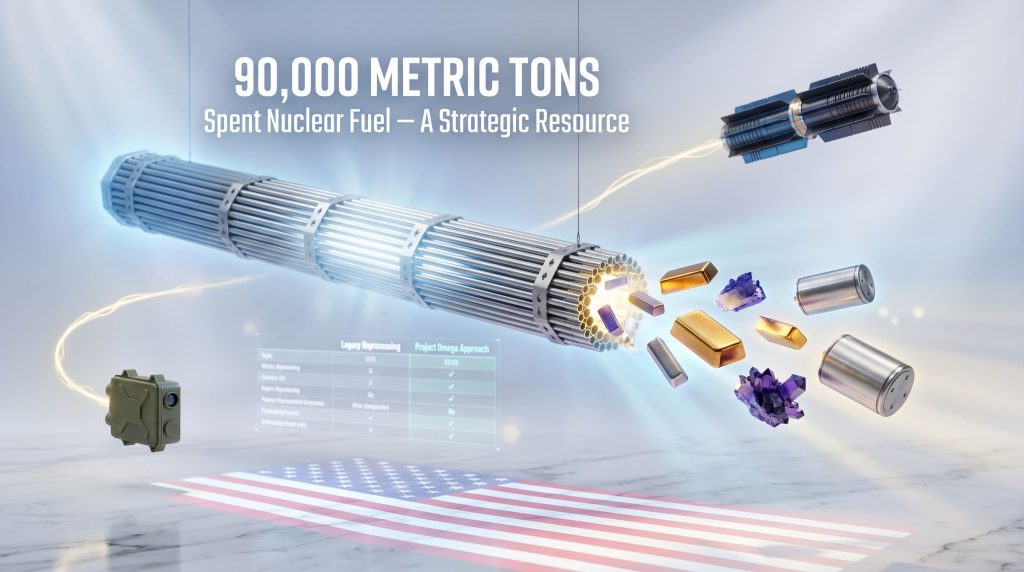
The scale of the challenge, and the opportunity, is difficult to overstate. The United States has accumulated more than 90,000 metric tons of spent nuclear fuel sitting in temporary storage at reactor sites spread across more than 30 states. This material was never intended to be a permanent fixture at those locations, yet here it remains, decades after the reactors that generated it first came online.
The reasons for this inertia are as much political as they are technical. The 1977 presidential decision to halt civilian reprocessing in the United States, driven by nonproliferation concerns over plutonium separation, effectively froze domestic fuel cycle development for a generation. The collapse of the Yucca Mountain repository programme removed what had been the assumed solution for permanent nuclear waste disposal. Between policy reversals and regulatory uncertainty, the industry defaulted to the path of least resistance: extended interim storage in dry casks.
What makes this situation particularly striking from a resource perspective is that spent fuel discharged from a light water reactor still contains roughly 95% of its original uranium, along with fissile plutonium, valuable minor actinides including neptunium, americium, and curium, and a range of fission product isotopes with medical, industrial, and defence applications. Treating this material purely as waste, rather than as a complex feedstock, represents an extraordinary opportunity cost.
What Project Omega Is Actually Proposing
In February 2026, a nuclear technology startup called Project Omega publicly announced its emergence from stealth mode with a stated mission to process and recycle spent nuclear fuel into long-duration, high-density power sources and critical materials for the nuclear industry. The announcement was notable not just for its ambition but for the strategic logic underpinning it.
Project Omega secured a $12 million seed round to advance its technology proposition, and its early-stage work has been conducted in collaboration with the Pacific Northwest National Laboratory (PNNL) and supported through ARPA-E's NEWTON programme, which stands for Nuclear Energy Waste Transmutation Optimized Now. The NEWTON programme was specifically structured to make spent fuel reprocessing economically viable within a generation, a mandate that directly shaped how Project Omega designed its commercialisation pathway.
What separates Project Omega's approach from legacy reprocessing models is a deliberate rejection of the PUREX-based chemistry that underpins French and Russian reprocessing operations. PUREX, which isolates weapons-usable plutonium as a discrete product stream, is the primary reason that reprocessing has faced such fierce nonproliferation opposition in the United States. Furthermore, Project Omega's chemistry avoids this separation, producing materials that are less proliferation-sensitive whilst still recovering significant energy value and critical isotopes.
| Feature | Legacy Reprocessing (France/Russia) | Project Omega Approach |
|---|---|---|
| Plutonium Separation | Yes (discrete product stream) | No |
| Primary Market | Commercial power grid | Defence, space, remote systems |
| Chemistry Model | PUREX-based | Proliferation-resistant alternatives |
| Development Stage | Commercial scale | Early demonstration / federal lab testing |
| Institutional Backing | State-owned or heavily regulated | ARPA-E + PNNL partnerships |
How Spent Fuel Recycling Works: The Technical Process
Understanding what Project Omega is attempting requires a basic grasp of how spent fuel recycling actually functions. The process is multi-stage and technically demanding, which is precisely why it has historically required state-level investment to pursue at scale.
-
Cooling and Interim Storage — Spent fuel assemblies are first held in water-filled cooling pools, typically for a minimum of five years, to allow short-lived radioisotopes to decay and heat output to decrease to manageable levels.
-
Chemical Separation — The cooled material undergoes dissolution and chemical processing to isolate useful isotopic fractions from the remaining waste matrix.
-
Material Characterisation — Each recovered fraction is assessed for isotopic purity, energy density, and suitability for specific downstream applications, from reactor fuel to radioisotope power systems.
-
Product Fabrication — Separated materials are converted into usable forms, whether that means fuel feedstocks for advanced reactors, radioisotope power unit components, or critical material inputs for defence systems.
-
Waste Conditioning — The residual high-level waste fraction, now significantly reduced in volume compared to unprocessed spent fuel, is stabilised for long-term storage through vitrification or other conditioning methods.
What Can Actually Be Recovered?
The material diversity within spent fuel is one of the least appreciated aspects of the recycling opportunity. A single tonne of spent light water reactor fuel contains recoverable fractions across multiple value categories:
-
Uranium — Still comprising roughly 95% of the original fuel mass, this material is recoverable for re-enrichment or use as feedstock in advanced reactor designs.
-
Plutonium — Present at roughly 1% by mass, this fissile material is usable in mixed-oxide fuel or fast reactor systems, though its management remains subject to strict international safeguards and nonproliferation constraints.
-
Minor Actinides — Neptunium-237, americium-241, and curium isotopes are increasingly sought for radioisotope thermoelectric generators (RTGs) used in space missions and for transmutation research in advanced reactor programmes.
-
Fission Products — Isotopes including cesium-137 and strontium-90 have applications in industrial radiography, food irradiation, and medical devices.
The emerging commercial interest in americium-241 for space power applications is particularly worth noting. U.K.-based Perpetual Atomics and U.S.-based QSA Global announced in late 2025 that they had achieved a scalable process for converting americium into stable ceramic pellets suitable for direct integration into radioisotope heater units and RTGs. This development directly validates the demand side of what Project Omega spent fuel recycling is attempting to supply.
The Defence-First Commercialisation Strategy
Perhaps the most strategically sophisticated element of Project Omega's approach is its decision to target defence and space applications before pursuing commercial grid integration. This is not an accident of circumstance but a deliberate market entry thesis.
Historical reprocessing ventures have consistently encountered the same failure mode: the technology functions, but commercial economics and political headwinds combine to make large-scale deployment unviable. The United States Barnwell reprocessing plant in South Carolina, which was constructed and then mothballed without ever processing commercial spent fuel at scale, stands as the most instructive domestic example.
By focusing on high-value, low-volume applications first, Project Omega sidesteps this trap. As Scientific American reports, defence customers have different procurement logic to commercial utilities — they prioritise energy independence, operational resilience, and mission capability over cost minimisation, which means they can absorb a higher unit cost for power sources that meet specific performance requirements.
Target application areas include:
- Portable and wearable power systems for troops operating in remote or austere environments
- Long-duration autonomous sensor networks that cannot rely on conventional fuel resupply logistics
- Forward operating base energy independence from vulnerable fuel supply chains
- Radioisotope power systems for deep-space missions where solar power is insufficient
- Remote civilian infrastructure in off-grid locations where long-duration power without maintenance is a premium proposition
The Broader U.S. Nuclear Fuel Cycle Revival
Project Omega spent fuel recycling is not emerging in isolation. It is, however, part of a broader and accelerating effort to reconstruct domestic nuclear fuel cycle capabilities that have atrophied over decades of import dependence and policy inertia. Understanding the current uranium market dynamics helps contextualise why this moment feels different from previous cycles of enthusiasm.
| Initiative | Organisation | Focus Area | Scale |
|---|---|---|---|
| H Canyon Uranium Recovery Restart | DOE / Savannah River Site | Uranium and isotope recovery from used fuel | Federal facility |
| HALEU Enrichment Awards | DOE (Centrus, General Matter, Orano) | Domestic enrichment capacity | $2.7 billion total |
| Centrus Oak Ridge Expansion | Centrus Energy | Large-scale centrifuge deployment | Major expansion |
| BWXT Centrifuge Manufacturing Facility | BWXT / NNSA | Defence-grade enriched uranium | National security |
| Hanford FMEF Lease | DOE / General Matter | Advanced fuel cycle technologies | Pilot-scale |
| LIS Technologies Investment | LIS Technologies | First commercial laser enrichment plant | $1.38 billion |
| Project Omega | Private startup + ARPA-E/PNNL | Spent fuel recycling into power products | Seed stage |
The restart of uranium recovery operations at the H Canyon facility at the Savannah River Site in South Carolina is particularly significant context. H Canyon is one of the few facilities in the United States with demonstrated capability to process irradiated nuclear materials, and its reactivation signals institutional momentum toward rebuilding the back-end fuel cycle infrastructure that Project Omega would eventually need to operate within at scale.
The role of AI-driven energy demand in this broader picture should not be underestimated. The Department of Energy's partnership with General Matter at the Hanford Site explicitly cited predicted future energy requirements associated with artificial intelligence as a driver for advanced fuel cycle investment. This creates a demand-pull dynamic that strengthens the uranium investment outlook for all fuel cycle technologies, including recycling.
The next major ASX story will hit our subscribers first
The Obstacles That History Keeps Repeating
Intellectual honesty requires acknowledging the formidable barriers that have prevented every previous U.S. attempt at commercial spent fuel recycling from reaching sustained operation.
Economic viability remains the most persistent challenge. Freshly mined uranium has historically been cheap enough that the economics of recovering uranium from spent fuel struggle to compete on a pure cost basis. The uranium supply challenges facing the industry are, however, shifting this calculus, with spot prices reaching $94.28 per pound at the end of January 2026 — the highest level since February 2024, according to Cameco — suggesting a tightening supply environment that could improve the relative economics of recycling.
Regulatory complexity presents a second major obstacle. The Nuclear Regulatory Commission licensing pathway for novel fuel cycle technologies is lengthy, expensive, and outcomes-uncertain. No startup has unlimited runway to absorb a multi-year licensing process without demonstrated revenue.
Nonproliferation politics continue to shape what is technically permissible. Even approaches that avoid explicit plutonium separation face scrutiny from arms control advocates who worry about dual-use chemistry and material diversion risks.
Scaling challenges are the final gauntlet. Moving from federal laboratory proof-of-concept to pilot-scale demonstration to commercial operation involves compounding technical, financial, and regulatory risks at each stage.
The tension between the proven technical functionality of reprocessing and its historically poor commercial and political track record is precisely what makes Project Omega's defence-first, proliferation-resistant approach intellectually interesting. It attempts to solve the business model problem before solving the scale problem, which inverts the sequencing that destroyed its predecessors.
How the U.S. Compares to Global Competitors
The global landscape of spent fuel recycling makes the U.S. position both more urgent and more complex to navigate.
France operates the world's most commercially advanced reprocessing infrastructure at the La Hague facility, processing roughly 1,700 tonnes of spent fuel annually and supplying mixed-oxide fuel to a fleet that runs partly on recycled material. French reprocessing is a state-integrated operation, not a free market venture.
Russia pursues a state-directed closed fuel cycle strategy anchored around fast reactor technology, with the BN-800 and BN-1200 reactor programmes designed specifically to burn recycled actinides as fuel.
China is investing heavily in closed fuel cycle infrastructure, including a large commercial reprocessing plant under development, positioning itself to achieve material independence from uranium imports within a generation.
Japan constructed the Rokkasho reprocessing plant at enormous cost but has faced repeated operational delays and post-Fukushima policy uncertainty that have prevented it from reaching steady-state commercial operations.
The United States, which pioneered reprocessing technology at the industrial scale, currently operates no commercial spent fuel recycling capacity. Consequently, Project Omega represents one of the most concrete attempts in recent years to begin reversing that position from the private sector rather than waiting for federal infrastructure programmes. The US uranium production rebound adds further urgency to the case for closing the loop on the domestic fuel cycle.
What the Next 24 Months Will Reveal
For those tracking the evolution of U.S. nuclear fuel cycle strategy, the indicators worth watching over the next two years are specific and measurable.
Progress at PNNL on proof-of-concept chemistry will determine whether Project Omega spent fuel recycling can achieve the material purity and throughput rates needed to support commercial product specifications. Federal laboratory validation at this stage carries credibility that startup announcements alone cannot provide.
The NRC's posture toward novel fuel cycle licensing will shape the regulatory timeline for any company attempting to move beyond laboratory demonstration. Constructive engagement between regulators and developers on pre-licensing frameworks would, furthermore, be a meaningful positive signal.
Defence procurement interest, if and when it materialises in the form of contracts rather than expressions of interest, would validate the entire commercial thesis. The Department of Defense's Strategic Capabilities Office, already engaged with nuclear power through programmes like Project Pele, represents the most credible near-term customer class.
The convergence of rising uranium prices, accelerating AI-driven electricity demand, and a reshaping of domestic fuel cycle policy creates conditions that are more favourable to spent fuel recycling commercialisation than at any point in the past three decades. Whether Project Omega can navigate the technical and regulatory gauntlet to capitalise on that window remains genuinely uncertain, but the strategic logic of the attempt has rarely been stronger.
This article contains forward-looking assessments based on publicly available information and should not be construed as financial or investment advice. Early-stage nuclear technology ventures carry substantial technical, regulatory, and commercial risks. Readers should conduct independent due diligence before making any investment decisions related to the nuclear fuel cycle sector.
For ongoing coverage of the U.S. spent fuel landscape and nuclear fuel cycle developments, the American Nuclear Society's Nuclear Newswire at ans.org/news provides regularly updated reporting across advanced reactor programmes, fuel supply developments, and federal energy policy.
Want to Track the Next Major Discovery in the Nuclear Energy Supply Chain?
Discovery Alert's proprietary Discovery IQ model instantly scans ASX announcements across more than 30 commodities — including uranium — delivering real-time alerts on significant mineral discoveries so investors can act ahead of the broader market. Explore historic discovery returns on Discovery Alert's dedicated discoveries page and begin your 14-day free trial to gain an immediate market-leading edge.