August 13, 2026
The Geology That Could Redefine America's Nuclear Supply Chain
Most conversations about domestic uranium revival begin and end in Wyoming. The roll-front deposits of the Powder River Basin have dominated investor narratives, policy briefings, and mining company presentations for years. Yet the geology of the American Southwest tells a fundamentally different story, one measured not in narrow sinuous ore bands but in thick, concentrated tabular deposits sitting beneath one of the most historically significant mineral belts on the continent.
New Mexico uranium ISR projects represent a convergence of underappreciated resource scale, maturing extraction technology, and shifting community sentiment that is slowly repositioning the state from a forgotten jurisdiction into what may become the most consequential domestic uranium address in the United States. Understanding why this shift is happening, and what it actually means for the future of American nuclear energy, requires unpacking geology, regulatory architecture, workforce economics, and decades of accumulated social debt all at once.
When big ASX news breaks, our subscribers know first
Why the Grants Mineral Belt Demands Attention
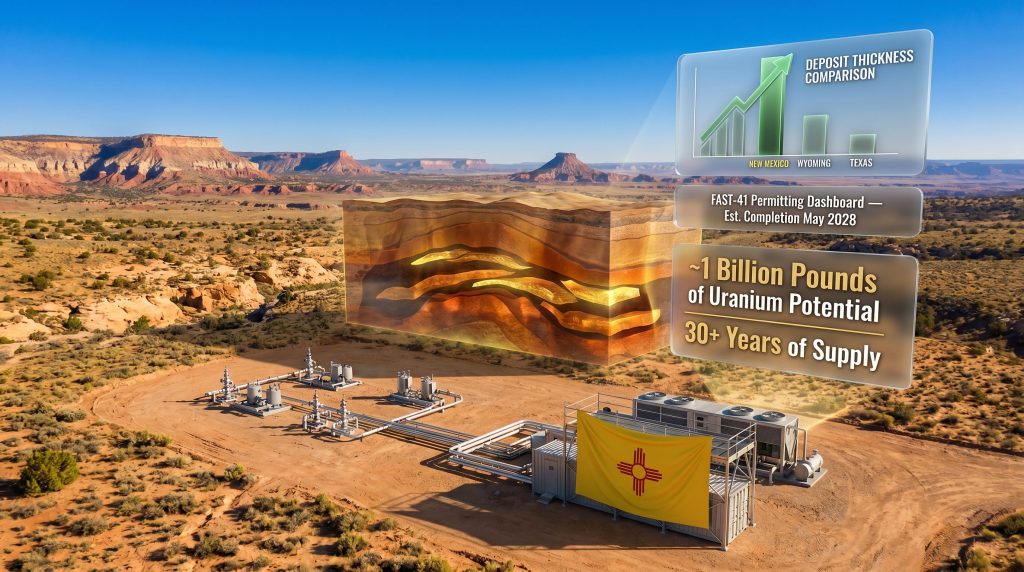
The Grants Mineral Belt, stretching across northwestern New Mexico, sits at the intersection of geological abundance and historical neglect. State and federal agency assessments suggest the region contributes substantially to New Mexico's overall uranium endowment, with total state estimates pointing to approximately 1 billion pounds of uranium potential when combining identified, historic, and prospective resources. That figure, cited by the state geologist and federal agencies including the EPA, is larger than any comparable estimate for Wyoming, Texas, Utah, or any other U.S. uranium state.
What separates New Mexico's deposits structurally is their geometry. Where Wyoming and Texas host roll-front deposits, which are thinner, more sinuous, and distributed across wider areas, New Mexico's ore bodies are thick and tabular. A single wellfield in New Mexico's Grants district can sustain production over a materially longer period than an equivalent operation in the Powder River Basin, fundamentally altering project economics and the infrastructure investment calculus.
The practical implication of deposit thickness is significant: fewer wellfields are needed to sustain production targets, operational footprints stay concentrated, and per-pound extraction costs carry downward pressure that thinner deposits simply cannot replicate.
New Mexico's departure from the mainstream uranium investment conversation was not accidental. The state's uranium history is anchored in conventional underground and open-pit operations conducted before the EPA existed, before ISR technology was commercially viable, and before modern environmental frameworks imposed baseline restoration requirements. Those legacy operations left documented environmental and community impacts, particularly affecting Indigenous communities in the Grants district, and effectively poisoned the jurisdictional narrative for decades.
Furthermore, the United States was quietly offshoring its uranium requirements to Kazakhstan, Australia, and Canada, removing any economic urgency to revisit the New Mexico resource base. The result was a structural information gap: a jurisdiction holding more uranium than any other U.S. state, largely invisible to investors and policymakers who defaulted to Wyoming as the domestic uranium benchmark. Understanding global uranium reserves helps contextualise just how significant this oversight has been.
How In-Situ Recovery Works and Why It Changes the New Mexico Equation
The Mechanics of ISR Extraction
In-situ recovery extracts uranium without excavating the ore body. A network of injection and extraction wells is installed across the ore zone, through which a lixiviant, typically a mildly alkaline or acidic leaching solution, is circulated underground. The solution dissolves uranium from the host rock, and the uranium-bearing fluid is pumped to the surface where it passes through an ion exchange facility for concentration and processing. No blasting, no open pits, no underground chambers.
The surface expression of an ISR operation is closer to an oil and gas wellpad than a conventional mine. Buildings housing ion exchange equipment, piping networks connecting wellheads, and modest processing infrastructure replace the tailings dams, overburden piles, and haul roads that define traditional uranium operations. This distinction matters enormously in a jurisdiction where community memory of conventional mining is still acute.
A variant known as Precision ISR, or horizontal well ISR, extends this model further by applying directional drilling techniques borrowed from the oil and gas industry. Rather than relying exclusively on vertical wells, horizontal wellbores can be steered through ore zones to optimise lixiviant contact and uranium recovery while reducing the number of surface penetrations required. This further compresses the surface footprint and reduces associated emissions. The in-situ leaching benefits over conventional mining methods are considerable in this regard.
ISR now accounts for the dominant share of global uranium production, driven largely by Kazakhstan's Kazatomprom operations, but also by growing US uranium ISR production alongside output in Uzbekistan and China. Its ascendancy reflects a broader industry recognition that the combination of lower capital intensity, reduced environmental disruption, and faster permitting timelines makes it structurally superior to conventional methods for suitable ore bodies.
Why New Mexico's Geology Is Particularly Compatible
The thick tabular ore bodies of the Grants Mineral Belt are well-suited to ISR wellfield design. Historical testing programmes, including work conducted by Mobil Oil at several New Mexico deposits, established ISR amenability data that predates current development activity by decades. This means that modern companies entering the New Mexico ISR space are not starting from a blank technical canvas.
They are, however, inheriting a foundation of drill data, leach test results, and resource estimates — many of them developed by oil and gas majors with significant technical resources — that provide a higher degree of confidence than would typically accompany early-stage exploration.
| Feature | New Mexico Deposits | Wyoming / Texas Deposits |
|---|---|---|
| Deposit geometry | Thick, concentrated tabular | Thin, sinuous roll-front |
| Resource density | High pounds per area | More dispersed across wider zones |
| Wellfield longevity | Extended production per wellfield | Shorter individual wellfield lifespan |
| ISR test history | Established through historical oil and gas programmes | Proven in operating commercial projects |
| Per-pound extraction cost potential | Lower due to deposit concentration | Higher due to infrastructure spread |
The deposit geometry advantage has a direct bearing on project economics that is rarely discussed in generalist uranium investment analysis. A compact, high-grade ore zone allows wellfield capital expenditure to be amortised over a longer production period, improving return profiles and reducing the frequency of new wellfield development cycles needed to maintain throughput.
Navigating New Mexico's Uranium Permitting Architecture
Understanding the Non-Agreement State Framework
One of the most operationally significant distinctions between New Mexico and its uranium-producing peers is its regulatory classification. Wyoming and Texas are what regulators call Agreement States, jurisdictions where the Nuclear Regulatory Commission has delegated primary licensing authority to the state level. New Mexico has not entered into this delegation arrangement, which means ISR uranium projects in the state require parallel engagement with both the NRC at the federal level and New Mexico state agencies simultaneously.
This dual-track structure adds procedural complexity but does not necessarily extend timelines beyond national benchmarks. Current industry estimates place the timeline from established resource to production at approximately 5 years across all U.S. uranium jurisdictions, reflecting a sector-wide constraint rooted more in regulatory agency staffing capacity than in jurisdictional-specific frameworks.
The uranium industry is expanding faster than regulatory agencies can hire and train qualified reviewers. This staffing bottleneck is a national phenomenon affecting Wyoming and Texas equally, not a New Mexico-specific disadvantage.
The Five Stages of New Mexico ISR Permitting
-
Exploration Permitting: Drill programmes covering fewer than five acres can be permitted within approximately two to three months, providing an accessible entry point for early-stage resource delineation. Larger programmes exceeding five acres require extended review timelines.
-
Resource Definition and NRC Pre-Licensing: Completion of a NI 43-101 or equivalent resource estimate, NRC engagement on ISR-specific licensing pathways, and critical aquifer baseline characterisation work that underpins all subsequent regulatory review.
-
State Environmental and Water Permitting: New Mexico's water regulatory environment places particular emphasis on aquifer restoration proof of concept, requiring operators to demonstrate that post-mining groundwater can be returned to baseline conditions. Community and tribal consultation obligations are formally integrated at this stage.
-
NRC License Application and Environmental Impact Statement: The full federal licensing process, including Environmental Impact Statement preparation and review. At least one New Mexico ISR project has been enrolled on the federal FAST-41 Permitting Dashboard, a framework designed to coordinate and accelerate environmental review timelines, with an estimated review completion date of May 2028.
-
Production Authorisation and Commissioning: Final state and federal approvals, wellfield construction, and operational commissioning.
The FAST-41 enrolment status of select New Mexico projects represents a federal-level coordination mechanism rather than a policy endorsement, and timelines associated with any specific project remain subject to regulatory process and agency capacity.
The New Mexico ISR Project Landscape
A Jurisdiction in Early Development with Significant Pipeline Depth
The New Mexico ISR development pipeline spans a range of advancement stages, from projects holding active NRC licences to assets still undergoing resource modernisation. What unifies them is a shared geological address within the Grants Mineral Belt and, in most cases, a historical technical foundation that distinguishes them from purely speculative exploration plays.
Grants Precision ISR Project (Grants Energy): Located near Grants, the historical epicentre of U.S. uranium production, this project employs horizontal directional drilling alongside conventional ISR methodology. It carries an enrolment on the federal FAST-41 Permitting Dashboard with an environmental review completion estimate of May 2028. The project covers approximately 6 square miles of private land near San Mateo in northwestern New Mexico and targets production in the early 2030s. According to Grants Energy's Precision ISR approach, proponents characterise it as capable of sustaining over 30 years of production at planned rates, a claim tied to the deposit's exceptional thickness relative to national comparators.
Crownpoint-Churchrock Project (Laramide Resources): One of the most permitting-advanced ISR uranium assets in New Mexico, this project holds an NRC-issued uranium recovery licence, a regulatory milestone that required substantial technical and environmental documentation to achieve. The primary outstanding requirement is final New Mexico state permitting, particularly relating to aquifer restoration demonstration. Its proximity to Navajo Nation land creates additional community engagement obligations that the operator must navigate carefully. Further detail on the Crownpoint-Churchrock uranium project illustrates the complexity involved.
Ambrosia Lake District: Historically operated as an underground conventional uranium mine by a predecessor to BHP, Ambrosia Lake represents a technically distinct opportunity. Post-flooding of the underground workings, solution mining tests were conducted in the submerged stopes, establishing that uranium dissolved in the existing underground water could be recovered through an ion exchange process. This stope mining pathway is categorically different from greenfield ISR, carrying a unique permitting profile and potentially faster path to cash flow than a conventional wellfield development programme. Infrastructure logistics under consideration include on-site ion exchange treatment with resin-loaded truck transport to a central processing facility, potentially located in a neighbouring state such as Utah where processing facility permitting timelines carry greater clarity. Transport economics for this configuration are estimated at approximately $1 per pound over distances of a few hundred miles.
West Largo: Characterised by knowledgeable observers as the highest-grade ISR uranium project in the United States, West Largo was originally developed and drilled by an oil and gas company, lending confidence to the robustness of existing resource estimates. The cut-off grade used in the original resource estimate was conservative by modern standards, suggesting significant resource expansion potential when the deposit is reassessed using current methodologies. A NI 43-101 resource update is underway, accompanied by a peripheral drill programme designed to test the ore zone's lateral extents. The deposit's thickness and grade profile place it at the top of internal geological ranking systems for New Mexico ISR assets.
Crownpoint Area Broader District: Multiple exploration-stage assets across the broader Crownpoint area carry demonstrated ISR amenability but require substantive community engagement with both the Navajo and Laguna Nations before development timelines can be meaningfully advanced. Deliberate pacing of community relationship development at Crownpoint reflects an understanding that social licence is not merely procedural but is a genuine prerequisite for permitting progression.
Workforce Scarcity and the Infrastructure That Already Exists
People, Not Permits, Are the Binding Constraint
A common assumption about resource development timelines is that physical infrastructure, whether roads, power access, or processing facilities, represents the primary bottleneck. In New Mexico's ISR uranium sector, the reality is more human. Decades of uranium outsourcing effectively disbanded the domestic workforce that once staffed wellfields, ion exchange facilities, and regulatory compliance functions. Rebuilding that talent pool is a multi-year undertaking that cannot be accelerated by capital expenditure alone.
The skill sets most immediately transferable into uranium ISR operations come from the oil and gas sector. Wellfield engineering, directional drilling, fluid management, and surface facility operations share sufficient technical overlap with ISR production to make oil and gas workers the most accessible adjacent labour pool. Scholarship and sponsorship programmes targeting university students toward nuclear energy careers have been initiated, but the pipeline rebuild is generational in its timeframe.
This workforce constraint is not a New Mexico-specific challenge. It is equally acute in Wyoming, Texas, and every other state where uranium ISR capacity is being expanded. The constraint is a function of the entire industry's contraction during the outsourcing era, not a jurisdictional characteristic.
New Mexico's Nuclear Infrastructure Advantage
What New Mexico does possess, in contrast to other uranium jurisdictions, is a remarkable concentration of nuclear infrastructure that positions the state uniquely within the full fuel cycle picture.
| Infrastructure Asset | Location | Relevance |
|---|---|---|
| Urenco USA Enrichment Facility | Eunice, NM | The only operating uranium enrichment plant in the United States |
| Waste Isolation Pilot Plant (WIPP) | Carlsbad, NM | Deep geological nuclear waste repository demonstrating regulatory and community acceptance of nuclear operations |
| Sandia National Laboratories | Albuquerque, NM | Advanced nuclear systems research and development |
| Los Alamos National Laboratory | Los Alamos, NM | Nuclear science and technology expertise, workforce depth |
| Grants Mineral Belt logistics | Northwestern NM | Historical mining road and rail infrastructure from 20th-century operations |
The presence of Urenco USA is particularly significant. It is not merely a piece of nuclear infrastructure. It is the only uranium enrichment facility operating in the United States, meaning that New Mexico already hosts a critical link in the fuel cycle that no other state can replicate. A functioning ISR uranium mining sector would complete the front-end of that cycle within the state's borders, creating a vertically integrated domestic supply chain spanning extraction, enrichment, research and development, and waste management within a single geographic jurisdiction.
The next major ASX story will hit our subscribers first
Community Relations and the Social Licence Challenge
A Legacy That Cannot Be Discounted
The social dynamics of uranium development in New Mexico cannot be separated from the historical record. Pre-regulatory conventional mining operations in the Grants Mineral Belt left tangible environmental impacts on land and groundwater, and documented health consequences within affected communities, including members of the Navajo Nation. Those impacts occurred in an era before ISR technology existed, before the EPA had authority to impose environmental standards, and before formal tribal consultation requirements existed in law.
That history created a default posture of opposition to uranium development that persisted across generations, and in some cases persists today. The challenge for ISR developers is not simply demonstrating technical competence. It is demonstrating that a categorically different extraction technology, operating within a fundamentally different regulatory framework, deserves to be evaluated on its own merits rather than through the lens of its predecessor industry.
How the Conversation Is Changing
Multi-stakeholder convenings bringing together tribal representatives, state regulators, community members, academics, national laboratory scientists, utility representatives, and international trading partners have begun to create structured dialogue channels that were previously absent. These forums have served not only as information-sharing mechanisms but as trust-building exercises, providing community members with direct exposure to operating ISR facilities in other states and the opportunity to assess modern extraction reality against historical perception.
Community councils across New Mexico have begun passing formal resolutions expressing support for ISR uranium development. Tribal representatives who attended these convenings have articulated a shift in position, recognising that the potential economic and energy sovereignty dimensions of New Mexico's uranium endowment deserve engagement rather than automatic rejection. The shift in framing, from categorical opposition toward a constructive search for a workable path forward, represents a meaningful evolution in the social licence environment.
The five-element social licence framework that responsible ISR developers are building in New Mexico involves:
-
Historical acknowledgement – Formal recognition of past mining impacts with ongoing commitments to remediation.
-
Technology differentiation – Active demonstration that ISR is categorically different in environmental footprint from conventional mining.
-
Economic inclusion – Ensuring that resource wealth extends measurable benefits to host communities and tribal nations.
-
Regulatory transparency – Community access to permitting timelines, environmental monitoring data, and aquifer restoration plans.
-
Joint advocacy – Collaborative representation to federal government combining tribal voices and industry perspective.
Social licence in New Mexico is not a parallel track to permitting. For projects with Navajo Nation adjacency, community relationship development is a practical prerequisite that directly influences when permit applications can be responsibly advanced.
New Mexico vs. Wyoming vs. Texas: A Comparative Framework
| Factor | New Mexico | Wyoming | Texas |
|---|---|---|---|
| Regulatory framework | NRC federal licensing plus state permitting (non-agreement state) | Agreement State, state-level NRC delegation | Agreement State, state-level NRC delegation |
| Deposit geometry | Thick, tabular, concentrated | Thin, sinuous roll-front | Thin, sinuous roll-front |
| Resource scale | Largest in the U.S., approximately 1 billion pounds potential | Significant but smaller individual deposits | Moderate |
| Community and tribal complexity | High, significant tribal land adjacency | Moderate | Lower |
| ISR amenability | Historically tested, demonstrated across multiple deposits | Proven in operating commercial projects | Proven in operating commercial projects |
| Permitting timeline | Approximately 5 years, resource to production | Approximately 5 years | Approximately 5 years |
| Nuclear fuel cycle infrastructure | Enrichment, waste management, national labs present | Limited to mining-stage infrastructure | Limited to mining-stage infrastructure |
| Workforce availability | Constrained, sector-wide issue | Constrained, sector-wide issue | Constrained, sector-wide issue |
The single most strategically differentiated characteristic in this comparison is deposit scale economics. The thick ore bodies of the Grants Mineral Belt allow individual wellfields to generate higher production volumes over longer periods than their Wyoming or Texas equivalents, compressing infrastructure cost per pound recovered. The largest ISR uranium project in the United States by resource size is located in New Mexico, yet this data point has been consistently underweighted in investment and policy analysis that defaults to Wyoming as the domestic uranium benchmark.
The National Energy Security Dimension
A Domestic Supply Gap With Structural Consequences
The United States imports the majority of its uranium fuel requirements, historically drawing from Kazakhstan, Canada, Australia, and Russia. The Prohibiting Russian Uranium Imports Act, signed into law in 2024, eliminated one source of supply and materially intensified urgency around domestic alternatives. The Russian uranium import ban has consequently strengthened the economic and strategic argument for developing domestic resources considerably, and broader uranium market dynamics have reinforced this urgency.
New Mexico's estimated 1 billion pounds of uranium potential represents a supply option of national significance. At current U.S. nuclear fuel consumption rates, a developed New Mexico uranium sector could address a substantial portion of domestic requirements over multiple decades, reducing dependence on geopolitically uncertain import sources.
The rare earth dimension adds another layer of complexity to the New Mexico resource story. Uranium deposits in the Grants Mineral Belt may carry associated rare earth element concentrations, a characteristic that sampling programmes accompanying resource updates could begin to quantify. If economically meaningful rare earth co-production potential is demonstrated, the project economics of New Mexico uranium ISR projects could improve further, though this remains an area of active investigation rather than established fact.
Disclaimer: Statements regarding production timelines, resource estimates, and supply capacity projections involve significant uncertainty and should not be interpreted as investment advice. All resource estimates and project timelines referenced in this article are subject to technical, regulatory, and market risk. Investors should conduct independent due diligence and consult qualified financial advisors before making investment decisions.
Frequently Asked Questions: New Mexico Uranium ISR Projects
What Makes New Mexico Uranium Deposits Different from Wyoming Deposits?
New Mexico's Grants Mineral Belt hosts thick, tabular ore bodies with high resource concentration per area, whereas Wyoming's Powder River Basin contains thinner, more sinuous roll-front deposits distributed across wider zones. New Mexico's geometry enables longer wellfield production periods and lower infrastructure spread per unit of production.
How Much Uranium Does New Mexico Contain?
State geological surveys and federal agency assessments, including EPA estimates, suggest New Mexico holds approximately 1 billion pounds of uranium potential, encompassing identified, historic, and prospective resources. This represents the largest state-level uranium endowment in the United States.
What Is the FAST-41 Permitting Dashboard?
FAST-41 is a federal framework for coordinating and accelerating environmental review and permitting for infrastructure projects of national significance. At least one New Mexico ISR uranium project has been enrolled on the dashboard, with environmental review completion estimated for May 2028. Enrolment represents a coordination mechanism, not a policy endorsement or guaranteed timeline.
Why Does New Mexico Have a More Complex Permitting Environment than Wyoming?
New Mexico is not an Agreement State, meaning uranium recovery licensing requires direct NRC federal engagement alongside state permitting, rather than being handled primarily at the state level as in Wyoming and Texas. Additionally, tribal consultation obligations for projects with Navajo Nation land adjacency add procedural and relationship-building requirements that extend the social licence development process.
What Is Stope Mining and How Does It Apply to New Mexico?
Stope mining in the New Mexico context refers to extracting uranium dissolved in water that has flooded former underground mine workings. Rather than installing a new wellfield, an ion exchange facility processes the uranium-bearing groundwater already present in the submerged underground environment. This approach carries a distinct permitting profile and potentially faster development timeline than conventional ISR wellfield construction.
How Long Does It Take to Permit a New Mexico ISR Uranium Project?
The current national industry benchmark is approximately 5 years from established resource to production, reflecting both NRC federal licensing and state environmental and water permitting processes. Exploration drill permits for programmes covering fewer than five acres can be obtained within approximately two to three months.
What Is the Biggest Non-Regulatory Obstacle to New Mexico Uranium Development?
Workforce scarcity is the primary non-regulatory constraint. Decades of U.S. uranium outsourcing dismantled the domestic technical talent pool. Rebuilding expertise in wellfield engineering, hydrogeology, ion exchange chemistry, and nuclear regulatory compliance is a multi-year process drawing on adjacent industries, particularly oil and gas, and early-career education pipelines.
Want to Track the Next Major Uranium Discovery Before the Broader Market Does?
Discovery Alert's proprietary Discovery IQ model delivers real-time alerts on significant ASX mineral discoveries — including uranium and critical minerals — turning complex resource data into actionable investment insights for traders and long-term investors alike. Explore historic discoveries and the returns they generated, then begin your 14-day free trial to position yourself ahead of the market.