May 19, 2026
The Uranium Supply Crisis Nobody Is Talking About Loudly Enough
The global energy system is quietly careening toward a uranium supply crunch that most mainstream investors have yet to fully price in. While headlines focus on lithium and rare earths, the structural mismatch between nuclear fuel supply and accelerating demand is compounding year by year. Understanding where new production must come from, and which projects are genuinely positioned to fill that gap, is becoming one of the more important questions in the resources sector.
Against this backdrop, the Atomic Eagle Mutanga uranium project Zambia is drawing increasing attention from investors looking beyond the crowded Canadian and Kazakhstani uranium narratives. What makes this story compelling is not just the resource itself, but the convergence of technical merit, jurisdictional quality, and timing that rarely aligns so clearly in a single exploration-stage asset.
When big ASX news breaks, our subscribers know first
Why the Uranium Supply-Demand Gap Is Structural, Not Cyclical
Most commodity deficits are temporary, corrected by price signals that unlock capital and bring new supply online. The uranium market deficit, however, is different. It is baked into depletion curves and reactor construction pipelines that are already locked in place.
Current global uranium production sits at roughly 150 million pounds per year, against consumption of approximately 200 million pounds annually. That gap is already being bridged by secondary supply sources, inventory drawdowns, and production from aging operations. By 2040, the picture deteriorates dramatically.
| Metric | Current Level | Projected Level (2040) |
|---|---|---|
| Global uranium supply | ~150 million lbs/year | ~50 million lbs/year |
| Global uranium demand | ~200 million lbs/year | ~400 million lbs/year |
| Annual deficit | ~50 million lbs | ~350 million lbs |
Several forces are compressing supply simultaneously:
- China has been constructing approximately 10 new reactors per year for the past four to five years, consuming an ever-larger share of available production
- India has been locking in long-term uranium supply agreements with major producers such as Kazatomprom and Cameco, reducing volumes available to other buyers
- The United States currently self-produces only around 2% of its annual uranium consumption requirements, making it acutely exposed to supply disruptions
- Middle East geopolitical instability is intensifying the energy security argument for nuclear baseload power across both Western and Asian economies
The implication for project developers is that production capacity coming online between 2030 and 2032 will enter an extremely tight market. Furthermore, understanding the uranium market dynamics at play reveals that projects in stable, mining-friendly jurisdictions with near-term production potential are positioned to negotiate premium offtake arrangements with utilities and strategic buyers who cannot afford to wait.
Zambia as a Uranium Jurisdiction: The Case Beyond the Headlines
When investors think African uranium, Namibia typically dominates the conversation. Yet Zambia has quietly moved ahead of its better-known neighbour in the rankings that matter most to institutional capital.
According to the Fraser Institute's annual survey of mining investment attractiveness, Zambia ranks third across all African nations for political stability and investment appeal, surpassing Namibia. This is not a trivial distinction. The Fraser Institute rankings are widely used by mining executives and fund managers as a first-pass filter for jurisdictional risk.
Several features make Zambia particularly attractive for uranium development:
- As the world's seventh-largest copper producer, Zambia has built deep institutional expertise in large-scale mining across regulatory, engineering, and workforce dimensions
- There is no government free-carry interest for uranium projects, meaning a larger proportion of project economics accrues directly to the developer compared with many peer African jurisdictions
- The fiscal structure consists of a 5% uranium royalty combined with a 30% corporate tax rate, which is competitive by global standards
- Zambia has historically maintained political non-alignment, making it an attractive source of supply for Western utilities seeking to diversify away from Russian and Chinese-controlled uranium supply chains
The combination of fiscal simplicity, established mining governance, and political neutrality positions Zambia as a genuinely compelling destination for uranium capital at a moment when supply-chain geopolitics are reshaping how utilities think about resource security.
The Mutanga Project: Geology, Tenure, and Resource Base
The Muntanga uranium project sits within the Siavonga and Chirundu Districts of southeastern Zambia, covering a tenement package of approximately 1,100 to 1,136 square kilometres. Critically, all mineral resources within the project sit on granted mining licences, a de-risking milestone that separates Mutanga from the vast majority of exploration-stage uranium assets globally.
The Karoo Sandstone Basin: Context for the Resource Opportunity
The project is situated within the Karoo Sandstone Basin, a sedimentary formation that extends from Tanzania through Zambia and Botswana and into southern Africa. This basin hosts in excess of 500 million pounds of known uranium resources across its full extent and remains one of the least systematically explored uranium corridors on the continent.
No serious, systematic drilling campaign had been conducted at the Mutanga project for approximately 15 years prior to the current program. This is an unusual situation for an asset of this quality, and it reflects the financial constraints of prior operators rather than any deficiency in the geological prospectivity.
Current JORC Resource: Key Statistics
| Resource Category | Uranium (Mlbs) | Grade (ppm) |
|---|---|---|
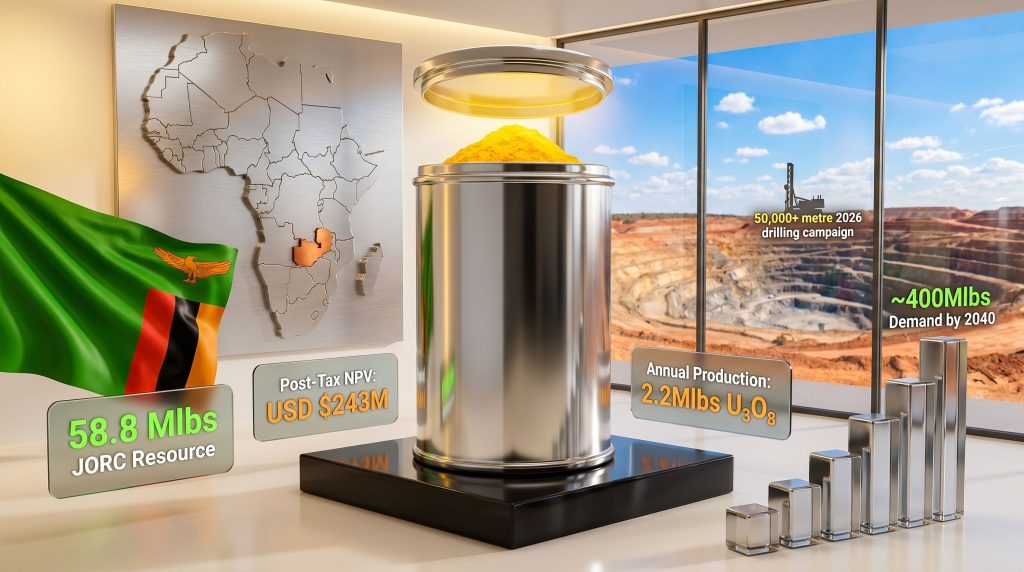
| Total JORC Resource | 58.8 | ~309 |
| Measured and Indicated | 40.0 | ~359 |
| Inferred | ~18.8 | Variable |
In a demonstration of what focused capital allocation can achieve, the Atomic Eagle team directed AUD $700,000 in drilling toward two underexplored targets in late 2025. The result was a 24% increase in the total resource base, lifting it from 47 million pounds to 58.8 million pounds. Two new resource areas were added:
- Chisebuka: 9.7 million pounds within an 800m x 600m footprint, with last meaningful drilling having occurred 12 to 15 years prior
- Mutanga East: 1.7 million pounds, with all mineralisation occurring within 50 metres of surface, suggesting very low strip ratios and low-cost mining conditions
The grade profile at Mutanga deserves particular attention. At approximately 359 ppm for the Measured and Indicated component, the project's grade is materially higher than comparable heap leach uranium operations, which typically operate at grades of 200 to 300 ppm. Higher grades reduce acid consumption, improve recovery economics, and reduce the volume of material that must be processed to generate each pound of uranium product.
Feasibility Study Economics: Understanding the Baseline and the Upside
The existing feasibility study, originally completed by GoviEx in March 2025 and subsequently re-released with independent engineering sign-off to meet ASX disclosure standards, establishes a technically credible economic baseline for the project.
Key Feasibility Study Parameters
| Parameter | Value |
|---|---|
| Mine Life | 12 years |
| Annual Production | 2.2 million lbs U₃O₈ |
| Capital Cost | USD $282 million |
| Post-Tax NPV | USD $243 million |
| Payback Period | ~3.5 years |
| Uranium Price Assumption | USD $90/lb |
| Mutanga Strip Ratio | 1.2:1 |
| Dibwe East Strip Ratio | Low 3s |
| Processing Method | Shallow open-pit, acid heap leach |
This study was completed to NI 43-101 or definitive feasibility study standard and was based exclusively on the Measured and Indicated resources from just two central deposits: Mutanga and Dibwe East.
What the Study Deliberately Excludes
Understanding what was excluded from the feasibility study is as important as understanding what it contains:
- Approximately 6 million pounds of inferred resources within the two central deposits were treated as waste rather than feed material in the current study
- Three satellite deposits, Dibwe, Njame, and Gwabi, were confirmed as cash-flow positive in prior analysis but excluded from the base case to maintain operational simplicity
- The 11.4 million pounds added at Chisebuka and Mutanga East under current management have not yet been incorporated into any mine plan
On a hypothetical basis, incorporating all currently defined resources into a mine plan would be sufficient to support a 12-year mine life at 3.9 million pounds per annum, without discovering a single additional pound of uranium.
Processing Characteristics: Where Mutanga Genuinely Stands Apart
Uranium heap leach operations vary significantly in their processing complexity and operating cost profiles. Mutanga sits at the favourable end of the spectrum on every key metric.
Technical Processing Advantages
- Recovery rate: Greater than 90% uranium extraction achieved in test work
- Grind size: Coarse crush to 25mm, which is relatively coarse by industry standards and significantly reduces grinding energy costs
- Acid consumption: Averaging just 20 kilograms per tonne, which is well below industry norms for acid heap leach uranium operations
- Tailings dam: Not required under the heap leach model, eliminating both capital expenditure and long-term environmental liability
- Flow sheet complexity: Simple acid heap leach design minimises operational risk and supports faster ramp-up timelines
The combination of high recovery at a coarse grind size with low acid consumption is technically unusual. In most uranium deposits, achieving above 90% recovery requires finer grinding and higher acid input. Mutanga's mineralogy appears to allow for efficient leaching without those cost penalties, a characteristic that is directly reflected in the project's low operating cost projections.
Infrastructure Advantages
- Sealed roads are accessible within kilometres of all deposits
- An 8-kilometre access road is already included within the capital cost estimate
- The export route runs through Walvis Bay, Namibia, an established uranium export corridor already utilised by Namibian producers
- Logistics costs are estimated at approximately USD $1.40 to $1.50 per pound, which is not cost-prohibitive for Zambian production
The next major ASX story will hit our subscribers first
The Scale Equation: How Heap Leach Economics Transform With Throughput
The single most important insight for understanding Mutanga's economic potential is how heap leach capital costs behave at scale. Unlike conventional milling circuits, heap leach infrastructure does not scale linearly with throughput.
The Bannerman Etango Comparison
| Parameter | Mutanga (Current FS) | Bannerman Etango (Stage 1) |
|---|---|---|
| Plant Throughput | 3.5 Mtpa | 8.0 Mtpa |
| Capital Cost | USD $282 million | ~USD $350 million |
| Processing Type | Acid heap leach | Acid heap leach |
| Acid Consumption | ~20 kg/t | Low |
| Recovery Rate | >90% | High |
The strategic implication is significant. Doubling plant throughput from 3.5 to 8 million tonnes per annum requires only a 20 to 25% increase in capital cost under heap leach economics. Doubling throughput approximately doubles cash flows, but the capital requirement increases only marginally. This non-linear improvement in project returns is the mechanism by which Mutanga's economics become compelling without requiring any increase in the uranium price.
The target production threshold of 4 to 5 million pounds per annum has been identified internally as the scale at which the project becomes financeable at current uranium prices. Achieving that scale requires expanding the resource base, which is precisely what the 2026 drilling program is designed to accomplish.
The 2026 Exploration Program: The Largest in Nearly Two Decades
The 2026 drill program represents the most significant exploration investment at the Mutanga project in approximately 20 years. The program is structured across three primary target areas with distinct geological rationale for each.
Program Overview
| Metric | Detail |
|---|---|
| Initial announced drilling | 30,000 metres |
| Projected total 2026 drilling | ~50,000+ metres |
| Drilling type | Shallow gamma-probe radiometric |
| RC and diamond drilling | Included |
| Estimated year-end cash balance | >AUD $8 million |
| Capital raise requirement | None anticipated |
Mutanga North
Eight discrete geochemical and geophysical targets have been defined in the northeastern portion of the tenement package. Several of these targets extend up to 4 to 5 kilometres in strike length. To contextualise that scale, the Chisebuka deposit, which returned a 9.7 million pound resource, sits on a footprint of just 800 metres by 600 metres. The potential scale contrast at Mutanga North is material.
Ground-based scintillometer surveys are being conducted prior to rig deployment to refine drill hole positioning. This approach, using handheld instruments to capture ground radiometric data, reduces the risk of wasted drilling and accelerates the discovery of mineralised zones.
Namakande
Located on the Kariba Valley licence in the southwest, Namakande displays the same geophysical and geochemical signature as Chisebuka. Ground radiometric survey crews are active on site, with drill positioning to be finalised on completion of those surveys.
Chisebuka Infill
Approximately 150 infill holes are planned to depths of 100 metres, with the objective of upgrading the existing inferred resource classification to Measured and Indicated. This upgrade in resource confidence is a prerequisite for incorporating Chisebuka into an updated feasibility study.
A Note on Uranium Exploration Economics
One aspect of uranium exploration that is not widely appreciated outside the sector is the cost efficiency of radiometric drilling methods. Using gamma probes to estimate uranium grade in real time is considerably cheaper than the assay-dependent drill programs required for gold or base metal exploration. This allows a high-metre program to be executed within modest cash reserves, which is why a 50,000+ metre program remains fundable within existing cash balances without a capital raise.
Development Timeline: Resource to Revenue
The company's stated development pathway is staged and internally consistent with the resource growth strategy.
2026: Resource Growth Phase
- 50,000+ metre drill program across Mutanga North, Namakande, and Chisebuka
- Environmental and Social Impact Assessment approval anticipated by mid-2026
- Resettlement Action Plan finalisation covering approximately 180 households and 900 individuals
2027: Feasibility Optimisation Phase
- Infill drilling to upgrade resource classification
- Metallurgical test work on newly defined resource areas
- Mine plan update incorporating the expanded resource base
- Updated feasibility study targeting completion in late 2027
Early 2028: Project Financing Phase
- Engagement with strategic investors, utilities, and offtake counterparties
- Uranium supply conditions expected to be materially tighter at this point
2030 to 2031: Target First Production
- Aligned with the projected onset of the structural uranium supply shortfall
- Global uranium demand forecast to reach approximately 400 million pounds per annum by 2040
Peer Valuation Analysis: The EV-per-Pound Discount
One of the more striking features of the current market positioning is the valuation discount relative to comparable ASX-listed uranium developers. In addition, current uranium investment trends suggest that this pricing gap is unlikely to persist as the project matures through its development milestones.
| Company | EV per Resource Pound (USD) | Resource Base | Processing Type |
|---|---|---|---|
| Atomic Eagle (Mutanga) | ~$3/lb | 58.8 Mlbs | Acid heap leach |
| Bannerman Resources | ~$5/lb | Larger | Acid heap leach |
| Deep Yellow | ~$6 to $7/lb | Larger | Conventional |
The grade profile at Mutanga compares favourably with Bannerman's Etango project on a like-for-like basis. The valuation discount appears to reflect the company's short ASX listing history of four to five months rather than any fundamental project deficiency.
The most instructive peer transaction is the strategic deal between Bannerman Resources and CNNC, which implied a 100% project valuation of approximately AUD $1 billion. At Atomic Eagle's enterprise value of approximately AUD $130 to $140 million, a comparable strategic transaction would imply a roughly 6x uplift from current levels. Furthermore, the divergence between spot versus term pricing in the uranium market is likely to favour projects with near-term production potential, such as Mutanga, as utilities increasingly prioritise long-term supply security.
Investors should note that this comparison involves significant execution risk and is speculative in nature. Transaction valuations reflect specific counterparty dynamics, timing, and market conditions that may not be replicable. Past transactions in the uranium sector do not guarantee similar outcomes for comparable projects.
The Niger Optionality: Madawela as a Free Call Option
The Madawela uranium project in Niger occupies a unique position in the Atomic Eagle investment case. At 116 million pounds at 1,319 ppm, it is approximately four times the grade of Mutanga and represents one of the higher-quality undeveloped uranium assets globally. Over USD $160 million has been invested in its acquisition, exploration, and development, with more than 600,000 metres of historical drilling completed.
The project was expropriated by the Niger government in 2024, prompting the filing of international arbitration proceedings. In 2025, both parties reached an agreement to pause arbitration and explore a negotiated resolution. Active dialogue continues as of the presentation date, with the company's stated preference being recovery of the project through a mutually acceptable transaction.
For investors, the appropriate framing is clear:
- Atomic Eagle's investment thesis is built entirely on the Zambian asset
- Madawela represents pure option value that is currently unpriced by the market
- No probability-weighted value should be assigned to Madawela without a confirmed resolution
- If recovered, the asset would represent a transformative addition to the portfolio given its scale and grade
This section contains speculative and forward-looking elements. The outcome of negotiations with sovereign governments is inherently uncertain, and investors should not rely on recovery of the Madawela asset in any investment decision.
Frequently Asked Questions
What Is the Mutanga Uranium Project's Current Resource Size?
The project holds a total JORC resource of 58.8 million pounds at an average grade of approximately 309 ppm, with 40 million pounds classified as Measured and Indicated at approximately 359 ppm. For broader context on how this compares across the sector, global uranium reserves data illustrates just how significant a deposit of this scale and grade can be.
What Processing Method Does Mutanga Use?
The project is designed around a shallow open-pit, acid heap leach operation achieving greater than 90% uranium recovery at a coarse crush size of 25mm and average acid consumption of just 20 kilograms per tonne.
When Could Mutanga Reach Production?
The development roadmap targets first production between 2030 and 2031, following a resource growth phase in 2026, feasibility optimisation in 2027, and project financing commencing in early 2028.
Why Is Zambia Considered a Favourable Uranium Jurisdiction?
Zambia ranks third in Africa for investment attractiveness and political stability according to the Fraser Institute, has no government free-carry interest for uranium projects, applies a 5% royalty and 30% corporate tax rate, and has a long-established mining sector as the world's seventh-largest copper producer.
Does Atomic Eagle Need to Raise Capital to Fund the 2026 Program?
No. The company entered 2026 with approximately AUD $19 million in cash and projects a year-end balance exceeding AUD $8 million after completing the full 2026 drill program, including RC and diamond drilling components. Investors interested in following the company's progress can visit the investor dashboard for the latest updates directly from the company.
This article is intended for informational purposes only and does not constitute financial advice. All forward-looking statements, production forecasts, resource estimates, and valuation comparisons involve inherent uncertainty and should not be relied upon as predictions of future performance. Readers should conduct their own due diligence and consult a licensed financial adviser before making any investment decisions.
Want to Know the Moment the Next Major Uranium Discovery Hits the ASX?
Discovery Alert's proprietary Discovery IQ model delivers real-time alerts on significant ASX mineral discoveries — including uranium — instantly translating complex resource data into actionable investment insights for both short-term traders and long-term investors. Explore how historic mineral discoveries have generated substantial returns on Discovery Alert's dedicated discoveries page, and begin your 14-day free trial today to position yourself ahead of the broader market.