May 20, 2026
The Uranium Supply Clock Has Been Running on Empty
For most of the past decade, the global uranium supply chain operated under a quiet but dangerous assumption: that imported fuel, much of it sourced from geopolitically sensitive regions, would remain available, affordable, and uninterrupted. That assumption has grown increasingly fragile. New mine development in the United States essentially stalled after uranium spot prices collapsed in the wake of the 2011 Fukushima disaster, spending much of the period between 2013 and 2020 trapped in a range of roughly $20 to $40 per pound, according to market data tracked by industry pricing services including UxC and TradeTech. At those price levels, developing new domestic mines was economically inviable for most operators. The result was a structural supply vacuum that has taken years to begin filling.
The April 2026 production launch at the UEC Burke Hollow uranium mine in South Texas is the most concrete signal yet that the vacuum is starting to close. It is not simply a corporate milestone. It is the first genuinely new uranium mine to enter production in the United States in over a decade, and it arrives at a moment when spot prices have recovered into the $80 to $100 per pound range, utilities are scrambling to lock in long-term fuel contracts, and the global nuclear energy pipeline is expanding at a pace not seen in a generation.
This article is intended for informational and educational purposes only. It does not constitute financial advice. All forecasts, projections, and market analyses represent forward-looking statements subject to material uncertainty.
When big ASX news breaks, our subscribers know first
Burke Hollow Project: Location, Scale, and Why the Geology Matters
Bee County, South Texas: A Uranium Belt With Unique Characteristics
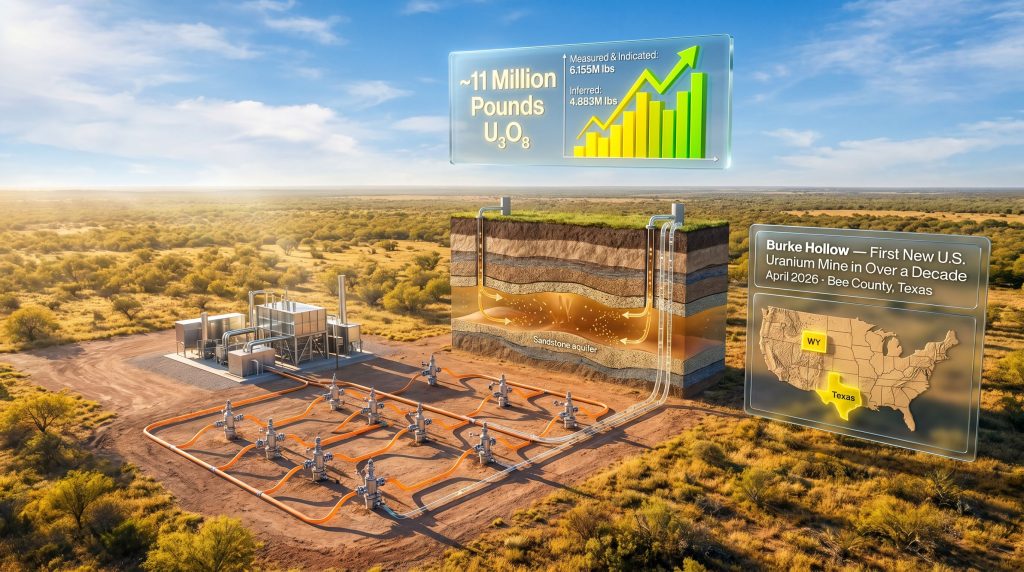
Burke Hollow sits in Bee County, South Texas, within a geological province that has hosted commercial uranium extraction for decades. The region's uranium deposits are classified as roll-front or tabular sandstone-hosted deposits, formed when uranium-bearing groundwater migrated through permeable sandstone formations and precipitated uranium minerals at geochemical redox boundaries. This sandstone-hosted geology is precisely why in-situ recovery mining is so effective here: the porous rock allows leaching solutions to circulate freely without requiring physical excavation.
The project was originally discovered in 2012 and took approximately fourteen years to move from initial discovery to first production, a timeline that reflects the combined weight of regulatory processes, prolonged low uranium prices, and cautious capital deployment across the sector. Final production approval was granted by the Texas Commission on Environmental Quality (TCEQ) before operations commenced in April 2026.
The project footprint covers roughly 20,000 acres, of which only approximately half has been systematically explored to date. That leaves an estimated 10,000 acres of largely uninvestigated ground, suggesting the current resource estimate represents a conservative floor rather than a definitive ceiling on the project's total potential.
Burke Hollow Resource Estimates at a Glance
| Resource Category | Estimated Volume (U₃O₈) |
|---|---|
| Measured and Indicated | 6.155 million pounds |
| Inferred | 4.883 million pounds |
| Total Resource Potential | ~11 million pounds |
Burke Hollow is recognised within the industry as the largest ISR uranium discovery made in the United States over the past ten years, according to World Nuclear News and UEC corporate disclosures. The significance of this designation extends beyond the tonnage figure: it establishes that meaningful new ISR deposits can still be found and developed within the existing South Texas uranium belt, providing a template for future exploration programmes in the region.
Processing Infrastructure: Hobson Central Processing Plant
Uranium extracted at Burke Hollow does not require a dedicated on-site processing facility. Instead, uranium-bearing solutions are transported to UEC's Hobson Central Processing Plant, which holds a licensed production capacity of up to 4 million pounds of uranium per year. This centralised model is a key cost-efficiency driver: by routing multiple wellfields through a single processing hub, the per-unit processing cost declines as throughput increases, creating meaningful operating leverage as additional wellfields are brought online.
How In-Situ Recovery Mining Works: A Technical Breakdown
ISR vs. Conventional Uranium Mining: Key Differences
| Feature | ISR Mining | Open-Pit / Underground Mining |
|---|---|---|
| Surface Disturbance | Minimal | Significant |
| Excavation Required | No | Yes |
| Environmental Footprint | Generally Lower | Higher |
| Water Management Complexity | High (groundwater focus) | Moderate to High |
| Capital Intensity | Generally Lower | Generally Higher |
| Scalability via Wellfields | High | Limited |
Step-by-Step: The ISR Extraction Process
-
Wellfield installation – Injection wells and recovery wells are drilled into the uranium-bearing aquifer zone. The spacing and configuration of these wells determines the efficiency of solution circulation.
-
Leaching solution preparation – A solution, typically oxygenated groundwater or a mildly alkaline or acidic mixture depending on local geology, is formulated to mobilise uranium from surrounding sandstone without destabilising the aquifer structure.
-
Underground circulation – The leaching solution is pumped through injection wells into the ore zone, where it dissolves uranium minerals from the host sandstone.
-
Uranium-loaded solution recovery – The uranium-rich solution is pumped back to the surface through recovery wells and transported to the central processing facility.
-
Ion exchange and precipitation – At the processing plant, uranium is separated from the solution through ion exchange resins, then precipitated as uranium oxide concentrate (U₃O₈), commonly known as yellowcake.
-
Groundwater restoration – After a wellfield is exhausted, the operator is required to restore groundwater chemistry to pre-mining baseline conditions, the most technically demanding and regulatorily scrutinised phase of any ISR operation.
Technical Insight: One of the lesser-known challenges in ISR mining is managing the geochemical footprint of the leaching solution underground. Even with oxygenated water as the leachant, the mobilisation process can temporarily alter the redox chemistry of the surrounding aquifer. Post-mining restoration must address not only uranium concentrations but also secondary parameters including radium, gross alpha activity, and total dissolved solids, all of which are monitored under TCEQ licensing conditions.
Why ISR Supports ESG Goals Without Eliminating Environmental Responsibility
ISR mining's reduced surface disturbance makes it attractive from a community relations and land-use perspective, particularly in agricultural regions like South Texas where above-ground land use matters to local stakeholders. However, reduced surface impact does not mean the environmental management burden is low. Groundwater protection is the primary regulatory and operational focus, and UEC's compliance with TCEQ's rigorous permitting standards is central to maintaining both its operating licence and its social licence to operate.
UEC's Dual-Hub Production Model: Architecture and Scalability
Two Active ISR Platforms Across Two U.S. States
With Burke Hollow now in production, Uranium Energy Corporation operates two simultaneous ISR production platforms within the United States. Furthermore, the U.S. uranium production rebound that has gathered pace in recent years provides vital context for why this dual-hub approach carries such strategic weight.
-
Burke Hollow (South Texas) – The world's newest operating ISR uranium mine as of April 2026, processing output directed to the Hobson Central Processing Plant.
-
Christensen Ranch (Wyoming) – An established ISR operation that recently received regulatory approvals for expanded wellfield development, adding incremental production capacity to the Wyoming hub.
Combined, UEC's licensed production capacity across both U.S. platforms reaches approximately 12 million pounds per year, though actual output will depend on the pace of wellfield development and prevailing market conditions.
The Hub-and-Spoke Architecture Explained
How It Works: Multiple satellite wellfields, each representing a discrete zone of uranium mineralisation, feed uranium-bearing solutions to a centralised processing facility. New wellfields can be brought online incrementally, adding production volume without requiring the construction of new processing infrastructure. This architecture creates a compounding capital efficiency advantage: the fixed-cost base of the processing plant is spread across increasing throughput as each new wellfield activates.
This scalability mechanism is particularly relevant at Burke Hollow, where approximately half the site's 20,000 acres remains unexplored. Each additional wellfield activated within that unexplored acreage translates directly to incremental production without proportional capital expenditure growth.
Production Pipeline: What Comes Next
| Platform | Status | Expected Timeline |
|---|---|---|
| Burke Hollow (Texas) | Active production | Commenced April 2026 |
| Christensen Ranch (Wyoming) | Active, expanding | Wellfield expansion approved |
| Ludeman ISR Project | Development stage | Targeted startup 2027 |
The Ludeman ISR project, targeted for a 2027 startup, would establish a third active production platform within UEC's U.S. portfolio, further diversifying jurisdictional exposure and expanding the company's aggregate production capacity.
UEC's Unhedged Uranium Sales Strategy: Risk, Reward, and Market Timing
What Unhedged Means in Practice
UEC sells uranium at prevailing spot market prices rather than committing production volumes to fixed-price long-term contracts in advance. This is a deliberate strategic choice that maximises revenue exposure to upward price movements while accepting greater revenue volatility during price downturns. In commodity markets, this approach is sometimes described as running a natural long position on the underlying commodity.
The financial results from early 2026 illustrate how powerful this strategy can be in a rising price environment. UEC completed a sale of 200,000 pounds of uranium at $101 per pound, a price approximately 25% above prevailing average market rates at the time. The transaction generated over $20 million in revenue and approximately $10 million in gross profit, according to UEC corporate disclosures.
When Does the Unhedged Model Outperform?
Investor Framework: An unhedged strategy functions as leveraged price exposure. Producers who hedge lock in margin certainty but sacrifice upside. Those who remain unhedged take on more volatility but capture the full benefit of price rallies. In a market where structural supply deficits are expected to persist for years, the asymmetric risk-reward of staying unhedged tilts in favour of the producer.
The conditions most favourable to UEC's unhedged approach include:
-
Spot uranium prices sustainably above approximately $80 to $90 per pound to generate strong per-unit margins.
-
Accelerating utility contracting activity as nuclear plant operators seek long-term fuel security, which supports price floors.
-
Constrained supply from major producing regions including Kazakhstan, Russia, and Canada.
-
A growing global reactor fleet requiring sustained multi-decade fuel procurement.
Global Uranium Demand: The Macro Forces Reshaping the Market
Nuclear Energy's Role in the Energy Transition
Nuclear energy currently supplies approximately 20% of U.S. electricity generation with zero direct carbon emissions during operation, according to the U.S. Energy Information Administration. As decarbonisation commitments intensify across government and corporate sectors, nuclear power's combination of firm baseload capacity and zero-emission operation is repositioning it as a critical complement to intermittent renewable energy sources. Consequently, understanding broader uranium market dynamics has become essential for investors and policymakers alike.
The International Atomic Energy Agency projects that global nuclear capacity could double by 2050 under high-growth scenarios, a trajectory that would require a sustained and substantial increase in uranium mine supply globally. Measured against current mine production levels, that scenario implies a supply gap of potentially significant magnitude over the coming decades.
Key Demand Accelerators for Uranium Through 2050
| Demand Driver | Impact on Uranium Markets |
|---|---|
| Small Modular Reactor (SMR) development | New reactor fleet requiring long-term fuel supply contracts |
| Existing plant lifetime extensions | Sustained demand from legacy assets operating beyond original design life |
| AI data centre electricity requirements | Accelerating baseload power demand driving nuclear capacity additions |
| Net-zero decarbonisation commitments | Nuclear repositioned as essential low-carbon baseload generation |
| Reactor fleet expansion in Asia | China, India, and South Korea driving incremental uranium demand |
The Under-Contracting Problem: A Structural Supply-Demand Mismatch
One of the less widely understood dynamics shaping the current uranium market is the legacy of utility under-contracting during the prolonged low-price era from roughly 2013 to 2020. During that period, many nuclear plant operators drew down existing fuel inventories and deferred new long-term contract negotiations, reasoning that abundant and inexpensive spot supply would remain available. Furthermore, the resulting uranium supply-demand volatility created a structural procurement gap that is now compelling utilities to re-enter the contracting market simultaneously, competing for limited available supply. This phenomenon is a primary driver of the price recovery into the $80 to $100 per pound range observed in the mid-2020s.
The next major ASX story will hit our subscribers first
U.S. Domestic Uranium and the Energy Security Imperative
The 95% Import Dependency Problem
Critical Statistic: The United States currently imports approximately 95% of its uranium requirements, with a significant share of global enrichment and conversion capacity concentrated in Russia and Kazakhstan.
This concentration creates a form of critical mineral vulnerability that parallels the rare earth supply chain concerns that emerged over the past decade. A supply disruption scenario, whether driven by geopolitical conflict, export restrictions, or sanctions regimes, could directly threaten the fuel security of the U.S. nuclear fleet. The Russian uranium import ban has, in addition, sharpened attention on how exposed the domestic nuclear sector remains to geopolitical disruptions. Given that nuclear power provides roughly one-fifth of U.S. electricity generation, the downstream consequences of a sustained fuel supply disruption would extend well beyond the energy sector.
Federal Investment in Domestic Uranium Capacity
The U.S. Department of Energy has committed $2.7 billion toward rebuilding domestic uranium enrichment infrastructure as part of broader energy security initiatives, reflecting the federal government's recognition that the current import dependency represents an unacceptable strategic vulnerability. These funding commitments create a supportive policy environment for domestic uranium producers, though they do not constitute direct project-specific funding for individual mining operations.
According to the EIA's Domestic Uranium Production Report, U.S. uranium concentrate production fell to less than one million pounds per year in most years after 2017, with some years recording output measured in tens of thousands of pounds rather than millions. That production collapse makes the significance of the UEC Burke Hollow uranium mine launch even more pronounced: it represents a genuine restart of domestic mine-level supply rather than simply an incremental expansion of existing operations.
UEC's Vertical Integration Ambition
Burke Hollow's production launch supports UEC's longer-term strategic objective of building a vertically integrated platform spanning uranium mining, processing, and eventually uranium conversion, the step that transforms U₃O₈ concentrate into uranium hexafluoride (UF₆) for enrichment. A vertically integrated domestic platform would reduce the company's, and by extension the U.S. nuclear fuel chain's, dependence on foreign conversion services, a segment of the supply chain currently dominated by non-U.S. operators.
What Burke Hollow Signals for the Broader U.S. Uranium Sector
A Replicable Development Template, Not Just a One-Off Event
Perhaps the most strategically significant aspect of the UEC Burke Hollow uranium mine launch is not the production volume it adds in the near term, but the regulatory and operational template it establishes. Burke Hollow has demonstrated that a greenfield ISR uranium project in South Texas can navigate the complete regulatory pathway from discovery through TCEQ permitting to first production. That validated pathway reduces uncertainty for other operators considering ISR development in the same geological province. However, the broader implications extend to how the spot-term price divergence currently playing out in uranium markets may further incentivise new project development.
Near, Medium, and Long-Term Implications
| Timeframe | Key Implication |
|---|---|
| Near-Term (2026-2027) | Incremental domestic supply; investor confidence signal; utility contracting catalyst |
| Medium-Term (2027-2030) | Multi-hub production scaling; Ludeman ISR startup; growing portfolio value |
| Long-Term (2030-2050) | Structural contribution to U.S. energy security; alignment with IAEA capacity doubling scenario |
What Market Participants Are Monitoring
Investors and industry analysts tracking this space are focused on several specific variables:
-
The pace at which UEC activates additional wellfields across Burke Hollow's remaining unexplored acreage, which will determine how quickly the project's resource base translates into incremental production.
-
Uranium spot price trajectory and its interaction with UEC's unhedged revenue model. A sustained price above $90 per pound substantially improves per-unit economics across all wellfields.
-
Progress toward the Ludeman ISR startup in 2027, which would mark the third operating ISR platform in UEC's U.S. portfolio and provide further evidence that the company's development pipeline is accelerating.
-
Utility contracting cycles: as more nuclear plants extend their operating licences and new reactors enter construction pipelines globally, the contracting market will tighten further, potentially pulling forward long-term price support.
Frequently Asked Questions: UEC Burke Hollow Uranium Mine
What makes Burke Hollow historically significant?
Burke Hollow is the first new uranium mine to commence production in the United States in over a decade, and is recognised as the newest operating ISR uranium mine globally as of April 2026. It is also identified as the largest ISR uranium discovery in the United States over the past ten years.
Where is the Burke Hollow mine located?
The project is situated in Bee County, South Texas, within a sandstone-hosted uranium geological province well-suited to ISR extraction methods. The site covers approximately 20,000 acres and was originally discovered in 2012.
How much uranium can Burke Hollow produce?
Extracted uranium is processed at UEC's Hobson Central Processing Plant, which holds a licensed production capacity of up to 4 million pounds of uranium per year. The project's current resource base totals approximately 11 million pounds of U₃O₈ across measured, indicated, and inferred categories, with significant unexplored acreage suggesting additional resource upside.
What is ISR uranium mining and why is it used at Burke Hollow?
In-situ recovery mining circulates a leaching solution through underground uranium-bearing sandstone formations without requiring surface excavation. It is particularly well-suited to South Texas's porous sandstone geology and produces lower surface disturbance than conventional open-pit or underground mining methods.
What comes next for UEC's production pipeline?
UEC is targeting startup of its Ludeman ISR project in 2027, which would add a third active production platform to its U.S. portfolio alongside Burke Hollow and Christensen Ranch, further expanding the company's aggregate licensed production capacity. For broader context on what this means for the sector, Carbon Credits offers useful analysis on how the first new U.S. uranium mine in a decade is reshaping market expectations.
Readers seeking ongoing coverage of uranium price movements, nuclear sector developments, and energy security analysis can explore related content at CarbonCredits.com, which publishes regular updates on uranium markets and the global clean energy transition.
Want To Be First When The Next Major Mineral Discovery Hits The ASX?
Discovery Alert's proprietary Discovery IQ model scans ASX announcements in real time, instantly identifying high-potential mineral discoveries across uranium and more than 30 other commodities — the same type of market-moving events that have historically generated exceptional returns, as showcased on Discovery Alert's dedicated discoveries page. Start your 14-day free trial today and position yourself ahead of the broader market.