August 12, 2026
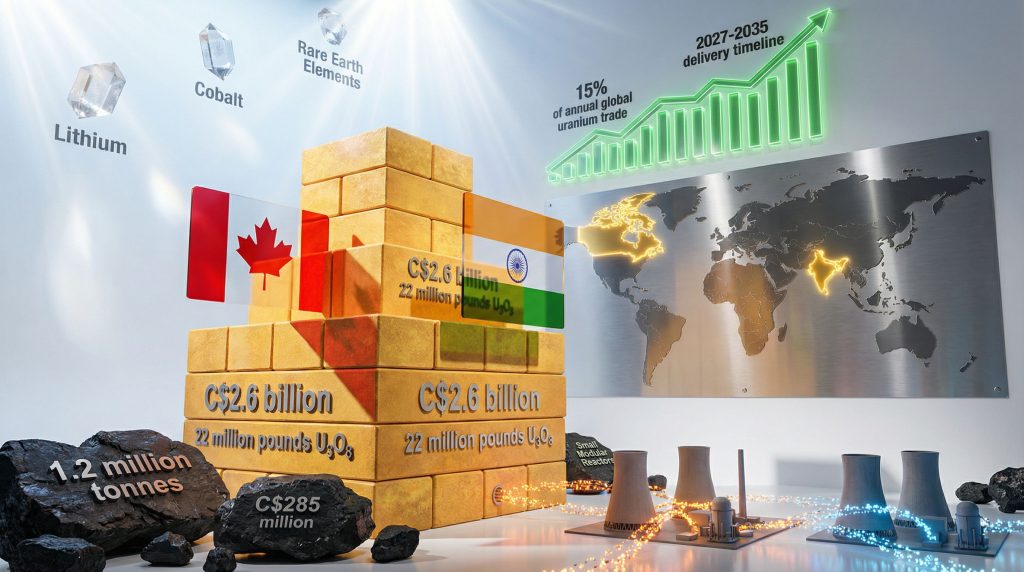
The Canada-India strategic partnership represents a pivotal moment in global energy security, highlighted by their groundbreaking C$2.6 billion uranium supply agreement. This comprehensive arrangement demonstrates how nations are shifting from traditional commodity markets toward bilateral partnerships that prioritise long-term energy independence over short-term cost optimisation. Furthermore, this evolution reflects broader recognition that uranium market volatility necessitates sophisticated procurement strategies in an era of accelerating energy transition.
Strategic Realignment in Global Nuclear Supply Networks
The emergence of sovereign-level uranium procurement represents a fundamental departure from historical market dynamics. Traditional uranium markets operated through relatively simple spot transactions and short-term contracts, with utilities purchasing fuel as needed from a liquid global marketplace. However, today's reality involves complex geopolitical calculations where supply chain resilience takes precedence over immediate cost considerations.
Nuclear energy's projected role in decarbonisation has intensified strategic competition for uranium resources. The International Atomic Energy Agency forecasts nuclear generation capacity expanding from 392 GW in 2021 to 722 GW by 2050, representing an 84% increase driven primarily by net-zero commitments. Consequently, this growth trajectory requires uranium consumption to increase from current levels of approximately 52,000 tonnes annually to potentially 95,000 tonnes by mid-century.
Current Global Nuclear Expansion Indicators:
- 193 countries have committed to net-zero carbon targets as of 2024, with nuclear designated as critical infrastructure
- Nuclear electricity must triple by 2050 to meet 1.5°C climate pathways according to IEA analysis
- Long-term contract premiums over spot prices have widened to 15-25%, reflecting strategic value perception
- Spot market transactions average 0.5-2 million pounds, insufficient for large-scale strategic procurement
For instance, developing effective uranium investment strategies requires understanding these structural market transformations. The uranium supply agreement between Canada and India emerges within this context of fundamental change, representing one of several bilateral partnerships reshaping global nuclear fuel procurement strategies.
When big ASX news breaks, our subscribers know first
Deconstructing the C$2.6 Billion Strategic Framework
The magnitude of Canada's uranium supply commitment to India extends beyond simple commercial metrics to encompass strategic resource diplomacy. This C$2.6 billion agreement delivers 22 million pounds of uranium concentrate between 2027 and 2035, positioning both nations within a new paradigm of energy security cooperation.
| Agreement Component | Specification | Strategic Significance |
|---|---|---|
| Total Contract Value | C$2.6 billion (US$1.9 billion) | Largest bilateral uranium agreement in Indian history |
| Volume Commitment | 22 million pounds U3O8 | Equivalent to 8.25 years of fuel for 1,000 MW reactor |
| Delivery Timeline | 2027-2035 (9 years) | Aligns with India's Phase II nuclear expansion schedule |
| Implicit Pricing | US$86.4 per pound | Within long-term contract range (US$80-100/lb) |
| Market Share | ~13% of commercial long-term contracts | Represents significant volume concentration |
This pricing structure reflects market-related terms rather than fixed pricing, providing flexibility for both parties whilst ensuring supply certainty. The implicit price of US$86.4 per pound positions the agreement within current long-term contract ranges, contrasting with spot market volatility that has seen uranium prices fluctuate from $29 per pound in January 2021 to $89 per pound by December 2024.
Technical Supply Chain Considerations:
- Conversion costs (U3O8 to UF6): US$10-15 per kilogram of uranium, typically handled by specialised facilities
- Enrichment requirements: Low-enriched uranium requires 30-50 US dollars per Separative Work Unit
- Transportation logistics: 2.4 million pounds annually require secure container shipment coordination
- Quality specifications: Uranium concentrate must meet IAEA standards for isotope concentration and impurity limits
Moreover, the agreement's structure addresses primary uranium supply whilst leaving enrichment and fabrication services to be secured through separate arrangements, reflecting the fragmented nature of nuclear fuel supply chains.
Risk Mitigation Through Supply Chain Diversification
Strategic uranium partnerships have evolved as responses to concentrated supply chain vulnerabilities that traditional market mechanisms cannot adequately address. Kazakhstan's position as the world's dominant uranium producer, controlling approximately 40-42% of global output through state-owned Kazatomprom, creates systemic dependency risks for nuclear-dependent economies.
Global Uranium Production Concentration:
- Kazakhstan: 22,000 tonnes annually (40-42% of global production)
- Canada: 7,500 tonnes annually (14% of global production)
- Australia: 6,200 tonnes annually (12% of global production)
- Namibia: 5,800 tonnes annually (11% of global production)
- Niger: 2,900 tonnes annually (5% of global production)
In addition, Russia's Rosatom compounds supply chain concentration through control of approximately 36-37% of global uranium enrichment capacity. This dual concentration in both primary production and enrichment services created strategic vulnerabilities exposed during geopolitical tensions. Understanding the broader implications of such disruptions, including the US uranium import ban impact, becomes crucial for strategic planning.
"Between 2011-2022, global uranium supply consistently fell 8-12% below annual reactor requirements, with shortfalls covered through strategic inventory releases and secondary supplies from decommissioned weapons programs."
The Canada-India uranium supply agreement directly addresses these concentration risks by establishing bilateral supply relationships outside traditional market dependencies. Furthermore, this approach reflects documented strategic procurement trends among nuclear-dependent nations seeking supplier diversification.
Sovereign Procurement Strategy Indicators:
- United States: Authorised Strategic Uranium Reserve replenishment in 2021 with ongoing purchases
- European Union: Implemented uranium procurement diversification mandates post-2022
- Japan: Renewed Australia-Japan nuclear cooperation agreements in 2023
- Czech Republic: Established direct government uranium procurement programmes
India's Nuclear Fuel Security Challenge
India's domestic uranium production capabilities create a structural supply deficit that necessitates international partnerships for nuclear programme expansion. Current domestic output of approximately 600-650 tonnes annually from mines in Jharkhand state falls significantly short of projected requirements.
India's Uranium Supply-Demand Analysis:
- Current domestic production: 600 tonnes U3O8 annually
- 2030 projected demand: 1,500-1,850 tonnes annually
- Import dependency: 67% of requirements by 2030
- Strategic supply gap: 1,200 tonnes requiring international sourcing
This supply deficit reflects geological constraints in currently operating Indian uranium mines rather than lack of exploration effort. The Uranium Corporation of India Limited has maintained relatively flat production levels despite continued development investments, indicating resource limitations in accessible deposits.
India's nuclear expansion targets compound supply security challenges. The Department of Atomic Energy projects nuclear capacity growth from current 6.8 GW to 10-12 GW by 2030, requiring fuel supply coordination for multiple reactor types including pressurised heavy water reactors and planned light water reactor installations.
Nuclear Reactor Fuel Cycle Requirements:
- Pressurised Heavy Water Reactors (PHWRs): Require natural uranium with specific isotope ratios
- Light Water Reactors (LWRs): Require enriched uranium (3-5% U-235 concentration)
- Small Modular Reactors (SMRs): Utilise higher enrichment levels (5-20% U-235) for extended fuel cycles
- Fast Breeder Reactors: Require specialised fuel cycle management with plutonium breeding capability
The uranium supply agreement between Canada and India addresses primary fuel requirements whilst requiring India to coordinate enrichment and fabrication services through additional supply chain partnerships.
Critical Minerals Integration Strategy
Beyond uranium procurement, the Canada-India partnership encompasses broader critical minerals cooperation addressing supply chain resilience across clean energy infrastructure. This integrated approach reflects recognition that energy transition requires coordinated access to multiple strategic materials. Consequently, understanding critical minerals energy security becomes essential for comprehensive strategic planning.
Critical Minerals Cooperation Framework:
- Lithium processing: Battery supply chain development for energy storage systems
- Rare earth elements: Permanent magnet materials for wind turbines and electric motors
- Cobalt and nickel: Battery cathode materials for energy storage applications
- Graphite and manganese: Anode materials and steel alloy components
The Saskatchewan Research Council's partnerships with Indian organisations focus on downstream processing capabilities, addressing value-added manufacturing rather than raw material extraction alone. Furthermore, this approach positions both countries to capture higher-value segments of critical minerals supply chains.
Technology Transfer Mechanisms:
- Small modular reactor design collaboration: Next-generation nuclear technology development
- Advanced nuclear fuel cycles: Thorium-based fuel systems and fast breeder reactor optimisation
- Mineral processing technologies: Hydrometallurgical and pyrometallurgical processing improvements
- Environmental remediation: Mining waste management and site restoration techniques
For instance, the development of a critical raw materials facility demonstrates similar strategic thinking in securing essential mineral supplies.
Metallurgical Coal Supply Chain Coordination
The inclusion of 1.2 million tonnes of metallurgical coal worth C$285 million demonstrates portfolio diversification within energy security partnerships. Elk Valley Resources' agreements with Indian steel producers address coking coal requirements for blast furnace operations.
India imports approximately 85% of metallurgical coal requirements, creating dependency on seaborne markets dominated by Australian producers. Canadian metallurgical coal from British Columbia deposits offers premium quality grades with low sulphur content and high coking strength parameters essential for steel production efficiency.
Metallurgical Coal Quality Specifications:
- Volatile matter content: 18-25% for optimal coking properties
- Sulphur content: <1% to minimise environmental impact
- Ash content: <10% for blast furnace efficiency
- Coking strength: >60 on Audibert-Arnu dilatometer testing
These quality parameters position Canadian metallurgical coal as a strategic complement to lower-grade Australian supplies, providing blending opportunities for Indian steel producers seeking optimal furnace performance.
The next major ASX story will hit our subscribers first
Geopolitical Implications for Global Energy Markets
The Canada-India strategic partnership signals broader realignment in global energy trade relationships, with implications extending beyond bilateral commercial arrangements. This realignment reflects systematic shifts away from traditional supplier relationships toward "trusted partner" sourcing preferences.
Strategic Partnership Model Characteristics:
- Political alignment considerations integrated into commercial decision-making
- Long-term supply security prioritised over short-term cost optimisation
- Technology transfer components embedded within resource supply agreements
- Regulatory harmonisation efforts to facilitate bilateral trade flows
Similar partnership models are emerging across multiple resource sectors as countries seek supply chain resilience through politically aligned relationships. The Australia-Japan nuclear cooperation agreement, expanded in 2023, demonstrates comparable strategic thinking in uranium procurement.
Competitive Response Dynamics:
- Kazakhstan positioning as swing supplier for countries seeking supplier diversification
- African uranium producers (Namibia, Niger) pursuing similar bilateral partnership models
- Australian critical minerals exports increasingly structured through strategic partnerships
- US-Canada integration accelerating across multiple resource sectors
Small Modular Reactor Development Collaboration
The partnership's emphasis on small modular reactor cooperation addresses India's distributed energy requirements whilst positioning both countries in emerging nuclear technology markets. SMR technology offers advantages for countries with grid constraints or industrial process heat requirements.
SMR Market Opportunity Assessment:
- Global SMR market projected at US$300 billion by 2040
- India's distributed energy needs align with SMR deployment characteristics
- Canada's regulatory framework provides SMR deployment pathway precedents
- Manufacturing scale advantages through bilateral cooperation arrangements
SMR fuel requirements differ significantly from large reactor specifications. Typical SMR designs utilise 12-24 month fuel cycles with enrichment levels of 5-20% U-235, requiring specialised fuel fabrication capabilities not addressed through conventional uranium supply agreements.
SMR Fuel Cycle Considerations:
- Higher enrichment requirements necessitate advanced enrichment services
- Longer fuel cycles reduce refuelling frequency but increase initial fuel loading
- Modular manufacturing enables standardised fuel assembly production
- Remote deployment scenarios require fuel supply chain reliability for isolated locations
Implementation Challenges and Success Factors
Several operational and regulatory factors will determine whether strategic partnerships achieve intended energy security outcomes. Nuclear fuel supply chains involve complex regulatory oversight across multiple jurisdictions with varying safety standards and export control requirements.
Regulatory Harmonisation Requirements:
- Nuclear safety standards alignment between Canadian and Indian regulatory authorities
- Export licensing coordination for dual-use nuclear technologies and materials
- Environmental assessment protocols for mining operations and transportation logistics
- Safeguards compliance with International Atomic Energy Agency monitoring requirements
The Canada Nuclear Safety Commission and India's Atomic Energy Regulatory Board must coordinate oversight protocols for uranium shipments and technology transfer activities. This coordination requires ongoing diplomatic engagement beyond commercial contract execution.
Infrastructure Development Requirements:
- Transportation logistics for uranium concentrate shipments across 9,000-kilometre distances
- Port facility capabilities for handling radioactive materials at both origins and destinations
- Storage infrastructure in India for managing 22 million pounds over delivery period
- Quality assurance systems ensuring material specifications throughout supply chain
Strategic Positioning in Global Energy Transition
The uranium supply agreement between Canada and India creates mutual strategic advantages extending beyond immediate commercial benefits. Both countries enhance their positions within evolving global energy markets through this partnership structure.
Canada's Strategic Position Enhancement:
- Export market diversification beyond traditional US uranium dependencies
- Leverage of 14% global production market share through strategic partnerships
- Integration with Indo-Pacific economic strategy supporting broader geopolitical objectives
- Critical minerals value chain development capturing higher-value processing segments
India's Energy Security Advancement:
- Supplier diversification reducing Russian nuclear fuel supply dependencies
- Foundation establishment for 100 GW nuclear capacity target by 2047
- Enhanced negotiating position with alternative suppliers through secured baseline supply
- Technology access for next-generation nuclear reactor development
Economic Impact and Trade Expansion Targets
The ambitious bilateral trade target of C$50 billion by 2030, expanding from current C$13 billion, positions resource sectors as central drivers of economic relationship development. Energy and mining sectors are expected to represent 40% of this trade growth trajectory.
Resource Sector Contribution Projections:
- Energy and mining trade growth: C$15-20 billion expansion by 2030
- Critical minerals annual trade potential: C$5 billion based on demand projections
- LNG export opportunities: C$8 billion over partnership duration
- Metallurgical coal stable supply: C$285 million annually based on current agreements
These projections assume successful implementation of infrastructure development, regulatory coordination, and technology transfer components embedded within the strategic partnership framework. For additional context on this landmark agreement, Cameco's official announcement provides detailed insights into the commercial arrangements.
The Canada-India uranium supply agreement represents a fundamental shift from market-based procurement toward strategic partnership models in critical energy sectors. This transformation reflects broader recognition that energy security requires sophisticated bilateral arrangements rather than reliance on volatile commodity markets alone. As reported by World Nuclear News, the agreement's success will depend on execution capabilities across regulatory coordination, infrastructure development, and technology transfer – factors that will determine whether strategic partnerships can effectively replace traditional market mechanisms in securing essential energy resources for the global energy transition.
Ready to Capitalise on Next-Generation Nuclear Investment Opportunities?
Discovery Alert's proprietary Discovery IQ model delivers real-time alerts on significant uranium and critical minerals discoveries across the ASX, instantly empowering subscribers to identify actionable opportunities ahead of the broader market. Begin your 14-day free trial today with Discovery Alert and secure your market-leading advantage in the evolving energy security landscape.