June 17, 2026
The Geopolitical Logic Behind Alliance-Based Mineral Sourcing
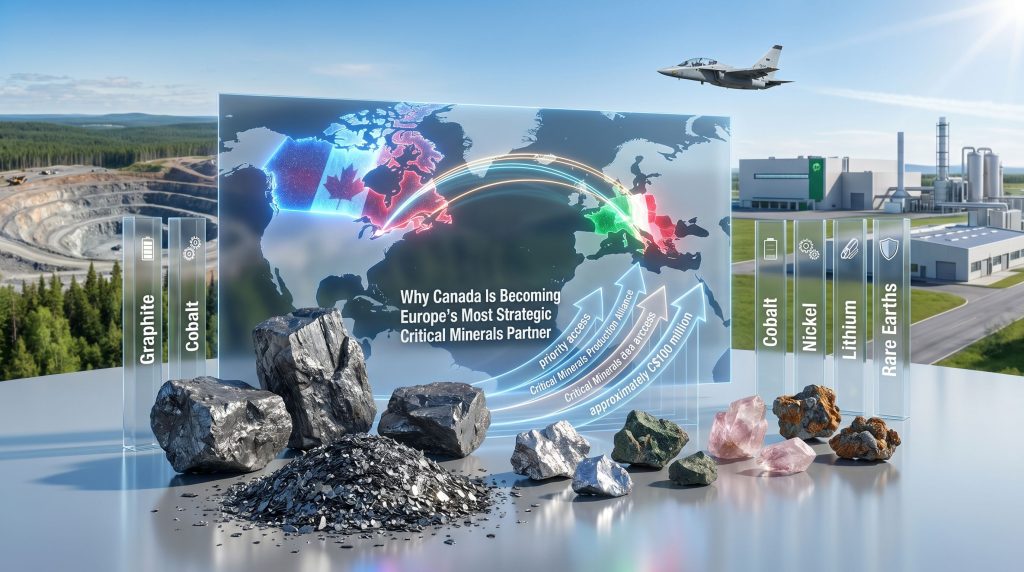
Canada offers Italy priority access to critical minerals at a moment when governments are rethinking how strategic resources should be sourced. For much of the past three decades, the minerals industry prioritised lowest-cost supply, regardless of origin. However, that model created highly concentrated supply chains and exposed import-dependent economies to serious geopolitical risk.
In particular, battery materials became clustered in a small number of jurisdictions. Consequently, allied governments are now moving minerals policy out of narrow trade discussions and into the realm of national security, industrial resilience, and long-term competitiveness.
It is within this context that Prime Minister Mark Carney’s offer to Italy carries genuine weight. Announced during bilateral talks at the G7 summit in Évian, France, the move is more than diplomatic theatre. Instead, it reflects Canada’s effort to position itself as a preferred supplier to friendly industrial economies.
According to a Canadian strategic partnerships overview, Ottawa has been deepening cooperation with trusted partners to strengthen secure supply chains. In addition, a Northern Miner report underlined how the Italy arrangement fits this broader push.
When big ASX news breaks, our subscribers know first
What the Canada–Italy Minerals Agreement Actually Entails
Priority Access Versus Standard Trade: A Critical Distinction
The language of priority access matters because it differs from a conventional trade agreement. Standard bilateral trade deals usually focus on tariffs, customs rules, and market entry. By contrast, priority access frameworks create supply security commitments between governments, especially during disruption, shortages, or market stress.
In practical terms, Italy’s industrial sector would gain a formalised claim on Canadian supply when other buyers might face constraints or price spikes. For manufacturers reliant on graphite, nickel, cobalt, lithium, and rare earths, that is increasingly a necessity rather than a diplomatic extra.
Italian Prime Minister Giorgia Meloni acknowledged the significance of the arrangement during the Évian meeting. Meanwhile, Canada signalled that Italy’s interest in stockpiling key inputs could support wider cooperation across energy and industry.
How the Relationship Reached This Point
The summit discussions did not emerge in isolation. Rather, they build on sustained engagement at both political and commercial levels. Italy’s entry into Canada’s Critical Minerals Production Alliance was a key step, placing Rome inside the framework through which Ottawa develops trusted supply partnerships.
That matters in light of rising critical minerals demand across batteries, defence systems, and clean energy technologies. Furthermore, the bilateral relationship is backed by capital, not only policy.
The clearest commercial example is Eni’s commitment of approximately C$100 million to secure graphite supply from Nouveau Monde Graphite’s Matawinie project in Québec. That investment is notable not just for its size, but also for what it says about Italy’s willingness to deploy funds into upstream Canadian supply.
Why Graphite Is at the Centre of Italy’s Mineral Strategy
The Anode Problem in Battery Manufacturing
Graphite plays a central role in lithium-ion batteries, even if it often receives less attention than lithium or cobalt. Every commercially viable lithium-ion battery currently uses graphite as the main anode material. As a result, secure access to graphite is crucial for battery manufacturing at scale.
Unlike cathode chemistry, the anode remains far harder to replace in mainstream production. Therefore, Italy’s interest in Canadian graphite is grounded in industrial reality rather than symbolism.
China has long dominated both natural graphite mining and the spherical graphite processing needed for battery-grade anode material. That downstream concentration is especially important, because raw ore must be purified and shaped before it can enter battery cells.
European gigafactory ambitions depend on reducing this vulnerability. In that sense, Canada offers Italy priority access to critical minerals that are directly tied to battery resilience and manufacturing continuity.
Québec’s Geological and Jurisdictional Advantages
Québec has emerged as one of the most significant graphite regions outside Asia. The Matawinie project is among the most advanced large-flake graphite developments in the Western Hemisphere, and large-flake material is especially valuable for battery anodes.
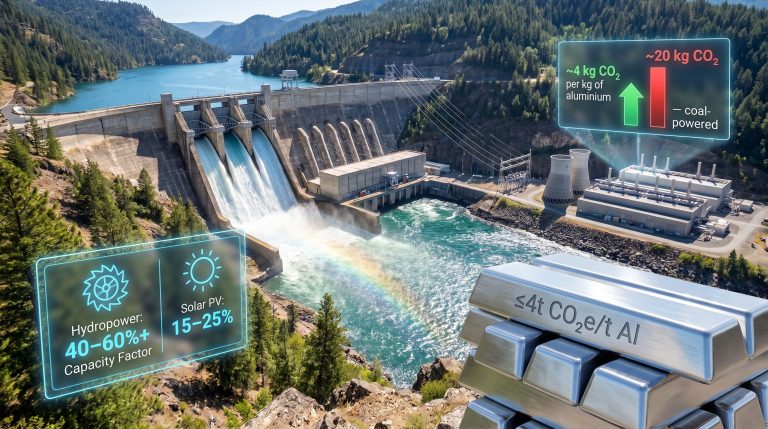
Beyond geology, Québec offers a regulatory and environmental profile that appeals strongly to European buyers. Its hydropower-heavy electricity mix means lower embodied carbon than supply chains powered by coal-intensive systems.
That ESG edge is not just a branding point. Under tighter reporting rules and procurement standards, buyers increasingly need traceable and lower-emission raw materials. This fits neatly with Europe’s strategic shift towards a stronger critical minerals strategy.
Key Minerals in the Bilateral Framework
- Graphite: used in lithium-ion battery anodes
- Cobalt: important for battery cathodes and aerospace alloys
- Nickel: essential for batteries, stainless steel, and defence applications
- Lithium: foundational for battery chemistries
- Rare earths: critical for magnets, electronics, and military systems
In addition, Italy’s interest in rare earth elements reflects wider concern over rare earth supply chains and their role in advanced manufacturing.
The G7 Architecture and Canada’s Bilateral Strategy
Multilateral Frameworks and Bilateral Deals
The Canada–Italy arrangement sits inside a broader G7 push on mineral security. However, multilateral and bilateral approaches serve different purposes. Multilateral frameworks establish standards and cooperation principles, whereas bilateral agreements create more specific commitments around access and allocation.
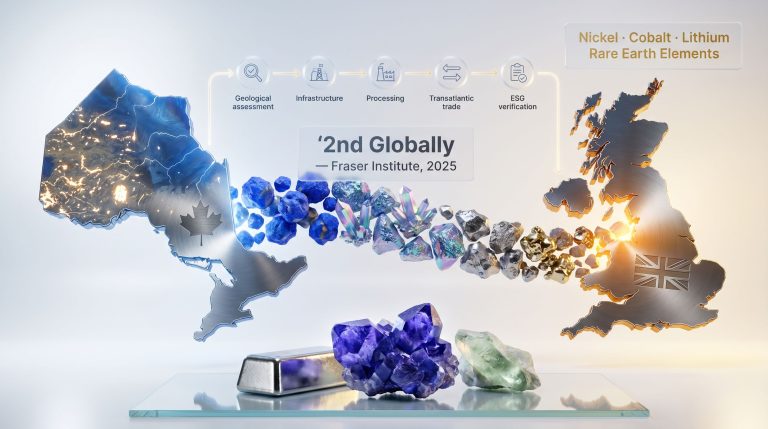
Canada has been pursuing this two-track model with increasing sophistication. Agreements with the UK, Japan, and the US all reflect the same logic: secure trusted long-term customers and partners before global competition intensifies.
That is especially relevant as the geopolitical minerals race accelerates. Italy matters because it is not a symbolic partner; it has substantial automotive, aerospace, defence, and energy demand.
Canada’s Competitive Position
Canada’s strengths are substantial. These include:
- Diverse geological endowment
- Political stability
- Transparent legal frameworks
- Strong ESG credentials
- Proximity to North American industrial corridors
Ontario’s Ring of Fire holds major nickel, cobalt, and chromite potential. Québec has advanced graphite and lithium projects. Rare earth exploration is also expanding, while innovation in areas such as direct lithium extraction may strengthen future supply options.
However, there are still weaknesses. Processing and refining remain underdeveloped. Permitting can be slow. In addition, Indigenous partnerships require careful, genuine engagement to secure lasting social licence.
Defence Cooperation as Part of an Integrated Bilateral Framework
When Resource Strategy and Military Procurement Converge
One of the most significant features of the talks is that minerals and defence were treated as linked issues. Alongside the supply framework, Canada and Italy launched negotiations over Canada’s potential purchase of Leonardo’s M-346 advanced jet trainer aircraft.
This integration is not accidental. Instead, it reflects a newer model of alliance-building where defence, resource security, finance, and industrial policy reinforce one another. A relationship built on several pillars is usually more durable than one centred only on commodities.
Carney also highlighted plans for a new Defence, Security and Resilience Bank. Consequently, the bilateral relationship may extend beyond immediate supply arrangements into longer-term institutional cooperation.
What This Means for Investors and Industrial Buyers
Reading the Signals in a Rapidly Evolving Market
For investors and procurement teams, the agreement sends several clear signals. First, priority access frameworks are becoming a structural feature of the emerging allied supply system. Secondly, commercial investment validates diplomacy far more convincingly than rhetoric alone.
Thirdly, ESG-compliant sourcing is moving from preference to requirement. European regulations are making provenance, labour standards, and carbon intensity increasingly important in minerals purchasing decisions.
Therefore, Canada offers Italy priority access to critical minerals in a way that may influence pricing, availability, and procurement risk over the medium term. Buyers outside these trusted arrangements could face more volatility if markets tighten.
As one key conclusion suggests, investors and procurement teams should track not just commodity prices, but also the spread of bilateral access frameworks. That is because early movers may secure markedly better supply outcomes than those relying only on open-market access.
The next major ASX story will hit our subscribers first
Frequently Asked Questions: Canada–Italy Critical Minerals Agreement
What minerals are included in the agreement?
The framework covers graphite, cobalt, nickel, lithium, and rare earth elements. These materials are essential for batteries, industrial manufacturing, electronics, and defence technologies.
How is priority access different from a normal trade agreement?
Priority access goes beyond tariffs or market access rules. Instead, it creates government-backed supply preferences that can apply during shortages, disruptions, or periods of heightened geopolitical stress.
Why is graphite so important?
Graphite is the main anode material in commercially viable lithium-ion batteries. Without it, large-scale battery production becomes extremely difficult, which is why Canada offers Italy priority access to critical minerals with graphite at the centre.
How significant is Eni’s investment?
Eni’s C$100 million commitment to Nouveau Monde Graphite’s Matawinie project is one of the most meaningful European investments into Canadian mineral development. In addition, it gives the bilateral partnership a concrete industrial foundation.
Does the arrangement include defence cooperation?
Yes. Alongside mineral access discussions, Canada and Italy also opened talks around defence procurement, including the possible purchase of Leonardo’s M-346 aircraft. That strengthens the relationship by linking resource security with broader strategic cooperation.
Could Alliance-Based Mineral Deals Reveal The Next Major ASX Discovery?
For investors tracking how critical minerals strategy can reshape market winners, Discovery Alert’s proprietary Discovery IQ model delivers real-time alerts on significant ASX mineral discoveries as they are announced. Explore how historic discoveries have driven exceptional returns on Discovery Alert’s discoveries page and start a 14-day free trial to stay ahead of the market.