June 16, 2026
The Architecture of Dependence: Why Western Nations Are Scrambling to Rewire Critical Mineral Supply Chains
For decades, the economics of globalisation encouraged specialisation at the expense of redundancy. Nations optimised for cost efficiency, and the result was a mineral supply chain architecture that concentrated refining and processing capacity in a single country to a degree that now registers as a systemic vulnerability. China controls roughly 85 to 90 percent of global rare earth refining capacity, dominates lithium processing, and holds commanding positions across cobalt supply chains. Allied nations, collectively, account for less than 10 percent of rare earth processing. This is not a geological problem. The mineral deposits exist across multiple jurisdictions, including in democratic, high-governance nations. It is an infrastructure and investment problem decades in the making.
The Ontario and U.K. critical minerals pact, formalised through a Statement of Intent signed by Ontario's Minister of Mines Stephen Lecce and U.K. Minister of Industry Chris McDonald in London, represents one of the more structurally significant bilateral responses to this challenge. However, to understand why this agreement matters, you need to look beyond the headline and examine the mechanics of what it is trying to accomplish, and the considerable distance between intent and execution.
When big ASX news breaks, our subscribers know first
Understanding What a Statement of Intent Actually Does
A Statement of Intent is frequently mischaracterised in media coverage as either meaningless diplomatic theatre or as a binding partnership with guaranteed outcomes. Neither characterisation is accurate. An SOI is a formal diplomatic instrument that establishes a shared policy framework and creates structured channels for cooperation without carrying the legal enforceability of a treaty. Its practical value lies in what it signals to capital markets, institutional investors, and project developers rather than what it mandates.
This particular SOI operates within a layered architecture:
- Federal layer: A Canada-U.K. Critical Minerals Supply Chains Dialogue, covering information-sharing, ESG alignment, R&D cooperation, and trade facilitation between the two national governments.
- Provincial layer: Ontario's parallel SOI, which positions the province as the primary Canadian delivery mechanism, leveraging its existing geology, processing infrastructure, and regulatory track record.
The dual-layer structure is deliberate and strategically significant. By nesting the provincial agreement within a federal framework, the parties create institutional depth that makes the cooperation more durable across changes in provincial government.
Key Pillars of the Cooperation Framework
The agreement encompasses five operational dimensions:
- Supply chain resilience: Joint vulnerability mapping and redundancy-building across critical mineral pathways.
- Transatlantic investment facilitation: Structured mechanisms to direct both U.K. domestic capital and international investment into Ontario's mineral sector.
- ESG standards alignment: A shared commitment to elevating environmental, social, and governance benchmarks across the full value chain.
- Research and innovation exchange: Collaborative R&D programs spanning industry, academia, and government institutions in both jurisdictions.
- Domestic processing expansion: Ontario's explicit ambition to increase in-province mineral processing, capturing value-added economic activity rather than exporting raw ore.
Ontario's Strategic Position: More Than Geological Fortune
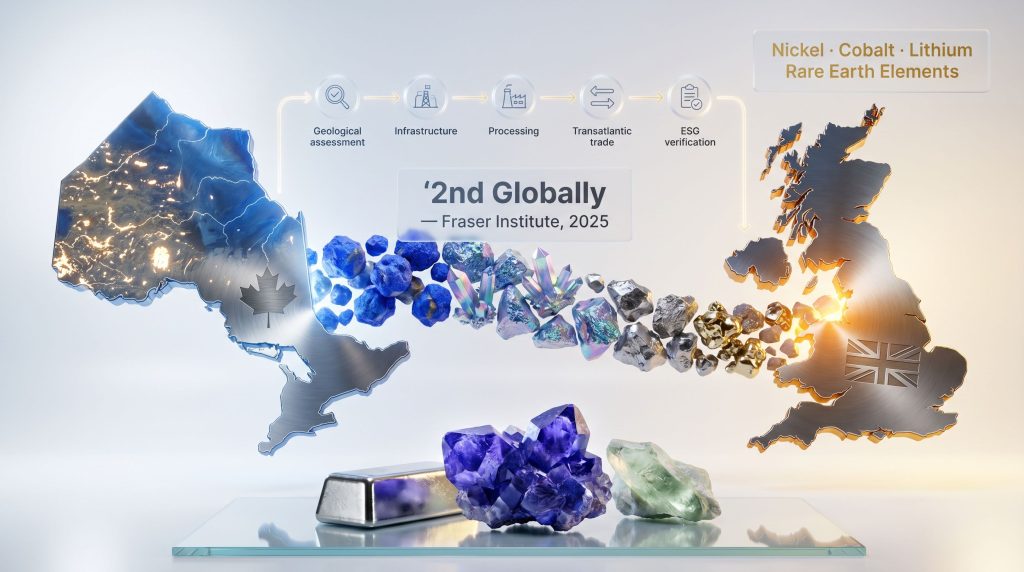
Ontario's credentials as a critical minerals partner are built on more than accident of geology. The province currently ranks second globally for mining investment attractiveness according to the Fraser Institute's most recent survey, a position the province attributes to recent regulatory reforms and infrastructure investment programmes. This ranking matters because it directly addresses one of the primary concerns institutional investors apply when evaluating long-duration capital commitments in mining: sovereign and regulatory risk.
| Capability | Ontario's Position |
|---|---|
| Geological Endowment | Nickel, cobalt, lithium, and rare earth elements across established northern mining regions |
| Processing Infrastructure | Existing smelting and refining capacity concentrated in the Sudbury basin |
| Regulatory Environment | 2nd globally, Fraser Institute 2025 survey |
| Workforce and Expertise | Established mining engineering, metallurgy, and technical talent base |
| ESG Track Record | Responsibly produced minerals certification pathways already operational |
The Sudbury basin deserves particular attention because it is frequently underestimated in discussions of Ontario's mineral potential. The basin is one of the world's largest known nickel-copper-cobalt sulphide ore systems, formed by a meteorite impact approximately 1.85 billion years ago. The geological event created an anomalously large magmatic intrusion that concentrated sulphide mineralisation across a strike length of roughly 60 kilometres.
This is not typical disseminated mineralisation requiring enormous volumes of ore to extract commercial quantities of metal. The deposit geometry and grade profile make Sudbury-region production among the most cost-competitive in global nickel supply. Furthermore, the critical minerals demand emerging from the clean energy transition only strengthens the strategic case for Ontario's position.
The Ring of Fire: Long-Term Potential, Near-Term Constraints
Beyond the Sudbury basin, Ontario's northern mineral belt includes the Ring of Fire, a region containing significant chromite, nickel, and cobalt resources with direct relevance to battery supply chains. The challenge is that the Ring of Fire sits in remote, seasonally inaccessible terrain with no permanent road access. Infrastructure development costs in this environment are substantial, and the economics of project development hinge on whether provincial and federal road investment programmes materialise on schedule.
This is not a new challenge. The Ring of Fire has been discussed as a generational mineral opportunity for over 15 years, yet it remains undeveloped largely because of infrastructure economics and Indigenous consultation processes. The Ontario-U.K. SOI's emphasis on increasing transatlantic investment could theoretically accelerate project economics by reducing the cost of capital, but the physical infrastructure constraints will not be resolved by diplomatic agreements alone.
Why the U.K. Needs This Partnership
The United Kingdom brings a structurally different problem to the table. Britain has no meaningful domestic critical mineral production capacity. Its EV manufacturing ambitions, defence sector requirements, and clean energy transition targets are entirely dependent on imported mineral inputs. Post-Brexit trade realignment has removed the U.K. from European mineral frameworks it previously accessed through EU membership, creating an urgent need to build new bilateral supply chain relationships.
In addition, the energy security implications of this dependency are substantial, as the U.K.'s industrial future is directly tied to securing stable, traceable supplies of battery-relevant minerals. The UK-Canada agreement to improve critical minerals supply chains further reinforces the urgency both governments are placing on this cooperation.
Darren Hazelwood, CEO of Panther Metals, characterised the agreement as a significant development for British investors, noting that Ontario's combination of geological endowment, established infrastructure, and deep technical expertise positions the province as a credible partner capable of meeting rising global mineral demand.
For British investors and mining companies, Ontario's second-place global ranking for mining attractiveness is not merely symbolic. It translates to lower political risk, more predictable permitting timelines, and a regulatory environment that reduces the contingency provisions institutional investors must build into project valuations. In a sector where cost-of-capital differentials can determine whether a project reaches final investment decision, governance quality is a material financial variable.
Priya Tandon, President of the Ontario Mining Association, framed the partnership as a mechanism to reinforce Ontario's standing as a globally recognised source of responsibly produced minerals, directly addressing the ESG-driven capital allocation criteria that institutional investors increasingly apply.
The Concentration Problem in Numbers
The strategic urgency driving agreements like the Ontario and U.K. critical minerals pact becomes clearer when the supply concentration data is presented directly:
| Mineral | Dominant Global Processor | Allied Nations' Share of Processing |
|---|---|---|
| Rare Earth Elements | China (~85-90% of global refining) | Less than 10% combined |
| Lithium | China (largest refiner globally) | Growing but structurally limited |
| Cobalt | China (dominant refiner) | Minimal domestic capacity |
| Nickel (battery-grade) | China (dominant in Class 1 processing) | Limited outside a few jurisdictions |
What this table obscures is the distinction between different grades and forms of each mineral. Battery-grade nickel, for instance, requires either sulphate conversion from Class 1 nickel or hydrometallurgical processing of laterite ores to produce nickel sulphate directly. China's dominance in this specific processing step, rather than just primary nickel production, is where the strategic chokepoint exists.
Ontario's Sudbury-region nickel is predominantly Class 1 sulphide ore, which has a processing pathway to battery-grade sulphate that is well-understood and less capital-intensive than laterite processing routes. This geological quality advantage is commercially significant and is frequently underweighted in general coverage of Ontario's critical mineral potential. The broader challenges facing rare earth supply chains underscore precisely why this advantage matters to allied nations.
How This Agreement Fits the Broader Allied Response
The Ontario-U.K. pact is not an isolated initiative. It is part of an accelerating pattern of allied-nation agreements targeting the same strategic minerals:
| Agreement | Parties | Primary Focus |
|---|---|---|
| Canada-U.K. Critical Minerals Dialogue | Federal Canada and U.K. | Supply chain resilience, R&D, ESG |
| Ontario-U.K. SOI | Province of Ontario and U.K. | Investment, processing, transatlantic trade |
| Minerals Security Partnership | U.S.-led, 14+ nations | Financing and project development |
| Australia-U.S. Critical Minerals MOU | Australia and U.S. | Processing investment, supply diversification |
The collective architecture of these agreements represents an emerging attempt to build what might be described as a values-based supply chain bloc, one where governance standards, ESG compliance, and supply chain transparency serve as both market differentiators and geopolitical tools. The Ontario-U.K. agreement's explicit emphasis on ESG alignment is strategically calculated to position jointly produced minerals as premium, traceable inputs, directly contrasting with supply chains where governance standards are lower and provenance is opaque.
Consequently, Europe's own push towards strategic autonomy, embodied in the European raw materials strategy, is creating additional demand for certified, allied-nation mineral supply that agreements like this one are positioned to serve.
The next major ASX story will hit our subscribers first
The EV Battery Supply Chain Connection
The commercial logic underpinning the Ontario and U.K. critical minerals pact is rooted in battery chemistry. Lithium-ion battery cells, which power electric vehicles and grid-scale energy storage, require nickel, cobalt, lithium, and manganese in proportions that vary by cathode chemistry. The dominant cathode chemistries in premium EV applications, including NMC (nickel-manganese-cobalt) and NCA (nickel-cobalt-aluminium), are heavily nickel-intensive. High-nickel cathodes deliver superior energy density but require battery-grade nickel sulphate of consistent purity.
Ontario's Sudbury sulphide nickel deposits produce a mineral type that sits near the top of the processing quality hierarchy for battery applications. Laterite nickel, which dominates global nickel production by volume, requires either high-pressure acid leaching or pyrometallurgical processing followed by additional conversion steps to reach battery-grade sulphate. Sudbury sulphide nickel, by contrast, has a more direct conversion pathway, which reduces processing costs and energy intensity while producing a more consistent chemical purity profile.
For those tracking battery metals investment trends, Ontario's sulphide nickel advantage represents a compelling structural differentiator within the broader competitive landscape for battery supply chain capital.
How the Supply Chain Could Materialise Step by Step
- U.K. investment capital flows into Ontario exploration and development projects targeting battery-relevant minerals, particularly nickel, cobalt, and lithium.
- Provincial regulatory reform and infrastructure investment, including road access improvements to northern mineral regions, reduce project development costs and timelines.
- Ontario expands domestic refining and processing capacity, producing battery-grade mineral outputs rather than shipping concentrate or raw ore.
- Processed critical minerals move from Ontario through transatlantic trade channels to U.K. and European manufacturing facilities.
- Shared ESG verification frameworks provide supply chain traceability and responsible sourcing certification, meeting European battery regulation disclosure requirements.
- The combined Canada-U.K. mineral pathway creates a measurably more resilient Western industrial supply chain for the battery materials that underpin both the energy transition and advanced defence manufacturing.
The Execution Gap: From Intent to Industrial Reality
Historical precedent from similar bilateral mineral agreements suggests the translation of SOI frameworks into operational supply chain outcomes typically requires sustained institutional effort measured in years, not months. The execution risks are structural:
| Challenge | Description | Mitigation Pathway |
|---|---|---|
| Remote Infrastructure Deficit | Northern Ontario projects face significant access cost burdens | Provincial road and power investment programmes |
| Processing Capacity Gap | Limited domestic refining capacity for battery-grade outputs | Capital investment incentives and bilateral partnership funding |
| Permitting Timelines | Environmental assessment and Indigenous consultation requirements | Regulatory streamlining initiatives already underway |
| Market Price Volatility | Critical mineral commodity prices fluctuate significantly | Long-term offtake agreements and government-linked financing |
| ESG Compliance Complexity | Aligning standards across two distinct regulatory jurisdictions | Shared governance framework established within the SOI |
One particularly underappreciated constraint involves the Indigenous consultation requirement in northern Ontario. Free, prior, and informed consent from First Nations communities along proposed infrastructure corridors is both a legal requirement and a moral obligation. Projects that fail to build genuine partnership with Indigenous communities face not just regulatory delays but reputational damage that affects social licence across the entire project region.
The Ontario-U.K. agreement's ESG framework will need to explicitly address Indigenous partnership models if it is to build supply chains that are credibly responsible rather than superficially certified. The joint statement published by the Canadian government outlines the shared principles underpinning both nations' commitment to responsible and inclusive mineral development.
Frequently Asked Questions
What minerals does the Ontario-U.K. agreement specifically target?
The agreement broadly covers critical minerals essential to the clean energy transition and advanced manufacturing. Nickel, cobalt, lithium, and rare earth elements are the primary targets given their relevance to EV battery production, defence applications, and clean energy infrastructure, all of which are abundant in Ontario's northern geological inventory.
How does the provincial SOI relate to the federal Canada-U.K. dialogue?
They are related but distinct instruments operating at different levels. The federal agreement creates a Critical Minerals Supply Chains Dialogue between national governments covering trade, ESG, and R&D. Ontario's SOI is a provincial-level parallel agreement that positions the province as the primary delivery mechanism within that broader bilateral framework.
What does Ontario's second-place global mining ranking actually mean for investors?
The Fraser Institute ranking reflects a composite assessment of geological attractiveness and policy environment. A second-place position signals that Ontario combines strong mineral endowment with a stable, transparent regulatory environment, which translates to lower political risk premiums in project valuations and more competitive access to institutional capital.
Why does ESG alignment matter commercially, not just ethically?
The European Union's Battery Regulation, which affects any battery sold into the European market, mandates supply chain due diligence and carbon footprint disclosure for battery materials. Minerals produced within an ESG-verified framework aligned with recognised international standards can be marketed as compliant inputs, avoiding the regulatory friction that will increasingly affect supply chains without traceable provenance documentation.
The Long View: Building a Transatlantic Mineral Corridor
Viewed across a decade-long horizon, the Ontario and U.K. critical minerals pact is best understood as one structural component of a larger allied-nation effort to redistribute global critical mineral supply chain influence. The near-term milestones worth monitoring include the establishment and first convening of the Canada-U.K. Critical Minerals Supply Chains Dialogue, the identification of priority Ontario projects eligible for U.K.-linked investment facilitation, and progress on domestic processing capacity expansion within Ontario.
The more speculative but analytically interesting scenario is whether this transatlantic corridor could eventually develop into a formalised trading bloc for responsibly sourced critical minerals, with standardised certification, preferential tariff frameworks, and coordinated strategic stockpiling arrangements. Several allied-nation agreements are moving in this direction conceptually, though the institutional architecture required to make it operational remains years away.
What is not speculative is that Ontario's combination of proven geology, second-place global investment ranking, existing processing infrastructure in the Sudbury basin, and a formal government-to-government bilateral framework with the U.K. creates a genuinely differentiated position in the global competition for critical mineral investment. The agreement will not resolve Western supply chain vulnerability on its own. However, it establishes the institutional scaffolding through which capital, technology, and political will can eventually close the gap.
This article contains forward-looking analysis and references to policy frameworks that are subject to change. Readers should not interpret any content herein as financial or investment advice. Critical mineral markets are subject to commodity price volatility, regulatory change, and geopolitical risks that can materially affect project economics and investment outcomes.
Want to Track the Next Major Critical Mineral Discovery Before the Market Does?
Discovery Alert's proprietary Discovery IQ model delivers real-time alerts on significant ASX mineral discoveries — instantly transforming complex mineral data into actionable investment insights for both short-term traders and long-term investors. Explore historic examples of major mineral discoveries and their returns, then begin your 14-day free trial at Discovery Alert to position yourself ahead of the broader market.