June 16, 2026
The World's Most Consequential Maritime Chokepoint
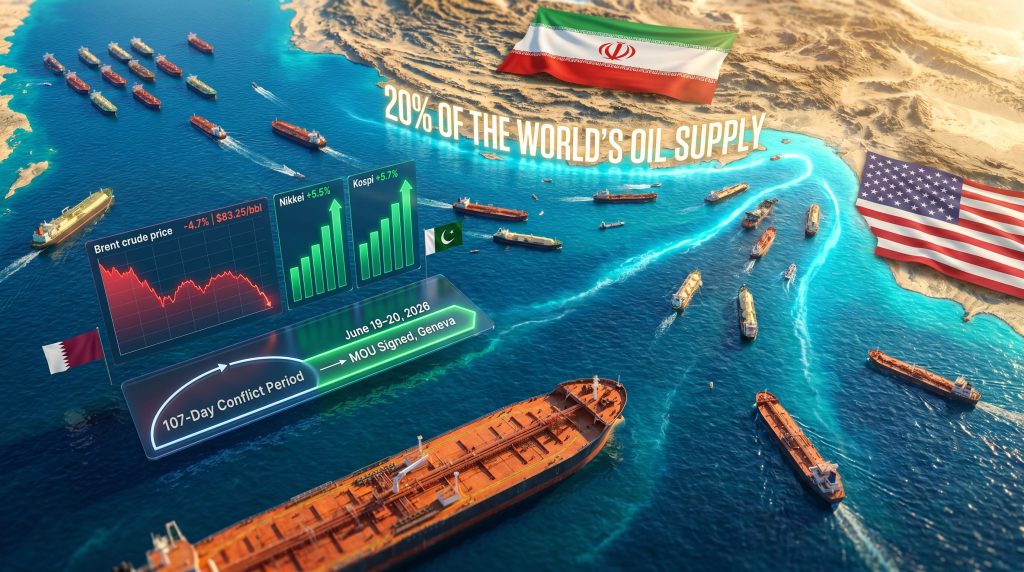
Every barrel of oil has a geography. And for roughly one-fifth of the world's daily crude supply, that geography runs through a narrow strip of water approximately 33 kilometres wide at its tightest point. The Strait of Hormuz, connecting the Persian Gulf to the Gulf of Oman and the broader Arabian Sea, is not merely a shipping lane. It is the circulatory system of the global fossil fuel economy, and when it closes, the entire body feels it.
The June 2026 US Iran deal to reopen Strait of Hormuz access ended 107 days of conflict that had pushed energy markets, diplomatic channels, and supply chain logistics to their limits. Understanding what the agreement actually contains, what it leaves unresolved, and what it means for global energy flows requires looking beyond the headline price moves and into the structural mechanics of how this waterway shapes the world economy.
Why No Alternative Can Replace the Strait
The Persian Gulf's major oil exporters, including Saudi Arabia, Iraq, the UAE, Kuwait, Qatar, and Iran, all depend on Hormuz as their primary export corridor. While overland pipeline alternatives do exist, their combined throughput capacity falls well short of what the Strait handles on any given day. Saudi Arabia's East-West Pipeline and the UAE's Abu Dhabi Crude Oil Pipeline offer partial bypass capacity, but neither can absorb the full volume normally transiting Hormuz.
Rerouting tankers around the Cape of Good Hope adds weeks to voyage times and substantially increases freight costs, making it economically viable only as a temporary emergency measure rather than a sustainable alternative. This geographic lock-in is precisely why Hormuz commands such outsized geopolitical leverage, a reality well understood by those tracking crude oil price trends over recent years.
When big ASX news breaks, our subscribers know first
What 107 Days of Disruption Did to Global Energy Markets
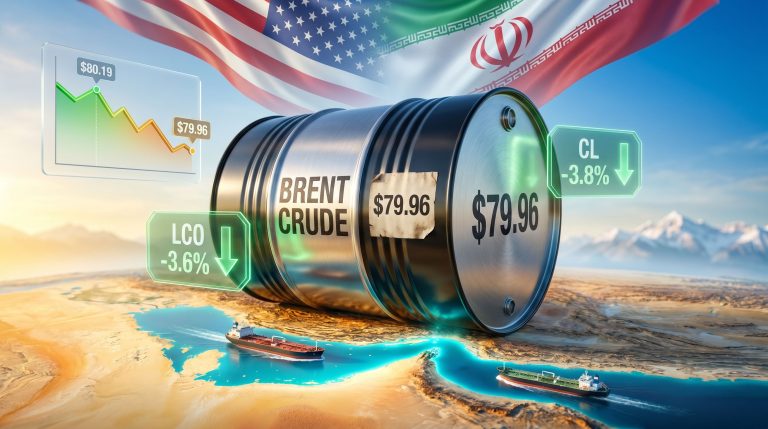
Before the agreement was announced on June 14, 2026, the market had already been pricing in prolonged disruption. Fitch revised its 2026 Brent crude forecast upward to $87 per barrel, a significant jump from its prior estimate of $70 per barrel, citing the sustained Hormuz disruption as the primary driver. Brent was trading at approximately $87.33 per barrel at peak disruption levels immediately before the deal was announced.
The disruption did more than spike prices. It fundamentally redirected crude trade flows in ways that may outlast the formal reopening of the waterway. Asian and European importers, unable to rely on Gulf supply, accelerated purchases from African crude producers to fill the gap. These newly established trade relationships, forged under supply duress, represent a structural shift that will not automatically unwind simply because Hormuz reopens.
Furthermore, geopolitical trade tensions of this magnitude rarely resolve without leaving lasting imprints on procurement strategies and long-term supply agreements across the global trading system.
"The Strait of Hormuz disruption did not merely spike oil prices. It restructured short-term global crude trade flows, with downstream consequences that will persist well beyond the formal reopening of the waterway."
Breaking Down the June 2026 Memorandum of Understanding
Core Provisions at a Glance
The agreement reached between Washington and Tehran is structured as a Memorandum of Understanding rather than a fully ratified treaty. This distinction carries significant implications for enforceability and implementation timelines. You can read the full BBC coverage of the announcement for further context on how the deal was received internationally.
| Provision | Detail |
|---|---|
| Agreement Type | Memorandum of Understanding (MOU) |
| Announcement Date | June 14, 2026 |
| Formal Signing Date | June 19-20, 2026 (Switzerland/Geneva) |
| Ceasefire Duration | 60-day ceasefire framework |
| Strait of Hormuz Status | Toll-free transit for all international vessels upon signing |
| Naval Blockade | Immediate lifting of U.S. naval blockade on Iranian ports |
| Military Operations | Permanent halt to regional military operations, including in Lebanon |
| Nuclear Negotiations | Dedicated 60-day negotiation window |
| Frozen Iranian Assets | Approximately $24 billion under review |
| Mediating Parties | Qatar and Pakistan |
| Preparatory Venue | Doha (pre-signing meetings) |
U.S. President Donald Trump announced the deal via Truth Social and authorised the immediate lifting of the naval blockade on Iranian ports. Iranian Deputy Foreign Minister Kazem Gharibabadi confirmed the agreement on state television, indicating that implementation would commence following the formal signing ceremony in Switzerland.
What the MOU Leaves Unresolved
Despite the significance of the announcement, several critical gaps remain embedded within the agreement's framework:
- Iranian naval mines remain present in Strait waters, and clearance operations are expected to require months of coordinated effort
- No confirmed sanctions relief or asset release will occur until Iran demonstrates verifiable compliance with MOU terms, according to U.S. officials
- Iran's nuclear enrichment program remains technically unresolved at the time of signing, with only a 60-day negotiation window allocated
- Vessel backlog: Dozens of tankers and cargo ships remain stranded in the Persian Gulf, requiring organised repositioning and clearance operations
"Market participants should note that the MOU represents a diplomatic framework, not a fully executed treaty. The gap between political commitment and operational normalization carries substantial execution risk that forward pricing may not fully reflect."
How Global Markets Responded to the Announcement
Immediate Price Movements
Financial markets moved decisively within hours of the June 14 announcement:
- Brent crude fell $4.08, or 4.7%, to $83.25 per barrel — its lowest level since March 10, 2026
- WTI crude fell $4.35, or 5.1%, to $80.53 per barrel, also reaching a March 10 low
- Japan's Nikkei gained 5.5% when Asian markets opened on June 15
- South Korea's Kospi advanced 5.7% on the same session
- U.S. gasoline prices were projected to fall below $4.00 per gallon
- U.S. diesel prices were projected to fall below $5.00 per gallon
These moves illustrate the forward-pricing mechanism at work: markets price anticipated future supply availability, not current physical flows. The sentiment-driven price response was immediate, but fundamental supply normalization remains months away.
Three Scenarios for Oil Prices Over the Next 12 Months
The International Energy Agency estimated in early June 2026 that even under an immediate agreement, shipping normalization would require six to eight months, due to stranded vessels, active mine clearance requirements, and port infrastructure inspections. This timeline frames three plausible price scenarios:
| Scenario | Conditions | Brent Price Range |
|---|---|---|
| Rapid Normalization | Mines cleared within 3 months; nuclear talks progress | $72-$78/barrel |
| Base Case (IEA Timeline) | 6-8 month normalization; partial sanctions relief | $78-$85/barrel |
| Delayed Reopening | Mine clearance setbacks; sanctions disputes stall compliance | $88-$95/barrel |
Disclaimer: These scenarios are analytical projections based on publicly available data and expert assessments. They do not constitute financial advice. Actual outcomes will depend on geopolitical developments, compliance timelines, and market dynamics that cannot be predicted with certainty.
The Diplomatic Architecture Behind the Agreement
Qatar and Pakistan as Mediators: A New Model for Gulf Diplomacy
The selection of Qatar and Pakistan as mediating parties reflects a carefully considered diplomatic logic rather than an arbitrary choice. Qatar occupies a structurally unique position in the Gulf. It hosts the largest U.S. military base in the Middle East at Al Udeid Air Base while simultaneously maintaining functional diplomatic and commercial relationships with Tehran.
Qatar's LNG export interests were directly harmed by the Hormuz disruption, creating a powerful economic incentive to facilitate resolution. Indeed, constraints on global LNG supply during this period intensified pressure on European and Asian buyers already competing for limited spot cargoes. This convergence of strategic positioning and economic self-interest made Qatar a credible intermediary for both parties.
Pakistan's role carries different but complementary logic. Sharing a border with Iran and maintaining pragmatic bilateral ties, Pakistan represents the growing influence of non-Western diplomatic intermediaries in major geopolitical settlements. Its inclusion signals that Gulf conflict resolution increasingly involves regional powers beyond the traditional Western-led frameworks.
Western Endorsement and the Geneva Signing Venue
Both UK Prime Minister Keir Starmer and French President Emmanuel Macron welcomed the agreement, with Starmer emphasising in a formal statement that full and permanent implementation of the memorandum must be the priority for all parties involved. The choice of Switzerland as the formal signing venue reflects a deliberate preference for neutral diplomatic ground, reinforcing the agreement's multilateral legitimacy rather than framing it as a bilateral Washington-Tehran arrangement.
The involvement of Iranian parliamentary leaders in the virtual signing, rather than exclusively executive representatives, is also diplomatically significant. It suggests a degree of domestic political buy-in within Iran that purely executive agreements have historically lacked, though Supreme Leader endorsement remains the ultimate arbiter of the deal's durability within Iran's political system.
The Six-to-Eight Month Normalization Roadmap
Phase-by-Phase Implementation Timeline
Full restoration of Strait of Hormuz functionality is a multi-stage operational challenge, not a single event triggered by signature:
Phase 1: Immediate Post-Signing (Weeks 1-4)
- Formal lifting of the U.S. naval blockade on Iranian ports
- Initial mine survey operations commence in Strait waters
- Stranded vessels begin repositioning from Gulf holding positions
Phase 2: Early Normalization (Months 2-4)
- Progressive mine clearance enables limited tanker transit
- Port infrastructure inspections completed at key Gulf terminals
- Iranian crude export volumes begin partial recovery toward pre-conflict levels
Phase 3: Full Normalization (Months 5-8)
- Full tanker transit capacity restored across the Strait
- Global crude supply chains rebalance toward pre-disruption trade patterns
- OPEC's market influence reasserts itself as member export volumes return to full operational capacity
Commodity Markets Beyond Crude Oil
The reopening's significance extends well beyond oil prices alone:
- LNG markets: Qatar and UAE LNG exports were constrained during the disruption period. Restored Hormuz access will ease supply conditions for European and Asian LNG buyers who had been competing for limited spot cargoes
- Petrochemical feedstocks: Naphtha and condensate flows from Gulf producers resume, reducing input cost pressures on downstream chemical manufacturers
- Tanker freight rates: Day rates for crude tankers surged during the blockade period. As vessel supply returns to the Strait, rates are expected to normalise, reducing a secondary inflationary input for energy markets globally
The next major ASX story will hit our subscribers first
Africa's Unexpected Role in the Hormuz Crisis
Which African Producers Benefited From Diverted Demand
When Gulf supply was cut off, Asian and European refiners did not simply reduce throughput. They sourced alternative crude grades from wherever reliable supply could be found at competitive prices. African producers stepped into this gap. Several nations were particularly well-positioned to benefit:
- Nigeria: Bonny Light crude is a preferred substitute for lighter Gulf grades sought by complex Asian refineries
- Angola: Deepwater crude production with established long-term relationships with Chinese and other Asian buyers
- Libya: Mediterranean-positioned crude offering logistical advantages for European buyers unable to access Gulf supply
- Equatorial Guinea, Gabon, and Republic of Congo: Smaller but active exporters capable of expanding volumes into a demand-hungry market
Will African Export Gains Survive the Hormuz Reopening?
This is among the most consequential and least-discussed questions arising from the June 2026 deal. The disruption period may have compressed years of supply diversification effort into a few months, forcing Asian refiners to operationalise African crude procurement chains they had only previously considered theoretically.
Factors that may sustain African export gains include:
- Long-term supply diversification mandates adopted by Asian national oil companies following the Gulf supply shock
- Infrastructure investments, including upgraded storage and offloading facilities, made during the disruption to accommodate African crude grades
- A recalibrated geopolitical risk premium now permanently embedded in Gulf supply assessments by procurement teams
Factors that may erode those gains include:
- Gulf producers offering competitive pricing incentives to recapture Asian market share
- The inherent logistical cost advantage of shorter Gulf-to-Asia shipping routes compared with Africa-to-Asia routes
- OPEC+ production discipline, which may limit the volume increases Gulf producers can offer to price-compete with African barrels
"The Hormuz disruption may have accelerated Africa's long-term integration into Asian energy supply chains by several years. This is an unintended but potentially durable consequence of 107 days of conflict."
Kenya's Fuel Subsidy Response: Downstream Fiscal Pressure in Action
The disruption's impact on net oil-importing African nations was felt through a different mechanism. Kenya's President William Ruto implemented fuel subsidies to protect domestic consumers from the elevated price environment created by Hormuz disruption. This illustrates the fiscal burden that chokepoint-linked supply shocks impose on import-dependent economies across the continent, a dynamic that contrasts sharply with the revenue gains experienced by Africa's net exporters during the same period.
The Nuclear Negotiation Stakes: The 60-Day Clock
Why Nuclear Talks Are Structurally Harder Than Reopening the Strait
The Hormuz reopening, while operationally complex, is fundamentally binary in nature. The Strait is either open or closed, and physical indicators are verifiable in real time. Nuclear compliance operates on an entirely different level of complexity. Key negotiating variables within the 60-day window include:
- Uranium enrichment ceiling, expressed as a percentage purity cap
- Centrifuge operational limits, covering both number and type of machines permitted
- IAEA inspection access, frequency, and scope of permitted monitoring activities
- Sanctions relief sequencing tied to specific, verifiable compliance milestones
In addition, the broader question of regional energy security — including the emerging nuclear energy partnership models being explored elsewhere on the continent — underscores just how fundamentally the global energy architecture is being reshaped by current geopolitical developments.
The $24 Billion Frozen Asset Question
Approximately $24 billion in frozen Iranian sovereign assets are under negotiation as part of the broader MOU framework. The U.S. position is unambiguous: no benefits will be released until Iran demonstrates compliance with the MOU's terms. Iran's position frames asset release and sanctions relief as preconditions for sustained cooperation rather than rewards for compliance already delivered.
This sequencing dispute carries a risk that extends beyond the nuclear track. If sanctions relief is delayed beyond what Tehran considers acceptable, Iranian authorities could slow-walk mine clearance operations or other Hormuz normalization steps as leverage, directly threatening the six-to-eight month normalization timeline the IEA has outlined. NBC News has also reported extensively on the deal's framework and the political dynamics surrounding it.
Risk Matrix: What Could Derail the Agreement
| Risk Factor | Probability | Potential Impact | Mitigation Path |
|---|---|---|---|
| Mine clearance delays | High | Shipping normalization pushed to 10-12 months | International naval technical cooperation |
| Nuclear talks collapse | Medium-High | Deal durability undermined; sanctions risk reimposed | Phased compliance with clear milestones |
| Sanctions relief dispute | Medium-High | Iranian compliance slows; partial reopening only | Escrow mechanisms; third-party asset management |
| Regional spoiler actions | Medium | Ceasefire violations in Lebanon or Yemen | Multinational monitoring mission |
| U.S. domestic political pressure | Medium | Congressional opposition to asset release | Executive action framing; energy security messaging |
| Iranian internal hardliner resistance | Medium | Parliamentary rejection of final agreement terms | Supreme Leader endorsement required |
Frequently Asked Questions: The US Iran Deal and Hormuz Reopening
What percentage of global oil passes through the Strait of Hormuz?
Approximately 20% of the world's total oil supply transits the Strait of Hormuz daily, along with a significant share of global LNG shipments, primarily destined for Asian markets. This makes it the single most strategically important maritime chokepoint in the global energy system.
When will Hormuz fully reopen after the US Iran deal?
The IEA estimated that full normalization of shipping activity would require six to eight months following an immediate agreement, due to the need for mine clearance, vessel repositioning, and port infrastructure inspection. Formal Strait reopening is expected upon the Switzerland signing on June 19-20, 2026, but unrestricted commercial traffic will take considerably longer to restore.
What are the $24 billion in frozen Iranian assets?
Approximately $24 billion in Iranian sovereign assets have been frozen under U.S. and international sanctions. Their release is under negotiation as part of the MOU framework, conditional on Iranian compliance with the agreement's terms.
How did oil prices respond to the deal?
Brent crude fell $4.08, or 4.7%, to $83.25 per barrel and WTI fell $4.35, or 5.1%, to $80.53 per barrel immediately following the June 14 announcement, both hitting their lowest levels since March 10, 2026.
What happens if nuclear negotiations fail within the 60-day window?
The MOU does not specify automatic consequences for failed nuclear talks. However, failure to reach a nuclear framework within the 60-day window would likely jeopardise the agreement's overall durability and could trigger reimposition of sanctions or restrictions on Iranian port access.
The Broader Lesson: Chokepoint Vulnerability in the Modern Energy System
What the Hormuz Crisis Exposed About Fossil Fuel Supply Chains
The 107-day Hormuz disruption delivered a vivid demonstration of what energy security analysts have long argued in theoretical terms: the concentration of global fossil fuel supply through single geographic chokepoints creates systemic fragility that no amount of strategic reserve policy can fully offset. The episode will consequently accelerate several structural responses across the energy system:
- Major energy-importing nations will intensify supply diversification programmes, locking in relationships with African, American, and Central Asian producers as deliberate risk mitigation
- Investment in alternative routing infrastructure, including expanded pipeline bypass capacity around the Gulf, will gain renewed political and commercial support
- The six-to-eight month normalization timeline the IEA cited reflects not just physical logistics but the institutional inertia of supply chains that were abruptly disrupted and will not simply snap back to prior configurations
Under the base-case IEA normalization scenario, global oil prices are expected to stabilise in the $78 to $85 per barrel range. A rapid normalization scenario could bring Brent toward the $72 to $78 per barrel range. However, a delayed reopening driven by mine clearance setbacks or sanctions disputes could push prices back toward $88 to $95 per barrel, effectively erasing much of the market relief already priced in following the June 14 announcement.
The June 2026 US Iran deal to reopen Strait of Hormuz access is, at its core, a beginning rather than a resolution. The memorandum provides a framework, a timeline, and a set of political commitments. Translating those commitments into functioning global supply chains, a verifiable nuclear agreement, and a durable diplomatic settlement is the task that now lies ahead — and it is considerably more complex than any single signing ceremony can capture.
This article contains forward-looking scenarios and analytical projections based on publicly available information as of June 2026. These projections do not constitute financial advice. Readers should conduct their own due diligence before making any investment or business decisions based on the information presented.
Want to Stay Ahead of the Market Shifts Reshaping the Resources Sector?
Geopolitical events like the Hormuz disruption ripple directly into commodity markets and mineral discovery valuations — and Discovery Alert's proprietary Discovery IQ model ensures subscribers receive real-time alerts the moment significant ASX mineral discoveries are announced, turning complex market signals into actionable investment opportunities. Explore how historic discoveries have delivered exceptional returns on Discovery Alert's dedicated discoveries page, and begin your 14-day free trial today to position yourself ahead of the next major market move.