June 28, 2026
The Geopolitical Architecture Behind a New Era of Mineral Alliances
For most of the past three decades, critical mineral supply chains operated on a logic of economic efficiency. Governments and manufacturers sourced materials from wherever production costs were lowest, and China's dominance in processing and refining was treated as a feature of globalisation rather than a strategic liability. That logic is now being systematically dismantled.
The events of early 2026 crystallised what many supply chain analysts had long warned: concentrated mineral supply is not merely a commercial risk, it is a geopolitical instrument. When China prohibited exports of dual-use materials to 20 Japanese entities in February 2026, following remarks by Japanese Prime Minister Sanae Takaichi regarding potential Japanese action in the event of a Taiwan conflict, the restriction sent a direct signal to every resource-dependent allied economy.
Diplomatic tensions, if acute enough, can sever the material arteries of modern industrial production almost overnight. It is against this backdrop that Canada and Japan critical minerals joint stockpiling discussions have moved from conceptual policy dialogue to active commercial negotiations, with implications that extend well beyond bilateral trade.
When big ASX news breaks, our subscribers know first
Understanding Why Gallium and Graphite Are the Bellwether Commodities
Not all critical minerals carry equal strategic weight. Two materials sit at the centre of the Canada-Japan conversation precisely because their supply concentration is most acute and their industrial applications most consequential.
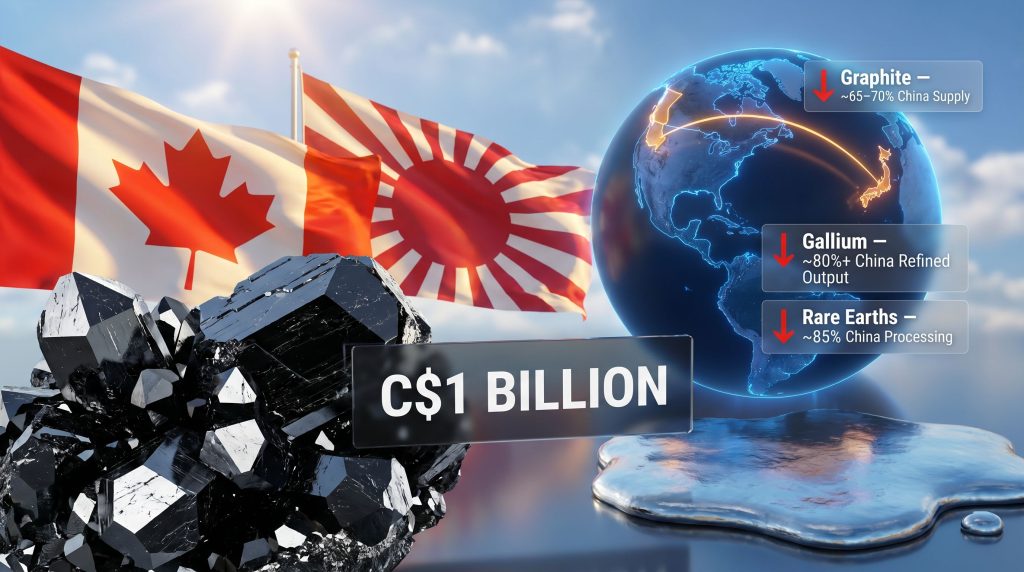
Graphite is the dominant anode material in lithium-ion batteries. Every electric vehicle, grid-scale battery storage system, and consumer electronics device relies on it. The global graphite shortage is compounded by China controlling an estimated 65 to 70 percent of global graphite supply, with an even larger share of the processing capacity that converts raw flake graphite into battery-grade spherical graphite. Without access to this processing infrastructure, raw graphite from other jurisdictions cannot easily substitute.
Gallium sits at the intersection of civilian and military technology. It is essential for gallium in semiconductors used in 5G networks, satellite communications, radar systems, and advanced weapons guidance. China's share of refined gallium output exceeds 80 percent globally, making it perhaps the most concentrated of all critical mineral supply points. China's export restrictions on gallium, introduced in stages since 2023 and expanded in 2026, have already forced allied governments to confront the depth of this dependency.
| Mineral | Primary Industrial Use | China's Estimated Market Share | Strategic Risk Level |
|---|---|---|---|
| Graphite | EV battery anodes | 65-70% of global supply | Very High |
| Gallium | Semiconductors, radar, defense | 80%+ of refined output | Extreme |
| Rare Earths | EV motors, magnets, military hardware | ~60% mining; ~85% processing | Very High |
| Cobalt | Battery cathodes | Major processing dominance | High |
What the Canada-Japan Framework Actually Proposes
The structure of the Canada and Japan critical minerals joint stockpiling initiative is built on three interconnected pillars, each addressing a different point of vulnerability in the supply chain.
Pillar One: Joint Mining Project Development
Canadian extraction assets, particularly in graphite, nickel, cobalt, and rare earths, represent significant untapped capacity. Joint development arrangements with Japanese capital could accelerate the conversion of reserve endowment into operational production. Canada's political stability, established rule-of-law mining frameworks, and increasingly recognised ESG compliance standards make it a preferred jurisdiction for allied investors seeking alternatives to operations in geopolitically complex regions.
Pillar Two: Long-Term Off-Take Agreements
The framework off-take agreement between Nouveau Monde Graphite and Panasonic represents the structural template this partnership is seeking to replicate and scale. This type of arrangement creates a committed demand signal for Canadian producers before a mine reaches full operational capacity, which is often the decisive factor in securing project financing.
For Japanese manufacturers, it locks in specification-grade supply from a non-Chinese source. The commercial logic is mutually reinforcing: Canadian producers gain bankable revenue certainty, Japanese buyers gain supply chain resilience.
Pillar Three: Coordinated Stockpiling Arrangements
This is the most structurally novel element of the proposed cooperation. Joint stockpiling goes beyond purchasing agreements by establishing physical reserves held in designated facilities, functioning analogously to strategic petroleum reserves but for industrial minerals. The governance architecture for such an arrangement would need to address reserve thresholds, drawdown triggers, replenishment cycles, and cost-sharing between the two governments.
Strategic mineral stockpiling fundamentally changes the risk calculus for allied manufacturers. Rather than managing supply disruption as a crisis event, pre-positioned reserves convert a potential shock into a manageable buffer, buying time for alternative sourcing to be activated.
The Commercial Signal: C$1 Billion and What It Reveals
The scale of Canada's June 2026 trade mission to Japan communicates something important about the urgency driving this partnership. Approximately 300 participants from nearly 180 companies and organisations made up the delegation, described as the largest Canadian trade mission to the Asia-Pacific region. According to reporting by Mining Weekly, the commercial agreements signed during the mission exceeded C$1 billion, equivalent to approximately US$705 million, spanning critical minerals and energy sectors.
This figure is significant not because of its absolute size, but because of what it signals about corporate behaviour relative to formal government frameworks. Private sector actors were committing capital and executing agreements ahead of any formalised intergovernmental stockpiling treaty. This pattern, where commercial logic validates policy architecture before the policy is fully constructed, typically indicates a convergence of interests robust enough to sustain long-term institutional development.
Mitsubishi Corporation's active interest in expanding its Canadian investment portfolio, expressed during International Trade Minister Maninder Sidhu's meetings in Tokyo, adds another dimension. Mitsubishi is already a key investor in LNG Canada, the first major liquefied natural gas export facility in North America with direct Pacific Coast access, located in Kitimat, British Columbia. This existing energy relationship creates an established foundation of commercial trust and operational familiarity that can be extended into minerals cooperation more readily than starting from zero.
The G7 Scaffolding: How Bilateral Deals Fit a Multilateral Strategy
The Canada-Japan initiative does not exist in isolation. The G7 critical minerals strategic alliance formalised in the week prior to the June 2026 Tokyo trade mission created a multilateral framework within which bilateral arrangements can operate. The core G7 commitment centred on reducing geographic concentration in mineral sourcing, using diplomatic language that notably avoided naming China explicitly.
This diplomatic framing is deliberate. Allied governments are building supply chain alternatives while preserving the option to maintain trade relationships with Beijing. The language of diversification rather than decoupling allows policy to advance without triggering retaliatory escalation.
Furthermore, Canada has also advanced a proposal that analysts have begun describing as a buyers' club model. The mechanics work as follows:
- Allied governments pre-commit to purchasing specified volumes of designated minerals from approved non-Chinese suppliers.
- These volume commitments create a guaranteed demand floor that makes project investment economically viable, even when Chinese state-backed producers are pricing below market rates through subsidy mechanisms.
- The price floor effectively inverts the competitive dynamic that has historically suppressed Western mining investment, where low Chinese spot prices made allied projects appear uneconomical against conventional financing metrics.
- Over time, the critical mass of committed demand creates sufficient market depth to sustain a genuinely alternative supply ecosystem.
This model draws a direct parallel to how strategic petroleum reserves were used historically, not just as physical buffers against disruption, but as demand signals that influenced investment decisions in upstream production.
Consequently, the broader shift in critical minerals demand across G7 economies is reinforcing the commercial case for these new procurement frameworks at an accelerating pace.
Canada's Structural Advantages and Its Critical Bottleneck
Canada's resource endowment across graphite, nickel, cobalt, lithium, and rare earth deposits is well documented. What is less frequently examined is the combination of complementary advantages that make Canada specifically attractive as a partner rather than simply as a resource province.
Political and regulatory stability across federal and provincial mining frameworks, while complex, operates within predictable rule-of-law structures that international investors can model and manage. This contrasts sharply with jurisdictions where resource nationalism, permitting unpredictability, or political instability introduce variables that undermine project bankability.
Pacific-facing logistics infrastructure is increasingly relevant. LNG Canada's Kitimat facility establishes that Canadian resource exports can reach Asian markets competitively. The same coastal corridor creates potential logistics infrastructure for mineral concentrate shipment, reducing transit costs and time for Japanese industrial buyers.
ESG compliance frameworks matter to Japanese corporate buyers whose own supply chains face scrutiny from investors and regulators. Sourcing from Canadian operations that meet international environmental and labour standards reduces downstream reputational and regulatory exposure for Japanese manufacturers.
However, one structural constraint stands above all others as the limiting factor in the partnership's long-term ambitions: midstream processing capacity.
Canada holds extraction reserves, but the conversion of mined material into refined, specification-grade product suitable for battery manufacturing or semiconductor fabrication requires processing infrastructure that Canada currently lacks at scale. This is not a trivial gap. Rare earth processing, for example, involves complex separation chemistry that China has developed and refined over decades of deliberate investment.
Building equivalent capacity in Canada requires capital, expertise, environmental permitting, and time measured in years rather than months. This is where Japanese industrial expertise becomes the complementary capability. Japan's advanced materials processing knowledge, combined with Canadian raw material access, could create a genuinely integrated bilateral supply chain. Without that processing dimension, stockpiling arrangements address supply assurance for raw material but do not resolve the value-added processing dependency.
The next major ASX story will hit our subscribers first
Japan's Institutional Memory and Why It Shapes Current Policy
Japan's urgency in pursuing mineral supply diversification is reinforced by historical experience that gives its policymakers a particular sensitivity to this class of risk. The 2010 rare earth supply disruption, triggered by diplomatic tensions over the Senkaku Islands, saw China temporarily restrict rare earth exports to Japan.
That episode caused immediate disruption to Japanese manufacturing and has informed supply chain policy thinking in Tokyo ever since. In addition, the broader lessons drawn from rare earth supply chains globally have reinforced Japan's determination to avoid single-source dependencies across all critical mineral categories.
The February 2026 restrictions on dual-use material exports to 20 Japanese entities were interpreted through exactly this institutional lens. The affected companies span sectors including advanced electronics and defence-related manufacturing. For Japanese policymakers, the episode confirmed that the 2010 precedent was not an anomaly but a repeatable instrument of economic statecraft.
This historical sensitivity explains why Japan's approach to the Canada partnership is characterised by genuine urgency rather than exploratory interest. The commercial commitments made during the June 2026 trade mission reflect a policy posture that has already moved past the analysis phase.
Scenario Pathways: Three Futures for the Joint Stockpiling Framework
Scenario One: Coordinated Reserve Build (Baseline)
Canada and Japan formalise minimum reserve thresholds for graphite and gallium within existing bilateral trade and investment frameworks. Japanese manufacturers gain supply assurance against short-term disruption. Canadian producers gain long-term demand visibility that makes project financing more accessible.
Based on comparable strategic reserve development timelines, operational stockpiles could be established within three to five years. Chinese export leverage would face moderate reduction in the near term, with more significant structural reduction over a decade.
Scenario Two: G7 Multilateral Expansion (Optimistic)
The bilateral framework becomes a template adopted across G7 membership, creating a coordinated allied stockpile covering rare earths, graphite, gallium, cobalt, and lithium. Combined purchasing power generates a structural alternative to Chinese supply at scale, with member state commitments creating the demand floor that makes non-Chinese projects consistently bankable.
The model bears some resemblance to the approach taken by the European critical raw materials facility, which similarly seeks to pool allied demand commitments to underpin non-Chinese supply development. The primary risks in this scenario are coordination complexity and the divergence of national economic interests among G7 members.
Scenario Three: Chinese Escalation Stress Test (Downside)
China expands export restrictions beyond the entities targeted in February 2026, creating a supply shock that accelerates allied stockpiling urgency while simultaneously exposing the processing capacity gaps that raw material reserves cannot bridge alone. In this scenario, the absence of domestic midstream processing infrastructure in Canada and Japan becomes the binding constraint.
Policy response would require accelerated capital deployment into Canadian refining capacity, potentially through development finance institutions and export credit mechanisms on both sides. As analysts at IndexBox have noted, the speed at which allied governments can mobilise processing investment will ultimately determine whether Canada and Japan critical minerals joint stockpiling achieves its strategic objectives under pressure.
Key Takeaways for Understanding the Canada-Japan Minerals Partnership
- The transition from market-efficiency logic to security-based procurement is now structurally underway among G7 economies, not merely discussed at the policy level.
- C$1 billion-plus in commercial commitments from Canada's largest-ever Asia-Pacific trade delegation demonstrates that corporate actors are validating the partnership's commercial logic independently of formal government frameworks.
- The Nouveau Monde Graphite-Panasonic off-take model provides a replicable template for other mineral categories, including gallium, rare earths, and cobalt.
- Midstream processing capacity is the decisive bottleneck. Japanese industrial expertise combined with Canadian resource endowment could create an integrated bilateral supply chain, but only with deliberate capital investment in Canadian processing infrastructure.
- The buyers' club model Canada is advocating within the G7 represents a structural intervention in mineral markets, not a market correction, and could fundamentally change the economics of non-Chinese supply projects if adopted at multilateral scale.
- Japan's institutional memory of the 2010 rare earth disruption means its engagement with the Canada and Japan critical minerals joint stockpiling framework is driven by genuine strategic urgency, creating a durable political foundation for long-term partnership.
- Strengthening rare earth supply chains outside of Chinese control remains one of the most complex and capital-intensive challenges embedded within this broader bilateral agenda.
This article contains forward-looking analysis, scenario modelling, and assessments of policy trajectories. Readers should note that outcomes in geopolitical and commodity markets are subject to significant uncertainty, and nothing in this article constitutes financial advice or an endorsement of any specific investment.
Want to Identify ASX Discoveries in Critical Minerals Before the Broader Market Does?
As geopolitical pressure reshapes global supply chains for graphite, gallium, and rare earths, the window to act on emerging ASX mineral discoveries is narrowing — Discovery Alert's proprietary Discovery IQ model delivers real-time alerts the moment significant discoveries hit the exchange, turning complex mineral data into actionable insights, so whether you're a short-term trader or a long-term investor, you can begin your 14-day free trial today, or explore historic discoveries and their returns to understand just how transformative early positioning in critical minerals can be.