May 14, 2026
What Makes Canada's LNG Strategy a Game-Changer for Asian Energy Security?
Canada LNG India energy cooperation is emerging as a transformative force in global energy markets, fundamentally reshaping traditional supply chains and strategic partnerships. Global energy security dynamics are facing unprecedented stress testing as traditional supply chains encounter geopolitical tensions and supply concentration risks. The intersection of these challenges with growing Asian energy demand has created a strategic opening for North American energy exporters to redefine their role in global markets.
Canada's emergence as a potential LNG powerhouse represents more than infrastructure development. It signals a fundamental shift in how energy-importing nations approach supply diversification and long-term security planning, particularly in addressing Canada's energy transition challenges.
When big ASX news breaks, our subscribers know first
British Columbia's Infrastructure Build: Timeline and Capacity Analysis
Canadian natural gas reserves position the nation as a formidable player in global LNG markets, with proven natural gas reserves of approximately 2.1 trillion cubic metres representing the world's third-largest proven reserves after Russia and Iran. However, the reality of production capacity tells a more nuanced story than initial projections might suggest.
Currently, LNG Canada's Kitimat facility stands as British Columbia's sole operational LNG export terminal, operating at 14 million tonnes per annum capacity since 2017. This facility has achieved 85-90% nameplate capacity utilization during full operational periods, demonstrating the technical viability of Canadian LNG operations in challenging Pacific maritime conditions.
The infrastructure expansion pipeline includes several projects in various development stages:
- Woodfibre LNG (Squamish): Approved by Federal Cabinet in December 2021 with 4.7 mtpa proposed capacity, though construction timelines remain uncertain
- Cedar LNG (Kitimat): 5 mtpa proposed capacity facing regulatory hurdles with uncertain permitting outcomes
- Pacific NorthWest LNG (Prince Rupert): Indefinitely suspended by Petronas in 2017 with no recent development activity
Rather than the simultaneous development of six facilities, the Canadian LNG sector faces the complex reality of federal and provincial approval processes requiring 3-7 years for completion, including National Energy Board reviews, Environmental and Socio-economic Assessment processes, and comprehensive Indigenous consultation requirements.
Canada's Reserve Advantage: Sustainability vs. Market Timing
Canada's natural gas production reached 194.7 billion cubic metres in 2023, with approximately 70-75 billion cubic metres available for export after meeting domestic consumption demands. The frequently cited "100-year reserve" figure reflects theoretical ultimate recoverable reserves including unconventional and undiscovered resources, requiring significant technological advancement and capital investment to realise.
At current production rates, Canadian proven reserves equate to approximately 15-20 years of production at domestic consumption levels. This distinction between proven reserves and ultimate recoverable resources represents a critical factor in long-term supply planning for Asian importers seeking multi-decade supply security.
Shipping logistics present both opportunities and challenges:
- Pacific route from British Columbia to India: 7,800-8,200 nautical miles with 28-32 day transit times
- Distance comparison reveals Canadian routes are 1,500-2,500 nautical miles longer than Middle Eastern or Australian suppliers
- LNG carriers with 138,000 to 174,000 cubic metre capacity require specialised berth infrastructure at both export and import terminals
The cryogenic liquefaction process reduces natural gas to approximately 1/600th of original volume at -162°C, enabling maritime transport but requiring substantial energy input and specialised infrastructure investment.
Why Is India Positioning Itself as Canada's Primary Asian LNG Partner?
India's energy import strategy reflects sophisticated risk management principles rarely discussed in conventional energy analysis. The nation's approach to supplier diversification extends beyond simple cost optimisation to encompass geopolitical stability, contract flexibility, and long-term supply security considerations.
India's Import Diversification Strategy: Moving Beyond Traditional Suppliers
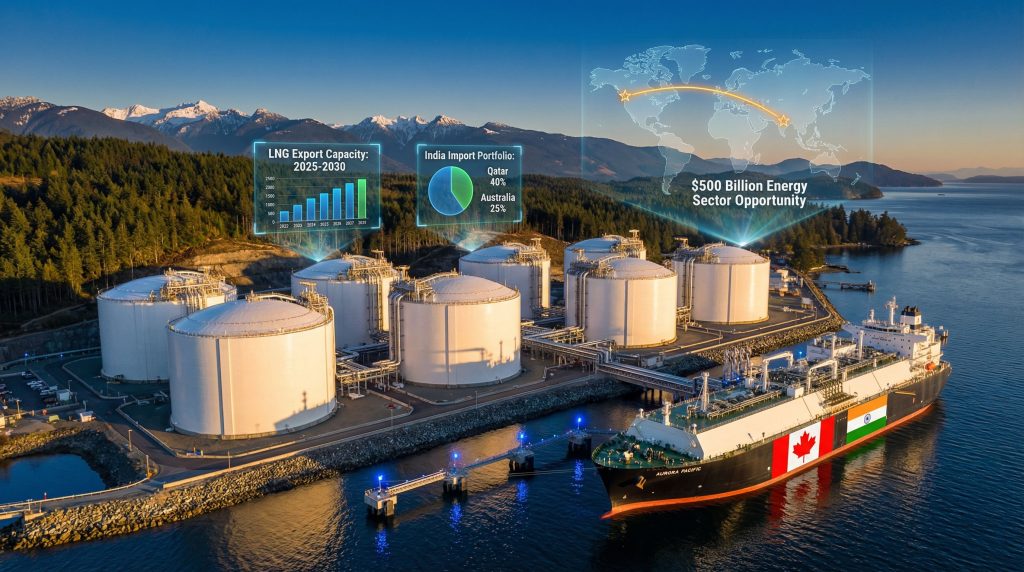
India's 32.5 million tonnes of LNG imports in 2024 represent approximately 20% of global LNG trade volume, positioning the nation as one of the world's most influential LNG buyers. The current import portfolio demonstrates strategic concentration management:
| Supplier Region | Import Share | Volume (mtpa) | Key Characteristics |
|---|---|---|---|
| Qatar | 40-42% | 10.5-13.5 | Long-term contracts, Henry Hub pricing |
| Australia | 22-25% | 7.0-8.5 | Multiple project sources, spot flexibility |
| United States | 8-10% | 2.6-3.3 | Growing share, flexible contracting |
| Russia | 5-7% | 1.6-2.3 | Post-2022 energy shift adaptation |
| Others | 15-18% | 4.9-5.9 | Malaysia, Brunei, Indonesia, PNG |
India's natural gas production of 32-35 billion cubic metres annually meets only 40-45% of domestic demand, creating a structural import dependency that LNG and pipeline gas must address. Projected demand growth to 65-75 mtpa by 2030 reflects industrial expansion and gas-based power generation increases.
The strategic rationale for Canada LNG India energy cooperation involves reducing single-supplier concentration risk while accessing politically stable, democratic supply sources with established rule-of-law frameworks. This approach mitigates potential supply disruptions, political tensions, or price manipulation concerns from concentrated supplier relationships.
IOCL's Canadian Investment Strategy: Beyond Simple Purchase Agreements
Indian Oil Corporation Limited operates with substantial financial capacity for international upstream investments, maintaining approximately INR 1.45-1.65 trillion market capitalisation and 12 million barrels per day refining capacity across six refineries. IOCL's existing international portfolio includes upstream equity stakes in Vietnam's Phu Khanh Block and partnerships with Woodside Energy in Australia's Exmouth Gulf operations.
The company's engagement approach involves chairman-level meetings and direct investment commitments, signalling institutional dedication beyond routine procurement discussions. This high-level engagement framework suggests IOCL views Canadian energy assets as strategic portfolio additions rather than simple supply contracts.
IOCL's investment evaluation criteria typically include:
- Return-on-investment thresholds for international upstream projects
- Political and regulatory risk assessment in target jurisdictions
- Technical complexity and operational feasibility analysis
- Long-term supply security benefits for downstream operations
India operates five operational LNG regasification terminals with combined capacity of 36-38 mtpa, providing infrastructure headroom for projected import growth. These facilities include Dahej (17.5 mtpa), Hazira (5 mtpa), Kochi (5 mtpa), Mundra (5 mtpa), and Kolkata floating storage regasification unit (3.2 mtpa).
How Do Critical Minerals Factor Into This Energy Alliance?
The convergence of energy transition demands and supply chain security concerns has elevated critical minerals to strategic commodity status. Canada's geological endowment positions the nation as a potential anchor supplier for India's battery manufacturing ambitions and renewable energy infrastructure development.
Canada's Critical Mineral Reserves: Strategic Value for India's Energy Transition
Canada contains estimated recoverable lithium reserves of approximately 3.0 million tonnes in spodumene and brine deposits, concentrated in Quebec and Ontario provinces. However, current production represents only 1-2% of global lithium production, producing approximately 30,000-50,000 tonnes annually with substantial growth potential from development-stage projects.
Major Canadian lithium developments include:
- Sigma Lithium Corporation's Coosas Project (Quebec): Advanced development stage with high-grade spodumene deposits
- Multiple Quebec-based projects: Leveraging provincial geological advantages and established mining infrastructure
- Ontario exploration programmes: Focusing on hard-rock lithium extraction methodologies
Canadian cobalt resources primarily emerge as by-products of nickel and copper mining rather than dedicated cobalt operations. Estimated production potential reaches 3,500-5,500 tonnes annually, representing less than 5% of global cobalt production but providing geographically diversified supply for battery manufacturing applications.
The strategic value extends beyond raw material availability to encompass processing capabilities, environmental standards, and supply chain transparency increasingly demanded by technology manufacturers and end-users concerned about ethical sourcing. These considerations align with critical minerals energy security objectives and support India's plans for a battery-grade lithium refinery.
ONGC's Global Upstream Expansion: Canadian Opportunities in Context
Oil and Natural Gas Corporation's international expansion strategy reflects India's broader energy security objectives through upstream asset diversification. The corporation actively pursues global upstream agreements across multiple jurisdictions, seeking to reduce dependence on imported energy through equity oil and gas production.
ONGC's current international operations provide precedent for Canadian engagement, demonstrating proven capability to negotiate, finance, and operate international energy assets. The corporation's relatively modest market capitalisation compared to international oil majors creates opportunities for strategic partnerships rather than outright acquisitions.
Key factors in ONGC's international investment decisions include:
- Geological prospectivity and reserve replacement potential
- Political and regulatory stability in target jurisdictions
- Operational complexity and technical requirements
- Long-term strategic value for India's energy security
Canadian upstream opportunities align with these criteria through established regulatory frameworks, advanced technical infrastructure, and long-term resource potential in conventional and unconventional hydrocarbon deposits.
What Are the Geopolitical Implications of Deeper Canada-India Energy Ties?
Energy relationships increasingly function as geopolitical anchors, extending beyond commercial transactions to encompass diplomatic influence, strategic partnerships, and multilateral engagement frameworks. Canada LNG India energy cooperation represents a strategic pivot toward democratic, rule-of-law suppliers for both nations.
Reducing India's Energy Import Concentration Risk
India's historical reliance on Qatar (40-42% of LNG imports) and Australia (22-25% of LNG imports) creates potential vulnerability to supply disruptions, contract disputes, or political tensions. Geographic diversification through Canadian supply sources provides strategic buffer capacity during crisis scenarios.
Political stability comparison reveals significant advantages:
| Supplier | Political Risk Rating | Regulatory Framework | Contract Enforceability |
|---|---|---|---|
| Canada | Low | Established common law | High |
| Australia | Low | Established common law | High |
| Qatar | Moderate | Civil law/Islamic | Moderate |
| Russia | High | Variable enforcement | Low |
Democratic governance structures in both Canada and India provide compatible regulatory and legal frameworks for long-term commercial relationships. This compatibility reduces transaction costs, dispute resolution complexity, and contract enforcement challenges common in cross-border energy transactions.
Canada's Non-US Export Diversification Goals
Canada currently exports 97-98% of energy products to the United States, creating strategic dependence on a single market despite positive bilateral relationships. Diversification targets include doubling non-US trade by 2030, with Asia-Pacific markets representing the most significant growth opportunity.
LNG market competition dynamics reveal competitive challenges:
- US Gulf Coast facilities benefit from Henry Hub pricing advantages and shorter Atlantic shipping routes
- Australian projects maintain cost advantages for Asian markets through proximity and established relationships
- Canadian facilities must compete through long-term contract stability and supply security guarantees
India represents a strategic anchor market for Canadian diversification objectives, providing long-term contract potential, growing demand, and strategic partnership opportunities beyond simple commodity transactions. This approach aligns with broader critical minerals strategy initiatives and renewable energy transformations.
The next major ASX story will hit our subscribers first
Which Investment Opportunities Will Drive This Partnership Forward?
Investment flows between Canada and India in the energy sector require sophisticated financial structures addressing currency risks, regulatory compliance, and long-term performance guarantees. Bilateral cooperation extends beyond fossil fuel development to encompass clean energy technologies and critical mineral processing capabilities.
Bilateral Investment Flow Projections: Infrastructure and Technology
LNG export capacity development requires capital expenditure of USD 8-15 billion per mtpa depending on project location and technical complexity. Canadian Pacific coast facilities face additional challenges including challenging marine conditions, seasonal weather constraints, and comprehensive Indigenous consultation requirements.
Indian private sector participation opportunities include:
- Equity stakes in upstream natural gas development projects
- Joint venture partnerships in LNG liquefaction facilities
- Technology sharing agreements for clean energy applications
- Supply chain integration for critical mineral processing
Investment structures must address currency hedging requirements, political risk insurance, and dispute resolution mechanisms suitable for multi-decade commercial relationships.
Clean Energy Collaboration Framework: Beyond Fossil Fuels
Canada's renewable energy potential extends beyond hydroelectric generation to encompass hydrogen production, small modular reactor technology, and carbon capture and storage applications. These technologies align with India's net-zero commitments and industrial decarbonisation objectives.
Hydrogen production potential leverages:
- Abundant renewable energy resources for electrolytic hydrogen production
- Existing natural gas infrastructure for blue hydrogen development with carbon capture
- Maritime shipping expertise for hydrogen carrier transportation to Asian markets
- Technical expertise in cryogenic gas handling and processing
Small modular reactor collaboration addresses India's baseload power requirements while supporting climate objectives. Canadian reactor technology provides enhanced safety systems, standardised manufacturing, and reduced construction timelines compared to conventional nuclear facilities.
What Challenges Could Derail Canada-India Energy Cooperation?
Successful energy partnerships require alignment of technical capabilities, commercial interests, and regulatory frameworks across multiple jurisdictions. Canada LNG India energy cooperation faces specific challenges related to infrastructure development, environmental approvals, and competitive market dynamics.
Shipping and Logistics Constraints: Pacific Route Optimisation
Transportation cost differentials significantly impact Canadian LNG competitiveness:
- Canadian LNG delivered cost to India: Estimated USD 11-14 per MMBtu including production, liquefaction, shipping, and regasification
- Australian LNG delivered cost: Estimated USD 9-12 per MMBtu leveraging proximity advantages
- Qatari LNG delivered cost: Estimated USD 8-11 per MMBtu through established supply relationships
LNG carrier availability presents operational constraints:
- Global LNG carrier fleet: Approximately 600 vessels with 80% utilised for established trade routes
- New vessel construction: 24-36 month delivery timelines with increasing construction costs
- Seasonal shipping considerations: Pacific winter weather impacts loading and discharge operations
Port infrastructure requirements include specialised LNG berths, cryogenic handling systems, and backup power and safety systems meeting international maritime safety standards.
Regulatory and Environmental Hurdles: Timeline Risk Factors
Canadian federal and provincial approval processes involve comprehensive environmental impact assessments, Indigenous consultation requirements, and climate policy alignment with federal net-zero commitments. These processes typically require 3-7 years for completion with outcomes uncertain until final decisions.
Key regulatory checkpoints include:
- Impact Assessment Agency of Canada review for major projects
- National Energy Board export licence approvals
- Provincial environmental assessments for facility construction
- Indigenous consultation and accommodation requirements
- Municipal zoning and permitting approvals
Environmental considerations increasingly emphasise lifecycle carbon emissions, methane leakage prevention, and compatibility with national climate targets. These requirements may increase project costs and development timelines beyond initial projections.
How Will This Partnership Reshape Global Energy Trade Patterns?
The emergence of Canada as a significant LNG supplier to Asian markets represents a structural shift in global energy trade patterns. Traditional supplier-customer relationships face competition from new market entrants offering alternative contract structures, supply security guarantees, and political stability advantages.
Impact on Traditional LNG Suppliers: Market Share Redistribution
Qatar's response to Canadian competition may include:
- Enhanced contract flexibility including shorter-term agreements and price adjustment mechanisms
- Downstream investment participation in Indian regasification and distribution infrastructure
- Technology transfer agreements for petrochemical and gas-to-liquids applications
- Strategic partnership development beyond simple supply contracts
Australia's competitive response options include:
- Cost optimisation through operational efficiency improvements and technology deployment
- Contract term flexibility including spot market participation and seasonal supply agreements
- Value-added services including financing support and technical assistance
- Regional partnership development with other Asia-Pacific energy consumers
Pricing pressure on established Asian LNG contracts reflects increasing buyer leverage as supply options diversify. Long-term contracts may incorporate more flexible pricing mechanisms, take-or-pay modifications, and destination flexibility clauses previously unavailable in seller-dominated markets.
Asia-Pacific Energy Security Evolution: Canada as a New Pillar
Regional energy import diversification trends reflect growing awareness of supply concentration risks, geopolitical dependencies, and price volatility management requirements. Canada's entry into Asia-Pacific LNG markets provides additional supply optionality for energy planners throughout the region.
Integration with existing multilateral frameworks includes:
- International Energy Agency emergency response mechanisms
- Asia-Pacific Economic Cooperation energy security initiatives
- ASEAN energy cooperation frameworks and emergency sharing agreements
- Quad partnership infrastructure development and technology sharing programmes
Canada's democratic governance structure and commitment to international law provides compatible partnership frameworks for multilateral energy security initiatives increasingly important in regional strategic planning. Moreover, as highlighted by S&P Global's analysis, India is actively looking to tap Canada to meet its growing appetite for crude, LPG, and LNG supplies.
What Does Success Look Like for Both Nations by 2030?
Measurable outcomes for Canada LNG India energy cooperation require specific performance indicators addressing trade volumes, investment flows, and strategic benefit realisation. Success metrics must account for market volatility, regulatory changes, and evolving technology landscapes.
Measurable Outcomes: Trade Volume and Investment Targets
LNG export volume projections from Canada to India:
- Conservative scenario: 3-5 mtpa by 2030 representing 15-20% of India's projected LNG imports
- Optimistic scenario: 8-12 mtpa by 2030 representing 25-35% of India's projected LNG imports
- Market conditions: Dependent on infrastructure completion, contract negotiations, and competitive pricing
Critical minerals trade value estimates:
- Lithium compounds: USD 500 million – 1.2 billion annually by 2030
- Cobalt and rare earth elements: USD 200-400 million annually
- Processing and technology transfer: USD 300-600 million in collaborative investments
Job creation and economic impact assessments:
- Canadian energy sector employment: 15,000-25,000 direct and indirect positions
- Indian manufacturing and processing: 20,000-35,000 positions in energy-related sectors
- Technology transfer and expertise development: Substantial but difficult to quantify economic benefits
Strategic Benefits Realisation: Energy Security and Economic Growth
India's energy import cost reduction potential:
- Diversification benefits: Estimated 5-12% reduction in average LNG procurement costs through competitive bidding
- Supply security premium: Reduced risk-adjusted energy costs through supplier diversification
- Contract flexibility: Enhanced negotiating position with traditional suppliers
Canada's energy export revenue diversification:
- Non-US market share targets: Increase from current 2-3% to 15-25% of energy exports by 2030
- Price realisation improvements: Reduced dependence on North American price benchmarks
- Strategic relationship development: Enhanced bilateral cooperation across multiple sectors
Technology and expertise exchange creates long-term value through collaborative research and development, joint infrastructure projects, and shared approaches to energy transition challenges. These benefits extend beyond measurable trade flows to encompass strategic partnership development and diplomatic relationship strengthening.
Furthermore, according to Energy Connects, Canada eyes doubling trade relations with India to $60 billion by the end of the decade, underscoring the ambitious scope of this partnership.
Disclaimer: This analysis contains forward-looking statements and projections based on current information and market conditions. Actual outcomes may vary significantly due to market volatility, regulatory changes, technological developments, and geopolitical factors. Readers should conduct independent research and consult qualified professionals before making investment or policy decisions.
Ready to Invest in the Next Major Mineral Discovery?
Discovery Alert instantly alerts investors to significant ASX mineral discoveries using its proprietary Discovery IQ model, turning complex mineral data into actionable insights. Understand why historic discoveries can generate substantial returns by exploring Discovery Alert's dedicated discoveries page, showcasing exceptional outcomes from companies like De Grey Mining and WA1 Resources. Begin your 14-day free trial today at Discovery Alert to position yourself ahead of the market.