July 10, 2026
The Hidden Cost of Conventional Mining and Why Canada Is Changing the Equation
Every tonne of waste rock blasted from a narrow vein deposit tells the same story: extraction methods that made economic sense in the twentieth century are increasingly incompatible with the environmental, financial, and supply chain demands of the twenty-first. As green energy transitions accelerate global critical minerals demand for lithium, cobalt, nickel, and rare earth elements, the gap between what conventional mining delivers and what modern supply chains require is widening fast.
Canada is responding to this gap not merely with policy statements, but with targeted capital deployment into the technologies reshaping how critical minerals are found, extracted, monitored, and cleaned up. The federal government's decision to direct C$6.7 million toward two Canadian mining technology companies reflects a broader strategic posture: that Canada invests in mine tech projects because the nation's long-term competitiveness in critical mineral supply chains depends as much on technological leadership as it does on geological endowment.
When big ASX news breaks, our subscribers know first
Canada's Critical Minerals Strategy: Capital Allocation With a Purpose
The C$6.7 million investment, announced by Industry Minister Mélanie Joly, is not a standalone commitment. It sits within the architecture of Canada's C$4 billion Critical Minerals Strategy, a multi-year federal framework designed to strengthen domestic supply chains, reduce dependency on foreign processing capacity, and position Canadian companies at the forefront of mining innovation. Furthermore, this critical minerals strategy reflects a growing international consensus that mineral supply security is a geopolitical priority.
A critical but often overlooked dimension of this strategy is its dual-value structure. Federal funding in mine technology does not simply subsidise extraction. It simultaneously creates measurable environmental performance improvements, generates high-skill employment, and builds exportable intellectual property in technology domains with global commercial relevance.
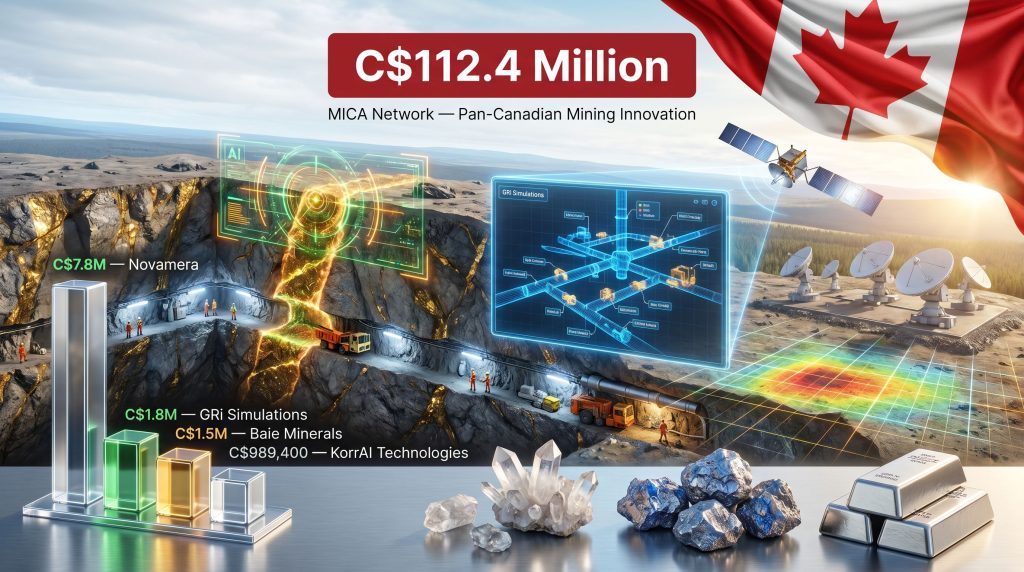
The specific investment vehicle delivering these outcomes is the Mining Innovation Commercialization Accelerator (MICA) Network, launched in 2021 with C$40 million in seed capital from the Strategic Innovation Fund. MICA has since grown into a C$112.4 million pan-Canadian initiative, with regional delivery infrastructure including bodies such as InnoTech Alberta providing provincial-level project management and due diligence.
How MICA's Two-Call Structure Works
MICA operates through a competitive call structure, with each funding round targeting distinct technology maturity levels and industry challenges. The program's second call has now concluded, selecting 24 projects across multiple provinces and deploying C$15 million in federal capital. According to Canada's critical minerals investment updates, the technology categories funded span a revealing cross-section of the industry's most urgent challenges:
- AI-assisted precision extraction in narrow vein deposits
- Dynamic mine operations simulation using digital twin platforms
- Satellite-based remote monitoring of ground movement and structural risk
- Sustainable mineral processing combined with legacy waste remediation
The program's co-investment model is central to its design logic. The C$15 million in public funding from the second call is structured to attract more than C$100 million in matching private investment, representing a leverage ratio exceeding 6:1. This multiplier effect is the metric by which MICA's efficiency as a public innovation program should be evaluated, and by current design, it is an ambitious but credible target given the commercial urgency of the technology domains being funded.
Where the C$6.7 Million Is Going: A Project-Level Analysis
The specific C$6.7 million tranche announced by Minister Joly flows to two companies: Ontario-based Novamera Inc. and its collaborator Koonkie. Within the broader MICA second-call context, Novamera received the largest single allocation across the round at C$7.8 million, underscoring the program's confidence in surgical mining as a priority technology category.
MICA Second Call: Funded Projects Overview
| Company | Province | Federal Funding | Primary Technology |
|---|---|---|---|
| Novamera Inc. | Ontario | C$7.8 million | AI surgical mining, narrow vein targeting |
| GRi Simulations Inc. | Newfoundland & Labrador | C$1.8 million | Digital twin mine operations simulation |
| Baie Minerals Inc. | Newfoundland & Labrador | C$1.5 million | Sustainable extraction, asbestos remediation |
| KorrAI Technologies Ltd. | Nova Scotia | C$989,400 | Satellite AI monitoring (InSAR) |
| 20 additional projects | Pan-Canadian | Remaining C$15M allocation | Various mining innovation categories |
Novamera: Surgical Mining at the Hammerdown Deposit
Novamera's core proposition challenges one of mining's most persistent inefficiencies: ore dilution in narrow vein deposits. Conventional bulk mining methods extract not only the target mineral but also surrounding waste rock, reducing overall ore grade and increasing processing costs per tonne of recovered metal. In narrow vein gold systems, where veins may be only centimetres to a metre or two wide, dilution can effectively destroy the economics of an otherwise viable deposit.
Novamera's AI in mineral exploration and machine learning systems are designed to characterise ore boundaries in real time during the extraction process, enabling what the industry increasingly calls surgical mining. Rather than blasting wide corridors to access a narrow seam, the technology allows operators to follow the vein geometry with precision, dramatically reducing waste rock generation while improving recovered ore grade.
The application site is the Hammerdown mine, a narrow vein gold deposit in Ontario. The choice of application site is instructive: Hammerdown is not a theoretical exercise but an active development-stage asset where the commercial case for precision extraction is already being stress-tested against real geological conditions.
Narrow vein deposits have historically been abandoned or left uneconomic not because of insufficient mineralisation, but because the cost of dilution made bulk extraction financially marginal. Surgical mining technologies have the potential to reclassify a substantial portion of Canada's stranded narrow vein resource base as economically recoverable.
This reclassification potential is among the least-discussed but most commercially significant implications of AI-guided extraction. Canada hosts a substantial inventory of narrow vein gold and polymetallic deposits that have been characterised as sub-economic under conventional mining assumptions. If surgical mining can systematically reduce dilution from typical levels of 20–40% in narrow vein operations toward single-digit percentages, the economic threshold for viable extraction shifts meaningfully.
GRi Simulations: Digital Twins in Underground Mine Planning
Newfoundland and Labrador-based GRi Simulations received C$1.8 million to advance digital twin technology for mine operations. The concept of a digital twin involves creating a dynamic, data-fed virtual replica of a physical mine environment that planners can use to model, simulate, and stress-test operational decisions before committing physical capital.
The practical value is substantial. Underground mine development decisions frequently involve irreversible capital commitments. A shaft sunk in the wrong location, a haulage drift developed with inadequate gradient data, or a ventilation circuit designed without modelling dynamic blasting schedules can all result in cost overruns that dwarf the investment in simulation infrastructure.
What distinguishes modern digital twin platforms from earlier static mine planning software is their capacity for iterative real-time updating. As sensor data flows from operating equipment, ground support monitoring systems, and environmental instruments, the digital model continuously recalibrates against observed reality. This feedback loop allows mine planners to identify divergence between planned and actual conditions early enough to intervene before costly failures materialise.
KorrAI Technologies: Satellite Intelligence for Ground Movement Monitoring
Nova Scotia-based KorrAI Technologies secured C$989,400 to develop an AI-enhanced satellite monitoring platform using InSAR technology (Interferometric Synthetic Aperture Radar). Understanding what InSAR actually measures is essential context for appreciating its mining applications.
Technical Note: InSAR works by comparing phase differences between radar signals transmitted by satellites at different times. When the ground surface moves, even by millimetres, the phase shift in the returning radar signal encodes that displacement. Processing multiple satellite passes produces displacement maps covering hundreds of square kilometres with measurement precision in the range of a few millimetres per year.
In mining contexts, this capability translates into continuous, wide-area monitoring of:
- Open pit slope stability, where early displacement signals precede failure by weeks or months
- Tailings storage facility deformation, which regulatory frameworks increasingly require operators to track
- Post-closure site subsidence, a growing liability concern as the number of legacy mine sites requiring long-term monitoring expands
- Underground subsidence bowls at operating mines in populated areas
The cost differential between satellite monitoring programmes and traditional geotechnical instrumentation networks is significant. Physical sensor arrays require installation, maintenance, and periodic replacement, with access costs that escalate sharply at remote or hazardous sites. Satellite-based monitoring eliminates the access requirement entirely while covering areas that would require dozens of physical instruments to replicate.
Baie Minerals: Turning a Historical Liability Into Commercial Value
Perhaps the most technically distinctive project in the MICA second call is Baie Minerals, which received C$1.5 million to pursue dual-mandate extraction: recovering industrial minerals from active deposits while simultaneously processing legacy asbestos tailings to decontaminate sites that represent long-term environmental and community health liabilities.
Asbestos tailings are a material challenge in Canadian mining jurisdictions. Abandoned chrysotile asbestos mines, particularly concentrated in Quebec, left behind tailings piles that present ongoing regulatory, financial, and community risk. The key insight embedded in Baie Minerals' approach is that asbestos tailings are not purely a waste management problem.
The host rock in many asbestos tailings deposits contains recoverable magnesium silicate minerals with commercial applications in industrial processing. In some cases, the tailings may also be amenable to mineral carbonation processes that could permanently immobilise the fibre hazard while generating useful byproducts. This reframing of a liability as a recoverable asset class is consistent with a broader industry trend toward circular extraction economics, where the value chain extends beyond primary ore extraction to encompass previously discarded material streams. This approach also aligns closely with broader goals around mine reclamation and long-term site stewardship.
Four Technology Pillars Reshaping Canadian Mine Operations
Taken together, the MICA-funded projects illuminate four technology pillars that federal investment is actively building into the foundation of Canada's mining sector:
1. AI-Driven Precision Extraction
Machine learning systems capable of real-time ore body characterisation are moving from research settings into active mine environments. The reduction in dilution and waste generation creates compounding benefits: lower processing costs, reduced tailings volumes, and smaller environmental footprints per unit of recovered critical mineral.
2. Digital Twin and Simulation Platforms
The shift from static mine planning to dynamic, continuously updated simulation represents a fundamental change in how underground development decisions are made and validated. As sensor infrastructure costs fall and data integration improves, digital twin adoption is expected to accelerate across both new and operating mines.
3. Satellite Remote Sensing
InSAR and related satellite monitoring technologies are moving from academic and government applications toward routine commercial deployment. The combination of AI processing with satellite data streams is creating monitoring capabilities that were previously inaccessible to all but the largest mining companies.
4. Remediation and Circular Extraction
Regulatory pressure on legacy mine sites is intensifying at both provincial and federal levels. Technologies that convert historical liabilities into commercial opportunities represent a significant market opportunity for companies capable of demonstrating verified decontamination outcomes alongside mineral recovery.
Canada vs. Global Peers: How the Investment Compares
Canada's C$112.4 million MICA commitment represents a meaningful but not dominant investment by global comparison. Australia's Critical Minerals Facility has deployed comparable quantum in recent years, while the United States has channelled substantially larger sums through Inflation Reduction Act provisions for domestic critical mineral processing and associated technology development.
Where Canada faces a structural disadvantage that investment alone cannot easily resolve is permitting velocity. Analysis published by Mining Magazine indicates that Canadian mine permitting timelines average approximately six years longer than those in Australia, a structural drag that delays the commercial return on innovation investment regardless of the quality of the underlying technology.
When MICA-funded technologies reach commercialisation readiness, their ability to generate returns will depend partly on how quickly the mines they serve can progress through regulatory approval processes. Consequently, permitting reform remains a critical complement to technology investment in Canada's broader competitiveness agenda.
The private sector co-investment leverage ratio provides a useful benchmark for evaluating programme efficiency across jurisdictions. MICA's target of attracting more than C$100 million in private investment from C$15 million in public funding represents a 6.7:1 leverage ratio. Programmes achieving ratios below 3:1 are generally considered to be substituting for rather than catalysing private investment, while ratios above 5:1 are considered indicators of strong market confidence in the funded technology domains.
Economic and ESG Outcomes Beyond the Technology
Workforce and Regional Economic Value
MICA's projected retention of more than 400 highly skilled jobs across participating provinces is significant in regional economic terms. The geographic distribution of second-call funded projects across Ontario, Nova Scotia, and Newfoundland and Labrador reflects a deliberate effort to distribute innovation capacity beyond established mining technology clusters.
High-skill technology employment in resource-dependent regions provides economic resilience that commodity price cycles do not. A software engineer working on digital twin platforms or a remote sensing data scientist working on satellite monitoring applications retains their employment value regardless of whether gold is trading at US$2,000 or US$3,000 per ounce.
Supply Chain Security and Trade Relationships
Canada's role as a supplier of lithium, cobalt, nickel, and rare earth elements to electric vehicle manufacturers and clean energy developers creates a strategic alignment between domestic technology investment and international trade relationships. Both the European Union and the United States have established critical mineral frameworks that preference supply from jurisdictions meeting environmental and governance standards.
Technologies that demonstrably reduce the environmental footprint of Canadian mineral extraction — whether through surgical mining precision, satellite-monitored tailings management, or remediation of legacy contamination — strengthen Canada's position as a preferred supplier within these frameworks. This is not a speculative benefit. It is increasingly embedded in the procurement criteria of major EV manufacturers sourcing battery materials.
The Clean Growth Programme Contribution
Complementing MICA, Natural Resources Canada's Clean Growth Program has invested C$1.6 million in active clay analyser technology developed by the Saskatchewan Research Council, targeting both oil sands and mine tailings applications. Furthermore, according to reporting on Canada's clean mining investments, these commitments also extend to clean energy transitions and Indigenous partnership programmes, broadening the scope of federal support across the sector. This investment addresses a persistent measurement challenge: characterising the mineralogical composition of complex tailings streams in real time to optimise processing and closure planning decisions.
The next major ASX story will hit our subscribers first
Frequently Asked Questions
What is Canada's C$6.7 million mine tech investment funding?
The C$6.7 million announced by Industry Minister Mélanie Joly flows to Ontario-based Novamera Inc. and its collaborator Koonkie, supporting the development of AI-guided surgical mining technology for narrow vein critical mineral extraction. This investment is part of MICA's second funding call, which deployed C$15 million across 24 projects nationally. It is a clear example of how Canada invests in mine tech projects as part of a long-term industrial strategy.
What makes narrow vein mining technically challenging?
Narrow vein deposits present a fundamental tension between ore recovery and dilution. Conventional drilling and blasting methods disturb rock volumes far larger than the target vein, reducing ore grade by mixing waste rock with mineralised material. In deposits where veins are only tens of centimetres wide, this dilution effect can render otherwise economic mineralisation commercially marginal.
How does InSAR satellite monitoring work in mining?
InSAR compares radar signals from multiple satellite passes to detect ground surface displacement at millimetre-scale resolution. Mining operators use this data to monitor slope stability at open pit walls, track deformation in tailings storage structures, and identify subsidence patterns at both operating and closed mine sites — often without requiring physical access to the monitored area.
What is the total scale of Canada's mining innovation investment?
The MICA Network represents C$112.4 million in structured innovation funding. Combined with complementary programmes under Natural Resources Canada's Clean Growth Program and the broader C$4 billion Critical Minerals Strategy, Canada's total federal commitment to mining technology and critical mineral development spans multiple programmes and multi-year horizons.
Why does permitting velocity matter for mining technology investment?
Even the most technically advanced extraction or monitoring system cannot generate commercial returns until the mine it serves is permitted and operating. Canada's mine approval timelines have been identified as averaging significantly longer than comparable jurisdictions, meaning that technology investments made today may take substantially longer to reach revenue-generating deployment than equivalent investments in faster-permitting environments.
Disclaimer: This article is intended for informational purposes only and does not constitute financial or investment advice. Forward-looking statements regarding programme outcomes, leverage ratios, and technology commercialisation timelines involve assumptions and uncertainties. Readers should conduct independent research before making investment decisions.
Want to Identify the Next Major ASX Mineral Discovery Before the Broader Market?
Discovery Alert's proprietary Discovery IQ model instantly scans ASX announcements across more than 30 commodities, delivering real-time alerts on significant mineral discoveries so subscribers can act on actionable opportunities ahead of the crowd — explore historic discoveries and their returns to see what's possible, then start your 14-day free trial at Discovery Alert today.