July 10, 2026
Understanding the East Coast Gas Market: A Structural Overview
When energy analysts talk about gas market "balance," they rarely mean a tidy equilibrium. What they mean is a constantly shifting negotiation between upstream producers, export obligations, pipeline capacity, storage buffers, and seasonal demand swings. Australia's east coast gas surplus in 4Q is one of the most structurally complex dynamics in the Asia-Pacific region, and understanding why a 13 petajoule (PJ) surplus in Q4 2026 matters requires stepping back from the headline number and examining the architecture beneath it.
How Australia's Eastern Gas Grid Actually Works
The east coast gas network stretches from Queensland's upstream production basins southward through New South Wales, the ACT, Victoria, South Australia, and Tasmania. Gas moves through a web of pipeline interconnectors, with critical storage infrastructure concentrated in Victoria, most notably the Iona underground storage facility. At the top of the system sit three LNG export terminals at Gladstone in Queensland, which are responsible for the fundamental tension at the heart of this market: domestic consumers and LNG exporters drawing from the same upstream resource base.
This dual-market structure creates a zero-sum dynamic that no regulatory framework has fully resolved. Every petajoule committed to an LNG Sales and Purchase Agreement (SPA) is a petajoule that cannot be sold to a domestic industrial buyer, a gas-fired power station, or a residential network. Managing this tension is the central challenge that the Australian Competition and Consumer Commission (ACCC) monitors through its quarterly Gas Inquiry reporting cycle.
Why Q4 Is Structurally Different From the Rest of the Year
The October to December quarter consistently registers lower gas demand across the east coast for two compounding reasons. First, the seasonal shift toward warmer temperatures reduces residential and commercial heating loads, which peak during the Q1 and Q2 winter months. Second, spring and early summer conditions generate substantially higher output from wind and solar generation assets, which directly displaces gas-fired power generation from the dispatch stack.
The combination means that Q4 is structurally predisposed to surplus conditions whenever upstream supply remains stable. This seasonal bias is important context for interpreting the ACCC's latest forecast, because a Q4 surplus does not, by itself, indicate that the east coast's supply adequacy challenge has been resolved. Furthermore, the LNG supply outlook for the broader region adds another layer of complexity to these domestic projections.
When big ASX news breaks, our subscribers know first
What the 13 PJ Surplus in Q4 2026 Actually Represents
The ACCC's Gas Inquiry June 2026 Interim Report, published on 10 July, projects a 13 PJ surplus for the October to December quarter, equivalent to approximately 347 million cubic metres of gas. This is described by the ACCC as the largest forecast surplus for a Q4 period since 2023. The ACCC's tight supply forecast earlier in the year, however, underscores how quickly market conditions can shift.
Critically, this projection is conditional. It assumes LNG producers continue exporting all uncontracted volumes at prevailing rates. Any increase in domestic-market diversions by LNG producers would push the surplus higher; a reversal would compress it. This conditionality is not a technicality. It is the defining variable in any near-term east coast supply forecast.
Within the broader 2026 annual picture, the ACCC projects a full-year east coast surplus of 54 to 99 PJ, reflecting a wide range of outcomes depending on producer behaviour. The Q4 figure sits within this range as one quarterly component, and its magnitude will be shaped by LNG export volumes over the coming months. In addition, natural gas price trends observed in recent periods suggest that suppressed prices may complicate upstream investment decisions.
The Iona Storage Factor: A Meaningfully Improved Buffer
One of the less-discussed but operationally significant data points in the June 2026 report is the fill rate of the Iona underground storage facility in Victoria. With a total capacity of 26 PJ, Iona functions as the primary demand-response mechanism for southern states during periods of pipeline constraint or unexpected demand spikes.
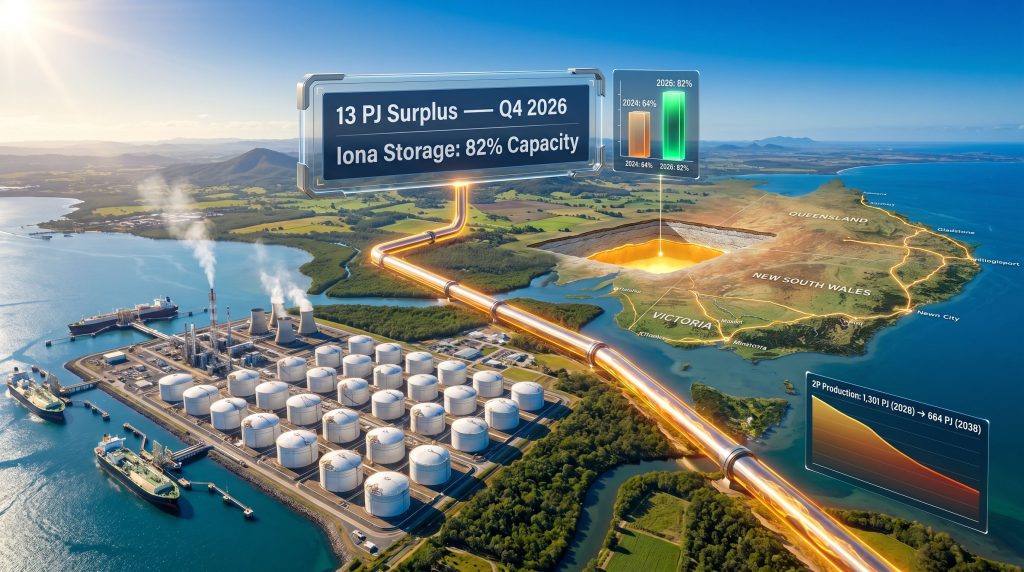
As of 10 July 2026, Iona was recorded at 82% of capacity, a substantial improvement from the 64% fill rate measured at the same point in 2024. That represents an additional 4.7 PJ of stored gas relative to the prior year.
| Storage Metric | 2024 Level | 2026 Level | Change |
|---|---|---|---|
| Iona Facility Capacity | 26 PJ | 26 PJ | Unchanged |
| Fill Rate (as at 10 July) | 64% | 82% | +18 percentage points |
| Implied Volume Stored | ~16.6 PJ | ~21.3 PJ | +4.7 PJ |
This elevated storage position provides meaningful insurance for Victoria and the southern states heading into Q4. It does not eliminate pipeline dependency, but it reduces the system's vulnerability to supply disruptions during high-demand events.
How a Single Operator Decision Eliminated the Q3 2026 Shortfall
To appreciate the Q4 surplus forecast in full, it is worth understanding what happened to the Q3 shortfall that preceded it. The ACCC's March 2026 interim report flagged a potential 12 PJ supply shortfall for July to September, raising legitimate concerns about winter supply adequacy across the eastern states.
That risk has since materially diminished, and the mechanism behind its disappearance is instructive. Shell-operated QGC rescheduled planned maintenance from April to July 2026. This decision alone is expected to reduce LNG export volumes by up to 8 PJ over the affected period, with equivalent volumes effectively redirected toward the domestic market.
The implication is profound: a single operational scheduling decision by one LNG operator can shift the domestic supply-demand balance by nearly half the originally projected shortfall. This is not a market that responds primarily to regulatory intervention in real time. It responds to the internal operational decisions of a small number of large producers whose export schedules and maintenance windows function as de facto domestic supply levers.
Market Structure Insight: The east coast gas market's short-term supply balance is less sensitive to policy signals than it is to the maintenance calendars and uncontracted volume decisions of three or four dominant LNG producers. Regulatory oversight of operator scheduling is therefore a critical informational input for any serious market participant.
What Short-Term Forecast Volatility Reveals About Market Design
The swing from a projected 12 PJ shortfall in Q3 to a 13 PJ surplus in Q4, resolved largely through one producer's maintenance rescheduling, illustrates a structural fragility in how east coast gas supply is forecast and managed. Near-term balance estimates are highly sensitive to:
- Maintenance timing and duration across major LNG facilities
- The volume of uncontracted gas that producers choose to export versus offer domestically
- Storage injection rates and the seasonal drawdown trajectory at Iona
- Demand variability driven by temperature anomalies and renewable generation output
For large industrial gas buyers and energy retailers, this volatility argues strongly for treating quarterly ACCC surplus and shortfall forecasts as probabilistic ranges rather than fixed outcomes. A 13 PJ surplus is not a guarantee of affordable spot gas through Q4. It is a central-case estimate built on assumptions that can shift within weeks.
The Domestic Supply Obligation: Policy Architecture and Commercial Friction
The structural context behind these quarterly swings is the Australian federal government's announced Domestic Supply Obligation (DSO), scheduled to take effect from July 2027. Under this framework, all 10 of Australia's LNG projects would be required to reserve gas volumes equivalent to 20% of their LNG export commitments for domestic market supply.
The policy objective is to reduce the east coast's structural dependence on producer discretion for domestic supply. Rather than relying on uncontracted gas volumes being diverted domestically, the DSO would mandate a baseline allocation, effectively hardwiring domestic supply into the commercial structure of LNG operations. Moreover, the broader supply chain impacts of international trade conditions are adding further pressure to these already complex domestic policy decisions.
Reserve Concentration: The Structural Problem the DSO Attempts to Address
The policy case for the DSO rests substantially on one data point: Gladstone-based LNG producers directly control, or purchase through associated entities, approximately 84% of proved and probable (2P) reserves across the eastern states. This concentration of reserve ownership is the defining structural feature of the east coast gas market, and it creates persistent barriers to competition and supply diversity for domestic buyers.
The ACCC's position is that reducing barriers for independent producers and new entrants seeking to develop prospective resources would help diversify supply, increase competition, and exert downward pressure on prices over the longer term. This perspective, articulated by ACCC Commissioner Anna Brakey in the June 2026 report, frames the DSO not as the only intervention required, but as one tool within a broader competition and investment framework. (Source: ACCC Gas Inquiry June 2026 Interim Report)
Opposition to the DSO: Commercial and Political Dimensions
The DSO faces substantial resistance. Most gas producers argue it creates investment uncertainty by altering the commercial terms under which long-term LNG SPAs are structured and financed. Queensland's state government has formally opposed the policy, reflecting the material fiscal significance of LNG export revenues to the state's budget position.
Industry stakeholders raise a deeper concern: mandatory domestic supply obligations could undermine the contractual integrity of long-dated LNG SPAs, potentially exposing Australian producers to penalty provisions or credit rating pressure if their ability to fulfil export commitments is perceived as contingent on domestic regulatory requirements.
This is not a hypothetical tension. It goes to the heart of how LNG projects are financed. Long-term SPAs are typically the collateral structure against which project debt is raised. Any policy that introduces uncertainty about the volume available for export could affect refinancing terms and the willingness of new capital to enter the sector. Consequently, Australia's energy exports face a delicate balancing act between domestic obligations and international competitiveness.
Long-Term Supply Projections: The Decade-Long Decline Curve
Beyond the near-term surplus, the ACCC's June 2026 report contains a decade-long production outlook for eastern LNG producers that deserves careful attention from anyone with a long-term stake in east coast energy markets. The government's gas supply and demand outlook further contextualises these projections within broader national energy planning considerations.
| Year | 2P Production (PJ) | Third-Party Purchases (PJ) | Total Supply (PJ) | Domestic Sales (PJ) | LNG SPAs (PJ) | Total Demand (PJ) |
|---|---|---|---|---|---|---|
| 2028 | 1,301 | 196 | 1,497 | 83 | 1,290 | 1,373 |
| 2029 | 1,241 | 241 | 1,482 | 83 | 1,317 | 1,400 |
| 2030 | 1,134 | 244 | 1,377 | 84 | 1,263 | 1,348 |
| 2031 | 1,067 | 251 | 1,318 | 73 | 1,251 | 1,324 |
| 2032 | 1,019 | 263 | 1,282 | 60 | 1,246 | 1,306 |
| 2033 | 952 | 280 | 1,231 | 56 | 1,222 | 1,277 |
| 2034 | 895 | 282 | 1,177 | 36 | 1,223 | 1,259 |
| 2035 | 841 | 276 | 1,116 | 16 | 1,068 | 1,084 |
| 2036 | 781 | 260 | 1,041 | 16 | 113 | 129 |
| 2037 | 716 | 251 | 967 | 16 | — | 16 |
| 2038 | 664 | 239 | 902 | 16 | — | 16 |
Source: ACCC Gas Inquiry June 2026 Interim Report
Three Structural Trends Embedded in the Data
Reading across this table reveals three compounding dynamics that fundamentally reframe the significance of today's Q4 surplus:
- A 49% decline in 2P production over ten years. Proved and probable production falls from 1,301 PJ in 2028 to 664 PJ by 2038 without new upstream investment to replenish reserve depletion. This is not a speculative concern. It is the mathematical output of known reservoir decline rates applied to existing assets.
- Rising third-party dependency. As LNG producers' own 2P reserves deplete, they increasingly purchase gas from independent operators to meet obligations. Third-party purchases grow from 196 PJ in 2028 to a peak of approximately 282 PJ in 2034, reflecting a structural shift in how the sector sources gas.
- The LNG SPA cliff. Long-term export contracts roll off dramatically from 2035 onward. SPA volumes fall from 1,068 PJ in 2035 to effectively zero by 2037, signalling the expiry of the contract structures that currently underpin the entire export sector's commercial model. What replaces them remains an open question.
Does the Surplus Mask a Deeper Investment Paradox?
There is a tension embedded in current market conditions that policy analysts are increasingly flagging. The east coast gas surplus, combined with suppressed domestic spot prices, reduces the financial incentive for upstream producers to commit capital to new exploration and field development. Yet the ACCC's own decade-long projections confirm that without precisely this investment, the current surplus environment will reverse into persistent structural shortfalls within the next ten years.
In other words, the policy tools designed to make gas more affordable in the short term may be inadvertently undermining the investment signals needed to sustain long-term supply. The DSO, if implemented without complementary investment incentive mechanisms, risks deepening this paradox by simultaneously mandating domestic allocation and suppressing the price signals that would otherwise attract exploration capital.
This is the defining policy challenge for Australian gas market governance heading into the second half of the 2020s. Furthermore, the broader commodity price impacts across the resources sector demonstrate how interconnected upstream investment decisions truly are. Quarterly surplus forecasts, however encouraging, cannot substitute for a coherent long-term investment framework.
Geopolitical Decoupling: Why the Middle East Conflict Has Not Moved Domestic Prices
One aspect of the current market that merits analytical attention is the apparent decoupling of east coast domestic gas prices from international LNG spot market dynamics. Ongoing hostilities in the Middle East Gulf region, including disruptions to Strait of Hormuz navigation, have not materially affected east coast domestic spot prices or demand as of mid-July 2026, according to the ACCC's June report.
This decoupling reflects the structural oversupply conditions currently prevailing on the east coast. Because domestic prices are suppressed by local surplus volumes rather than indexed to international benchmarks in real time, geopolitical risk premiums embedded in Asian LNG spot prices are not transmitting into what Australian industrial buyers pay at the domestic hub level. This is an unusual market condition that may not persist once surplus volumes tighten.
The next major ASX story will hit our subscribers first
Key Market Dynamics to Monitor Through H2 2026 and Into 2027
For market participants tracking the Australia east coast gas surplus in 4Q and beyond, the following variables warrant ongoing attention:
- QGC maintenance window completion: The volume of gas redirected to the domestic market as a result of the July maintenance schedule will directly influence Q3 supply adequacy before the Q4 surplus period begins.
- Iona injection trajectory: Whether the facility maintains its 82% fill rate through winter drawdown will determine the southern states' storage buffer entering Q4.
- DSO legislative progress: Regulatory clarity on the July 2027 DSO implementation timeline is critical for both LNG producers structuring their commercial forward books and industrial buyers negotiating supply contracts.
- Upstream investment announcements: Any material exploration or development commitments in Queensland's Surat or Bowen basins would represent positive signals against the decade-long 2P reserve depletion curve.
- Uncontracted LNG export volumes: The single largest variable in any near-term surplus forecast remains how much uncontracted gas producers choose to export versus offer domestically, a decision driven by LNG spot price differentials rather than domestic policy signals.
FAQ: Australia's East Coast Gas Surplus in Q4 2026
What is the forecast gas surplus for Australia's east coast in Q4 2026?
The ACCC's June 2026 interim report projects a 13 PJ surplus, equivalent to approximately 347 million cubic metres, for the October to December 2026 quarter. This forecast assumes LNG producers maintain current export volumes across uncontracted gas.
Why is there an east coast gas surplus in Q4 2026?
The surplus reflects seasonally lower heating demand, higher renewable energy output displacing gas-fired generation, elevated Iona storage levels at 82% of a 26 PJ capacity, and the redirection of up to 8 PJ to the domestic market resulting from QGC's maintenance rescheduling.
Does the Q4 surplus mean Australia's east coast gas supply problems are resolved?
No. The ACCC explicitly cautions that short-term surplus conditions do not resolve the structural supply decline projected across the 2028 to 2038 period. Without new upstream investment, 2P production is forecast to fall by approximately 49% over the next decade.
What is the Domestic Supply Obligation?
The DSO is a federal government policy requiring Australia's 10 LNG projects to reserve gas volumes equivalent to 20% of LNG export commitments for domestic market supply, taking effect from July 2027. It is designed to structurally increase domestic gas availability and apply downward pressure on prices.
Why do southern states still face supply risks during a market surplus?
Queensland generates the majority of east coast gas production. Victoria, New South Wales, South Australia, Tasmania, and the ACT depend on northward pipeline flows and storage drawdowns to meet local demand, creating structural vulnerability even when the overall market records a headline surplus.
How does LNG maintenance scheduling affect domestic gas supply?
When producers reschedule maintenance, the volumes that would otherwise have been exported become available domestically. QGC's rescheduling from April to July 2026 is expected to redirect up to 8 PJ to the domestic market, directly contributing to the elimination of the previously forecast Q3 shortfall.
Disclaimer: This article contains forward-looking projections and market forecasts sourced from the ACCC Gas Inquiry June 2026 Interim Report. All projections are subject to material uncertainty and should not be relied upon as a basis for investment decisions. Market conditions, regulatory frameworks, and producer behaviour may change materially from the assumptions underlying these forecasts.
Want to Stay Ahead of the Next Major ASX Resource Discovery?
While east coast gas market dynamics continue to reshape Australia's energy investment landscape, Discovery Alert's proprietary Discovery IQ model delivers real-time alerts on significant ASX mineral discoveries — instantly translating complex resource data into actionable opportunities for both short-term traders and long-term investors. Explore how historic mineral discoveries have generated substantial returns and begin your 14-day free trial today to position yourself ahead of the broader market.