July 10, 2026
The Long Road Between Gas Discovery and Economic Prosperity
History offers a sobering lesson for resource-rich developing nations: the presence of vast hydrocarbon reserves does not automatically translate into broad-based economic growth. From Angola to Equatorial Guinea, the pattern repeats with troubling consistency. Oil and gas revenues accumulate in sovereign accounts while poverty rates stagnate, infrastructure gaps widen, and institutional capacity fails to keep pace with the scale of incoming capital.
Economists have labelled this the "presource curse" — a period before production begins when inflated expectations distort policy, crowd out diversification, and set governments up for fiscal disappointment when revenue timelines inevitably slip.
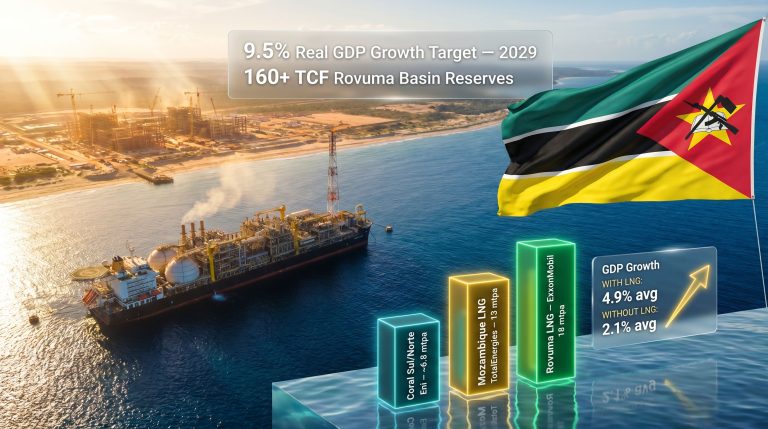
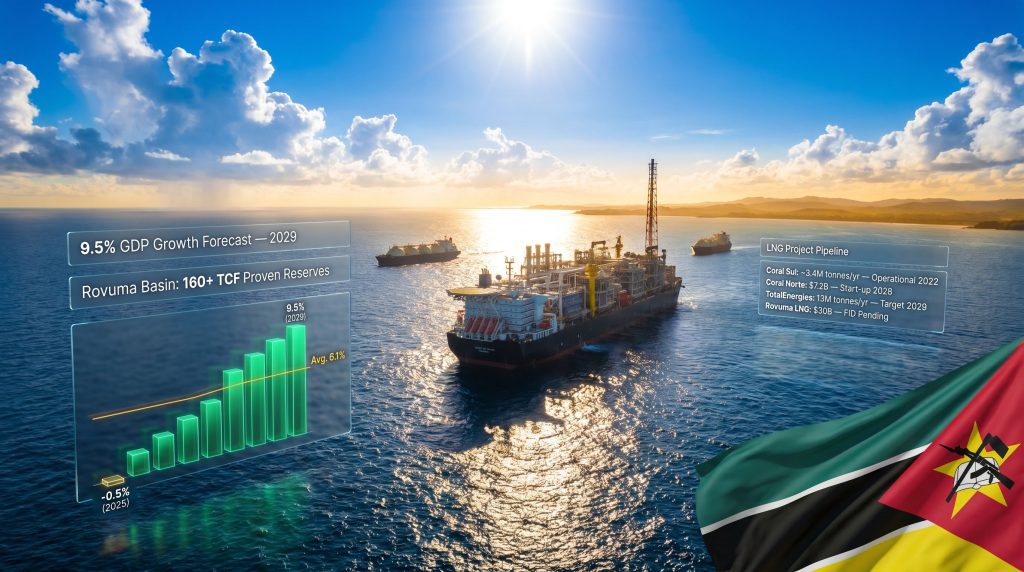
Mozambique is now navigating precisely this terrain. With more than 160 trillion cubic feet of proven natural gas reserves in the Rovuma Basin, the country holds Africa's third-largest gas endowment. Yet the path from geological abundance to the projected 9.5% GDP growth target for 2029 — a core ambition of Mozambique LNG projects GDP growth forecasts — runs through a gauntlet of security threats, project delays, sovereign debt pressures, and the inherent unpredictability of global LNG markets.
When big ASX news breaks, our subscribers know first
What the Rovuma Basin Actually Represents
Africa's Third-Largest Gas Endowment in Context
The Rovuma Basin sits offshore Cabo Delgado province in Mozambique's far north, straddling the maritime border with Tanzania. Its discovery in the early 2010s by Eni and Anadarko (later acquired by TotalEnergies) fundamentally reordered global assessments of East African energy potential. The scale of the find placed Mozambique in rare company across the African continent.
| Reserve Metric | Mozambique (Rovuma Basin) | Nigeria | Algeria |
|---|---|---|---|
| Proven Gas Reserves (TCF) | 160+ | ~206 | ~159 |
| Africa Ranking | 3rd | 1st | 2nd |
| Primary Reserve Location | Cabo Delgado (offshore) | Niger Delta | Saharan Basin |
| Key Operators | Eni, TotalEnergies, ExxonMobil | Shell, TotalEnergies | Sonatrach |
Source: U.S. Department of Commerce; industry estimates
To appreciate the significance of these figures, consider that Qatar — the world's leading LNG exporter for much of the past two decades — built an entire national development model on reserves of roughly 900 TCF. Mozambique's 160+ TCF is a fraction of that, but it is more than sufficient to sustain multi-decade export contracts and generate transformative fiscal revenues, provided the infrastructure gets built and production reaches design capacity on schedule.
The Geography Problem: Opportunity and Exposure in Cabo Delgado
The same remoteness that preserved the Rovuma Basin's geology has complicated its commercial development. Cabo Delgado is one of Mozambique's most underdeveloped provinces, with limited road networks, inadequate port infrastructure, and, since 2017, an active Islamist insurgency that has displaced hundreds of thousands of people and triggered one of sub-Saharan Africa's most severe humanitarian crises.
The offshore nature of the Rovuma reserves provides some insulation — floating LNG technology, for example, reduces onshore construction exposure — but onshore pipeline corridors, worker accommodation, and logistics hubs remain vulnerable to security disruptions. Furthermore, cyclone disruption risks compound these challenges, adding another layer of operational complexity to an already fragile environment.
This is not a peripheral consideration. It is the single most consequential variable in determining whether Mozambique LNG projects GDP growth forecasts materialise on schedule or slide further into the future.
Three Projects, Three Very Different Risk Profiles
Coral Sul FLNG: The Benchmark That Works
Operated by Italy's Eni, Coral Sul became Africa's first deepwater floating LNG facility to achieve commercial production when it came online in 2022. Its annual output of approximately 3.4 million tonnes of LNG provides a working proof of concept for Mozambique's broader LNG ambitions. The floating infrastructure model is particularly relevant here: by processing gas offshore and loading it directly onto LNG carriers, Coral Sul avoids much of the onshore construction complexity that has plagued larger competing projects.
The planned follow-on facility, Coral Norte FLNG, is targeting a 2028 start-up and represents a $7.2 billion investment confirmed by Eni in June 2026. Combined, the two Coral facilities would bring total complex capacity to approximately 6.8 million tonnes per annum, doubling Mozambique's currently operational LNG output.
TotalEnergies Mozambique LNG: Five Lost Years and a Fragile Restart
TotalEnergies' onshore LNG project carries the most complicated history of the three. Construction was suspended in April 2021 following a devastating armed attack on the nearby town of Palma, which killed dozens of people and forced a mass evacuation. The five-year suspension was not simply a logistical pause — it represented a fundamental reconsideration of whether large-scale onshore LNG construction in northern Mozambique was commercially viable under prevailing security conditions.
Construction resumed in January 2026, with first production now targeted for 2029 and an annual capacity of 13 million tonnes of LNG. That capacity figure makes this the most significant single project in the government's growth forecast. It also makes the forecast most exposed to security-related slippage. According to the Mozambique LNG project overview, the development represents one of the largest private investments on the African continent.
Rovuma LNG: ExxonMobil's $30 Billion Question Mark
The third and largest planned development is Rovuma LNG, led by ExxonMobil with an estimated investment of $30 billion and a designed capacity of 18 million tonnes per annum. Its final investment decision (FID), which was initially expected during 2026, had not been announced as of mid-2026. Without FID, construction cannot begin, and without construction commencing imminently, any contribution to the 2029 growth target becomes arithmetically impossible.
The combined designed capacity of all three Mozambique LNG projects would place the country among the top ten LNG exporters globally — but only if all three reach full production, which remains an aspirational rather than confirmed outcome.
Dissecting the 9.5% GDP Growth Forecast
What the Government's Fiscal Framework Actually Says
On 7 July 2026, Mozambique's Council of Ministers approved the 2027-2029 Medium-Term Fiscal Scenario, the country's primary fiscal planning document for the upcoming budget cycle. The framework projects sharply divergent growth paths depending on whether LNG projects proceed as planned.
| Fiscal Indicator | 2025 Actual | 2029 Forecast (With LNG) | 2029 Forecast (Without LNG) |
|---|---|---|---|
| Real GDP Growth | -0.5% | 9.5% | ~2.1% average |
| Average Annual Growth (Forecast Period) | — | ~4.9% | ~2.1% |
| Consumer Price Inflation | ~8.7% (2026) | ~5.5% | ~5.5% |
| Government Debt (% of GDP) | 91% | 67.1% | Higher |
Source: Mozambique Council of Ministers, Medium-Term Fiscal Scenario 2027-2029
The divergence between the LNG and non-LNG scenarios is stark. A 2.1% average annual growth trajectory without gas production would be insufficient to reduce the country's 91% debt-to-GDP ratio or fund meaningful improvements in health, education, or infrastructure. The LNG scenario, by contrast, projects a decline in public debt to 67.1% of GDP by 2029 — a reduction of nearly 24 percentage points in just four years.
Why Independent Analysts Are Less Optimistic
The gap between official projections and independent assessments is significant and worth examining carefully.
| Forecasting Body | GDP Growth Projection | Key Caveats |
|---|---|---|
| Mozambique Government (2026) | 9.5% by 2029; avg. 4.9% with LNG | Dependent on project timelines and security |
| Institute for Security Studies (ISS Africa) | Avg. 6.1% (2026-2043) | 3.1 percentage points below official forecast |
| International Monetary Fund (IMF) | Cautious; revenues unlikely before ~2030 | Public debt currently unsustainable under existing policy |
The IMF's February 2026 assessment described Mozambique's public debt position as unsustainable under existing policies and cautioned that LNG fiscal revenues are unlikely to materialise in meaningful volumes until approximately 2030. This is a critical distinction: production starting in 2029 does not mean revenue flowing to the government treasury in 2029.
Project development agreements typically include cost recovery phases during which operators recoup capital expenditure before the host government receives profit-sharing distributions. Furthermore, the global LNG supply outlook suggests that competitive pressures from new export capacity in North America and the Middle East could compress per-unit revenues even if Mozambican production meets targets.
Even under optimistic modelling assumptions, the present value of Mozambique's projected LNG revenue stream over the full lifetime of current projects is estimated at approximately $3.4 billion in today's money — a figure substantially smaller than the headline numbers that circulate in policy documents and investor presentations.
This present-value figure reflects the reality that revenues are back-loaded, discount rates are applied to future cash flows, and a meaningful share of production economics will flow to international operators rather than the Mozambican state during the cost recovery period.
A Decade of Missed Milestones
Understanding the current forecast requires situating it within a longer history of optimism and delay. When major gas discoveries were confirmed in the Rovuma Basin between 2010 and 2014, the IMF projected GDP growth of up to 34% by 2021, leading analysts to describe Mozambique as a potential African energy powerhouse and draw comparisons to Qatar. Actual growth over that period averaged closer to 2.5% annually — a divergence that illustrates how dramatically resource optimism can outpace structural and geopolitical reality.
The sequence of events that followed is instructive:
- 2010-2014: Major gas discoveries confirmed in the Rovuma Basin, triggering a wave of international investor interest and highly optimistic official forecasts.
- 2016: IMF projections of 34% GDP growth by 2021 circulate widely, cementing Mozambique's reputation as Africa's next energy giant.
- 2016-2020: A hidden debt crisis involving roughly $2 billion in undisclosed loans to state-linked companies triggers a financial crisis, donor aid suspension, and currency collapse — setting back institutional capacity significantly.
- 2021: Armed attacks escalate in Cabo Delgado; TotalEnergies suspends construction on its flagship LNG project.
- 2022: Coral Sul FLNG achieves first production, providing the sector's first concrete milestone.
- 2025: Post-election instability contributes to a -0.5% GDP contraction, the country's worst economic performance in years.
- 2026-2029: The critical execution window during which multiple projects must simultaneously advance for the 9.5% growth target to remain achievable.
Key Risk Factors That Could Undermine the Forecast
Security Conditions in Cabo Delgado
The insurgency in Cabo Delgado, linked to groups affiliated with Islamic State, remains the primary operational risk for every project in the region. While regional military forces from Rwanda and the Southern African Development Community (SADC) have reduced the intensity of attacks since 2021, the underlying conditions that enabled the insurgency — extreme poverty, youth unemployment, and governance deficits in the province — have not been substantively addressed.
A deterioration in security conditions could trigger renewed construction suspensions, contractor withdrawals, and insurance premium escalations that materially alter project economics. The broader geopolitical risk landscape across the region further reinforces the need for sustained stability frameworks to protect long-term investment.
Global LNG Price Dynamics
Mozambique's fiscal projections are implicitly benchmarked against LNG price assumptions that may not hold through the late 2020s. The global LNG market is entering a period of significant supply expansion, with major new export capacity coming online in the United States, Qatar, and Canada. Increased competition could compress spot and contract prices, reducing per-unit revenues even if production volumes meet targets.
For a government projecting up to $11 billion in potential annual LNG revenue additions — roughly 60% of its current GDP base — price sensitivity is a material consideration. Analysis from Standard Bank highlights how Rovuma LNG could add that $11 billion figure annually, though this is contingent on sustained favourable pricing conditions.
The Debt Sustainability Constraint
Mozambique's 91% debt-to-GDP ratio creates a structural vulnerability that interacts with the LNG timeline in a problematic way. The country needs LNG revenues to reduce its debt burden, but it must service that debt in the years before revenues arrive. The IMF's assessment that the current debt position is unsustainable under existing policies suggests that without a bridging arrangement or additional fiscal adjustment, Mozambique faces a period of elevated financial stress precisely when it needs fiscal stability to maintain the enabling environment for LNG investment.
Climate Vulnerability in Northern Mozambique
Mozambique consistently ranks among the world's most climate-vulnerable nations. Cyclone Idai in 2019 and Cyclone Kenneth in the same year caused combined damages exceeding $3 billion, equivalent to roughly 15% of GDP at the time. Cabo Delgado's offshore infrastructure has some natural resilience to cyclone impacts, but onshore facilities, coastal logistics hubs, and the workforce accommodation that large LNG projects require are all exposed to extreme weather events projected to intensify in frequency and severity.
In addition, the broader resource export challenges facing major energy exporters globally illustrate how climate exposure, infrastructure constraints, and market volatility can simultaneously undermine even well-capitalised projects.
The next major ASX story will hit our subscribers first
Lessons From Other African Gas Economies
Tanzania: Same Basin, Parallel Challenges
Tanzania shares the Rovuma Basin with Mozambique and holds roughly 57 TCF of proven gas reserves in its southern waters. Yet Tanzania's LNG export ambitions have been delayed by more than a decade due to regulatory disputes, financing challenges, and shifting government priorities. The Tanzanian experience underscores a critical insight: geological endowment is a necessary but not sufficient condition for LNG export success.
Nigeria: Revenue Management in a Mature LNG Economy
Nigeria has operated Nigeria LNG (NLNG) since 1999 and provides the most instructive African case study for Mozambique. Despite decades of LNG export revenues, Nigeria's broader economy has struggled with infrastructure deficits, currency instability, and persistent poverty — largely because resource revenues were managed through systems vulnerable to fiscal leakage and elite capture. The Nigerian experience suggests that Mozambique's fiscal architecture for managing LNG revenues will be at least as important as the volumes those revenues represent.
What Qatar's Model Reveals About Long-Term LNG Strategy
Qatar's transformation from a small Gulf state into the world's leading LNG exporter required not just reserves but a deliberate, decades-long industrialisation strategy. This included downstream petrochemical investment, a well-capitalised sovereign wealth fund, and sustained institutional capacity building. Mozambique's current fiscal framework does not yet incorporate a fully articulated sovereign wealth fund mechanism, raising questions about how windfall revenues will be saved, invested, and insulated from short-term political pressures when they eventually arrive.
However, supply chain pressures related to global trade tensions add further complexity, potentially affecting the cost and availability of the specialised equipment and engineering services that major LNG developments require.
Key Statistics Summary: Mozambique LNG Projects and GDP Growth Outlook
| Metric | Value | Source/Context |
|---|---|---|
| GDP Growth Forecast (2029, with LNG) | 9.5% | Mozambique Council of Ministers |
| GDP Growth Forecast (2029, without LNG) | ~2.1% avg. | Mozambique Council of Ministers |
| GDP Contraction (2025) | -0.5% | Post-election instability |
| Government Debt-to-GDP (2025) | 91% | Fiscal framework baseline |
| Projected Debt-to-GDP (2029) | 67.1% | Conditional on LNG revenues |
| Inflation Forecast (2029) | ~5.5% | Down from 8.7% in 2026 |
| Rovuma Basin Gas Reserves | 160+ TCF | U.S. Department of Commerce |
| Coral Sul Annual Production | ~3.4 million tonnes LNG | Eni operational data |
| Coral Norte Investment | $7.2 billion | Eni, June 2026 |
| TotalEnergies LNG Capacity Target | 13 million tonnes/year | Project design specification |
| Rovuma LNG Investment Estimate | $30 billion | ExxonMobil project estimate |
| Rovuma LNG Capacity Target | 18 million tonnes/year | Project design specification |
| ISS Africa Growth Projection | Avg. 6.1% (2026-2043) | Independent analysis |
| Potential Annual LNG Revenue Addition | Up to $11 billion | ~60% of current GDP base |
Frequently Asked Questions: Mozambique LNG Projects and GDP Growth
When Will LNG Projects Start Generating Meaningful Government Revenue?
The IMF projects that meaningful fiscal revenues are unlikely to materialise until approximately 2030 at the earliest, reflecting the cost recovery phases embedded in most project development agreements. The bulk of cumulative gains under current timelines is concentrated after 2040.
What Happens If Projects Are Delayed Further?
The government's own fiscal framework projects average annual growth of only approximately 2.1% without LNG contributions — insufficient to materially reduce the country's debt burden or fund structural development priorities. Each year of delay also compounds financing costs on existing sovereign debt.
Is the 9.5% Growth Target Realistic?
It is technically achievable under a scenario in which TotalEnergies' project delivers first production in 2029 as planned, security conditions in Cabo Delgado remain stable enough to sustain construction activity, global LNG prices hold at levels consistent with the fiscal model's assumptions, and Rovuma LNG's FID is confirmed on a timeline that at minimum signals investor commitment. Each of these conditions is plausible individually. Their simultaneous occurrence is considerably less certain.
Mozambique LNG projects GDP growth ambitions are ultimately not a question of whether gas exists in the ground. The geology is not in dispute. The question is whether the institutional, security, and fiscal architecture can convert that geology into durable economic development within the timelines that the country's debt position and development needs demand. The gap between the government's 9.5% forecast and the IMF's more cautious stance reflects precisely that uncertainty.
This article contains forward-looking projections and independent analytical assessments. Economic forecasts are subject to material revision based on security developments, global commodity prices, project financing conditions, and political factors. Nothing in this article constitutes financial or investment advice.
Want To Spot The Next Major Resource Discovery Before The Market Does?
Discovery Alert's proprietary Discovery IQ model delivers real-time alerts on significant ASX mineral discoveries, transforming complex geological and commodity data into actionable investment insights — ideal for investors tracking the kind of transformative resource developments explored in this article. Explore historic examples of exceptional discovery returns and begin your 14-day free trial today to position yourself ahead of the broader market.