July 10, 2026
The Economics of Gas Dependency: How Mozambique Is Betting Its Future on LNG
Across sub-Saharan Africa, the relationship between natural resource discovery and lasting economic transformation has rarely followed a straight line. Nations rich in hydrocarbons have repeatedly discovered that GDP figures can balloon while poverty rates remain stubbornly entrenched, debt burdens accumulate, and non-resource sectors atrophy. Against this historical backdrop, Mozambique's current trajectory demands serious analytical attention, not because the numbers are impressive on paper, but because the distance between forecast and outcome will be determined by forces far more complex than geology alone.
The Mozambique LNG projects GDP growth forecast released through the country's 2027–2029 Medium-Term Fiscal Scenario represents one of the most ambitious economic planning exercises in recent African history. Understanding what it actually means, and what it doesn't guarantee, requires dissecting the assumptions layer by layer.
When big ASX news breaks, our subscribers know first
From Contraction to 9.5%: Decoding the Scale of Ambition
Mozambique's economy contracted by -0.5% in 2025, a deterioration driven by post-election political instability and persistent security challenges in the northern Cabo Delgado province. The Council of Ministers approved the 2027–2029 Medium-Term Fiscal Scenario in early July 2026, embedding LNG production timelines as the central engine of recovery and growth.
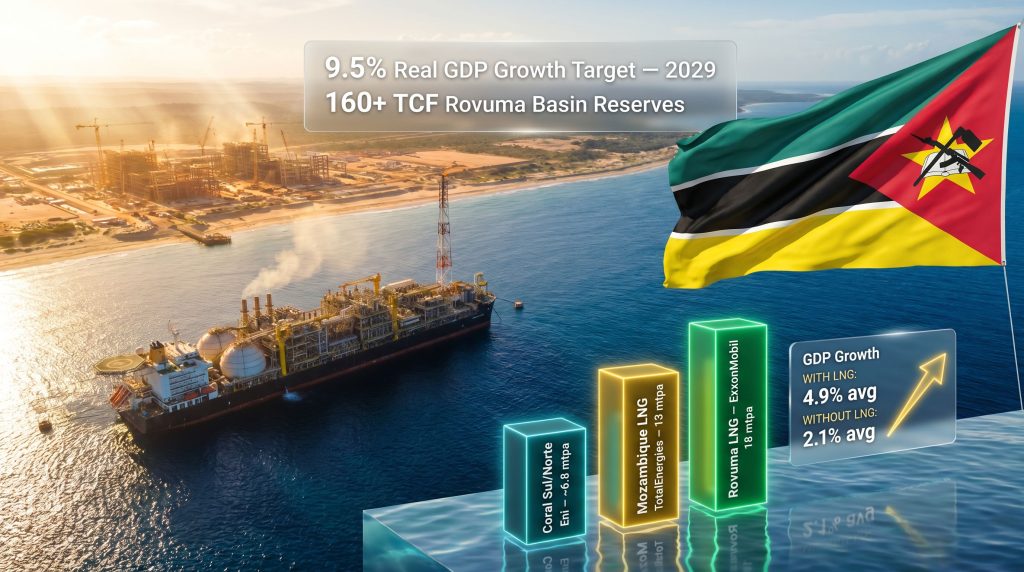
The framework's headline figure is striking: real GDP growth of 9.5% by 2029, anchored to the anticipated start of production from major liquefied natural gas developments. The underlying assumption is even more revealing. The baseline scenario projects average annual growth of 4.9% with LNG against just 2.1% without it, a differential of 280 basis points that exposes the full depth of Mozambique's hydrocarbon dependency. Furthermore, the natural gas supply outlook for 2025 and beyond suggests global appetite for LNG remains robust, which broadly supports Mozambique's long-term export positioning.
The macroeconomic targets embedded in the framework paint a picture of a country banking heavily on a single commodity cycle:
| Indicator | 2025 Actual | 2026 Estimate | 2029 Target |
|---|---|---|---|
| Real GDP Growth | -0.5% | 0.9% | 9.5% |
| Inflation (CPI) | — | 8.7% | ~5.5% |
| Public Debt (% of GDP) | 91% | — | 67.1% |
| GDP Growth (ex-LNG) | — | — | ~2.1% avg. |
The 2.1% non-LNG baseline is arguably the most important number in the entire framework. It represents Mozambique's structural economic foundation, and it is fragile.
The Rovuma Basin: Africa's Third-Largest Gas Reserve in Context
The geological foundation underpinning all of these projections is the Rovuma Basin, located off the coast of Cabo Delgado province. According to the U.S. Department of Commerce, the basin holds more than 160 trillion cubic feet (TCF) of proven natural gas reserves, positioning Mozambique as Africa's third-largest proven gas holder after Nigeria and Algeria.
This resource endowment is not a marginal increment. For context, Mozambique's total GDP is currently estimated at roughly $18–20 billion. According to a study cited by Ecofin Agency, ExxonMobil's Rovuma LNG project alone, if it reaches full production, could theoretically contribute up to $11 billion annually to GDP — a figure equivalent to approximately 60% of the country's current economic output. The scale of potential transformation is genuinely extraordinary.
What makes the Rovuma Basin particularly significant from a structural perspective is the offshore depth and methane composition profile of the reservoirs. Deep-water gas fields of this type typically produce lean gas with high methane content, well-suited for LNG liquefaction with lower processing costs per unit relative to associated gas fields that require more complex separation infrastructure. This geological characteristic provides a natural cost advantage for operators, which in turn strengthens project economics and the durability of long-term offtake agreements.
The Three Projects Underpinning the Forecast
The government's growth projections rest on three distinct LNG developments, each at a different stage of maturity and carrying different risk profiles.
Coral Sul and Coral Norte (Eni)
Eni's Coral Sul FLNG facility has been operational since 2022, producing approximately 3.4 million tonnes per annum (mtpa) of LNG. The floating LNG model is operationally significant in a region with active insurgency risk: the facility sits offshore, removing its critical infrastructure from the security threat environment that affects onshore developments.
Coral Norte, the second floating vessel, represents a $7.2 billion investment and is expected to come online in 2028, effectively doubling Eni's production capacity in the basin. This project carries the lowest execution risk of the three, given the established offshore operational model and Eni's existing presence in the basin.
Mozambique LNG (TotalEnergies)
TotalEnergies' onshore facility was suspended for five years following armed attacks in Cabo Delgado. Construction formally resumed in January 2026, with first production targeted for 2029 at an annual capacity of 13 mtpa. Estimated total capital expenditure is approximately $20 billion.
This project is the primary driver of the 0.9% GDP recovery forecast for 2026, as renewed construction activity feeds directly into national accounts through employment, procurement, and service sector spending. It also carries the highest execution risk, given its onshore footprint in a region where the security environment, while improved, remains volatile.
Rovuma LNG (ExxonMobil)
The largest of the three by capacity, ExxonMobil's Rovuma LNG is designed to produce 18 mtpa annually through an estimated $30 billion total investment. As of mid-2026, the Final Investment Decision (FID) has not been announced, despite having been initially anticipated for 2026.
The FID delay introduces material uncertainty into the government's 2029 projections. If construction does not begin within a defined window, the project's contribution to peak GDP growth will shift beyond the 2029 horizon. The potential employment impact of Rovuma LNG alone has been estimated at up to 151,000 jobs across direct and indirect roles.
| Project | Operator | Capacity (mtpa) | Status (mid-2026) | Est. Capex |
|---|---|---|---|---|
| Coral Sul / Coral Norte | Eni | 3.4 → ~6.8 | Producing / 2028 start | $7.2B (Norte) |
| Mozambique LNG | TotalEnergies | 13 | Construction resumed Jan 2026 | ~$20B |
| Rovuma LNG | ExxonMobil | 18 | Pre-FID | ~$30B |
The Optimism Gap: Government Forecasts vs. Independent Analysis
The 9.5% GDP target sits well above independent consensus, a divergence that reflects both the genuine scale of the resource base and the substantial execution, security, and fiscal risks that surround it.
The Institute for Security Studies (ISS) Africa projects average economic growth of 6.1% between 2026 and 2043, approximately 3.1 percentage points below the government's baseline scenario. The IMF has taken a more cautious position still, warning in a February assessment that LNG revenues are unlikely to materialise meaningfully until approximately 2030 and that Mozambique's public debt remains unsustainable under current policy settings.
Independent near-term modelling suggests a far more gradual ramp: 0.9% in 2026, rising to 1.6% in 2027 and 2.5% in 2028, before the potential step-change in 2029 if LNG production comes online as planned.
The gap between official and independent projections exists for several structurally important reasons:
-
Production-to-revenue timing: LNG production start dates and government revenue receipt dates are not the same event. Under typical production-sharing agreement (PSA) structures, operators recover capital expenditure before profit-sharing begins. At $20–$30 billion per project, that recovery phase spans years, not months.
-
Debt service obligations: With public debt at 91% of GDP in 2025, a significant portion of early LNG revenues will be absorbed by debt repayment rather than channelled into productive public expenditure.
-
Security premium: Any renewed escalation in Cabo Delgado could delay TotalEnergies' onshore construction schedule, the project most central to the 2029 peak growth target.
-
Global LNG price exposure: Mozambique's fiscal revenues will be directly correlated to international LNG benchmark prices. Monitoring natural gas price trends is consequently essential for understanding the revenue variability Mozambique faces. Long-term offtake contracts, while providing revenue certainty, may also lock in prices below prevailing spot rates during early production phases.
When Will the Money Actually Arrive? The Revenue Lag Framework
One of the most consistently misunderstood dimensions of LNG economics is the gap between when a facility begins producing and when a host government receives meaningful fiscal benefit. For Mozambique, this lag is not a minor technical detail. It is the central variable that separates the headline GDP forecast from the lived fiscal reality.
The revenue lag occurs for interconnected reasons:
-
Capital cost recovery periods: Under most PSA structures, international oil companies (IOCs) are entitled to recover their capital investment from production revenues before profit-sharing begins. On projects of this scale, that recovery phase can extend five to ten years from first production.
-
Project finance debt repayment priority: These developments are typically financed through structured project finance arrangements where lender repayment takes priority over government revenue shares.
-
Production ramp-up periods: LNG facilities operate well below nameplate capacity in their early years. A facility designed for 13 mtpa may produce at 40–60% of capacity in its first two to three years, compressing the revenue base.
-
Hedged offtake structures: Long-term supply contracts negotiated during project development may lock in delivery prices that underperform spot markets during early production phases.
| Period | Expected Revenue Phase | Key Driver |
|---|---|---|
| 2026–2028 | Construction spillovers only | Employment, procurement, service taxes |
| 2029–2031 | Early production; limited fiscal flows | Capital cost recovery under PSA |
| 2032–2035 | Meaningful government revenue begins | Post-recovery profit-sharing |
| 2035–2045 | Peak fiscal contribution | Full production across multiple projects |
The next major ASX story will hit our subscribers first
Risk Architecture: What Could Derail the Forecast?
The Mozambican government's own framework acknowledges a matrix of internal and external risks that could undermine its projections. A structured assessment reveals four primary risk categories.
Security and Geopolitical Risk
The Cabo Delgado insurgency is the single largest operational risk to the entire development timeline. TotalEnergies' five-year suspension between 2021 and 2026 demonstrated that even projects backed by some of the world's largest energy companies are not immune to armed disruption. Onshore infrastructure, including pipelines, liquefaction trains, and worker accommodations, is inherently more exposed than Eni's floating model. In addition, the broader geopolitical risk landscape affecting resource-producing nations adds a further layer of complexity to long-term planning.
Structural Poverty and the Enclave Economy Problem
Despite the government's ambitious GDP targets, the poverty rate is projected to remain at approximately 82% through 2028. This figure is not a paradox. It reflects the enclave nature of capital-intensive LNG extraction, where aggregate GDP expands significantly while the broader population has limited direct participation in the production economy. Translating LNG revenues into poverty reduction requires deliberate fiscal policy design, sustained social investment, and meaningful local content development.
Dutch Disease Risk
A lesser-discussed but historically significant risk is currency appreciation driven by large LNG export revenues. In economies where a dominant export commodity generates substantial foreign exchange inflows, the resulting appreciation of the local currency can erode the competitiveness of agriculture, manufacturing, and other labour-intensive sectors. For Mozambique, where the majority of the population derives income from smallholder agriculture, this dynamic could paradoxically worsen rural welfare even as national GDP climbs.
Climate Vulnerability
Mozambique consistently ranks among the world's most climate-exposed nations. Cyclones, coastal flooding, and agricultural disruption are not tail risks but recurring shocks. Climate events create competing fiscal pressures by increasing emergency expenditure while reducing agricultural GDP, complicating the government's ability to maintain the fiscal discipline necessary to convert LNG revenues into durable development gains.
How Mozambique Compares to Established African LNG Producers
Nigeria has exported LNG since 1999 through Nigeria LNG (NLNG) and remains the continent's largest gas producer by reserve size. Its experience offers both an aspirational template and a cautionary tale: despite decades of hydrocarbon revenues, poverty rates and institutional fragility have remained persistent challenges. The lesson is not that LNG fails to generate wealth but that wealth distribution and institutional quality determine whether that wealth translates into development.
Algeria's state-controlled model through Sonatrach contrasts sharply with Mozambique's international oil company-led framework. Tanzania, which shares the Rovuma Basin's geological characteristics, has experienced even longer development delays in its own offshore LNG programme, making Mozambique's comparative progress notable. However, broader resource export challenges observed across commodity-exporting nations suggest that infrastructure bottlenecks and policy uncertainty can significantly slow the conversion of reserves into revenues.
The GTA LNG project in Senegal and Mauritania, brought online in 2024 by BP and Kosmos Energy, offers the most recent African precedent for first-LNG-nation dynamics. Its early operational history will provide instructive data points on revenue lag timelines, local content outcomes, and fiscal management challenges that Mozambique's planners should study closely.
The Strategic Verdict: Conditional Optimism With Eyes Open
The Mozambique LNG projects GDP growth forecast of 9.5% for 2029 is a best-case outcome contingent on simultaneous execution across multiple megaprojects in a fragile security environment, combined with fiscal discipline, institutional capacity, and favourable international LNG market conditions. It is not a prediction. It is a planning scenario.
Three conditions will determine whether the forecast is achievable:
-
Durable security stabilisation in Cabo Delgado: Without sustained peace, TotalEnergies' onshore facility, the largest capacity contributor to the 2029 growth target, remains vulnerable to further disruption.
-
ExxonMobil's Final Investment Decision on Rovuma LNG: A positive FID would confirm the full scale of the basin's development trajectory and anchor long-term investor confidence in Mozambique's hydrocarbon sector.
-
IMF-aligned debt management: Reducing public debt from 91% to 67% of GDP by 2029 requires that LNG revenues, when they do arrive, are directed toward productive investment rather than consumed entirely by debt service obligations.
Furthermore, as energy transition demand reshapes the global energy landscape, Mozambique must also consider how long-term shifts in international gas consumption patterns may affect the commercial viability of its LNG export model beyond the 2030s.
Mozambique's LNG growth story is real, resource-backed, and supported by credible international operators with deep basin knowledge. But the distance between forecast and outcome is measured in security conditions, investment decisions, and institutional capacity — not in gas reserves alone. The 2.1% non-LNG baseline growth rate is the number that deserves equal attention: it represents the structural foundation that must be built regardless of what happens offshore.
This article contains forward-looking projections and economic forecasts drawn from government planning documents and independent analytical sources. These projections are subject to material uncertainty and should not be interpreted as investment advice or guarantees of future economic outcomes. Readers should conduct their own due diligence before making investment or business decisions related to Mozambique's LNG sector.
For ongoing coverage of African energy economics and public finance developments, Ecofin Agency at ecofinagency.com provides sector-focused reporting across nine key African economic sectors.
Want to Stay Ahead of the Next Major Resource Discovery?
Discovery Alert's proprietary Discovery IQ model delivers real-time alerts on significant ASX mineral discoveries, instantly converting complex resource data into actionable investment insights — visit the Discovery Alert discoveries page to explore how historic mineral finds have generated extraordinary returns, and begin your 14-day free trial today to position yourself ahead of the broader market.