July 10, 2026
The Exploration Funding Gap That State Governments Are Built to Fill
Greenfields mineral exploration sits in an uncomfortable position within global capital markets. The activity is expensive, technically demanding, and statistically humbling: the vast majority of drill programs never return an economic discovery. Yet the consequences of underinvestment are profound, because today's exploration holes are the only pathway to tomorrow's operating mines. When private capital retreats from early-stage discovery work, the entire downstream pipeline of mine development, employment, royalty revenue, and export earnings contracts with it.
This structural tension between the high social returns of exploration and the comparatively modest private returns is precisely the environment in which co-funding programs like the South Australia PACE Minerals program were designed to operate. Understanding the mechanics, history, and strategic logic of this program reveals why it occupies such a central role in the state's mineral development ambitions and why its 2026 relaunch has attracted broad attention across the exploration community. Furthermore, the mineral exploration importance of sustained early-stage investment cannot be overstated when considering the downstream economic benefits at stake.
When big ASX news breaks, our subscribers know first
How the South Australia PACE Minerals Program Actually Works
Program Design and the Co-Funding Architecture
The South Australia PACE Minerals program operates as a co-investment mechanism rather than a straight subsidy. The state government commits funding to cover a portion of eligible exploration costs, with the balance contributed by the applying company. This shared-risk structure is deliberate: it ensures that private operators retain skin in the game while lowering the financial threshold that would otherwise prevent many junior explorers from commencing work.
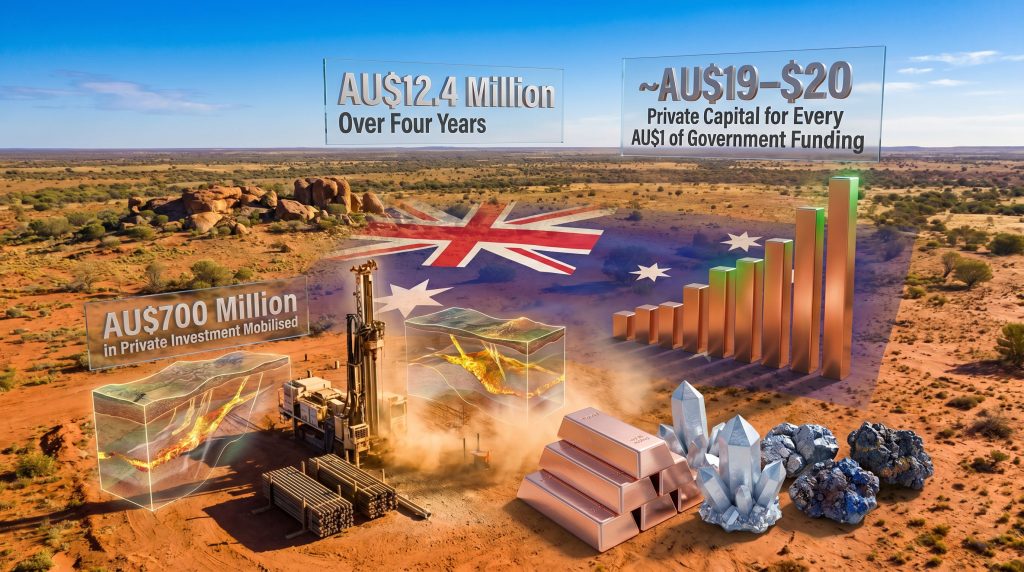
The current iteration of the program carries a total government commitment of AU$12.4 million over four years, equating to roughly AU$3.1 million annually. Eligible exploration activities covered under the grant framework include:
- Diamond core drilling and reverse circulation (RC) drilling programs
- Airborne geophysical surveys, including electromagnetic (AEM) and magnetic surveys
- Ground geophysical surveys such as gravity, induced polarisation (IP), and seismic methods
- Geochemical sampling, rock chip analysis, and soil sampling programs
- Other qualifying early-stage discovery methodologies approved under program guidelines
Each of these activity types addresses a different layer of the geological discovery process. Airborne geophysics provides broad-scale targeting data across large land packages, often identifying buried anomalies beneath thick cover sequences. Ground geophysics then refines those targets, while drilling ultimately tests them at depth. The PACE program's willingness to co-fund all stages of this funnel is one of its most practically useful design features for junior explorers navigating tight budgets.
Who Qualifies and When Applications Close
The program is open to junior explorers, mid-tier mining companies, and exploration joint ventures holding active tenements within South Australia. The current round specifically prioritises copper and critical minerals as target commodities, reflecting both the state's geological strengths and the prevailing demand conditions in global commodity markets.
Applications are currently open, with submissions closing 11 September 2026. The geographic scope extends across South Australia, with particular emphasis on underexplored regions and areas concealed beneath deep sedimentary cover, known in exploration parlance as covered terranes. These are zones where surface geology provides few clues about what lies beneath, making remote sensing and systematic geophysical methods especially valuable.
Junior explorers are frequently the primary beneficiaries of co-funding structures like PACE. Without the balance sheet depth of major mining houses, these companies often cannot absorb the financial exposure of a multi-hole drill program on their own. Government co-investment changes that calculus fundamentally.
Two Decades of Evidence: The PACE Program's Historical Track Record
From Policy Tool to Proven Economic Catalyst
The South Australia PACE Minerals program is not a new experiment. Its origins trace back to 2004, when the framework was established under South Australian government stewardship, with active grants commencing in 2005. Over the intervening two decades, the program has accumulated a performance record that is difficult to dismiss.
The headline figure is the private investment leverage ratio. Historically, every dollar of government co-funding channelled through PACE has mobilised approximately AU$19 in private exploration expenditure, with some estimates placing this ratio as high as $20:$1. Across the program's operational history, this leverage effect has contributed to cumulative private mineral exploration investment of approximately AU$700 million within the state.
At the program's current funding commitment of AU$12.4 million over four years, applying the historical leverage ratio produces a theoretical private capital mobilisation figure of up to AU$248 million over the same period, assuming performance consistent with prior rounds.
The Carrapateena Discovery: A Case Study in What PACE-Enabled Exploration Produces
The most frequently cited example of PACE's real-world impact is the Carrapateena copper-gold deposit, now an operating mine of global significance located approximately 160 kilometres north of Port Augusta. The deposit hosts substantial copper and gold resources within a classic iron oxide copper-gold (IOCG) geological system. IOCG deposits of this kind represent the same broad class of mineralisation that hosts Olympic Dam, one of the world's largest known copper-uranium-gold deposits.
| Discovery | Mineral Type | Current Status |
|---|---|---|
| Carrapateena | Copper-Gold (IOCG) | Operating mine; major multi-decade asset |
| Olympic Dam | Copper-Uranium-Gold | World-scale operating mine |
| Various emerging prospects | Lithium, REEs, Cobalt | Active exploration pipeline |
Carrapateena's journey from unexplored tenement to operating mine illustrates precisely why early-stage exploration investment, even when it appears speculative at the time, carries enormous long-term economic value. The royalties, permanent employment, and regional infrastructure investment generated by a single major discovery can exceed the cost of an entire decade of co-funded exploration programs many times over.
The Geology Behind South Australia's Critical Mineral Potential
Understanding the Gawler Craton and Its Mineral Endowment
South Australia's geological architecture makes it one of Australia's most compelling jurisdictions for copper and critical mineral exploration. The state is underlain in its central and northern regions by the Gawler Craton, an ancient continental nucleus that has been highly prospective for IOCG-style mineralisation for hundreds of millions of years. The same geological processes that formed Olympic Dam and Carrapateena may have generated numerous other deposits that simply remain buried beneath younger sedimentary cover.
This geological concealment is one of the key reasons government-supported exploration programs carry particular value in South Australia. A substantial proportion of the state's most prospective ground is covered by between 50 and 500 metres of younger sediments, rendering surface mapping and conventional prospecting largely ineffective. Discovering what lies beneath requires capital-intensive geophysical surveys and deep drilling programs, precisely the types of activities that the PACE Minerals program is structured to partially fund.
The Critical Minerals Priority List for the 2026 Round
The current PACE round's focus on critical minerals extends well beyond copper. In addition, Australia's critical minerals strategy aligns closely with the full suite of commodities targeted under this round, which includes:
- Copper: Essential for electrification infrastructure, wiring, motors, transformers, and electric vehicle (EV) drivetrains
- Lithium: The dominant cathode and electrolyte material in current-generation battery storage systems
- Cobalt: A key component in high-energy-density EV battery chemistries and aerospace applications
- Rare Earth Elements (REEs): Critical inputs for permanent magnets used in wind turbines, EV motors, and defence electronics
- Nickel: Used in stainless steel production and increasingly in battery cathode materials for high-nickel NMC chemistries
- Manganese: Applied in steel alloys and emerging as a significant material in next-generation battery architectures
Australia's federal government has formally designated 31 minerals as critical to national economic and strategic interests. South Australia's geological endowment intersects with a meaningful subset of this list, providing the state with a structural rationale for sustained exploration investment.
The Investment Leverage Mechanism: Why AU$12.4 Million Can Punch Far Above Its Weight
Market Failure Theory and the Economic Logic of Co-Funding
The economic justification for programs like PACE rests on a well-established concept in public policy: the divergence between private and social returns. In mineral exploration, private companies capture only a fraction of the total economic value that a successful discovery generates. Royalties flow to the state, employment benefits accrue to regional communities, and supply chain activity stimulates businesses far removed from the mine gate. Because private investors cannot capture these externalities, they systematically underinvest relative to what is socially optimal.
Government co-funding corrects this market failure by effectively subsidising the cost of discovery until the private return becomes sufficient to attract capital. This is not a novel idea: equivalent programs exist across multiple Australian jurisdictions and internationally. The PACE grants program page maintained by the South Australian government provides further detail on the program's full eligibility criteria and administrative requirements.
| State Program | Approximate Funding | Co-Funding Model | Priority Minerals |
|---|---|---|---|
| SA PACE Minerals | AU$12.4M over 4 years | ~20:1 private leverage ratio | Copper, Critical Minerals |
| WA Exploration Incentive Scheme | Variable annually | Co-funded drilling focus | Broad mineral base |
| QLD Collaborative Drilling Initiative | Project-based allocation | Industry co-contribution | Base and precious metals |
What distinguishes PACE is its documented leverage ratio. A 20:1 private capital multiplier is an exceptionally high return on public investment by any measure, particularly when compared to direct infrastructure spending, which typically generates far lower near-term economic multipliers.
Industry Endorsement and What It Signals to the Market
AMEC's Position and Its Significance for Junior Explorers
The Association of Mining and Exploration Companies (AMEC), Australia's peak representative body for junior and mid-tier explorers, formally endorsed the PACE Minerals relaunch. AMEC CEO Warren Pearce stated publicly that for junior explorers particularly, co-funding programs like PACE can make a meaningful difference by helping to distribute exploration risk and attract additional private investment into South Australia.
Industry body endorsement carries practical significance beyond symbolic support. When a representative organisation with direct knowledge of member capital requirements validates a program's design, it signals that the grant structure aligns with real exploration budgeting constraints rather than bureaucratic assumptions about how exploration works.
Pearce also noted that supporting exploration activity today is the mechanism by which future mines, employment, royalty streams, and economic development opportunities are created. This framing reflects a long-standing truth about the mining sector's value chain: the economic dividends of a major discovery are separated from the exploration investment that enabled it by years or even decades, making the returns largely invisible to short-term capital allocation frameworks but enormously significant over longer horizons.
The next major ASX story will hit our subscribers first
The Discovery-to-Production Value Chain: Mapping the Economic Ripple Effects
Every Drill Hole Starts a Potential Economic Chain
The economic impact of a successful exploration program extends far beyond the discovery announcement itself. Consequently, interpreting drill results correctly at each stage of this funnel is essential for investors and companies seeking to understand the full value potential unlocked by early exploration investment.
- Exploration phase: Geologists, drilling contractors, survey crews, logistics operators, and camp support personnel are employed, often in regional areas with limited alternative employment opportunities.
- Discovery and feasibility phase: Environmental consultancies, hydrogeological studies, metallurgical testing laboratories, and engineering firms engage in extended programs that can span several years.
- Development phase: Construction of mine infrastructure mobilises billions of dollars in capital investment and creates large-scale temporary employment across a broad range of trades and professional disciplines.
- Production phase: Permanent employment, ongoing royalty revenue to the state, export earnings, and multi-decade supply chain activity become embedded in the regional and state economy.
| Value Chain Stage | Economic Contribution Type | Illustrative Example |
|---|---|---|
| Exploration | Field employment, drilling contracts, geoscience services | Hundreds of direct roles per active project |
| Feasibility | Engineering, environmental, metallurgical studies | Multi-year consultant and laboratory engagement |
| Development | Capex, construction workforce, infrastructure | Billions in investment at major projects |
| Production | Royalties, permanent jobs, export revenue | Decades of ongoing economic contribution |
Frequently Asked Questions: South Australia PACE Minerals Program
What is the PACE Minerals program in South Australia?
The South Australia PACE Minerals program is a state government co-funding initiative that provides grants to mineral exploration companies undertaking qualifying drilling, geophysical surveying, geochemical sampling, and related discovery activities within the state.
How much total funding is committed to the current PACE Minerals round?
The current program carries a total government funding commitment of AU$12.4 million over four years, distributed at approximately AU$3.1 million per year.
When do applications close?
The current application window closes on 11 September 2026.
What exploration activities does the program co-fund?
Eligible activities include diamond and RC drilling, airborne and ground geophysical surveys, geochemical sampling and analysis, and other approved early-stage discovery methodologies.
What is the historical leverage ratio of the PACE program?
Historically, the program has generated approximately AU$19 to AU$20 in private investment for every AU$1 of government co-funding, contributing to roughly AU$700 million in cumulative private exploration expenditure across prior program rounds.
What minerals does the 2026 PACE round prioritise?
The current round targets copper and critical minerals, encompassing lithium, cobalt, rare earth elements, nickel, and manganese.
Who is eligible to apply?
Junior exploration companies, mid-tier mining operators, and exploration joint ventures holding active tenements within South Australia and proposing qualifying work programs are eligible to apply.
Key Takeaways: Why the PACE Program Represents Sound Exploration Policy
The South Australia PACE Minerals program stands on three mutually reinforcing value propositions that collectively explain why it has endured and expanded over more than two decades.
First, risk reduction. By sharing the financial burden of exploration with government, junior companies can initiate programs they could not otherwise fund, bringing more exploration activity into existence than the market would generate independently.
Second, capital leverage. The historically demonstrated ~20:1 private capital multiplier means that AU$12.4 million in public funding has the potential to drive hundreds of millions of dollars in private exploration activity, representing an unusually efficient deployment of public resources.
Third, discovery pipeline development. Without a sustained flow of early-stage exploration investment, the pipeline of future mines dries up. PACE maintains that pipeline by ensuring that geological targets across South Australia's vast and underexplored covered terranes continue to attract systematic testing, even during periods of broader market risk aversion.
South Australia's proven track record, anchored by world-class discoveries including Carrapateena, combined with its geological prospectivity for the commodities most in demand during the global energy transition, positions the South Australia PACE Minerals program as more than a state government initiative. It functions as a sustained commitment to the discovery process itself, and to the long-term economic future that process makes possible. Indeed, Australian Mining's coverage of the program's relaunch further underscores how broadly the exploration community has welcomed its return.
Readers seeking additional context on the PACE program announcement and industry responses can find supplementary coverage at Resources Review.
Want to Know When the Next Carrapateena-Scale Discovery Hits the ASX?
Discovery Alert's proprietary Discovery IQ model scans ASX announcements in real time, instantly identifying significant mineral discoveries across copper, critical minerals, and beyond — the same commodities driving South Australia's exploration renaissance — so subscribers can act before the broader market reacts. Explore historic discoveries and the returns they generated, then start your 14-day free trial at Discovery Alert to position yourself ahead of the next major find.