August 7, 2026
The Hidden Geometry of Nickel Sulphide Systems: Why Grade Distribution Matters More Than Headline Numbers
When analysts evaluate a large-tonnage nickel sulphide project, the instinct is to focus on total contained metal. Tonnes multiplied by grade equals a simple narrative. But experienced geologists and mine planners know that the internal architecture of a deposit — specifically how grade escalates from the outer envelope toward the core — often determines whether a project ever reaches production. Understanding nickel deposit formation is essential here, as a deposit with uniformly low-grade mineralisation and no higher-grade internal zones faces a fundamentally different economic reality than one where concentrated sulphide accumulation zones are nested within a broader bulk-tonnage envelope.
This geological distinction sits at the heart of why the Canada Nickel Reid Nickel Sulphide Project drill results released in August 2026 carry technical significance well beyond the headline intercept figures.
When big ASX news breaks, our subscribers know first
What the Nested Intercept Structure at Reid Actually Reveals
The first two results from Canada Nickel's current nine-hole infill campaign at Reid demonstrate something that bulk-tonnage nickel investors rarely see confirmed in a single drill hole: a clearly defined grade escalation architecture across multiple nested intervals.
Hole REI26-92A returned the following nested structure:
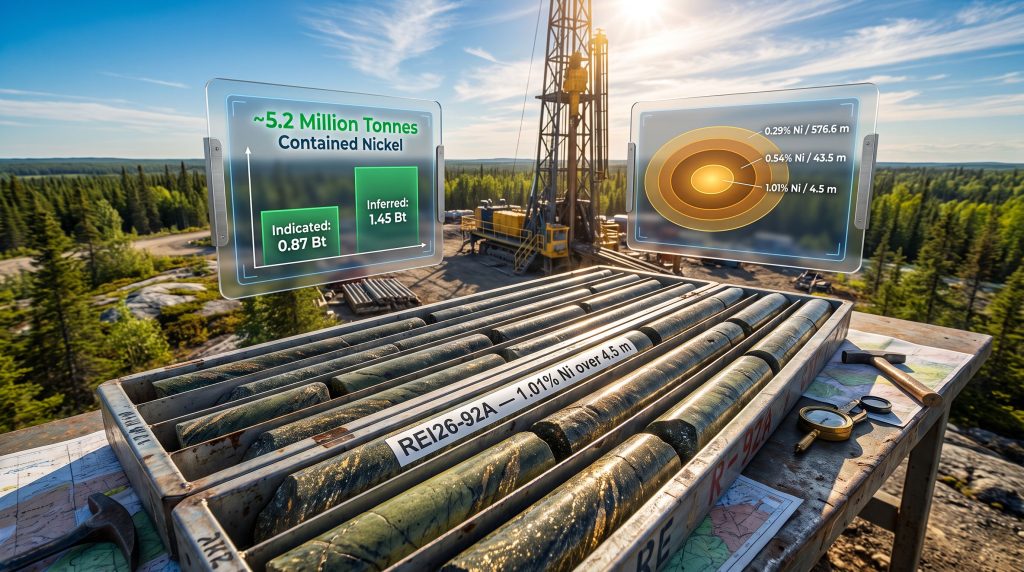
- Outer mineralised envelope: 0.29% Ni over 576.6 metres — the broad corridor that supports bulk resource tonnage
- Intermediate higher-grade domain: 0.54% Ni over 43.5 metres — more than double the outer envelope grade
- High-grade core: 1.01% Ni over 4.5 metres — the highest-grade interval ever recorded at Reid
The second hole, REI26-90B, returned 0.26% Ni over 801.4 metres — a result that is less visually dramatic but arguably more strategically important for resource modelling purposes. The sheer width of continuous above-average mineralisation across 801.4 metres provides exceptional geological confidence in deposit continuity, which is precisely what an infill programme is designed to establish.
Technical Note: In bulk-tonnage sulphide systems, grade continuity over long intercepts carries more weight in resource modelling than narrow high-grade spikes. REI26-90B's 801.4-metre intercept materially strengthens the geological framework supporting a future resource category upgrade.
Why the 1.01% Ni Intercept Is Geologically Meaningful Despite Its Narrow Width
A grade of 1.01% Ni over 4.5 metres may seem modest compared to the ultra-high-grade intervals that generate headlines in gold or base metal exploration. However, in the context of a serpentinised ultramafic system where the ambient grade baseline sits around 0.22–0.23% Ni, a fourfold grade escalation to above 1.0% Ni confirms something critical: concentrated sulphide accumulation zones exist within the Reid system.
This has meaningful implications for mine planning. Selective mining techniques, optimised cut-off grade calculations, and phased extraction strategies can all be designed around these higher-grade internal domains, potentially improving early-stage cash flow projections and enhancing overall project economics in feasibility study stages.
Situating Reid Within the Global Nickel Sulphide Supply Landscape
Understanding why the Canada Nickel Reid Nickel Sulphide Project drill results matter requires stepping back to appreciate how structurally constrained the global nickel sulphide supply pipeline has become.
The nickel market has bifurcated sharply over the past decade. Indonesian laterite operations, primarily utilising high-pressure acid leach (HPAL) processing, have flooded the market with Class II nickel, suppressing prices and challenging the economics of conventional sulphide producers. However, this dynamic obscures a deepening structural problem: large-scale, low-risk, battery-grade nickel sulphide deposits in politically stable jurisdictions are genuinely rare.
| Nickel Type | Primary End Use | Processing Pathway | Jurisdictional Risk Profile |
|---|---|---|---|
| Sulphide (high-grade) | EV batteries, stainless steel | Conventional smelting / hydromet | Generally lower (stable geologies) |
| Laterite (saprolite/limonite) | Stainless steel, HPAL for batteries | Energy-intensive HPAL | Higher (tropical, complex permitting) |
| Mixed sulphide-laterite | Blended applications | Hybrid processing | Variable |
Nickel sulphide deposits require significantly less processing energy than laterites, produce lower carbon emissions per tonne of refined metal, and are more compatible with the net-zero production ambitions of automotive OEMs and battery manufacturers operating under Scope 3 emissions commitments. As end-users increasingly scrutinise supply chain provenance, the production pathway matters as much as the price.
Ontario's Timmins-Cochrane corridor adds another dimension to this picture. The region offers established road and power infrastructure, a deep pool of experienced mining labour, provincial regulatory frameworks with demonstrated permitting pathways, and geological precedent from decades of base metal production. These factors are increasingly reflected in how institutional investors and project financiers price jurisdictional risk into asset valuations.
The Reid Deposit: Scale, Geology, and Why Footprint Alone Is a Statement
Reid is hosted within a serpentinised ultramafic body composed predominantly of dunite with minor peridotite. This geological classification is significant because ultramafic-hosted nickel sulphide systems of this character are associated with wide, continuous mineralisation profiles that lend themselves to bulk-mineable extraction scenarios. The mineralogy favours large-scale open-pit or substantial underground operations rather than narrow-vein selective mining.
Furthermore, when considering deposit scale and tiering, the deposit's current resource base — published on January 12, 2026 — reflects the impressive scale of the system:
| Resource Category | Tonnage | Nickel Grade | Contained Nickel |
|---|---|---|---|
| Indicated | 0.87 billion tonnes | 0.23% Ni | ~2.0 million tonnes Ni |
| Inferred | 1.45 billion tonnes | 0.22% Ni | ~3.2 million tonnes Ni |
| Exploration Target (additional) | 0.5–1.4 billion tonnes | 0.21%–0.22% Ni | TBD |
Exploration targets are conceptual in nature and require additional drilling to define. Resource figures are sourced from Canada Nickel's January 12, 2026 resource estimate.
Combined Indicated and Inferred resources represent approximately 5.2 million tonnes of contained nickel across 2.32 billion tonnes of mineralised material. To contextualise this scale: Reid's geophysical footprint is approximately 2.5 times larger than Canada Nickel's flagship Crawford project, which is itself already recognised as one of the largest undeveloped nickel sulphide deposits globally.
Critically, a September 2025 drill result demonstrated that Reid's mineralisation extends at least 300 metres beyond the current resource boundary at depth, with hole REI24-18's successor returning 0.28% Ni over 1,018 metres. This strongly implies the existing resource estimate materially understates the deposit's true scale.
Drilling History in Context: How Reid Has Evolved Campaign by Campaign
The August 2026 results do not exist in isolation. They represent the latest chapter in a multi-year technical narrative that has consistently expanded what is known about Reid's mineralisation geometry.
| Drill Campaign | Key Hole | Headline Intercept | Notable Feature |
|---|---|---|---|
| 2024 Programme | REI24-18 | 0.27% Ni over 687 m | Best result at that time; all 4 holes exceeded 676 m |
| September 2025 | Depth extension hole | 0.28% Ni over 1,018 m | Mineralisation extended ~300 m beyond resource boundary |
| August 2026 | REI26-92A | 0.29% Ni over 576.6 m (incl. 1.01% Ni over 4.5 m) | Highest-grade intervals ever recorded at Reid |
| August 2026 | REI26-90B | 0.26% Ni over 801.4 m | Longest consistent intercept in recent programme |
Each successive campaign has added a new dimension of understanding: first establishing the breadth of mineralisation, then extending it at depth, and now confirming that high-grade internal domains exist within the bulk envelope.
Infill Drilling: The Mechanism Behind Resource Category Upgrades
A key aspect of the current nine-hole programme that deserves detailed explanation is its explicit purpose as an infill rather than extensional campaign. These are fundamentally different activities with different objectives.
Extensional drilling seeks to expand a deposit's known footprint by testing areas beyond current resource boundaries. Infill drilling places new holes between previously completed holes to reduce data spacing and improve the confidence level of the geological model.
The practical outcome of successful infill drilling is the reclassification of lower-confidence Inferred resources into higher-confidence Indicated resources. This distinction carries substantial implications:
- Economic study eligibility: Indicated resources are required to support prefeasibility and feasibility studies under NI 43-101 standards. Inferred resources cannot be used in mine planning scenarios.
- Financing prerequisites: Project-level debt financing and strategic partnership discussions typically require a minimum Indicated resource base as a threshold condition.
- Valuation methodology: Institutional analysts weight Indicated resources more heavily in Net Asset Value (NAV) models, meaning a successful reclassification can materially re-rate a project's implied value.
- De-risking signal: Each infill hole that confirms grade and continuity reduces geological uncertainty, which is one of the primary discount factors applied to junior mining valuations.
"The transition from Inferred to Indicated resource status is among the most technically straightforward yet commercially significant milestones in junior mining development. It does not require new discovery — only confirmation of what is already known — but the valuation impact can be substantial."
With results from only 2 of the 9 infill holes released as of August 2026, assay data from the remaining 7 holes represents a sequenced series of near-term catalysts. For guidance on interpreting drill results in this context, understanding how individual intercepts contribute to the broader geological model is essential for informed assessment.
The next major ASX story will hit our subscribers first
Canada Nickel's District-Scale Architecture: Reid as One Piece of a Larger System
Reid's development trajectory cannot be assessed independently of Canada Nickel's broader corporate strategy. The company is constructing a multi-asset platform within a single geological district rather than pursuing a single-project development model.
| Attribute | Crawford (Flagship) | Reid |
|---|---|---|
| Development Stage | Federal decision milestone reached | Resource definition / infill drilling |
| Geophysical Footprint | Reference benchmark | ~2.5x Crawford's footprint |
| Resource Confidence | More advanced | Building toward Indicated classification |
| Key Commodity | Nickel-Cobalt | Nickel (primary) |
| Strategic Role | Near-term development asset | Pipeline / district-scale optionality |
The Timmins-Cochrane corridor's shared infrastructure — existing road networks, grid power access, and proximity to established processing and smelting capacity — reduces the per-project capital overhead that typically inflates development costs in remote jurisdictions. A district-scale approach also creates strategic optionality: toll-milling arrangements between projects, phased capital deployment across multiple assets, and the potential for asset-level transactions that allow the company to monetise individual properties without diluting the broader portfolio.
The recently amended Cochrane District property acquisition further consolidates this land package. Under revised terms, Canada Nickel will pay $2,400 in cash and issue 60,000 common shares to vendors, subject to TSX Venture Exchange approval. Vendors retain a 1.5% Net Smelter Return royalty, with Canada Nickel holding an option to reduce this royalty by 50% through a one-time payment of $500,000.
Canada Nickel has also applied in multiple jurisdictions to trademark NetZero Nickel™, NetZero Cobalt™, and NetZero Iron™, positioning the company to pursue ESG-aligned offtake arrangements with battery manufacturers and automotive OEMs. According to the latest Reid project technical report, if the underlying processing technology is successfully commercialised, this capability could differentiate Reid's future production in a market where carbon provenance increasingly influences offtake pricing.
Quality Assurance Framework: How Reid's Data Is Validated
The technical credibility of any drill programme rests on the rigour of its quality assurance architecture. At Reid, this follows a structured sequence:
- Core collection: Drill core is secured in sealed trays, catalogued, and marked at the drill site
- Sampling intervals: Core is cut at 1.5-metre lengths using a diamond blade saw for consistent sample geometry
- Laboratory submission: Samples are transported directly to Actlabs Timmins, an ISO/IEC 17025-accredited analytical laboratory
- Analytical methods: Precious metals by fire assay; nickel, cobalt, sulphur, and associated elements by peroxide fusion and ICP-OES
- QA/QC insertion rate: Certified reference standards and blanks inserted at 3 QA/QC samples per 20 core samples, forming batches of 60 samples per submission
The Qualified Person responsible for the ongoing programme is Edwin Escarraga, MSc, P.Geo. Technical data disclosed in the August 2026 release was independently verified and approved by Stephen J. Balch, P.Geo. (ON), VP Exploration at Canada Nickel, in accordance with National Instrument 43-101 requirements.
ISO/IEC 17025 accreditation represents the international benchmark for testing and calibration laboratory competence, ensuring that analytical results meet globally recognised accuracy and reproducibility standards. Its use at Actlabs Timmins means that Reid's assay data is methodologically defensible under institutional scrutiny.
Key Catalysts and Forward Milestones for Reid
For investors and analysts tracking the Canada Nickel Reid Nickel Sulphide Project drill results and their broader implications, the near-to-medium term catalyst calendar is structured as follows:
Near-Term:
- Assay results from the remaining 7 of 9 infill holes — the most immediate data catalyst, with each result either confirming or challenging the grade and continuity patterns established by the first two holes
- Updated resource estimate following completion of the infill programme, with potential reclassification of a portion of the 1.45 billion tonne Inferred resource into the Indicated category
Medium-Term:
- Potential preliminary economic assessment (PEA) or prefeasibility study at Reid once Indicated resource confidence reaches the required threshold
- Further property consolidation in the Timmins-Cochrane corridor through additional acquisitions
- Continued advancement of Crawford through post-federal milestone development phases
This article contains forward-looking statements and speculative analysis. Mineral resource estimates, exploration targets, and development timelines are subject to geological, technical, regulatory, and market risks. Exploration targets referenced in this article are conceptual in nature and may not result in additional mineral resources. Investors should conduct independent due diligence before making investment decisions. Past drill results are not necessarily indicative of future outcomes.
Want to Track the Next Major Nickel Discovery the Moment It Hits the ASX?
Discovery Alert's proprietary Discovery IQ model delivers real-time alerts on significant ASX mineral discoveries — turning complex geological data into actionable investment insights the moment announcements are made. Explore historic examples of major mineral discoveries and the returns they generated, then begin your 14-day free trial to position yourself ahead of the broader market.