
July 9, 2026
Carbon-Differentiated Metal Supply Is Reshaping How Mining Projects Reach Market
The global steel industry is undergoing a structural transformation, and the Canada Nickel RWEST MOU for low-carbon steel in Europe and North America sits squarely within that shift. For decades, steel input economics were driven by ore grade, logistics, and energy costs. Today, however, a fourth factor is becoming decisive: the carbon intensity of the electricity grid powering production.
For mining developers in low-emissions jurisdictions, this is not a branding exercise. Instead, it is a genuine pricing advantage that strengthens as carbon compliance costs rise. Consequently, projects able to prove lower embedded emissions may enjoy a measurable edge when entering regulated markets.
This is the commercial context that makes the Canada Nickel RWEST MOU for low-carbon steel in Europe and North America worth examining beyond the headline. The non-binding memorandum of understanding signed between Canada Nickel’s downstream subsidiary Net Zero Metals and RWE Supply and Trading GmbH on 1 June 2026 is not yet a contracted revenue stream.
Even so, it is a deliberate move to build demand architecture for Crawford’s future output before a shovel enters the ground. That sequencing matters because it can influence project finance, valuation, and overall risk ahead of a targeted 2027 Final Investment Decision.
Understanding RWEST and What It Actually Brings to the Table
RWE Supply and Trading GmbH functions as the commercial trading and supply arm of RWE AG, one of Europe’s largest energy groups by installed generation capacity. In addition, RWEST operates across power, gas, and commodities markets with direct exposure to Europe’s carbon pricing framework.
That exposure includes familiarity with the EU Emissions Trading System and CBAM rules now reshaping import economics. Therefore, RWEST offers more than buyer access. It brings carbon market fluency that many conventional offtake counterparties simply do not possess.
For Canada Nickel, this creates several potential advantages:
- established links across European industrial sectors exposed to CBAM
- carbon market infrastructure that can quantify import cost benefits
- access to German and wider European export credit agency networks
This final point is particularly important. Although mining finance commentary often centres on debt and equity, export credit agencies can play a major role in large industrial supply chains. As a result, RWEST’s ability to open those channels may support bankability as much as sales development.
For further market context, the deal has also been covered by Crux Investor’s report on the RWEST agreement and the company’s official press announcement via IRW-Press.
How CBAM Creates a Structural, Not Cosmetic, Pricing Advantage
The Mechanism Behind the Carbon Cost Differential
CBAM was designed to prevent carbon leakage. In other words, it reduces the incentive to shift production to lower-regulation jurisdictions while still selling into the EU. As its phased implementation advances, importers face levies based on the embedded carbon content of covered goods.
Steel products, including stainless and alloy intermediates of the kind Crawford is expected to produce, fall within CBAM’s scope. Consequently, as the EU carbon price rises, the gap between high-carbon and low-carbon imports naturally widens.
This is not a subsidy for cleaner supply. Rather, it acts as a financial penalty on more carbon-intensive material. In practice, the result is the same: lower-carbon producers can become more competitive on delivered cost.
Ontario’s Grid as a Production Economics Input
Ontario’s electricity system is dominated by nuclear and hydroelectric generation, giving it one of the lowest grid emissions profiles among major industrial regions in North America. That matters because the electricity mix directly affects the embedded carbon of refined metal products.
For Crawford, this means semi-finished steel, stainless intermediates, alloy products, and battery-grade nickel could all carry structurally lower emissions than comparable material produced in coal-heavy jurisdictions. Furthermore, this supports the project’s argument that carbon intensity is not merely an ESG narrative but a core commercial variable.
That same dynamic also connects to broader trends in green steel pricing and the push towards low-carbon steelmaking. As carbon costs harden, cleaner feedstocks may become increasingly valuable within both Europe and North America.
“This is a compounding advantage. The same carbon intensity differential that generates a modest pricing premium today will generate a materially larger one as EU carbon prices escalate and CBAM’s full cost regime takes effect.”
Crawford’s Product Mix and the Markets It Is Designed to Address
Target Products and End-Use Applications
Crawford’s proposed output is aimed at several end markets:
- semi-finished steel intermediates for industrial manufacturing
- nickel alloy products for high-performance engineering
- stainless steel intermediates for construction and energy infrastructure
- low-carbon nickel for batteries for cell manufacturing supply chains
This spread matters because it reduces reliance on a single buyer category. In addition, it aligns Crawford with industries where emissions intensity is becoming a procurement consideration rather than a side issue.
Where Demand Is Being Anchored
RWEST’s Marc Milligan has highlighted offshore and onshore wind infrastructure as a primary structural demand channel for Crawford’s low-carbon steel output. Meanwhile, battery-related demand represents a secondary channel for high-purity nickel.
These are not speculative categories. European renewable deployment targets require large amounts of steel, while battery manufacturing continues to expand alongside grid upgrades. That is especially relevant given rising battery storage expansion across Europe and the strategic need for renewable energy in mining.
More broadly, this trend also sits within accelerating critical minerals demand linked to the energy transition. Therefore, Crawford’s positioning intersects both decarbonised metals and future-facing industrial supply chains.
Crawford’s Capital Stack and Where RWEST Fits Within It
The Existing Financing Architecture
Canada Nickel has already outlined several financing pillars:
- approximately C$600 million in anticipated Canadian investment tax credits
- an Export Development Canada letter of interest for US$500 million
- strategic shareholder equity from Agnico Eagle, Samsung SDI, Anglo American, and Taykwa Tagamou Nation
- a Samsung SDI offtake-linked investment
This means the RWEST relationship is not replacing an existing funding structure. Instead, it appears additive, potentially strengthening both the demand case and the financing case.
The Additive Logic of European ECA Access
Large projects are typically judged on three pillars:
- permits
- financing
- offtake demand
These pillars must progress in parallel. Otherwise, delays in one area can weaken leverage in another. Therefore, the RWEST relationship matters because it addresses the demand pillar while introducing possible European export credit support.
Importantly, none of the existing finance appears contingent on the MOU. However, if RWEST helps translate market access into a definitive agreement, lenders may view that as a meaningful reduction in commercial risk. In that sense, the Canada Nickel RWEST MOU for low-carbon steel in Europe and North America is relevant not only to customers but also to credit committees.
Project Economics and Milestone Sequencing
Crawford’s FEED Update in Context
The project’s FEED update reported:
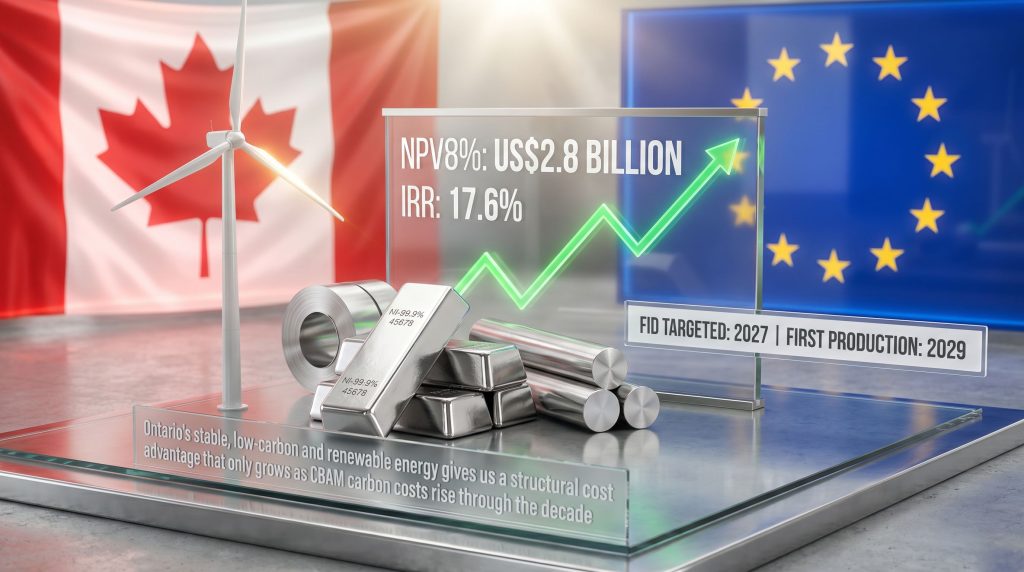
- Net Present Value (NPV8%): US$2.8 billion
- Internal Rate of Return (IRR): 17.6%
- targeted first production: 2029
- construction period: around 27 months
These figures provide a baseline for future commercial negotiations. In particular, they give both Canada Nickel and potential financing partners a quantified project framework when discussing offtake value and institutional support.
The Convergent Milestone Window
The current timeline points to:
- Summer 2026: final permits targeted
- Year-end 2026: full financing package targeted
- Year-end 2026: definitive agreement with RWEST targeted
- 2027: Final Investment Decision targeted
- 2029: first production targeted
This overlap is significant. Lenders reviewing debt packages may do so at the same time RWEST negotiations are meant to convert from framework to binding terms. Consequently, progress on offtake could become a visible signal of project readiness.
From MOU to Contracted Certainty: What the Conversion Test Looks Like
Investors monitoring the next phase should watch for several indicators:
- volume term sheets tied to Crawford’s ramp-up profile
- pricing frameworks such as fixed, indexed, or floor-price structures
- formal carbon premium mechanisms linked to CBAM economics
- ECA mandate letters from German or EU institutions
- named industrial customers within the European network
Each milestone would reduce uncertainty. By contrast, limited progress by year-end 2026 could leave a notable gap in the bankability case before FID.
The Broader Pattern in Canada Nickel’s Commercialisation Strategy
The RWEST arrangement is not an isolated move. Rather, it extends a wider pre-production commercialisation strategy already seen in Canada Nickel’s shareholder and offtake relationships. The company has worked to line up capital, strategic partners, and customer pathways before construction begins.
That approach is less common than it sounds. Many developers wait until construction is underway before pursuing serious offtake negotiations. However, that can compress timelines and reduce pricing flexibility when a project has the least room to manoeuvre.
By contrast, early commercial structuring can preserve leverage across both debt and offtake talks. If converted into a binding framework, the Canada Nickel RWEST MOU for low-carbon steel in Europe and North America would give Crawford meaningful market coverage across North America, Asia, and Europe before FID.
This article is intended for informational purposes only and does not constitute financial advice. All forward-looking statements, project economics, milestone targets, and financing projections referenced herein are subject to material risks, uncertainties, and assumptions. Readers should conduct independent research and consult qualified financial advisers before making investment decisions. The Canada Nickel RWEST MOU announced July 6, 2026 is a non-binding framework agreement and does not represent contracted offtake, committed financing, or guaranteed production outcomes.
Want to Track the Next Major Mineral Discovery Before the Market Does?
Discovery Alert's proprietary Discovery IQ model delivers real-time alerts the moment significant ASX mineral discoveries are announced, transforming complex data across more than 30 commodities into clear, actionable insights for both traders and long-term investors — explore Discovery Alert's discoveries page to see the historic returns major discoveries have generated, then begin your 14-day free trial to position yourself ahead of the broader market.