July 9, 2026
The West's Mineral Vulnerability and Why Processing Infrastructure Is the Real Bottleneck
For decades, Western nations treated critical mineral processing as an industrial afterthought, comfortable in the assumption that global supply chains would reliably deliver whatever materials advanced manufacturing required. That assumption has been systematically dismantled over the past three years. China's progressive export controls on gallium, germanium, and antimony shortage risks have exposed a structural flaw that no amount of mining policy can quickly correct: even where raw mineral deposits exist in Western jurisdictions, the refining and processing infrastructure to convert them into usable industrial inputs is almost entirely absent.
Furthermore, this is the context in which the Teck Trail critical minerals expansion has moved from a regional industrial story to a matter of continental strategic importance. Trail is not simply a smelter being upgraded. It represents one of the few existing, fully integrated polymetallic processing facilities in North America capable of producing the precise materials that Western defence, telecommunications, and semiconductor industries now urgently require from non-Chinese sources.
When big ASX news breaks, our subscribers know first
Canada's Critical Minerals Accelerator: A New Model for Government-Industry Collaboration
C$2 Billion and a Deliberate Departure From Grant-Based Policy
Launched under Canada's Budget 2025, the Canada Critical Minerals Accelerator represents a meaningful evolution in how Ottawa approaches resource sector investment. Rather than distributing grant funding to exploration-stage projects, the CCMA deploys C$2 billion (~US$1.4 billion) through an equity-like investment mechanism managed by Export Development Canada in partnership with Canada Growth Fund.
The critical distinction here is structural. By taking equity-like positions, the government aligns its financial returns directly with the commercial performance of the projects it supports. This is not subsidy architecture — it is strategic co-investment. Returns flow back to Canadian taxpayers if projects succeed, and the investment discipline it imposes on project selection is considerably more rigorous than traditional grant programmes.
The inaugural transaction under the CCMA is the Trail Operations agreement with Teck Resources, a choice that signals Ottawa's preference for brownfield processing capacity over early-stage exploration as its first deployment of this capital. The critical minerals demand surge occurring globally has made this kind of decisive government action increasingly necessary.
Policy Insight: The CCMA's equity-like investment model represents a structural shift away from grant-based mining support. Government capital is deployed to de-risk private investment while preserving upside participation, rather than simply transferring public funds to industry balance sheets.
Export Development Canada and Canada Growth Fund: Complementary Roles
Understanding how these two agencies interact is important for assessing how the Trail deal is actually structured. Export Development Canada, traditionally focused on trade finance and export credit, serves as the managing entity for the CCMA programme architecture. Canada Growth Fund, a C$15 billion vehicle established to attract private investment into clean economy and strategic sector transitions, is the direct investor taking the equity-like position in Trail Operations.
Together, they form a dual-agency structure designed to blend commercial investment discipline with policy mandate, ensuring that public capital flows toward projects with both strategic value and credible financial returns.
Breaking Down the Teck Trail Strategic Metals Initiative
Investment Architecture and Scale
The financial structure of the Teck Trail critical minerals expansion involves multiple layers that are worth disaggregating clearly.
| Investment Component | Value (CAD) | Value (USD) | Structure |
|---|---|---|---|
| Canada Growth Fund Equity-Like Investment | Up to C$400M | ~US$282M | Equity-like, via CCMA framework |
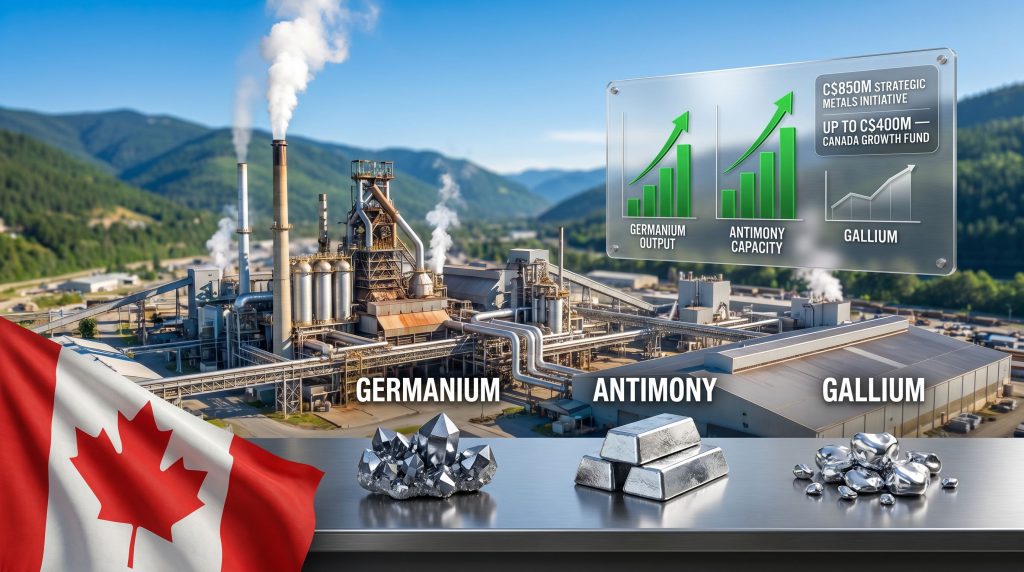
| Teck Strategic Metals Initiative (Total) | Up to C$850M | ~US$600M | Sustained capital deployment |
| Canada Critical Minerals Accelerator Pool | C$2B | ~US$1.4B | Trail = inaugural transaction |
The government's C$400 million commitment represents roughly 47% of the total Strategic Metals Initiative scope, with Teck's own capital accounting for the remainder. This co-investment ratio is meaningful: it demonstrates that public capital is being used to catalyse private sector commitment rather than replace it.
It is important to note that the full investment and offtake arrangements remain subject to definitive documentation and applicable approvals. These conditions precedent mean the agreement should be understood as a commercial framework rather than a fully executed funding commitment at this stage.
What Offtake Rights as a Policy Tool Actually Mean
Beyond the capital injection, perhaps the most strategically significant element of the agreement is the provision granting the Government of Canada offtake rights over a defined portion of future germanium, antimony, and gallium production from Trail.
This mechanism allows Ottawa to build a sovereign supply pipeline for critical materials without constructing state-owned processing infrastructure. The government effectively reserves access to a specified volume of finished critical mineral output, which can be directed toward domestic industrial users, allied nation supply agreements, or a national strategic stockpile. Consequently, this approach strengthens both critical minerals and energy security across the broader North American region.
Key Mechanism: Government offtake rights embedded in the Trail agreement create a sovereign supply pipeline for germanium, antimony, and gallium without requiring the construction of new state-owned facilities — potentially one of the most capital-efficient national stockpiling approaches available.
Trail Operations: Why This Facility Is Genuinely Irreplaceable
Scale, Integration, and Industrial History
Trail Operations, situated on the Columbia River in southern British Columbia, has been refining metals since 1896. That heritage matters because it reflects more than a century of accumulated metallurgical expertise, infrastructure investment, and operational optimisation that simply cannot be replicated quickly or cheaply.
The facility currently employs more than 1,400 people and produces at least 19 distinct products, spanning base metals, precious metals, specialty metals, fertilisers, and industrial chemicals. Its product range includes zinc, lead, silver, gold, indium, germanium, gallium, cadmium, sulphuric acid, and fertiliser products.
What makes Trail particularly distinctive as a critical minerals asset is its fully integrated character. Unlike standalone processing plants that require external smelting or refining partnerships, Trail takes raw concentrates through every stage of the value chain to finished metal products. This vertical integration eliminates the bottlenecks that often delay critical mineral value capture at other facilities.
Brownfield Advantage: Why Trail Beats a New Mine on Every Strategic Metric
When evaluating where to deploy scarce public capital for critical mineral supply security, the choice between supporting an existing complex like Trail and backing new mine development involves a comparison that consistently favours brownfield infrastructure. In addition, the importance of maintaining a resilient critical minerals supply chain cannot be overstated in the current geopolitical climate.
| Factor | Trail Expansion | New Mine Development |
|---|---|---|
| Infrastructure Status | Fully operational | Requires full construction |
| Permitting Complexity | Incremental approvals | Full environmental review cycle |
| Time to Production | Accelerated timeline | Typically 7 to 15+ years |
| Capital Efficiency | Leverages existing smelter | Full capital expenditure required |
| Feedstock Flexibility | Multi-source capable | Single deposit dependent |
| Processing Expertise | Decades of operational knowledge | Must be built from scratch |
The time-to-production advantage alone is decisive in the current geopolitical environment. Western governments cannot afford to wait 10 years for new mine development to address supply vulnerabilities that are acute today.
The Three Metals Driving the Expansion
Germanium: The Invisible Backbone of Digital Infrastructure
Germanium occupies a unique position in the global technology supply chain. It is a semiconductor material used in fibre optic cables, infrared optics, night-vision systems, and as a substrate in high-efficiency solar cells and compound semiconductors. Despite its critical importance, global primary germanium production is highly concentrated, with China historically controlling the majority of refined supply.
Trail is already recognised as one of the world's largest producers of refined germanium, deriving the material as a byproduct of zinc smelting. The Strategic Metals Initiative targets doubling existing germanium output from the facility, a goal that becomes more tractable when considered alongside the feedstock agreements discussed below.
One less widely appreciated aspect of germanium metallurgy is how the material reports through zinc processing streams. Germanium concentrates in specific mineralogical environments and must be recovered through targeted hydrometallurgical processing steps after the primary zinc circuit. Trail's existing capability to execute this recovery at scale is not easily replicated elsewhere.
Antimony: From Obscurity to National Security Priority
Antimony has moved from relative industrial obscurity to the centre of NATO supply security discussions with remarkable speed. Its applications span flame retardants embedded in electronics and construction materials, lead-acid battery plates, military-grade alloys, hardened ammunition components, and night-vision equipment casings.
China's export controls on antimony, which escalated through 2023 and 2024, exposed the near-total absence of Western antimony processing capacity. Unlike germanium, there is no equivalent Western production base to scale from. Trail's existing antimony circuit, targeted for capacity doubling, therefore represents a genuinely rare asset for allied supply chain security. Furthermore, the bismuth export controls imposed alongside antimony restrictions have compounded pressure on Western processors seeking alternative supply sources.
Gallium: The Compound Semiconductor Enabler with Almost No Western Supply
Of the three expansion metals, gallium presents the most acute supply vulnerability. Western gallium production at any meaningful scale is effectively non-existent. China has historically supplied more than 80% of global primary gallium, and its export restrictions on the material have created a structural shortage that is constraining 5G infrastructure rollout, advanced radar production, and compound semiconductor manufacturing.
Gallium is recovered as a trace byproduct of aluminium and zinc refining. Trail's zinc smelting circuit provides a natural recovery pathway, and the Strategic Metals Initiative targets establishing new gallium production capacity at the facility where none currently exists at commercial scale. This is not an expansion of an existing product line; it is the construction of an entirely new revenue and supply stream from existing feedstock.
The Feedstock Challenge and the Empire State Mines Solution
Red Dog Mine: An Ageing Cornerstone Navigating a Transition
Teck's Red Dog zinc mine in Northwest Alaska has historically provided the backbone of Trail's germanium-bearing concentrate supply. At its peak, Red Dog supplied up to 5% of global zinc production, along with substantial quantities of lead, silver, and germanium. It has been one of Trail's most important strategic feedstocks for nearly four decades.
However, Red Dog is currently transitioning from its original high-grade zinc deposit to a new mining area approximately 10 miles to the north. During this transition, feedstock volumes to Trail are expected to temporarily taper before recovering as the new area reaches full production. This creates a near-term supply gap that Teck is actively working to fill through diversified feedstock agreements.
Titan Mining's Empire State Mines: Tailings Reprocessing as a Strategic Pathway
In May 2026, Teck entered into an agreement with Titan Mining Corp. to evaluate the potential recovery of up to 13,000 kilograms of germanium per year from processing streams at Titan's Empire State Mines complex in Upstate New York.
Titan's July 2026 sampling programme confirmed widespread germanium mineralisation across multiple historic tailings facilities at Empire State Mines, along with meaningful values in primary ore. The programme identified consistent germanium tenor across the deposit portfolio, alongside high-grade zinc values suitable for reprocessing.
The strategic logic of this partnership is compelling for several reasons:
- Processing preparation is already complete: the tailings material has already been mined, crushed, and milled, eliminating the most energy-intensive stages of conventional mineral processing
- No new mining required: because extraction has already occurred, permitting requirements are significantly less intensive than new mine development
- Geographic diversification: a U.S.-based feedstock source reduces trans-boundary logistics complexity and strengthens continental supply chain integration
- Speed to contribution: the accelerated permitting and development pathway could allow Empire State Mines germanium to contribute to Trail's expanded output within a timeline that aligns with the Strategic Metals Initiative
Operational Insight: The pre-existing material liberation at Empire State Mines tailings could make this one of the most capital-efficient germanium recovery pathways in North America. The energy cost of crushing and milling, which typically represents a significant proportion of processing operating costs, has already been absorbed in prior mining cycles.
Third-Party Concentrate Sourcing and Multi-Feed Flexibility
Trail's established capability to process concentrates from multiple third-party sources provides additional feedstock resilience that purpose-built single-mine processing facilities cannot replicate. This multi-feed architecture means the expanded facility is not exposed to the single-point-of-failure risk that defines many critical mineral processing projects globally.
The next major ASX story will hit our subscribers first
Risk Factors Investors and Policymakers Should Monitor
Several substantive risks attach to the Teck Trail critical minerals expansion that deserve clear-eyed assessment:
- Conditions precedent: the full investment and offtake structure remains subject to definitive documentation and applicable regulatory approvals, meaning commercial execution is not yet finalised
- Commodity price volatility: germanium, gallium, and antimony prices are subject to significant fluctuation driven by Chinese export policy, global demand cycles, and speculative positioning; processing economics shift materially with price movements
- Red Dog transition timing: the temporary reduction in Red Dog feedstock volumes introduces near-term production uncertainty that alternative sources must bridge effectively
- Capital cost execution: large-scale smelter upgrades carry inherent engineering and construction risk, particularly in inflationary cost environments
- Environmental and community factors: expanded operations in southern B.C. will require ongoing community engagement and environmental permitting that could affect timelines
This article discusses forward-looking plans and capital commitments that remain subject to definitive agreements, regulatory approvals, and market conditions. Readers should not rely on forward-looking statements as predictions of actual outcomes.
What the Trail Model Signals for Canada's Resource-to-Technology Strategy
The CCMA's selection of Trail as its inaugural transaction is not accidental. It reflects a deliberate policy choice to prioritise existing processing infrastructure over new resource development as the fastest route to critical mineral supply security. As reported in the Cranbrook Townsman, the $400M injection into Trail Operations has been widely received as a landmark moment for the region and for Canadian industrial policy alike.
This prioritisation carries a broader message for the Canadian mining sector. Government capital under the CCMA framework appears oriented toward projects that can demonstrate a credible path to near-term production at scale, rather than exploration-stage assets requiring decade-long development timelines. Brownfield smelting and refining facilities with diversified feedstock capability, established workforces, and existing environmental permits occupy the front of that queue.
For the wider North American critical minerals ecosystem, Trail also demonstrates how polymetallic smelting hubs can function as sovereign infrastructure in the 21st-century economy, converting diverse mineral inputs from multiple jurisdictions into the finished materials that advanced technology supply chains require.
Want to Stay Ahead of the Next Major Critical Minerals Discovery?
Discovery Alert's proprietary Discovery IQ model scans ASX announcements in real time, instantly identifying significant mineral discoveries — including critical metals such as germanium, gallium, and antimony — and converting complex data into clear, actionable insights for investors at every level. Explore how historic mineral discoveries have delivered substantial returns and begin your 14-day free trial today to ensure you're positioned ahead of the market.