August 22, 2026
The Geopolitical Calculus Behind Clean Energy Dominance
When historians assess the energy transitions of the 2020s, they will likely identify a critical inflection point: the moment when governments stopped treating nuclear power as a legacy technology requiring managed decline and started treating it as a strategic asset requiring aggressive investment. That shift is now visible across G7 nations, and Canada's nuclear energy strategy is positioning the country to lead it rather than follow.
The convergence of three macro-forces is driving this transformation. Electricity demand is accelerating beyond what most grid planners anticipated a decade ago, fuelled by the rapid uptake of electric vehicles, the exponential growth of AI data centres with enormous and continuous power appetites, and the industrial electrification of processes that previously ran on fossil fuels.
At the same time, decarbonisation commitments are legally binding in most developed economies, creating regulatory pressure to replace thermal generation with clean alternatives. Overlaying both is a geopolitical competition for clean energy leadership that increasingly frames energy investment as a matter of national security, and the energy security transition agenda has never been more urgent.
Canada's response to these converging pressures is a comprehensive Canada nuclear energy strategy that draws on the country's formidable existing nuclear infrastructure while targeting the next generation of reactor technology, international fuel supply, and global technology export markets.
When big ASX news breaks, our subscribers know first
Canada's Nuclear Foundation: Stronger Than Most Realise
A critical distinction separates Canada from many nations currently announcing nuclear ambitions: Canada is not constructing a nuclear sector from the ground up. The country operates 17 CANDU reactors across Ontario and New Brunswick, with nuclear energy contributing approximately 13% of national electricity supply. This operational base represents decades of accumulated regulatory expertise, workforce competency, and supply chain infrastructure.
The upstream position is equally substantial. According to the World Nuclear Association, Canada supplied approximately 15% of global uranium output in recent years, establishing the country as a critical node in the international nuclear fuel supply chain. Saskatchewan province hosts some of the world's highest-grade uranium deposits, with the sector contributing approximately C$2.6 billion to the provincial economy in 2024 alone.
Why Saskatchewan's Uranium Matters
What makes Saskatchewan's uranium position particularly significant is the exceptional grade of its Athabasca Basin deposits. Uranium ore grades at mines like Cigar Lake and McArthur River historically average in the range of 15% to over 20% uranium oxide, compared to global average grades often below 0.1%. Furthermore, this extraordinary concentration means Canadian uranium production generates disproportionately large economic value per tonne of ore mined.
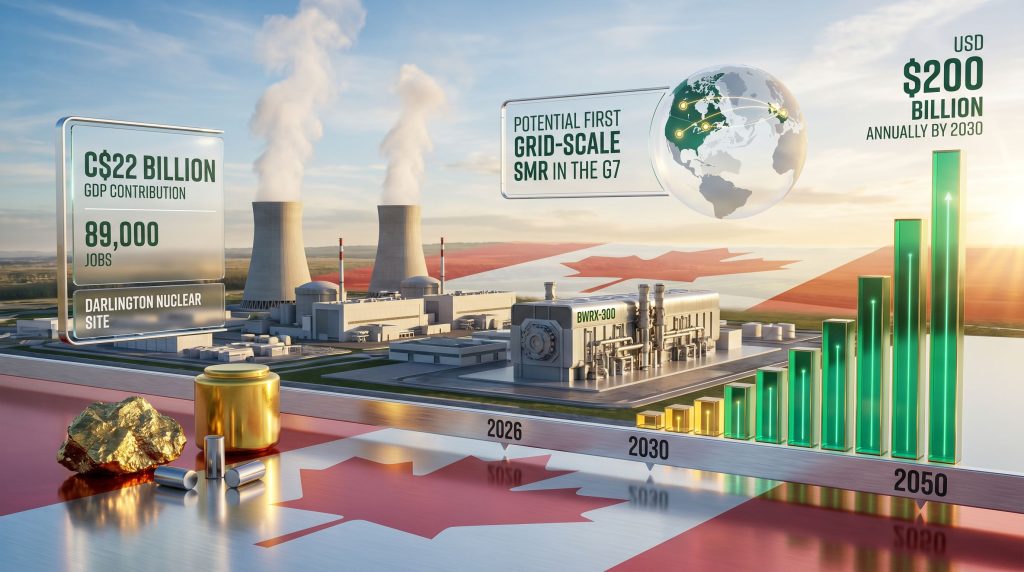
These geological advantages translate directly into cost competitiveness and environmental efficiency that no policy framework can replicate. Across the full nuclear value chain, the sector contributes approximately C$22 billion to Canada's GDP annually and supports around 89,000 jobs, based on industry estimates. Understanding the broader uranium market trends helps contextualise why Canada's resource base carries such strategic weight.
The Four Strategic Pillars Shaping Canada's Nuclear Future
The federal government announced its intention to release a comprehensive nuclear strategy before the end of 2026, led by Natural Resources Canada. The announcement, made by Energy and Natural Resources Minister Tim Hodgson at the Canadian Nuclear Association conference in April 2026, outlined a framework built across four distinct but interconnected dimensions.
Pillar 1: Enabling New Reactor Construction
The first pillar addresses the most persistent barrier to nuclear expansion in Western economies: investment risk. Historical nuclear projects in the United Kingdom, United States, and Finland demonstrated that cost overruns and construction delays could make private capital reluctant to commit without federal risk-sharing mechanisms. Canada's strategy explicitly commits to de-risking investment through financing mechanisms, acknowledging that the federal government must serve as anchor investor if private capital is to follow at the required scale.
Pillar 2: Becoming a Global Nuclear Supplier
The second pillar targets export market capture at a moment of exceptional global demand. Thirty-eight countries have endorsed the goal of tripling global nuclear capacity by 2050, creating a procurement pipeline that current supplier nations cannot individually satisfy. The global nuclear industry is projected to grow to as much as USD $200 billion annually by 2030, representing an extraordinary commercial opportunity for nations with established nuclear technology.
Pillar 3: Expanding Uranium Production and Fuel Capabilities
The third pillar aligns Canada's domestic resource endowment with the fuel requirements of allied nations building out their reactor fleets. However, uranium supply challenges remain a real concern globally, making Canada's approval of its first new uranium mine in 20 years all the more significant. The strategy's ambitions extend beyond raw uranium production toward fuel processing and enrichment capabilities.
Pillar 4: Advancing Next-Generation Technologies
The fourth pillar encompasses a C$2.2 billion capital investment programme over 10 years for Canadian nuclear laboratories, alongside targeted investment in small modular reactors, microreactors, and early-stage fusion research. The pan-Canadian coordination framework known as the Team Canada SMR Action Plan provides the organisational architecture for cross-provincial and public-private collaboration.
Small Modular Reactors: The Technology Redefining Nuclear Economics
Small modular reactors are advanced nuclear reactors with a power output typically below 300 megawatts electric. Unlike conventional large-scale nuclear plants, SMRs are factory-built, modular in design, and deployable in locations where traditional reactors are impractical, including remote communities, industrial facilities, and smaller electricity grids.
The appeal of SMRs extends well beyond their physical dimensions. Conventional large nuclear plants require upfront capital commitments measured in the tens of billions of dollars, construction timelines spanning ten to twenty years, and grid integration capacity that only large interconnected systems can absorb. SMRs disrupt this economic model in several important ways:
- Factory-manufactured reactor modules enable standardised quality control and learning curve cost reductions as production scales
- Modular design allows capacity to be added incrementally as demand grows, reducing the commitment required for any single investment decision
- Smaller absolute capital requirements make project financing accessible to a broader range of investors, including private equity and infrastructure funds
- Deployment flexibility enables installation at industrial sites, remote communities, and locations without existing grid connections
The Darlington BWRX-300: Canada's Flagship SMR Deployment
| Project Detail | Specification |
|---|---|
| Location | Darlington Nuclear Site, Ontario |
| Reactor Technology | GE Hitachi BWRX-300 |
| Developer | Ontario Power Generation |
| Strategic Significance | Potential first grid-scale SMR in the G7 |
| Economic Impact | Thousands of direct and indirect jobs; domestic supply chain development |
Ontario Power Generation's BWRX-300 project at Darlington carries significance that extends well beyond its immediate electricity output. If successfully commissioned, it would establish Canada as the first G7 nation to operate a grid-scale SMR, creating a commercial proof-of-concept that could catalyse export demand for Canadian nuclear technology. The demonstration effect of a functioning first-mover deployment is difficult to overstate in a technology market where risk perception governs investment decisions.
Microreactors and Canada's Arctic Sovereignty Dimension
The federal allocation of C$40 million to assess microreactor feasibility for remote military installations and northern operations introduces a strategic dimension that goes beyond electricity economics. Remote communities and military installations in these regions pay dramatically higher effective energy costs than southern populations, creating both an economic and strategic case for locally generated clean power.
Minister Hodgson specifically emphasised northern energy security as a core motivation, and the connection to Arctic sovereignty objectives is direct: energy self-sufficiency in remote northern installations reduces logistical vulnerability and enhances operational independence.
Canada's C$13 Billion Climate Finance Pledge: Industrial Policy by Another Name
Canada's commitment of C$13 billion over five years in international climate finance is most accurately understood as dual-purpose industrial policy rather than purely humanitarian climate assistance. The funding targets developing economies seeking support for emissions reduction, climate resilience infrastructure, and clean technology adoption — areas where Canadian companies, nuclear expertise, and uranium supply have direct commercial relevance.
Rick Smith, president of the Canadian Climate Institute, articulated this dual-benefit logic: "International climate finance simultaneously reduces global emissions and opens new markets for Canadian clean technology industries." When developing nations receive financing support to build clean electricity infrastructure, they create procurement demand for technology and fuel that Canadian companies are positioned to supply.
The pledge also aligns with international pressure on developed nations following COP29 commitments. The United Nations has assessed that developing countries may require trillions in climate investment by 2030, meaning Canada's contribution, while substantial, represents a fraction of the total capital mobilisation required.
The Canada Strong Fund and Workforce Investment
Alongside the nuclear strategy and climate finance commitment, the federal government announced the Canada Strong Fund, an initial C$25 billion sovereign-style investment vehicle targeting private-sector co-investment in national priority projects. Eligible sectors include energy, mining, infrastructure, agriculture, and technology — a scope that directly encompasses the nuclear value chain from uranium mining through reactor construction to technology development.
Complementing this capital deployment is a nearly C$6 billion commitment to skilled trades training, targeting the development and deployment of up to 100,000 skilled workers by 2030. This workforce investment addresses what may be the binding constraint on nuclear expansion timelines: the availability of qualified tradespeople, engineers, and technical specialists. The broader uranium investment outlook also points to growing international demand for precisely these kinds of supply-side capabilities.
The next major ASX story will hit our subscribers first
How Canada Compares to Global Nuclear Peers
| Country | Nuclear Strategy Focus | Key Metric |
|---|---|---|
| Canada | SMRs, CANDU modernisation, uranium export leadership | 13% of electricity from nuclear; C$22B GDP contribution |
| United States | Inflation Reduction Act incentives, advanced reactor licensing | 20%+ of electricity from nuclear; major SMR pipeline |
| United Kingdom | Large-scale new builds (Hinkley Point C), SMR competition | Target: 25% of electricity from nuclear by 2050 |
| France | Fleet refurbishment and new EPR reactor programme | Approximately 70% of electricity from nuclear |
| China | Aggressive new build programme; 26+ reactors under construction | Dominant global nuclear construction pipeline |
Canada's competitive position within this peer group is differentiated by the combination of domestic uranium supply, proprietary CANDU technology heritage, and a credible SMR development pipeline. In addition, Kazakhstan uranium dominance reminds us that geopolitical competition for fuel supply influence is intensifying — making Canada's resource advantages even more strategically valuable to allied nations.
The risk of inaction is concrete rather than theoretical. Nuclear technology export markets are being actively contested by United States, French, South Korean, and Chinese developers, each backed by national financing mechanisms and diplomatic support. Canada's window to establish first-mover credibility through the Darlington SMR project is time-limited.
Key Risks Canada Must Navigate
No honest assessment of Canada's nuclear ambitions can ignore the substantial risks that accompany them. Three categories of risk deserve particular attention:
Capital Cost and Construction Timeline Risk: Western nuclear projects have repeatedly exceeded budget and schedule projections. The Hinkley Point C project in the United Kingdom and Vogtle units 3 and 4 in the United States both significantly overran initial cost estimates. Canada's strategy proposes federal de-risking mechanisms, but specific financial instruments and contingency frameworks have not yet been publicly detailed.
Regulatory Complexity: The Canadian Nuclear Safety Commission must review and approve novel SMR and microreactor designs that were not contemplated in regulatory frameworks developed for conventional large reactors. Timeline implications for first-mover projects depend significantly on how regulatory review processes are resourced and structured.
Fuel Supply Chain Completeness: Canada's uranium advantage is real but partial. The nuclear fuel cycle requires not only uranium mining but also conversion, enrichment, and fuel fabrication — steps in which Canada currently has limited domestic capability. Consequently, strategic development of fuel processing capacity is essential to fully capturing the value chain.
Strategic Outlook Across Three Time Horizons
Understanding Canada's nuclear trajectory requires thinking across distinct time horizons, each with different milestones and uncertainties.
Short-Term Priorities (2026 to 2030):
- Release and implementation of the full Nuclear Energy Strategy document before end of 2026
- Regulatory progression of the Darlington BWRX-300 project toward construction commencement
- Completion of microreactor feasibility assessments for northern and military applications
- Deployment of initial capital tranches from the Canada Strong Fund
- Scaling of skilled trades training programmes to build nuclear construction workforce capacity
Medium-Term Trajectory (2030 to 2040):
- Potential commissioning of Canada's first operational grid-scale SMR at Darlington
- Expansion of uranium production capacity through newly approved mining projects
- Growth of nuclear technology export revenues as 38 nations pursue capacity tripling goals
- Development of domestic fuel processing capability to extend supply chain control
Long-Term Vision (2040 to 2050):
- Nuclear energy's expanded contribution to a substantially decarbonised Canadian electricity grid
- Canada established as a top-tier global nuclear technology and fuel supplier to allied nations
- Integration of advanced reactor technologies, potentially including fusion, into the national energy mix
- Full realisation of the C$22 billion GDP baseline expanded through new reactor capacity, exports, and value-added fuel services
Canada's nuclear strategy is not simply an energy policy document. It is an industrial competitiveness framework designed to secure economic positioning in a global clean energy economy projected to be worth hundreds of billions of dollars annually within this decade. The countries that establish operational credibility now will be the preferred partners and suppliers for the nations tripling their nuclear capacity through 2050.
This article contains forward-looking statements and projections based on currently available government announcements, industry estimates, and policy frameworks. Actual outcomes regarding project timelines, costs, and economic impacts may differ materially from those described. Readers should conduct independent research and seek professional advice before making investment decisions related to any sector discussed in this article.
Frequently Asked Questions: Canada's Nuclear Energy Strategy
What is Canada's new nuclear energy strategy?
Canada's nuclear energy strategy is a federal policy framework announced in April 2026 and expected to be fully published before the end of 2026. Led by Natural Resources Canada, the strategy covers four pillars: enabling new reactor construction, positioning Canada as a global nuclear supplier, expanding uranium production and fuel capabilities, and advancing next-generation technologies including SMRs and microreactors.
How many nuclear reactors does Canada currently operate?
Canada operates 17 CANDU reactors located in Ontario and New Brunswick, generating approximately 13% of the country's national electricity supply.
What is a CANDU reactor?
CANDU stands for Canadian Deuterium Uranium. It is a reactor design developed in Canada that uses natural uranium as fuel and heavy water as both moderator and coolant. The use of natural uranium distinguishes CANDU reactors from many other designs that require enriched uranium, providing fuel flexibility and supply chain independence advantages.
What are SMRs and why is Canada investing in them?
Small modular reactors are advanced nuclear reactors with power output typically below 300 megawatts electric. They are factory-built, modular, and deployable in locations unsuitable for conventional large reactors. Canada is investing in SMRs because they offer lower upfront capital requirements, scalable deployment, and dispatchable low-carbon baseload power that complements variable renewable energy sources.
What is the Canada Strong Fund?
The Canada Strong Fund is a sovereign-style investment vehicle announced as part of Canada's latest federal economic update, with an initial capitalisation of C$25 billion. It targets private-sector co-investment in national priority projects across energy, mining, infrastructure, agriculture, and technology sectors.
How does Canada's nuclear strategy connect to its 2050 net-zero target?
Canada has a legislated net-zero emissions target for 2050. Nuclear energy provides firm, dispatchable, low-carbon baseload power that can decarbonise electricity supply for heavy industry, hydrogen production, and electrified transport at scale. Analysts broadly consider nuclear a necessary complement to renewables for achieving full grid decarbonisation given the limitations of intermittent generation sources.
Want to Stay Ahead of the Next Major Resource Discovery Driving Canada's Clean Energy Boom?
Discovery Alert's proprietary Discovery IQ model delivers real-time alerts on significant ASX mineral discoveries — including uranium and critical minerals powering the global nuclear energy transition — instantly transforming complex data into actionable investment opportunities for traders and long-term investors alike. Explore historic discoveries and their market-moving returns, then begin your 14-day free trial at Discovery Alert to position yourself ahead of the market.