July 14, 2026
Why Carbon Capture May Be the Only Viable Path for Oil Sands Decarbonisation
Industrial decarbonisation rarely follows a straight line. For most heavy-emitting sectors, the journey toward lower carbon intensity involves incremental operational improvements, fuel switching, or efficiency gains that compound over time. But for Canada's oil sands producers, the arithmetic is fundamentally different. Bitumen extraction and processing generates greenhouse gas emissions at a structural level that marginal improvements simply cannot resolve.
The energy intensity required to separate viscous bitumen from sand, upgrade it into synthetic crude, and then transport it to refineries means that even best-in-class operations carry a carbon footprint that conventional reduction strategies cannot adequately address.
This is the core problem the Canada oil sands Pathways CO2 project is designed to solve, and understanding its scale, complexity, and significance requires looking beyond the headline figures to the technical, geological, and financial architecture underneath.
When big ASX news breaks, our subscribers know first
The Structural Emissions Challenge Unique to Bitumen Production
Unlike conventional crude, which flows freely to the surface under natural reservoir pressure, bitumen must be coaxed out of the ground through steam injection processes such as Steam-Assisted Gravity Drainage (SAGD) or mined directly and processed through extraction plants. Both approaches are thermally intensive. SAGD operations, which dominate in situ production, require enormous volumes of steam generated by burning natural gas, and that combustion produces CO2 at every stage of the process.
The result is a carbon intensity profile that sits meaningfully above that of most conventional crude grades. Canada's oil sands collectively account for a substantial share of the country's total industrial greenhouse gas output. Furthermore, unlike a refinery or chemical plant where point-source emissions can sometimes be addressed through equipment upgrades or process changes, the emissions from oil sands operations are distributed across heating systems, upgrading units, and utility infrastructure that cannot simply be retrofitted with off-the-shelf solutions.
Three structural realities define why standard emissions reduction approaches fall short here:
- Steam generation for SAGD is thermally irreducible without fundamentally changing the extraction method itself
- Bitumen upgrading requires hydrogen addition or carbon rejection, both of which generate CO2 as byproducts
- The sheer geographic dispersal of production facilities across northern Alberta makes facility-by-facility solutions economically inefficient
The logical conclusion, supported by independent analysis and the producers themselves, is that centralised carbon capture and storage infrastructure represents the most cost-effective decarbonisation pathway available to the sector at scale.
The Pathways Alliance: Six Competitors, One Shared Infrastructure Mandate
The Oil Sands Alliance bringing the Canada oil sands Pathways CO2 project to life comprises six of Canada's largest energy companies: Canadian Natural Resources, Cenovus, Suncor, Imperial Oil, ConocoPhillips Canada, and MEG Energy. Together, these companies account for approximately 95% of Canada's total oil sands production, making this one of the most concentrated industry coalitions in Canadian energy history.
The decision to pursue a consortium model rather than individual operator CCS investments reflects both economic logic and practical necessity. The capital cost of building dedicated pipeline and storage infrastructure for a single producer would be prohibitive relative to the emissions reduction achieved. Shared infrastructure spreads those fixed costs across a much larger volume of captured CO2, dramatically improving the cost per tonne of abatement.
The Pathways Alliance brings direct competitors together around a shared infrastructure mandate with implications that extend well beyond any single company's balance sheet. The governance arrangements that make this work, including cost-sharing obligations and joint decision-making frameworks, represent as significant an achievement as the engineering itself.
Each member retains responsibility for capturing CO2 at its own facilities, while the Alliance functions as the shared provider of transportation and permanent sequestration infrastructure. This division of operational and financial responsibility matters enormously for how regulators, investors, and counterparties assess liability and compliance obligations across a multi-decade project.
How the Technical Architecture Actually Works
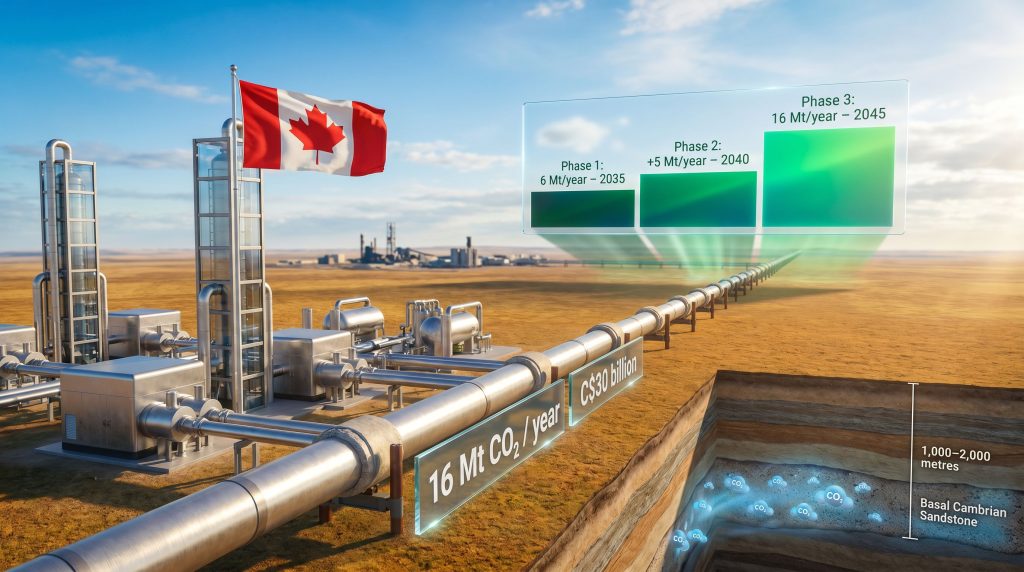
The Phase 1 scope of the Canada oil sands Pathways CO2 project targets 13 oil sands facilities spread across three geographic clusters: Fort McMurray, Christina Lake, and Cold Lake. From each of these facilities, captured CO2 will be fed into a shared pipeline network extending more than 650 kilometres, ultimately connecting to a centralised underground storage hub in the Cold Lake area.
The geological target for permanent sequestration is the Basal Cambrian Sandstone formation, located roughly 1,000 to 2,000 metres below the surface. This is the same geological unit that has already proven effective at Shell Canada's Quest CCS project, which has been operational since 2015. However, the Pathways project would use this formation at a scale that dwarfs anything previously attempted in Canada.
Estimated storage capacity assessments for the Basal Cambrian Sandstone in the Cold Lake area range from more than 1.1 billion tonnes of CO2 to projections exceeding 2 billion tonnes, depending on the methodology applied. That storage volume provides the geological headroom necessary for a multi-decade, multi-phase sequestration program.
Phased Emissions Reduction Targets
| Project Phase | Emissions Reduction Target | Target Year |
|---|---|---|
| Phase 1 (MoU commitment) | 6 million tonnes CO₂/year | 2035 |
| Phase 2 expansion | Additional 5 million tonnes CO₂/year | 2040 |
| Phase 3 expansion | Remaining balance to 16 Mt/year total | 2045 |
| Long-term net-zero goal | Full oil sands decarbonisation | 2050 |
A less commonly appreciated aspect of this architecture is the pipeline procurement requirement embedded in the trilateral agreement. The Oil Sands Alliance is obligated to make best efforts to source pipeline materials from Canadian suppliers, a condition that adds both political significance and potential cost complexity to the procurement process.
The Trilateral MoU: What the Three-Party Agreement Actually Commits To
The memorandum of understanding bringing together the Oil Sands Alliance, the Government of Alberta, and the Government of Canada represents more than a climate agreement. Its stated objectives span emissions reduction, expanded market access, increased production capacity, and Indigenous engagement, reflecting the political reality that this project exists at the intersection of climate policy and energy security.
The federal dimension of the agreement includes Canada's existing investment tax credits for capital expenditures related to carbon capture, utilisation, and storage. In addition, the federal government is planning to legislate investment tax credits specifically for enhanced oil recovery-related carbon capture, further expanding the incentive architecture available to consortium members. These developments reflect the broader Canada energy challenges that have shaped national policy in recent years.
What government incentives support the Pathways CO2 project? Canada offers investment tax credits for CCUS capital expenditures and is moving to legislate additional credits for enhanced oil recovery-related carbon capture, both designed to reduce the financial risk associated with deploying private capital at the scale required.
Definitive binding agreements between all three parties are expected by 15 November, converting the MoU's framework commitments into contractual obligations. The gap between a memorandum of understanding and a binding definitive agreement is not merely procedural. It is the difference between stated intent and legal enforceability, and several critical cost-sharing, liability, and regulatory questions remain unresolved ahead of that deadline.
Capital Costs: From C$16.5 Billion to C$30 Billion and the Range in Between
No official project cost figure has been released by the Oil Sands Alliance. What is publicly known is that Cenovus chief executive Jon McKenzie indicated in June 2025 that costs could reach as much as C$30 billion (approximately US$21 billion). Earlier independent estimates placed Phase 1 costs alone at approximately C$16.5 billion, underscoring the wide uncertainty band that currently surrounds the project's financial profile.
The gap between these figures reflects several compounding variables:
- Pipeline procurement costs, particularly given Canadian supplier mandates that may constrain competitive tendering
- Geological characterisation and monitoring well requirements across a large and geologically variable storage reservoir
- Compression infrastructure needed to maintain pipeline pressure across a 650+ kilometre network
- Regulatory compliance and environmental monitoring systems required over the full operational life
How Pathways Compares to Global CCS Benchmarks
| Project | Location | Estimated Cost | Annual Storage Capacity |
|---|---|---|---|
| Pathways CO₂ Project | Alberta, Canada | Up to C$30 billion | 16 Mt CO₂/year (full build-out) |
| Northern Lights CCS | Norway | ~US$1.8 billion (Phase 1) | 1.5 Mt CO₂/year |
| East Coast Cluster | United Kingdom | ~£10 billion | 10 Mt CO₂/year |
| Quest CCS (Shell) | Alberta, Canada | ~C$1.35 billion | ~1 Mt CO₂/year |
Placed in global context, the Pathways project would represent the largest integrated CCS initiative ever undertaken in terms of the number of industrial facilities served by a single shared network. The cost-per-tonne economics improve significantly at scale, but only if the full build-out proceeds on schedule.
The next major ASX story will hit our subscribers first
The Connection to the West Coast Oil Pipeline
The Canada oil sands Pathways CO2 project does not exist in isolation. It is structurally linked to the proposed West Coast Oil Pipeline (WCOP), a 1 million barrel-per-day export corridor targeting greater Vancouver, British Columbia, following a route broadly parallel to the existing Trans Mountain system. The WCOP carries an estimated cost of up to C$44 billion and is led jointly by Canada and Alberta, with Pembina Pipeline holding a 10% equity stake.
The political logic connecting these two megaprojects is straightforward: expanded export capacity provides the revenue base that makes long-cycle CCS investment economically viable for producers, while decarbonisation commitments provide the social and regulatory licence that justifies new export infrastructure. The two projects are being treated as interdependent policy objectives within the trilateral framework.
This linkage raises a legitimate analytical question. Treating production growth and emissions reduction as mutually reinforcing assumes that the carbon price and regulatory environment remain stable across multiple decades and multiple government terms. If either changes materially, the economics that underpin one side of this equation can undermine the other. Consequently, this interdependency deserves careful scrutiny from both investors and policymakers.
Pathways vs. Quest CCS: Understanding the Step-Change in Scale
Alberta has existing operational CCS infrastructure, and Quest, operated by Shell Canada since 2015, is the most directly comparable precedent for the Pathways project. The energy transition mining sector more broadly has looked to Quest as a proof-of-concept for large-scale sequestration in the region.
Structural Comparison: Quest vs. Pathways
| Attribute | Quest CCS (Shell) | Pathways CO₂ Project |
|---|---|---|
| Operator | Shell Canada | Pathways Alliance (6 members) |
| Facilities served | 1 (Scotford upgrader) | 13+ oil sands facilities (Phase 1) |
| Annual capture capacity | ~1 Mt CO₂/year | 6 Mt/year (Phase 1); 16 Mt/year (full) |
| Pipeline length | ~65 km | 650+ km |
| Storage formation | Basal Cambrian Sandstone | Basal Cambrian Sandstone |
| Operational status | Operational since 2015 | Under development |
Quest demonstrated that the Basal Cambrian Sandstone formation is a reliable and geologically stable sequestration target. Over roughly a decade of operations, Quest has shown that CO2 injected into this formation behaves predictably and remains securely stored.
However, the formation has never been used at anything approaching the injection rates that the Pathways project would require at full build-out. Scaling from 1 million tonnes per year to 16 million tonnes per year is not simply a linear extrapolation — it introduces new questions about reservoir pressure management, injection well spacing, and long-term monitoring obligations.
Alberta's approval for further geological evaluation of the storage space has been granted, but final regulatory approval remains outstanding, adding uncertainty to construction timelines that originally targeted Q4 2025 commencement, with operations anticipated between 2029 and 2030.
Key Risks That Could Derail the Project
Several material risks stand between the current MoU framework and an operational CCS network.
Financial and governance risks:
- Cost-sharing arrangements between federal, provincial, and corporate stakeholders remain under active negotiation
- Capital cost escalation has already expanded the estimated range from C$16.5 billion to C$30 billion, and further increases cannot be ruled out
- Sustained federal tax credit frameworks must survive across multiple government terms for the project economics to hold
Regulatory and approval risks:
- Multiple overlapping federal and provincial regulatory jurisdictions must all be satisfied before construction can proceed
- Timeline risk is real: original construction start targets have already been superseded by negotiation timelines
Indigenous consultation and social licence:
Cold Lake First Nation has publicly characterised the consultation process as insufficient, raising concerns that extend beyond procedural compliance to the principle of free, prior, and informed consent. The trilateral MoU includes commitments to Indigenous engagement, but critics argue these fall meaningfully short of internationally recognised standards.
Social licence risk is among the most consequential non-financial barriers to project execution. A regulatory approval obtained without genuine community consent can be challenged through courts, delayed by protests, or ultimately rendered politically untenable regardless of its technical merits.
Furthermore, financial risks around carbon capture and storage in Canada have been independently assessed as a significant concern for the Pathways project specifically, with analysts highlighting uncertainties around long-term liability and monitoring costs.
Frequently Asked Questions: Canada Oil Sands Pathways CO₂ Project
What is the Pathways CO2 project?
The Pathways CO2 project is a large-scale carbon capture and storage initiative in northern Alberta, designed to collect CO2 emissions from oil sands facilities and transport them via pipeline to a permanent underground storage hub near Cold Lake.
Who is behind the Pathways Alliance?
The alliance comprises Canada's six largest oil sands producers: Canadian Natural Resources, Cenovus, Suncor, Imperial Oil, ConocoPhillips Canada, and MEG Energy, collectively responsible for approximately 95% of Canada's oil sands production.
How much CO2 will Pathways capture?
Phase 1 targets 6 million tonnes of CO2 per year by 2035. Full build-out across all phases is designed to achieve approximately 16 million tonnes per year, contributing to the industry's net-zero ambition by 2050.
What is the estimated cost of the Pathways project?
Estimates range from approximately C$16.5 billion to as high as C$30 billion, with the higher figure cited by Cenovus's chief executive in mid-2025. No official cost figure has been released by the consortium.
Where will the CO2 be stored?
Captured CO2 will be injected into the Basal Cambrian Sandstone formation, located roughly 1,000 to 2,000 metres underground near Cold Lake, Alberta, a geological formation with estimated storage capacity exceeding 1.1 billion tonnes.
What are the main risks facing the project?
Key risks include unresolved cost-sharing arrangements, outstanding regulatory approvals, Indigenous consultation concerns raised by Cold Lake First Nation, and potential capital cost escalation beyond current estimates.
What the Pathways Project Signals for Canada's Long-Term Energy Position
Whether the Canada oil sands Pathways CO2 project ultimately succeeds or stalls will carry implications well beyond Alberta's borders. For investors in Canadian oil sands equities, the project's progression toward binding agreements and regulatory approval represents a key indicator of whether long-cycle oil sands assets can sustain their investment case in a carbon-constrained world.
For global energy markets, the project functions as a real-world test of whether industrial-scale CCS can serve as a credible bridge technology for high-emission fossil fuel sectors. The role of critical minerals and energy security concerns further reinforces why governments are willing to co-invest at this scale. If Pathways demonstrates that a consortium of private operators can build, finance, and operate a 650-kilometre CO2 pipeline network delivering permanent underground sequestration at 16 million tonnes per year, it strengthens the argument for CCS as a meaningful component of the global energy transition toolkit.
If cost escalation, regulatory delays, or social licence failures prevent the project from reaching its operational targets, the opposite conclusion will be drawn, with significant consequences for how policymakers and investors assess CCS-dependent decarbonisation strategies across other high-emitting industrial sectors globally. In addition, renewable energy solutions may become more attractive by comparison should CCS projects of this nature underperform.
The November 15 deadline for converting the trilateral MoU into binding legal agreements is the next pivotal milestone. Between now and then, the details of cost-sharing structures, procurement arrangements, Indigenous consultation processes, and financing frameworks will determine whether this agreement marks a genuine turning point in Canada's industrial climate strategy, or whether it becomes another framework commitment that fails to cross the threshold into execution.
Readers seeking ongoing commodity market intelligence and coverage of Canadian energy developments can access related reporting via Argus Media.
Disclaimer: This article contains forward-looking statements, cost projections, and regulatory assessments based on publicly available information current at the time of writing. Project timelines, cost estimates, and policy frameworks are subject to change. Nothing in this article constitutes financial or investment advice.
Want to Stay Ahead of Major Resource and Energy Discoveries on the ASX?
Discovery Alert's proprietary Discovery IQ model delivers real-time alerts on significant ASX mineral discoveries, transforming complex resource data into actionable investment insights for both short-term traders and long-term investors. Explore historic examples of exceptional returns from major discoveries and begin your 14-day free trial today to position yourself ahead of the broader market.