July 25, 2026
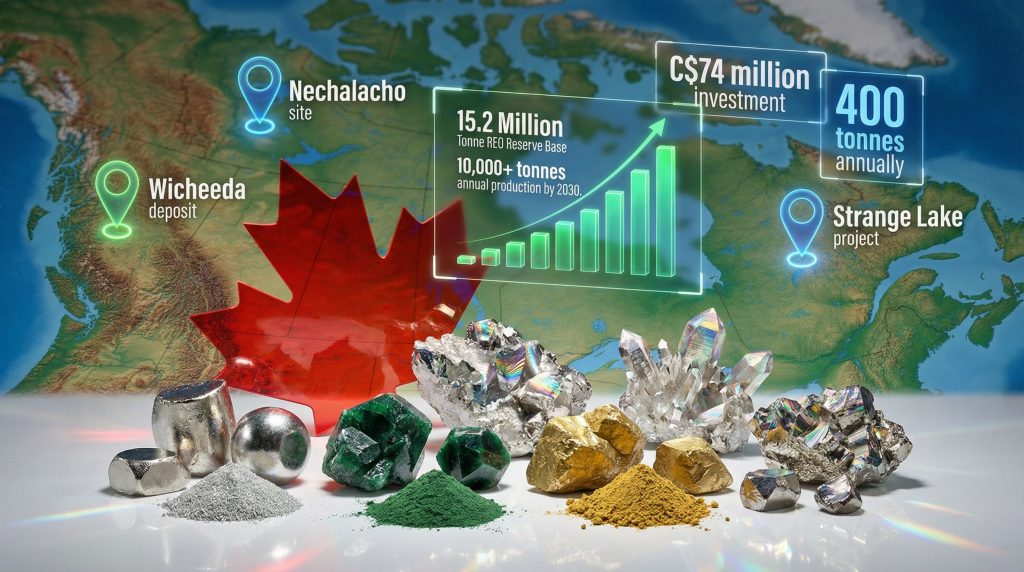
Canada's rare earth elements represent a crucial component in addressing global supply chain vulnerabilities that have created dependencies on single-source suppliers across strategic industries. The concentration of critical mineral production in specific regions poses systemic risks to manufacturing sectors underpinning modern technological infrastructure. These supply chain bottlenecks extend beyond traditional commodities, affecting advanced materials essential for defence systems, renewable energy technologies, and emerging digital applications.
Within this complex landscape, rare earth elements in Canada represent a pivotal opportunity for supply chain diversification and strategic resource development. Furthermore, understanding the geological, technical, and economic factors driving this sector requires analysis of deposit characteristics, processing capabilities, and market dynamics that will shape production timelines and investment outcomes over the next decade.
What Makes Canada's Rare Earth Element Deposits Strategically Significant?
Understanding Canada's Geological REE Foundation
Canada's rare earth elements resources span diverse geological formations across multiple provinces, creating a distributed foundation for potential supply chain development. The country's deposits occur primarily within carbonatite complexes, alkaline intrusions, and associated mineral systems that contain both light and heavy rare earth concentrations.
Provincial distribution creates natural diversification opportunities:
• Quebec and Labrador: Carbonatite-hosted deposits with significant heavy REE enrichment
• Northwest Territories: Complex alkaline systems containing thorium-rare earth associations
• British Columbia: High-grade carbonatite deposits with favourable infrastructure proximity
• Saskatchewan: Historic exploration targets with processing development potential
• Ontario: Emerging exploration projects and downstream processing opportunities
The geological diversity of Canadian deposits provides strategic advantages compared to single-formation dependencies. Consequently, carbonatite complexes typically yield higher concentrations of heavy rare earth elements, including dysprosium and terbium, which command premium pricing due to supply constraints and specialised applications in permanent magnets and defence systems.
Heavy rare earth elements comprise less than 10% of total global REE production but account for disproportionate value in high-technology applications. Canadian deposits with elevated heavy REE content position the country to capture premium market segments rather than competing primarily on volume with light REE producers.
Critical Applications Driving Industrial Demand
The integration of rare earth elements into modern manufacturing has created demand patterns that extend across multiple high-growth sectors. For instance, electric vehicle production requires substantial REE quantities for permanent magnet motors, with neodymium and praseodymium forming the primary magnetic compounds in drive systems.
Electric Vehicle Integration:
• Motor magnets: Neodymium-iron-boron alloys provide power density advantages
• Battery systems: Lanthanum compounds enhance energy storage performance
• Electronic controls: Yttrium applications in power management circuits
• Sensor technologies: Various REE compounds in autonomous driving systems
Wind energy infrastructure represents another major consumption category, with permanent magnet generators requiring substantial REE inputs per megawatt of installed capacity. Direct-drive turbine designs eliminate gearboxes while increasing magnetic material requirements, creating demand concentration in specific REE compounds. However, defence applications consume relatively small volumes but require assured supply chains and stringent material specifications.
Precision-guided munitions, electronic warfare systems, and advanced radar technologies incorporate REE compounds with performance characteristics that alternative materials cannot replicate. These energy transition minerals play a critical role in modern defence infrastructure.
Market analysts project global REE demand could increase three to seven times current levels by 2040, driven primarily by clean energy infrastructure deployment and electric vehicle adoption acceleration.
Medical imaging systems, telecommunications infrastructure, and consumer electronics create additional demand streams that contribute to overall market growth. Magnetic resonance imaging equipment relies on gadolinium compounds, while fibre optic systems incorporate erbium for signal amplification across long-distance networks.
When big ASX news breaks, our subscribers know first
How Does Canada's REE Processing Infrastructure Challenge China's Market Position?
Saskatchewan's Processing Development Initiatives
Historical patterns in global REE production have concentrated processing capabilities within China's industrial system, creating supply chain vulnerabilities for Western manufacturing sectors. The Natural Resources Canada website documents that approximately 97% of global REE supply originated from Chinese sources, with China implementing strategic policies to maintain market control through price manipulation and export restrictions.
The development of North American processing infrastructure represents a fundamental shift toward supply chain diversification. Saskatchewan has emerged as a focal point for this transition, with facilities designed to handle complex ore processing and rare earth separation at commercial scales.
Canadian companies have invested substantial capital in developing hydrometallurgical processing capabilities that can handle diverse ore types from domestic and international sources. In addition, these facilities incorporate advanced separation technologies that enable production of high-purity rare earth compounds meeting specifications for advanced manufacturing applications.
Processing Technology Advantages:
• Multi-stage separation: Ion exchange and solvent extraction systems
• Purity achievement: 99.9%+ rare earth oxide production capabilities
• Flexibility: Ability to process various ore types and concentrates
• Environmental compliance: Advanced waste management solutions and recycling systems
• Quality control: Consistent product specifications for industrial customers
The establishment of domestic processing capabilities reduces dependence on Chinese refineries while creating opportunities for Canadian companies to capture higher-value downstream activities. Processing rare earth ores domestically enables better quality control, shorter supply chains, and enhanced security of supply for North American manufacturers.
Value-Addition Through Downstream Development
Beyond basic rare earth oxide production, Canadian companies are developing capabilities in specialised product manufacturing that serves specific industrial applications. This includes production of rare earth compounds used in medical imaging, precision optics, and specialised alloys for aerospace applications.
The integration of mining, processing, and product manufacturing within Canadian operations creates vertical integration opportunities that improve project economics while reducing supply chain complexity. Furthermore, companies can optimise production based on market demands for specific rare earth compounds rather than producing standardised oxide mixes.
Research and development partnerships between Canadian companies and technology institutions have generated intellectual property in processing methods, separation technologies, and product applications. These technological advances provide competitive advantages and potential licensing revenue streams that enhance overall project valuations.
Technology transfer opportunities exist particularly in areas where Canadian companies have developed innovative solutions for complex ore processing challenges. Similarly to Canada energy transition initiatives, environmental regulations in Canada have driven development of cleaner processing methods that could be applied internationally in jurisdictions with similar environmental standards.
Which Canadian REE Projects Demonstrate the Greatest Development Potential?
Strange Lake Quebec-Labrador Megaproject Assessment
The Strange Lake deposit on the Quebec-Labrador border represents one of the largest undeveloped rare earth resources in North America, with geological characteristics that distinguish it from typical carbonatite-hosted deposits. The property contains significant concentrations of heavy rare earth elements, including yttrium, dysprosium, and other high-value compounds.
Strange Lake Project Characteristics:
| Development Aspect | Technical Specifications |
|---|---|
| Geological Setting | Peralkaline granite complex |
| Resource Scale | Multi-hundred million tonne potential |
| Processing Approach | Hydrometallurgical extraction |
| Infrastructure Status | Remote location requiring development |
| Heavy REE Content | Elevated yttrium and heavy lanthanides |
| Development Timeline | Multi-phase approach over decade+ |
The project's remote location presents both challenges and opportunities. While infrastructure development requires substantial capital investment, the isolation provides advantages in terms of environmental permitting and community relations compared to projects near populated areas.
Processing Strange Lake ores requires specialised metallurgical approaches due to complex mineralogy and elevated concentrations of radioactive elements. Consequently, companies developing the property have invested in extensive metallurgical testing to optimise recovery rates while managing environmental and safety requirements.
The scale of the Strange Lake resource provides optionality for staged development approaches, beginning with smaller-scale operations that can be expanded as markets develop and processing technologies mature. This development flexibility reduces initial capital requirements while maintaining long-term production potential.
Nechalacho Northwest Territories Advanced Development
The Nechalacho project in the Northwest Territories has progressed through multiple development phases, with extensive resource definition and preliminary economic assessments completed. The deposit contains both light and heavy rare earth elements within a complex geological system that includes thorium-rare earth associations.
Resource definition at Nechalacho encompasses multiple zones with varying rare earth concentrations and mineralogical characteristics. Surface zones contain lighter rare earth elements suitable for initial production, while deeper portions of the deposit show heavy rare earth enrichment that could support premium product development.
Nechalacho Development Considerations:
• Resource confidence: Extensive drilling and geological modelling completed
• Processing studies: Metallurgical testing for multiple ore types
• Environmental assessment: Baseline studies and impact evaluations
• Indigenous consultation: Ongoing engagement with affected communities
• Transportation planning: Logistics solutions for northern operations
• Regulatory progress: Permitting activities advancing through territorial system
The project's location in the Northwest Territories provides access to established mining industry innovation services and transportation networks while maintaining distance from populated areas. This balance supports operational efficiency while minimising community impact concerns that can complicate permitting processes.
Expansion potential at Nechalacho extends beyond initial development scenarios, with exploration targets that could substantially increase resource estimates. However, the property's size and geological complexity provide opportunities for multi-decade mining operations that could justify substantial infrastructure investments.
Wicheeda British Columbia Carbonatite Development
The Wicheeda deposit in British Columbia represents a high-grade carbonatite system with favourable characteristics for near-term development. The project's proximity to existing transportation infrastructure reduces development costs while providing access to established mining service providers.
Carbonatite mineralogy at Wicheeda enables conventional processing approaches using flotation and hydrometallurgical techniques that have been proven in similar operations. This reduces technical risk compared to projects requiring development of novel processing methods.
Wicheeda Competitive Advantages:
• Grade profile: Above-average rare earth concentrations
• Infrastructure proximity: Access to highways and power grid
• Processing simplicity: Conventional flotation applicable
• Light REE focus: Neodymium and praseodymium concentrations
• Permitting environment: Established provincial regulatory framework
• Service availability: Mining contractors and suppliers accessible
The light rare earth focus of Wicheeda aligns with large-volume applications in permanent magnets and catalysts, providing market depth that supports sustained production. While light REE pricing typically generates lower margins than heavy REE compounds, market size enables larger-scale operations with improved economies of scale.
Development timelines for Wicheeda benefit from British Columbia's established mining regulatory framework and existing environmental assessment procedures. Companies can leverage precedents from similar projects in the province to streamline permitting while maintaining environmental compliance standards.
What Economic and Geopolitical Factors Drive Canada's REE Strategy?
Market Demand Evolution and Supply Security Imperatives
Global rare earth element demand patterns have transformed substantially since the early 2000s, when total annual consumption approximated 130,000 tonnes. Industry projections now anticipate demand exceeding these historical levels by multiples as clean energy infrastructure deployment accelerates and electric vehicle adoption reaches mass market scales.
The United States maintains import dependencies for rare earth materials that create strategic vulnerabilities across defence, energy, and technology sectors. Historical documentation shows that 95% of U.S. rare earth imports originated from China, establishing a supply chain concentration that subsequent policy initiatives have sought to address through diversification programmes.
Demand Growth Drivers:
• Electric vehicles: Permanent magnet motor adoption expanding globally
• Wind energy: Direct-drive turbine deployments requiring REE magnets
• Energy storage: Battery technologies incorporating rare earth compounds
• Defence systems: Advanced weaponry and electronic warfare equipment
• Consumer electronics: Ongoing miniaturisation requiring specialised materials
• Medical devices: Imaging and diagnostic equipment growth
Price volatility in rare earth markets reflects both supply constraints and geopolitical tensions that affect trade relationships between major producing and consuming regions. Historical price cycles demonstrate how supply disruptions can generate rapid price increases across rare earth compounds, creating investment opportunities for projects with development flexibility.
Strategic stockpile policies in Western countries have evolved to address supply security concerns while providing market stabilisation mechanisms. Furthermore, government procurement programmes create demand floors that support project economics during commodity price downturns while ensuring availability of critical materials during supply disruptions.
Government Investment Framework and Policy Support
Canadian federal and provincial governments have implemented policy frameworks designed to accelerate critical mineral development while ensuring environmental protection and Indigenous consultation standards. These policies provide both financial incentives and regulatory streamlining that improves project economics for rare earth development initiatives.
Investment programmes target multiple aspects of critical mineral development, including exploration incentives, processing infrastructure support, and technology development funding. Companies can access various funding mechanisms that reduce development costs while sharing risks associated with early-stage project advancement.
Policy Support Mechanisms:
• Tax incentives: Flow-through shares and accelerated depreciation
• Infrastructure funding: Transportation and utility development support
• Research grants: Technology advancement and processing improvement
• Environmental streamlining: Coordinated assessment processes
• Trade promotion: Market development and international partnerships
• Skills development: Training programmes for specialised mining occupations
International cooperation agreements between Canada and allied nations create market access opportunities while providing diplomatic support for Canadian mineral development initiatives. These partnerships facilitate technology transfer, joint research projects, and coordinated supply chain development that benefits all participating countries.
The integration of environmental, social, and governance considerations into government support programmes ensures that funded projects meet sustainability standards while creating long-term economic benefits for affected communities. This approach builds social licence for mining operations while maintaining international competitiveness.
How Do Processing Challenges Impact Canadian REE Project Viability?
Technical Complexity and Metallurgical Solutions
Rare earth element extraction and processing present unique metallurgical challenges that distinguish these operations from conventional mineral processing systems. The chemical similarity between rare earth elements requires sophisticated separation technologies that can achieve the purity levels demanded by industrial applications.
Canadian deposits often contain complex mineralogy that includes radioactive elements such as thorium and uranium alongside rare earth concentrations. Processing investigations at projects consider both flotation and leaching options to optimise recovery while managing radioactive material handling requirements.
Processing Technology Requirements:
• Initial concentration: Flotation or gravity separation of REE minerals
• Acid leaching: Dissolution of rare earth compounds from concentrates
• Separation circuits: Ion exchange and solvent extraction systems
• Purification stages: Removal of impurities and radioactive elements
• Product finishing: Conversion to specific rare earth oxide compounds
• Waste management: Treatment and disposal of radioactive residues
The multi-stage nature of rare earth processing requires substantial capital investment in specialised equipment and facilities designed to handle both chemical and radiological hazards. Environmental regulations governing radioactive material management add complexity and cost to facility design and operation.
Metallurgical testing programmes at Canadian projects have generated extensive databases on processing approaches for various ore types and compositions. This technical knowledge provides competitive advantages while reducing risks associated with scaling up to commercial production levels.
Optimisation of processing parameters enables companies to maximise recovery rates while minimising operating costs and environmental impacts. In addition, advanced process control systems and automation technologies contribute to operational efficiency while ensuring consistent product quality.
Economic Competitiveness and Market Positioning
Canadian rare earth projects must achieve cost structures that enable competition with established Chinese operations while providing acceptable returns to investors. This requires optimisation of mining methods, processing efficiency, and product mix to maximise revenue potential.
Scale considerations affect project economics significantly, as rare earth processing benefits from economies of scale that reduce per-unit costs as production volumes increase. Projects must balance initial capital requirements with long-term cost competitiveness to achieve sustainable operations.
Economic Optimisation Factors:
• Mining costs: Open pit versus underground extraction methods
• Processing efficiency: Recovery rates and reagent consumption
• Product mix: Balance between light and heavy REE production
• Market timing: Price cycles and demand growth alignment
• Transportation: Logistics costs for remote project locations
• Financing structure: Capital cost management and debt capacity
Long-term supply contracts provide revenue stability that supports project financing while ensuring customers have secure access to required materials. These arrangements often include price adjustment mechanisms that share commodity price risks between producers and consumers.
Technology advancement continues to improve processing efficiency and reduce environmental impacts, creating opportunities for Canadian projects to achieve competitive advantages through innovation. Investment in research and development generates intellectual property that can provide additional revenue streams through licensing arrangements. Similarly, AI mining technologies are being integrated to enhance operational efficiency.
What Role Does Canada Play in Global REE Supply Chain Diversification?
Allied Nation Strategic Partnerships
International cooperation frameworks have emerged as Western nations seek to reduce dependencies on Chinese rare earth supplies while building resilient supply chains for critical materials. Canada's political stability, environmental standards, and mining expertise position the country as a preferred partner for these strategic initiatives.
The United States has implemented various programmes designed to support North American critical mineral development, including funding mechanisms that provide capital for qualifying projects. These programmes recognise that supply chain security requires development of alternative sources that can operate independently of geopolitical tensions.
Bilateral agreements between Canada and allied nations facilitate investment flows, technology transfer, and market access arrangements that improve project economics while supporting broader strategic objectives. European Union initiatives similarly prioritise supply chain diversification through partnerships with trusted supplier countries.
Partnership Opportunities:
• Technology sharing: Advanced processing and separation methods
• Market access: Preferential purchasing arrangements
• Infrastructure investment: Transportation and processing facility funding
• Research collaboration: Joint development of new applications
• Training programmes: Skills development and knowledge transfer
• Regulatory coordination: Streamlined environmental and safety standards
Japanese and South Korean companies bring advanced materials expertise and established supply chains that can accelerate Canadian project development while providing access to Asian markets. These partnerships often include technology transfer agreements that enhance Canadian processing capabilities.
Australian cooperation in rare earth development creates opportunities for shared infrastructure, joint processing facilities, and coordinated market strategies that benefit both countries. The complementary nature of Australian and Canadian deposits enables optimisation of product portfolios to serve different market segments.
Investment and Development Timeline Scenarios
Canadian rare earth project development follows complex timelines that reflect technical challenges, regulatory requirements, and capital availability considerations. Understanding these timelines enables investors and policymakers to plan for supply chain integration and market development activities.
Development Phase Progression:
| Development Stage | Typical Duration | Key Activities | Critical Success Factors |
|---|---|---|---|
| Exploration and Resource Definition | 3-5 years | Drilling, geological modelling, resource estimation | Geological continuity, grade consistency |
| Preliminary Studies | 2-3 years | Metallurgical testing, economic assessment | Processing optimisation, market analysis |
| Environmental Assessment | 2-4 years | Impact studies, consultation, permitting | Regulatory approval, social acceptance |
| Engineering and Construction | 3-5 years | Detailed design, facility construction | Capital availability, contractor performance |
| Commissioning and Ramp-up | 1-2 years | Equipment testing, production optimisation | Technical performance, market readiness |
The extended timelines reflect the complexity of rare earth operations and the thoroughness required for environmental and regulatory approval processes. Companies that begin development activities now can potentially achieve commercial production by the early 2030s if they maintain consistent progress through all phases.
Market timing considerations affect project development decisions, as companies must balance early market entry advantages against risks of developing ahead of demand growth. Projects with development flexibility can adjust timelines based on market conditions while maintaining competitive positioning.
Capital requirements for rare earth projects typically range from hundreds of millions to over a billion dollars for large-scale integrated operations. These investment levels require sophisticated financing structures that may include government support, strategic partnerships, and public market participation.
The next major ASX story will hit our subscribers first
Future Outlook: Canada's Position in the Global REE Market by 2030
Production Capacity Projections and Market Share Potential
Canadian rare earth elements projects collectively possess the geological resources and technical capabilities to establish significant production capacity by 2030, provided development timelines proceed according to current planning scenarios. The combination of multiple advanced projects creates potential for Canada to achieve meaningful market share in specific rare earth compounds.
Market share calculations must account for both light and heavy rare earth segments, as Canadian projects demonstrate particular strength in heavy REE production that commands premium pricing. This positioning enables Canada to capture disproportionate value relative to production volumes compared to light REE focused operations.
Production Capacity Building Blocks:
• Integrated operations: Mining, processing, and product manufacturing
• Staged development: Incremental capacity additions as markets develop
• Product specialisation: Focus on high-value heavy REE compounds
• Geographic distribution: Multiple projects reducing operational risks
• Technology advancement: Continuous improvement in processing efficiency
• Market integration: Direct relationships with end-user manufacturers
The achievement of meaningful market share requires coordination between multiple Canadian projects to avoid oversupply conditions while building sufficient scale to influence global pricing dynamics. Industry cooperation through trade associations and research partnerships can facilitate this coordination.
Export market development depends on Canadian projects establishing quality reputations and reliable supply relationships with international customers. This requires consistent product specifications, delivery performance, and technical support that builds long-term customer loyalty.
Technology Innovation and Competitive Positioning
Canadian rare earth development benefits from access to advanced research institutions, environmental technologies, and automation systems that can provide competitive advantages over traditional mining operations. These technological capabilities enable Canadian projects to achieve higher efficiency while meeting stringent environmental standards.
Innovation opportunities exist throughout the rare earth value chain, from exploration technologies that improve resource definition to processing methods that increase recovery rates and reduce environmental impacts. Canadian companies that successfully develop these innovations can license technologies internationally while improving their own operations.
Environmental sustainability represents a key differentiator for Canadian rare earth operations compared to international competitors. Advanced waste management systems, renewable energy integration, and ecosystem protection measures create competitive advantages in markets where environmental performance influences purchasing decisions.
Technological Competitive Advantages:
• Automated mining systems: Reduced labour costs and improved safety
• Advanced metallurgy: Higher recovery rates and lower processing costs
• Environmental management: Cleaner operations and reduced regulatory risk
• Digital integration: Data analytics and process optimisation
• Research partnerships: Access to cutting-edge technologies and methods
• Intellectual property: Proprietary processes and equipment designs
The integration of artificial intelligence and machine learning technologies into rare earth operations enables real-time optimisation of processing parameters while predicting equipment maintenance requirements. These applications reduce operating costs while improving product consistency.
Partnerships with technology companies and research institutions provide Canadian rare earth projects with access to innovations that may not be available to international competitors. These relationships create ongoing competitive advantages while supporting Canada's broader innovation economy objectives. According to Vital Metals, technological advancement continues to drive efficiency improvements across the sector.
Investment Disclaimer: Rare earth element projects involve significant technical, regulatory, and market risks that can affect project timelines, development costs, and ultimate commercial success. Investors should conduct thorough due diligence and consider their risk tolerance before making investment decisions in this sector. Past performance and geological resources do not guarantee future production or profitability. Market conditions, government policies, and technological developments may materially affect project outcomes and investment returns.
Ready to Capitalise on Canada's Critical Mineral Opportunities?
Discovery Alert's proprietary Discovery IQ model delivers real-time alerts on significant ASX mineral discoveries, including critical mineral announcements that could position investors ahead of market-moving developments. Understand why major mineral discoveries can lead to substantial returns by exploring historic examples, then begin your 14-day free trial today to secure your market-leading advantage in the evolving critical minerals sector.