August 6, 2026
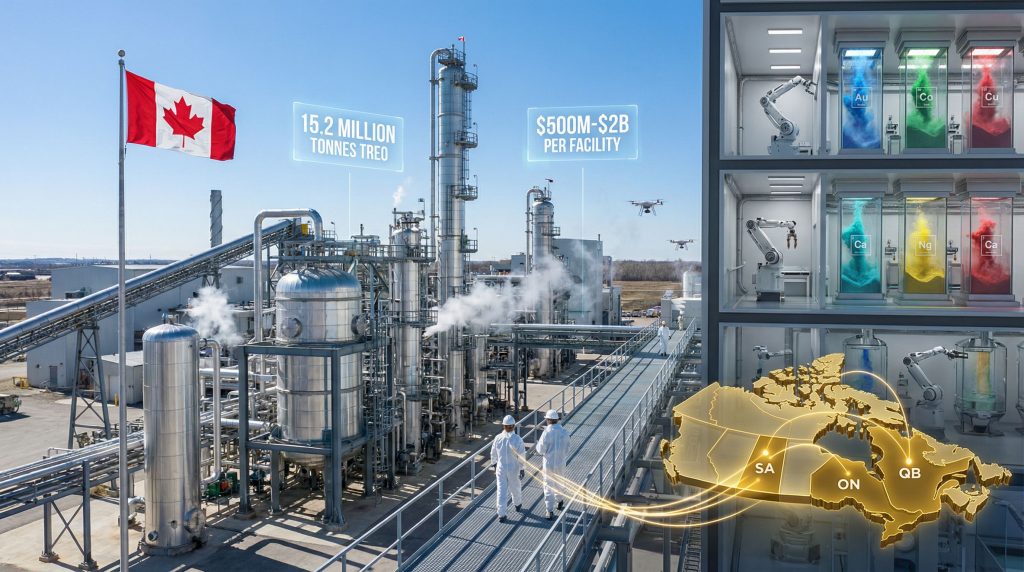
Canada's rare earth processing challenge represents one of the most complex strategic resource development initiatives facing Western nations in the current geopolitical environment. While Canada possesses substantial rare earth deposits containing 15.2 million tonnes of total rare earth oxides (TREO), the nation's ability to capture value from these resources depends entirely on developing processing capabilities that can compete with China's established 85-90% global processing monopoly.
The transformation from mining potential to strategic independence requires overcoming significant technical, economic, and regulatory barriers. Furthermore, Canada economic challenges related to the energy transition are intensifying pressure to develop domestic processing capabilities that can support both economic growth and strategic autonomy.
Understanding Canada's Strategic Position in the Global Rare Earth Value Chain
Canada's rare earth endowment spans geologically diverse deposit types, positioning the nation as a potential cornerstone of Western supply chain independence. However, the distribution and characteristics of these deposits reveal a more nuanced strategic picture than simple tonnage figures suggest.
The rare earth value chain demonstrates extreme concentration of economic returns in processing stages, with mining operations typically capturing only 10-15% of total value, while processing and separation facilities command 60-70% of margins. This distribution explains why China's control over processing capacity provides more strategic leverage than raw material access alone.
The Fundamental Economics of Rare Earth Processing vs. Mining
Manufacturing and fabrication stages, while representing the final 20-25% of value creation, require proximity to processing facilities due to quality specifications and supply chain logistics. This vertical integration creates powerful network effects that reinforce China's dominant position across the entire value chain.
Revenue concentration in processing stages stems from technical complexity, capital intensity, and specialized expertise requirements. Unlike mining operations, which can achieve profitability at relatively modest scales, processing facilities require substantial throughput volumes to justify fixed infrastructure investments.
Canada's Resource Endowment: Beyond Simple Tonnage Metrics
Canadian rare earth deposits divide into two primary geological categories, each offering distinct strategic advantages. The relationship between geological endowment and processing capability directly affects critical minerals energy security considerations for allied nations.
Alkaline Silicate Complexes demonstrate superior heavy rare earth concentrations:
- Nechalacho (Northwest Territories)
- Strange Lake (Quebec-Labrador border)
- Kipawa (Quebec)
- Foxtrot (Labrador)
- Red Wine Mountains (Labrador)
Carbonatite Deposits excel in light rare earth production:
- Ashram/Eldor (Quebec)
- Wicheeda (British Columbia)
- Saint-Honoré (Quebec)
- Montviel (Quebec)
- Prairie Lake (Ontario)
The alkaline silicate deposits contain eudialyte minerals that complicate extraction but yield valuable heavy rare earths including dysprosium and terbium. These elements command premium pricing due to limited global supply outside Chinese ion-adsorption clays.
Co-product Economics Enhancement:
| Co-Product | Primary Sources | Strategic Value |
|---|---|---|
| Niobium | Carbonatites | Superalloy applications, limited global producers |
| Scandium | Alkaline complexes | Aerospace alloys, emerging battery technology |
| Zirconium | Both deposit types | Nuclear applications, specialty ceramics |
| Tantalum | Alkaline complexes | Electronics manufacturing |
These co-products can contribute 15-30% of total project revenues, significantly improving economic viability compared to rare-earth-only operations.
When big ASX news breaks, our subscribers know first
What Makes Rare Earth Processing So Technically Complex?
Rare earth elements present unique separation challenges due to nearly identical chemical properties across the lanthanide series. This molecular similarity necessitates sophisticated processing techniques that require precise control of chemical environments, temperature, and pressure conditions.
The 200-Step Separation Challenge
Commercial rare earth separation involves 200+ individual processing steps to achieve the 99.9%+ purity levels required for high-technology applications. Each step removes fractional amounts of unwanted elements through solvent extraction, ion exchange, or precipitation techniques.
The separation process operates through multiple stages:
Pre-concentration Phase:
- Physical beneficiation to achieve 20-40% TREO content
- Acid leaching to dissolve rare earth minerals
- Initial purification to remove major contaminants
Primary Separation Stage:
- Group separation (light vs. heavy rare earths)
- Individual element isolation through solvent extraction
- Continuous recycling of organic solvents and aqueous solutions
Final Purification Steps:
- Precipitation of individual rare earth compounds
- Calcination to produce oxides
- Quality control testing for purity specifications
Temperature requirements range from ambient conditions for leaching to 800-1,200°C for calcination, demanding sophisticated process control systems and energy-intensive operations.
Radioactive Waste Management: Canada's Environmental Standards vs. Global Practices
Canadian rare earth deposits contain thorium and uranium concentrations that generate radioactive waste streams requiring specialized handling protocols. Unlike jurisdictions with relaxed environmental oversight, Canada mandates comprehensive radioactive material management throughout the processing lifecycle.
The development of advanced waste management solutions becomes crucial for maintaining competitive operations while meeting stringent Canadian environmental standards.
Water Consumption and Treatment Requirements:
Rare earth processing consumes 200-400 cubic meters of water per tonne of TREO produced, creating substantial treatment and recycling obligations. Canadian facilities must implement:
- Closed-loop water systems with >95% recycling rates
- Advanced treatment for radioactive contaminant removal
- Long-term monitoring of tailings storage facilities
- Comprehensive environmental bonding for remediation costs
Tailings Management Complexity:
Radioactive tailings from thorium-bearing rare earth ores require engineered containment systems designed for 1,000+ year stability. Canadian regulations mandate:
- Geochemical stabilisation of radioactive materials
- Multi-barrier containment systems
- Perpetual care and monitoring programs
- Financial assurance for long-term stewardship
These requirements add $50-100 million to processing facility capital costs compared to jurisdictions with minimal environmental oversight.
How China Built Its Processing Monopoly (And Why It's Hard to Replicate)
China's rare earth processing dominance resulted from a 30-year systematic development programme combining geological advantages, industrial policy coordination, and strategic acceptance of environmental externalities that Western nations cannot politically or economically replicate.
The 30-Year Infrastructure Development Timeline
China's processing monopoly emerged through coordinated phases:
1990-2000: Foundation Building
- State-sponsored geological surveys and deposit development
- Basic separation technology acquisition and adaptation
- Environmental cost externalisation through relaxed standards
2000-2010: Scale Development
- Massive capacity expansion in Inner Mongolia and Jiangxi
- Vertical integration linking mining, processing, and manufacturing
- Export restrictions forcing downstream industry migration to China
2010-2025: Technology Leadership
- Advanced separation technology development
- Recycling and secondary recovery capabilities
- Strategic stockpiling and supply chain optimisation
This phased approach created network effects where processing capacity attracted downstream manufacturers, which justified additional processing investments in a self-reinforcing cycle.
Technical Expertise Concentration: The Human Capital Gap
China's processing advantage extends beyond infrastructure to encompass specialised human capital developed over decades:
Global Expertise Distribution:
| Region | Specialised Engineers | Processing Plants | Years of Experience |
|---|---|---|---|
| China | ~3,000 | 50+ facilities | 25+ years |
| Rest of World | ~500 | <10 facilities | 5-15 years |
| Canada | ~150 | 1 operational | <10 years |
This expertise concentration creates substantial barriers for new market entrants, as processing optimisation requires intimate knowledge of specific ore types, equipment configurations, and quality control procedures that cannot be easily transferred through technical documentation alone.
Intellectual Property Considerations:
Chinese processing companies hold significant patents in separation technology, particularly for:
- Solvent extraction optimisation
- Impurity removal techniques
- Energy efficiency improvements
- Waste treatment methods
Western companies face licensing costs and technology transfer restrictions when accessing these innovations, adding complexity to competing processing facility development.
Canada's Processing Hub Strategy: Three-Province Approach
Canada's emerging rare earth processing strategy leverages regional geological advantages and existing industrial infrastructure across three provinces, each specialising in different aspects of the value chain.
Quebec's Light Rare Earth Processing Focus
Quebec's carbonatite deposits and established chemical processing industry create natural advantages for light rare earth separation, particularly neodymium and praseodymium production for the North American permanent magnet market.
Strategic Infrastructure Advantages:
- Proximity to Ashram and Montviel carbonatite deposits
- Existing chemical processing workforce and suppliers
- Hydroelectric power providing low-cost, low-carbon energy
- Transportation links to U.S. magnet manufacturing facilities
Timeline and Capacity Projections:
The province targets 15,000-20,000 tonnes per year of separated light rare earth oxides by 2028-2030, serving approximately 40% of North American magnet industry demand.
Government support includes:
- CAD $200 million in processing facility development incentives
- Streamlined permitting for strategic mineral projects
- Research partnerships with universities for process optimisation
Saskatchewan's Heavy Rare Earth Specialisation
Saskatchewan's emerging role focuses on heavy rare earth processing, leveraging the province's established chemical and mining expertise to address the most strategically critical elements in Western supply chains.
Ion-Adsorption Clay Processing Capabilities:
Unlike traditional rare earth deposits, Saskatchewan's approach emphasises:
- Advanced leaching techniques for low-grade materials
- Selective extraction of high-value heavy elements
- Integration with potash mining infrastructure and expertise
Strategic Importance of Heavy Elements:
Heavy rare earths represent <5% of total volume** but **>30% of strategic value due to:
- Limited global supply sources outside China
- Critical applications in defence and advanced electronics
- Premium pricing (dysprosium: $300-400/kg vs. neodymium: $60-80/kg)
International Funding and Partnerships:
Saskatchewan processing development benefits from:
- USD $150 million in U.S. Defense Production Act funding
- Technology sharing agreements with Australian processing initiatives
- Japanese investment in heavy rare earth separation capabilities
Ontario's Downstream Manufacturing Integration
Ontario's strategy emphasises value-added manufacturing and recycling capabilities, positioning the province as the hub for permanent magnet production and end-of-life material recovery.
Magnet Production and Recycling Facility Development:
The province targets development of:
- 5,000-8,000 tonnes per year permanent magnet production capacity
- Advanced recycling facilities processing 10,000+ tonnes per year of end-of-life magnets
- Research and development centres for next-generation magnet technologies
Circular Economy Integration:
Ontario's approach emphasises sustainable material flows:
- Recovery of rare earths from electronic waste streams
- Magnet-to-magnet recycling minimising processing requirements
- Integration with automotive and wind energy manufacturers
End-User Industry Proximity Advantages:
Geographic proximity to major manufacturers provides:
- Reduced transportation costs and lead times
- Enhanced quality control and customer relationships
- Opportunities for custom alloy development and specification
Economic Viability Challenges: Scale, Costs, and Market Competition
Canada's rare earth processing challenge fundamentally centres on achieving sufficient scale to compete with established Chinese facilities while meeting Western environmental and labour standards that increase operational costs.
Minimum Economic Scale Requirements for Processing Plants
Rare earth processing facilities require substantial minimum scales to achieve economic viability due to high fixed costs and complex infrastructure requirements. The integration of mining industry innovations becomes essential for achieving these scale thresholds efficiently.
Critical Scale Thresholds:
| Processing Stage | Minimum Economic Scale (tonnes TREO/year) | Capital Intensity |
|---|---|---|
| Ore Concentration | 50,000-100,000 | $200-400M |
| Primary Separation | 20,000-40,000 | $300-600M |
| Individual Element Separation | 5,000-15,000 | $400-800M |
| Integrated Facility | 25,000-50,000 | $800M-1.5B |
These scale requirements necessitate feedstock from multiple mining operations, creating coordination challenges and supply security risks for processing facilities.
Feedstock Volume Coordination:
A single integrated processing facility serving 30,000 tonnes per year requires:
- 3-5 operating mines providing consistent ore supply
- Long-term offtake agreements spanning 15-20 years
- Standardised ore preparation and transportation logistics
- Risk management for mining operation disruptions
Capital Investment Requirements and Financing Structures
Rare earth processing facilities represent among the most capital-intensive industrial projects outside of oil refining and steel production, requiring sophisticated financing structures and risk-sharing arrangements.
Processing Plant Construction Costs:
Basic Separation Facility (Light REEs only):
- Capital cost: $500-800 million
- Construction timeline: 3-4 years
- Working capital requirements: $50-100 million
Advanced Integrated Facility (Light + Heavy REEs):
- Capital cost: $1.2-2.0 billion
- Construction timeline: 4-6 years
- Working capital requirements: $100-200 million
Government Funding Mechanisms:
Canadian processing facility financing leverages multiple funding sources:
- Strategic Innovation Fund: Up to 50% of eligible costs for strategic projects
- Canada Infrastructure Bank: Low-cost financing for qualifying infrastructure
- Export Development Canada: Political risk insurance and project financing
- Defense Production Act (U.S.): Cross-border funding for critical mineral projects
Risk-Sharing Models:
Successful projects typically employ multi-stakeholder financing structures:
- Government provides 30-40% of capital through grants and low-cost loans
- Mining companies contribute 20-30% through offtake commitments and equity
- Strategic investors (automotive, defence) provide 20-30% for supply security
- Commercial financing covers remaining 10-20% with government guarantees
Regulatory and Environmental Hurdles Unique to Canada
Canada's comprehensive regulatory framework and high environmental standards create substantial compliance costs and timeline extensions for rare earth processing facilities, differentiating Canadian projects from those in jurisdictions with more permissive oversight.
Permitting Timeline Complexity
Rare earth processing facilities require coordination across multiple regulatory jurisdictions and stakeholder groups, creating complex approval processes that can extend 5-8 years from initial application to construction commencement.
Environmental Assessment Process Timeline:
Federal Environmental Assessment (2-3 years):
- Impact assessment under the Impact Assessment Act
- Species at Risk Act compliance evaluation
- Fisheries Act authorisation for water use and discharge
- Navigation Protection Act approvals for water body modifications
Provincial Environmental Assessment (18-24 months):
- Provincial environmental assessment processes
- Water use permits and discharge authorisations
- Air emission permits and monitoring requirements
- Waste management approvals for radioactive materials
Municipal and Regional Approvals (12-18 months):
- Land use and zoning compliance
- Building permits and safety certifications
- Local infrastructure impact assessments
- Community benefit agreement negotiations
Indigenous Consultation Requirements and Benefit-Sharing Agreements
Canadian law mandates meaningful consultation with Indigenous communities for projects affecting traditional territories, creating additional complexity but also opportunities for partnership development.
Consultation Process Requirements:
Free, Prior, and Informed Consent (FPIC) protocols:
- Early engagement during project planning phases
- Traditional knowledge integration in environmental assessments
- Co-development of monitoring and mitigation measures
- Ongoing consultation throughout project lifecycle
Benefit-Sharing Agreement Components:
- Employment and training opportunities for Indigenous workers
- Procurement preferences for Indigenous-owned businesses
- Revenue-sharing based on production volumes or profits
- Environmental monitoring and stewardship partnerships
- Cultural preservation and enhancement programmes
Economic Impact of Indigenous Partnerships:
Well-structured Indigenous partnerships provide:
- Reduced regulatory and legal risks through community support
- Access to traditional knowledge improving environmental management
- Workforce development in remote regions with limited alternatives
- Social licence enabling long-term operational stability
Environmental Standards Impact on Competitiveness
Canadian environmental standards impose costs that may represent 15-25% of operating expenses compared to 5-10% in jurisdictions with minimal oversight, creating significant competitive disadvantages that require strategic mitigation. However, the mining decarbonisation benefits can partially offset these costs through operational efficiencies and market premiums.
Radioactive Waste Management Cost Differentials:
| Cost Category | Canada | China | Cost Difference |
|---|---|---|---|
| Waste Treatment | $15-25/tonne ore | $2-5/tonne ore | 300-500% |
| Tailings Storage | $50-100/tonne TREO | $10-20/tonne TREO | 250-400% |
| Long-term Monitoring | $5-10/tonne TREO | $0-1/tonne TREO | 500-1000% |
| Closure and Remediation | $20-40/tonne TREO | $2-5/tonne TREO | 400-800% |
Water Treatment and Recycling Requirements:
Canadian facilities must implement closed-loop water systems achieving:
- >95% water recycling rates vs. <50% in permissive jurisdictions
- Advanced treatment for radioactive contaminant removal
- Real-time monitoring systems for discharge quality
- Financial assurance for long-term treatment obligations
These requirements add $30-60 million to facility capital costs but provide long-term operational advantages through reduced water consumption and environmental liability.
The next major ASX story will hit our subscribers first
Technology Innovation Pathways to Competitive Advantage
Canada's rare earth processing challenge creates opportunities for technological innovation that could fundamentally alter the economics of separation and processing, potentially providing competitive advantages over established Chinese facilities.
Low-Temperature Processing Development
Traditional rare earth separation operates at 200-600°C, consuming substantial energy and requiring expensive high-temperature equipment. Canadian research initiatives target sub-100°C processes that could reduce energy consumption by 40-60%.
Advanced Solvent Extraction Techniques:
Next-generation separation technologies under development include:
- Ionic liquid extraction enabling room-temperature separation
- Selective precipitation using engineered organic compounds
- Membrane separation technologies for continuous processing
- Microfluidic reactors providing precise control over separation conditions
Energy Reduction Impact Analysis:
Low-temperature processing provides multiple advantages:
| Benefit Category | Traditional Process | Low-Temperature Process | Improvement |
|---|---|---|---|
| Energy Consumption | 15-25 GJ/tonne TREO | 6-12 GJ/tonne TREO | 40-60% reduction |
| Equipment Costs | $800-1,200/tonne capacity | $400-700/tonne capacity | 30-50% reduction |
| Maintenance Requirements | 8-12% of equipment value | 4-6% of equipment value | 40-50% reduction |
Advanced Ore Pre-Concentration and Sorting Technologies
Modern ore sorting and pre-concentration technologies can improve feed grade quality delivered to processing plants, reducing waste volumes and processing complexity while enhancing economic viability.
Sensor-Based Sorting Technologies:
X-ray Transmission (XRT) Sorting:
- Identification of rare earth minerals based on density differences
- Rejection of 40-60% of barren material before processing
- Concentration improvements from 1-2% TREO to 4-8% TREO
Near-Infrared (NIR) Spectroscopy:
- Real-time identification of rare earth-bearing minerals
- Selective recovery of high-value heavy rare earth concentrates
- Integration with automated sorting systems for continuous operation
Electromagnetic Separation Enhancement:
- Magnetic separation of rare earth minerals from gangue materials
- Recovery improvements for fine-grained ore particles
- Reduced chemical consumption in downstream processing
Economic Impact of Pre-Concentration:
Advanced sorting technologies provide:
- 30-50% reduction in processing plant feed tonnage requirements
- 25-40% decrease in reagent consumption for chemical processing
- 15-25% improvement in overall rare earth recovery rates
- $20-40/tonne reduction in processing costs
Strategic Scenarios for Canada's Processing Future
Canada's rare earth processing challenge presents multiple potential development pathways, each with distinct implications for Western supply chain independence and Canadian economic development over the next decade.
Scenario 1: Successful Domestic Processing Integration (2027-2030)
This scenario assumes coordinated development of Canadian processing capability achieving 60-80% domestic value chain capture by 2030, fundamentally altering global rare earth market dynamics.
Market Share Capture Potential:
North American Market Penetration:
- 40-60% of magnet-grade light rare earth demand served by Canadian processing
- 20-30% of heavy rare earth requirements met through Saskatchewan facilities
- $2-4 billion annually in processing sector revenues by 2030
- 15,000-25,000 direct employment in processing and downstream manufacturing
Geopolitical Implications:
Successful integration would provide:
- Strategic autonomy for North American defence and clean energy industries
- Negotiating leverage in broader trade relationships with China
- Technology leadership in sustainable rare earth processing methods
- Model development for other Western nations seeking supply chain independence
Required Enabling Conditions:
- Sustained government funding commitment of $3-5 billion over 8-10 years
- Coordinated development timeline across multiple projects and provinces
- Successful Indigenous partnership development and community acceptance
- Technology breakthrough in low-cost, environmentally sustainable processing
Scenario 2: Continued Chinese Processing Dependence
This scenario reflects failure to achieve economically viable domestic processing, resulting in continued Chinese control over Canadian rare earth value creation despite expanded mining activity.
Strategic Vulnerability Assessment:
Continued dependence creates:
- Export dependency on Chinese processing capacity for Canadian concentrates
- Limited value capture restricting Canadian economic development potential
- Strategic exposure to Chinese supply disruption or trade restrictions
- Technology gap perpetuation in critical mineral processing capabilities
Economic Consequences:
- Canadian rare earth sector limited to 10-15% value chain capture
- Mining employment of 2,000-4,000 workers without processing multiplier effects
- Annual export revenues of $400-800 million in concentrate sales vs. $2-4 billion potential in integrated operations
Risk Factors Leading to This Scenario:
- Insufficient sustained government funding for processing development
- Regulatory delays exceeding 8-10 years for facility approvals
- Technology development failures in competitive processing methods
- Chinese market manipulation through pricing or supply disruption
Scenario 3: Hybrid Processing Network Development
This intermediate scenario envisions regional specialisation across North American processing facilities with Canada focusing on specific elements or processing stages within a broader allied network.
Regional Processing Specialisation:
Canada's Specialised Role:
- Heavy rare earth processing leadership serving North American markets
- Carbonatite deposit processing expertise for light rare earth production
- Recycling and secondary recovery capabilities for urban mining
Allied Nation Integration:
- U.S. facilities focusing on defence-grade materials and advanced alloys
- Australian partnerships in ion-adsorption clay processing technology
- European cooperation in magnet manufacturing and automotive applications
Risk Mitigation Through Diversification:
Network development provides:
- Reduced individual facility scale requirements through specialised production
- Technology sharing accelerating capability development across partners
- Supply chain resilience through multiple processing sources
- Political risk distribution across allied nations with shared strategic interests
Investment Implications and Market Dynamics
Canada's rare earth processing challenge presents complex investment opportunities characterised by high capital requirements, extended development timelines, and significant potential returns for successful projects within supportive policy frameworks.
Public-Private Partnership Models
Successful rare earth processing development requires sophisticated financing structures that distribute risks and returns across multiple stakeholder categories while ensuring long-term strategic alignment.
Government Strategic Investment Mechanisms:
Canada Growth Fund Participation:
- Equity investment in processing facilities providing patient capital
- Technology development grants for innovative processing methods
- Infrastructure loans at below-market rates for strategic projects
- Risk-sharing instruments reducing private sector exposure to early-stage development
International Cooperation Frameworks:
USMCA Critical Mineral Provisions:
- Cross-border investment protection for Canadian processing facilities
- Preferential access to U.S. defence and clean energy procurement
- Technology sharing agreements for processing innovation development
- Coordinated stockpiling to ensure market stability during capacity ramp-up
AUKUS and Quad Partnership Integration:
- Shared research and development funding for processing technology
- Supply chain coordination ensuring complementary facility development
- Joint procurement commitments providing long-term revenue certainty
- Technology transfer agreements accelerating Canadian capability development
Risk-Sharing Structure Optimisation:
| Stakeholder Category | Investment Share | Risk Profile | Return Mechanism |
|---|---|---|---|
| Government (Federal/Provincial) | 30-40% | Policy/regulatory | Strategic value, employment |
| Mining Companies | 20-30% | Resource/operational | Offtake premiums, equity appreciation |
| Strategic Users (Auto/Defence) | 20-30% | Supply security | Guaranteed supply, cost stability |
| Financial Investors | 10-20% | Market/commercial | Equity returns, debt service |
Market Timing and Demand Projections
Rare earth demand growth driven by clean energy transition and defence modernisation creates favourable market conditions for Canadian processing capacity development, assuming successful execution of development timelines.
Electric Vehicle Growth Impact:
North American EV Market Projections:
- EV sales growth from 1.2 million units (2023) to 8-12 million units (2030)
- Neodymium-praseodymium demand increasing from 2,500 tonnes to 15,000-20,000 tonnes annually
- Supply gap development as Chinese processors prioritise domestic consumption
- Premium pricing for non-Chinese sourced materials in automotive applications
Wind Energy Expansion Requirements:
Offshore Wind Development:
- 30-40 GW of new capacity planned through 2030 in North American waters
- Dysprosium demand of 300-500 tonnes annually for high-efficiency generators
- Supply security concerns driving preference for allied-nation sourcing
- Long-term contracts enabling processing facility financing with 10-15 year offtake commitments
Defence and Aerospace Strategic Stockpiling:
Recent geopolitical tensions have accelerated military modernisation programmes requiring rare earth-intensive systems:
- Guided missile production scaling requiring samarium-cobalt magnets
- Electronic warfare systems utilising yttrium-based materials
- Advanced radar applications consuming scandium-aluminium alloys
- Strategic reserve buildout creating sustained demand independent of economic cycles
Timeline and Milestones for Processing Capacity Development
Canada's path to rare earth processing capability requires coordinated development across multiple projects and provinces, with specific milestones determining overall timeline success and strategic value realisation.
Near-term Developments (2025-2027)
The immediate focus centres on demonstration-scale facilities and technology validation that will inform larger commercial-scale investments scheduled for the latter part of the decade.
Saskatchewan Heavy Rare Earth Facility Targets:
Technology Demonstration Phase (2025-2026):
- Pilot plant commissioning processing 500-1,000 tonnes per year of ore
- Process optimisation for heavy rare earth recovery from local deposits
- Environmental monitoring systems validation for scaled operations
- Workforce training programmes developing local technical expertise
Commercial Scale Transition (2026-2027):
- Production capacity scaling to 5,000-8,000 tonnes per year TREO output
- Product qualification with downstream manufacturers and strategic users
- Supply agreement finalisation with North American magnet producers
- Financial performance validation supporting additional facility investment
Quebec Light Rare Earth Processing Hub Construction:
Infrastructure Development Milestones:
- Site preparation completion for integrated processing facility by Q2 2025
- Major equipment procurement and installation through 2025-2026
- Environmental management systems commissioning and regulatory approval
- Commissioning and ramp-up targeting 15,000-20,000 tonnes per year by end-2027
Technology Innovation Project Outcomes:
Research and Development Priorities:
- Low-temperature separation technology validation at demonstration scale
- Automated ore sorting integration reducing processing facility feed requirements
- Waste treatment optimisation minimising environmental compliance costs
- Digital process control systems enhancing separation efficiency and product quality
Medium-term Strategic Goals (2027-2030)
The 2027-2030 period represents Canada's transition from demonstration capabilities to strategic-scale processing capacity that can meaningfully compete with Chinese facilities and serve allied nation supply chains.
Integrated Value Chain Operational Capacity Targets:
National Processing Capacity Goals:
| Province | Processing Focus | 2030 Target Capacity | Strategic Role |
|---|---|---|---|
| Saskatchewan | Heavy REEs | 8,000-12,000 tonnes/year | Allied defence supply |
| Quebec | Light REEs | 20,000-30,000 tonnes/year | North American automotive |
| Ontario | Manufacturing/Recycling | 15,000-25,000 tonnes/year | Circular economy hub |
| Total National | Integrated | 43,000-67,000 tonnes/year | Regional supply chain anchor |
Market Share Objectives in North American Supply Chains:
By 2030, Canadian processing facilities target:
- 60-80% of Canadian rare earth concentrate processed domestically rather than exported
- 40-60% of North American magnet industry light rare earth requirements
- 25-35% of allied nation heavy rare earth strategic materials demand
- 30-50% of North American rare earth recycling and secondary recovery
International Partnership Expansion and Technology Transfer:
Allied Nation Processing Network Integration:
- Technology sharing agreements with Australian and U.S. processing initiatives
- Coordinated development timing preventing excess capacity and market disruption
- Joint research programmes for next-generation processing methods and applications
- Strategic stockpiling coordination ensuring market stability during transition periods
Investment and Employment Impact Projections:
Successful processing capacity development would generate:
- $8-12 billion in total facility investment by 2030
- 25,000-35,000 direct and indirect employment across processing and manufacturing
- $3-6 billion annually in processing sector revenues
- $500 million-1 billion in annual government tax revenues from integrated operations
Disclaimer: The projections and scenarios presented in this analysis are based on current market conditions, government policies, and technological development timelines that may change significantly. Rare earth processing facility development involves substantial technical, regulatory, and market risks that could materially affect actual outcomes. Investment decisions should consider comprehensive due diligence beyond the strategic considerations outlined here.
Canada's rare earth processing challenge exemplifies the broader strategic imperative facing Western nations: transforming geological endowments into industrial capabilities that can compete with established Asian supply chains. While Canada possesses world-class rare earth resources across both light and heavy elements, the path to processing independence requires sustained coordination across government funding, private investment, technology innovation, and international partnership development.
The success or failure of Canada's processing ambitions will significantly influence broader Western efforts to achieve critical mineral supply chain independence, making this challenge a crucial test case for allied nation resource security strategies in an increasingly multipolar world.
Ready to Capitalise on Canada's Strategic Rare Earth Opportunity?
Canada's transition from rare earth mining to processing represents a transformational shift that could reshape North American supply chains, creating substantial investment opportunities for those positioned ahead of the market. Discovery Alert's proprietary Discovery IQ model delivers instant notifications on significant Canadian rare earth and critical mineral discoveries, empowering subscribers to identify actionable opportunities as this strategic sector rapidly evolves. Begin your 30-day free trial today to secure your market-leading advantage in this critical transition.