July 10, 2026
The Global Race for Critical Minerals Is Rewriting Diplomatic Playbooks
Across the world's resource corridors, a structural realignment is underway. The scramble for critical minerals powering electric vehicles, battery storage systems, and clean energy grids has transformed geology into geopolitics. Nations that once engaged primarily through energy trade are discovering that their most strategically valuable interactions now revolve around graphite, lithium, cobalt, nickel, and rare earth elements. Within this context, Canada Saudi mining and energy ties stand out as one of the more analytically interesting bilateral partnerships to emerge in 2026, not because they follow a conventional trade logic, but because they fuse two very different resource economies around a shared industrial imperative.
Canada brings to the table a world-class critical minerals endowment, sophisticated mining governance, and deep operational expertise accumulated across some of the planet's most geologically complex ore bodies. Saudi Arabia contributes sovereign capital at scale, an ambitious industrial diversification mandate under Vision 2030, and a geographic position that bridges Asian and European supply chains. Individually, these are formidable assets. Combined under a coherent bilateral framework, they represent something considerably more consequential for the global energy transition.
When big ASX news breaks, our subscribers know first
From Diplomatic Rupture to Resource Partnership: Understanding the Trajectory
The 2018 Freeze and Its Lasting Commercial Damage
The Canada-Saudi relationship did not arrive at its current cooperative posture without friction. In 2018, a public dispute over human rights triggered a sharp deterioration in bilateral ties that went well beyond rhetoric. Saudi Arabia expelled the Canadian ambassador, froze new trade and investment, cancelled Saudi student scholarships in Canada, and withdrew Saudi patients from Canadian hospitals. The commercial fallout was tangible and extended across multiple sectors, depressing bilateral trade volumes at precisely the moment when the critical minerals economy was beginning to accelerate globally.
The restoration of full diplomatic relations in 2023 was therefore not a minor administrative milestone but a structural prerequisite for any serious economic re-engagement. It cleared the institutional pathway through which the 2026 Memorandum of Understanding on mineral resources cooperation, the reactivation of the Joint Economic Commission, and the ongoing Foreign Investment Promotion and Protection Agreement negotiations could proceed.
Why the 2026 Prime Ministerial Visit Carries Weight Beyond Symbolism
When Canadian Prime Minister Mark Carney traveled to Riyadh in July 2026, it marked the first visit by a sitting Canadian prime minister in 26 years. In diplomatic terms, the signal value of this visit was significant. Senior-level engagement at the head-of-government level communicates institutional commitment in ways that ministerial delegations and trade missions simply cannot replicate. For Canadian mining companies evaluating whether to allocate capital and management bandwidth to the Saudi market, the prime ministerial visit functions as a credibility anchor, reducing perceptions of political risk in what has historically been an uncertain bilateral environment.
The visit included discussions with Saudi Aramco leadership on deepening cooperation across energy sectors, a meaningful data point given that Aramco is not merely an oil producer but increasingly a sophisticated technology and industrial platform with international investment ambitions.
Key Insight: Canada's trade diversification push is not purely reactive to U.S. tariff pressure. It reflects a structurally grounded recognition that overconcentration in a single export market creates systemic economic vulnerability, regardless of the short-term cost efficiency of that relationship.
Mapping the Bilateral Trade Relationship: Scale, Composition, and the Gap Between Present and Potential
Current Trade Architecture
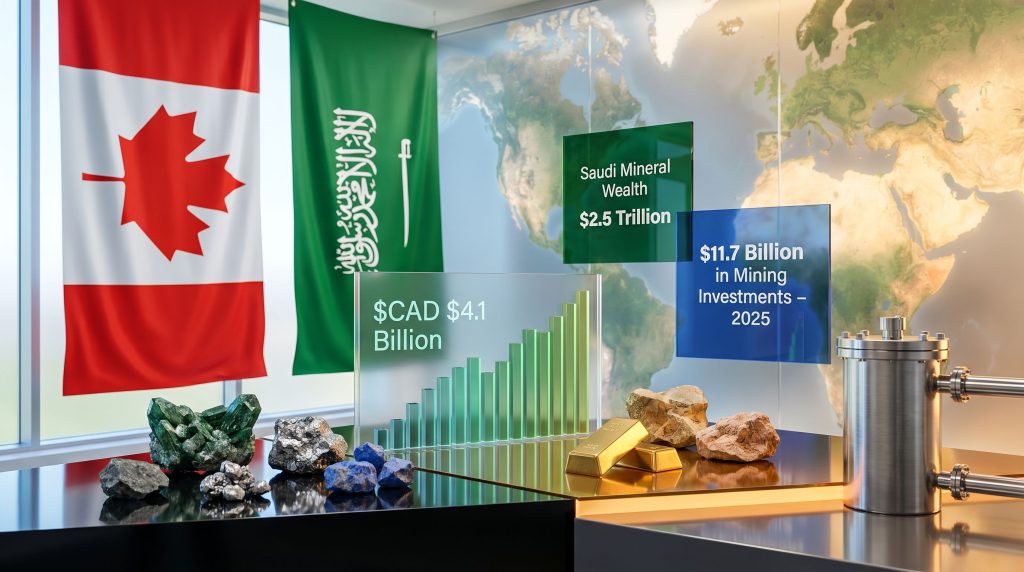
Bilateral merchandise trade between Canada and Saudi Arabia reached approximately CAD $4.1 billion in 2024, positioning Saudi Arabia as Canada's largest trading partner across the entire Middle East and North Africa region. However, the composition of that trade tells a more nuanced story than the headline figure suggests.
| Metric | Value |
|---|---|
| Total bilateral merchandise trade (2024) | ~CAD $4.1 billion |
| Saudi Arabia's rank among Canada's MENA partners | #1 |
| Share of Canadian imports from Saudi Arabia that are energy products | >97% |
| Leading Canadian exports to Saudi Arabia | Defence products, aircraft, motor vehicles, industrial machinery |
The energy product dominance on the import side is a legacy of eastern Canadian refinery infrastructure that was built around imported crude oil, reflecting historical procurement decisions rather than an assessment of optimal future supply chains. As the energy transition reshapes refinery economics, this dependency is increasingly a structural liability rather than a stable commercial foundation.
On the export side, the current basket, weighted toward defence, aviation, and industrial goods, substantially understates the potential contribution of Canadian mining technology, processing expertise, and critical mineral products. This gap between the existing trade profile and the plausible future one is precisely where the strategic opportunity resides. Furthermore, the link between critical minerals and energy security means that closing this gap carries strategic importance well beyond commercial returns.
Benchmarking Against Peer Nations
Australia offers the most instructive comparison for Canada's ambitions. Australian mining companies have built deep operational and investment relationships across Gulf sovereign wealth ecosystems, with Australian lithium, iron ore, and gold sectors attracting meaningful Gulf capital over the past decade. The Australian model demonstrates that resource expertise can be successfully monetised through Gulf partnerships when the institutional framework is sufficiently developed to reduce transaction costs and investment risk. Canada is at an earlier stage of this trajectory but moving with notable intent.
Saudi Arabia's Mining Sector: The $2.5 Trillion Opportunity and the Expertise Deficit
Understanding Saudi Arabia's Geological Endowment
One of the least appreciated dimensions of the Canada Saudi mining and energy ties story is the sheer scale of Saudi Arabia's untapped mineral wealth. The kingdom's estimated mineral resource base has been valued at approximately $2.5 trillion, encompassing phosphate deposits among the world's largest, substantial gold reserves concentrated in the Arabian Shield geological formation, copper, zinc, and a range of rare earth elements whose full extent remains only partially characterised through systematic exploration.
The Arabian Shield, the ancient Precambrian basement rock that underlies western Saudi Arabia, is geologically analogous to the Canadian Shield in several important respects. Both are ancient cratons with long, complex geological histories that have produced highly diverse mineral assemblages. This geological similarity creates a natural knowledge transfer pathway, as Canadian geologists and mining engineers trained on Shield-type geology possess directly applicable expertise for Arabian Shield exploration and development. In addition, the strategic importance of rare earth supply chains makes the characterisation of Saudi Arabia's rare earth potential a priority for both nations.
Saudi Arabia recorded $11.7 billion in mining investments in 2025, a figure that reflects accelerating momentum under Vision 2030's mandate to establish mining as the third pillar of the national economy alongside hydrocarbons and petrochemicals. The qualification of 24 bidders for a new mineral exploration licensing round in 2026 further underscores the kingdom's active effort to attract international mining expertise and capital. Saudi exploration licenses are consequently attracting growing attention from Canadian juniors and mid-tier companies seeking first-mover positioning.
The Structural Gap That Canada Can Fill
Despite its geological wealth, Saudi Arabia's mining sector faces a clearly defined expertise deficit. World-class mineral deposit development requires a specific combination of skills that take decades to accumulate: complex ore body interpretation, metallurgical test work to determine optimal processing routes, environmental baseline studies, tailings management engineering, and community engagement frameworks. Canadian mining companies, particularly those with experience operating in Canada's remote and environmentally sensitive regions, possess precisely these capabilities.
The in-country value (ICV) requirements embedded in Vision 2030 add a further dimension. Saudi Arabia requires foreign companies operating in the kingdom to demonstrate measurable contributions to local economic development, including technology transfer, local procurement, and skills development. Canadian companies with strong records of building local capacity, developed in part through decades of engagement with Indigenous communities in Canada, are well-positioned to meet these requirements in ways that purely extractive operators are not. Furthermore, the breadth of Saudi mining licences on offer creates a diverse range of entry points for Canadian operators at different stages of capability and capitalisation.
The Battery Anode Material Venture: A Blueprint for Bilateral Co-investment
Why Graphite Is the Critical Mineral Most Investors Underestimate
Within the critical minerals landscape, graphite occupies an unusual position. It is essential to every lithium-ion battery manufactured today, comprising the dominant share of battery anode material by weight, yet it receives a fraction of the investor and policy attention directed at lithium or cobalt. A standard electric vehicle battery requires significantly more graphite by mass than lithium, yet graphite supply chains remain highly concentrated and poorly understood outside specialist circles.
Battery-grade graphite requires extensive processing beyond what raw mined graphite can provide. Natural graphite must be purified to carbon purity levels exceeding 99.95% and then shaped into spherical particles of precise diameter to function effectively in battery anodes. This spheroidisation and purification process is technically demanding, energy-intensive, and currently dominated by Chinese processing capacity, representing one of the most acute single-country supply chain concentration risks in the entire battery materials ecosystem. Consequently, critical minerals demand for battery-grade graphite is expected to intensify sharply as electric vehicle adoption accelerates globally.
The Northern Graphite and Obeikan Partnership
The collaboration between Canada's Northern Graphite and Saudi Arabia's Obeikan Investment Group to develop a Battery Anode Material processing facility in Saudi Arabia represents a concrete application of the broader Canada Saudi mining and energy ties framework. This venture combines Canadian graphite sourcing and processing know-how with Saudi capital resources and a geographic position that provides potentially advantageous logistics access to both Asian and European battery manufacturing supply chains.
The significance of this partnership extends beyond its immediate commercial scope. It demonstrates that the bilateral framework can generate bankable industrial projects rather than remaining an aspirational diplomatic construct. If this facility reaches financial close and commercial operation, it provides a replicable template for similar co-investment structures across lithium, nickel, and cobalt value chains.
The Institutional Architecture: MoU, FIPA, and the Joint Economic Commission
What the January 2026 MoU Actually Commits to
The Memorandum of Understanding on mineral resources cooperation signed at the Future Minerals Forum in Riyadh on January 13, 2026 establishes a formal framework for sustainable supply chain development, knowledge transfer, joint exploration initiatives, and alignment of ESG standards between the two countries. Canada strengthened its critical minerals partnership with Saudi Arabia at this forum, with Canadian Parliamentary Secretary Claude Guay articulating how Canadian governance frameworks around environmental management and responsible mining support Saudi Arabia's own Vision 2030 objectives.
It is important to note what an MoU does and does not represent. As a non-binding framework document, it creates political commitment and institutional channels for engagement without guaranteeing specific commercial outcomes. The translation from MoU to operational projects requires additional steps, including project-level feasibility studies, financing arrangements, and regulatory approvals in both jurisdictions.
The FIPA: The Missing Piece for Capital Deployment
The Foreign Investment Promotion and Protection Agreement currently under negotiation between the two countries addresses the most significant structural barrier to Canadian mining capital deployment in Saudi Arabia. Without a FIPA in place, Canadian companies investing in Saudi Arabia lack the internationally recognised legal protections, investor-state dispute settlement mechanisms, and guarantees against arbitrary expropriation that institutional investors typically require before committing to long-duration mining projects.
The completion of FIPA negotiations would meaningfully lower the risk-adjusted cost of capital for Canadian companies developing Saudi mineral assets, potentially unlocking a pipeline of projects that are currently assessed as commercially marginal due to political and legal uncertainty rather than geological or operational factors.
The Joint Economic Commission: Converting Diplomacy into Pipelines
The reactivation of the Joint Economic Commission (JEC) after its effective suspension during the 2018 to 2023 diplomatic freeze provides the operational mechanism for converting high-level political commitments into sector-specific working groups and project pipelines. Expected priority areas for JEC working groups include critical minerals, energy transition technologies, advanced manufacturing, and defence industry cooperation.
The JEC's effectiveness will ultimately be measured by the quality and pace of its project identification and facilitation work rather than by the frequency of its ministerial-level meetings.
The next major ASX story will hit our subscribers first
Investment Scenarios and the Road to 2030
Three Pathways for Bilateral Engagement Depth
| Scenario | Key Conditions | Projected Outcome |
|---|---|---|
| Conservative | FIPA stalls; JEC underperforms; limited project pipeline | Trade grows modestly; relationship remains largely energy-import focused |
| Base Case | FIPA completed; JEC operational; 3-5 mining joint ventures established | Bilateral trade expands to $6-8 billion; Canadian companies gain meaningful Saudi market presence |
| Accelerated | PIF co-investment activated; multiple critical mineral processing facilities built; clean energy cooperation launched | Bilateral trade exceeds $10 billion; Canada becomes Saudi Arabia's preferred Western mining partner |
Key Milestones for Investors to Monitor
- Completion and ratification of FIPA negotiations
- Progress of the Northern Graphite and Obeikan Battery Anode Material facility toward financial close
- Outcomes of Saudi Arabia's mineral exploration licensing round and Canadian company participation rates
- Activation of clean energy and hydrogen cooperation workstreams under the JEC
- Public Investment Fund international mining investment decisions and any Canadian project allocations
Investor Note: The Public Investment Fund manages assets exceeding $700 billion and holds an explicit mandate to deploy capital across global resource and technology sectors. As the bilateral framework matures, PIF and its affiliated entities represent a credible source of large-scale co-investment capital for Canadian mining projects seeking development financing. This relationship remains nascent and is subject to the pace of institutional framework development.
Risks That Could Derail the Partnership
Structural and Operational Barriers
Several practical challenges stand between the current diplomatic momentum and durable commercial outcomes. Saudi Arabia's mining regulatory framework, while modernising rapidly, differs substantially from the Canadian system in terms of land tenure, environmental permitting, and royalty structures. Canadian junior and mid-tier companies entering the Saudi market for the first time face a steep learning curve in navigating these differences without local partners who can provide regulatory guidance and relationship capital.
Local content requirements under Vision 2030 are rigorous and enforced with increasing seriousness. Companies that structure their Saudi operations as simple export arrangements rather than genuine technology transfer and capacity-building partnerships will find themselves at a commercial disadvantage relative to competitors who engage more substantively with ICV obligations.
Geopolitical Fragility
The 2018 rupture demonstrated that Canada Saudi mining and energy ties can deteriorate rapidly when human rights and foreign policy positions diverge sharply. The structural foundations of the current engagement are considerably stronger than they were before 2018, supported by multiple institutional frameworks and commercial interests on both sides. However, the bilateral relationship remains sensitive to changes in Canadian domestic politics and to developments in Saudi Arabia's international posture that may generate political pressure in Canada.
Saudi Arabia is simultaneously engaging Chinese, Australian, European, and other mining partners across overlapping opportunity sets. Canadian companies should not assume that diplomatic momentum at the prime ministerial level translates automatically into preferred access to Saudi mineral assets. Commercial terms, operational capabilities, and local partnership quality will ultimately determine competitive outcomes.
FAQ: Canada-Saudi Mining and Energy Ties
What is the current scale of bilateral trade between Canada and Saudi Arabia?
Total bilateral merchandise trade reached approximately CAD $4.1 billion in 2024, making Saudi Arabia Canada's largest trading partner in the MENA region.
What formal agreements govern the resource partnership?
A Memorandum of Understanding on mineral resources cooperation was signed in January 2026. Negotiations for a Foreign Investment Promotion and Protection Agreement are ongoing, and the Joint Economic Commission has been reactivated to coordinate trade and investment priorities.
Why is graphite central to this partnership?
Battery-grade graphite is the dominant material in lithium-ion battery anodes by mass and requires sophisticated purification and spheroidisation processing. Canadian graphite expertise combined with Saudi capital creates a viable model for developing processing capacity outside the currently dominant Chinese supply chain.
What is Saudi Arabia's estimated mineral wealth?
Saudi Arabia's untapped mineral resource base is estimated at approximately $2.5 trillion, encompassing phosphate, gold, copper, zinc, and rare earth elements concentrated primarily within the ancient Arabian Shield geological formation.
Disclaimer: This article is intended for informational purposes only and does not constitute financial or investment advice. Projections, scenario analyses, and forward-looking statements involve inherent uncertainty and should not be relied upon as predictions of actual outcomes. Readers should conduct independent due diligence before making investment decisions.
Want to Track the Next Major Critical Minerals Discovery Before the Market Moves?
Discovery Alert's proprietary Discovery IQ model delivers real-time alerts on significant ASX mineral discoveries — from graphite and lithium to rare earths and nickel — instantly converting complex geological data into actionable investment insights for traders and long-term investors alike. Explore historic examples of exceptional discovery returns and begin your 14-day free trial at Discovery Alert to position yourself ahead of the market.