May 23, 2026
The Capital Architecture Reshaping Canadian Resource Development
Global competition for critical minerals demand has reached an intensity not seen since the post-war era of state-sponsored industrialisation. Nations are no longer content to leave the development of strategically vital resources entirely to private capital markets, particularly when those markets have proven structurally reluctant to finance long-duration, capital-heavy projects in remote jurisdictions. The result is a worldwide recalibration of how governments participate in resource extraction, not as regulators at arm's length, but as equity co-owners with skin in the game.
Canada's response to this structural shift arrived in late April 2026, and it represents one of the most significant reconfigurations of federal resource finance policy in a generation. The Canada sovereign wealth fund for mining projects is now a defining feature of this new landscape.
When big ASX news breaks, our subscribers know first
Why Existing Public Finance Tools Left a Critical Gap
For decades, Canada's toolkit for supporting large-scale resource development leaned heavily on debt-based instruments. The Canada Infrastructure Bank provided loan guarantees and concessional financing. Export Development Canada extended credit facilities to resource exporters. Provincial development corporations offered royalty deferrals and exploration incentives. These mechanisms served their purposes, but they shared a fundamental limitation: none of them could take equity positions in projects still years from production.
This left a structural vacuum in the financing lifecycle of major mining projects. The gap between a bankable feasibility study and the first drawdown of project-level debt financing can span several years and require hundreds of millions in development capital. Private equity funds active in the mining sector typically demand returns and exit horizons that are incompatible with the decade-plus timelines of large-scale mine construction and ramp-up.
Institutional investors with long-duration mandates, such as pension funds, have furthermore increasingly retreated from direct mining exposure following a decade of commodity price volatility and ESG screening pressures.
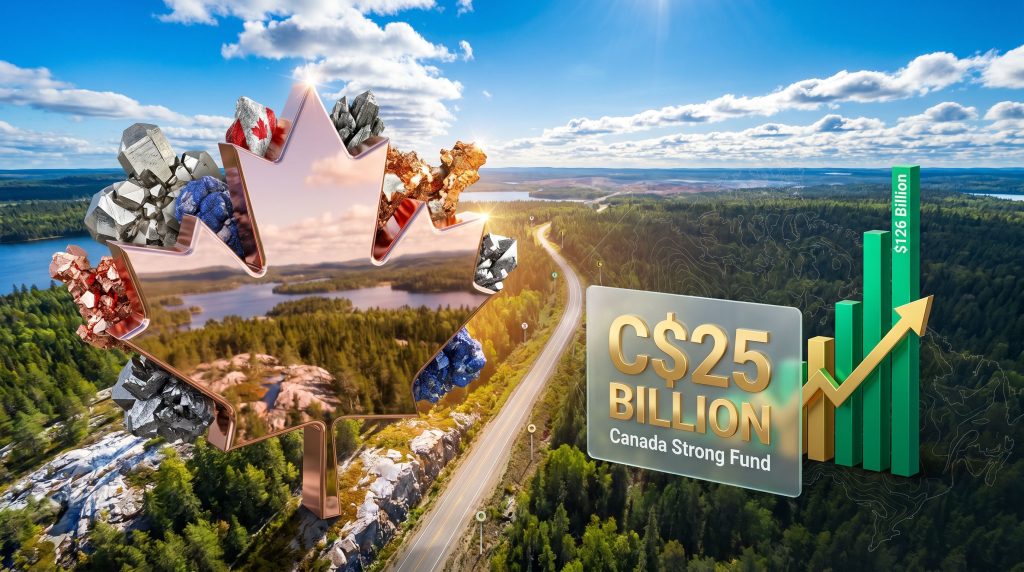
The Canada Strong Fund, announced by Prime Minister Mark Carney on April 27, 2026, is designed specifically to inhabit this financing gap. By deploying sovereign equity capital directly into major resource projects, the fund can absorb the development-stage risk that private capital has historically been unwilling to carry at acceptable cost.
Canada Sovereign Wealth Fund for Mining Projects: Structure, Scale, and Governance
The fund's architecture reflects a deliberate attempt to balance political accountability with investment-grade governance. Understanding how these two objectives interact is essential for any mining company or investor seeking to engage with this new capital framework.
Core Features of the Canada Strong Fund
| Feature | Detail |
|---|---|
| Initial Capitalisation | C$25 billion over three years |
| Announcement Date | April 27, 2026 |
| Announced By | Prime Minister Mark Carney |
| Governance Structure | Independent arm's length Crown corporation |
| Investment Type | Direct equity positions |
| Target Sectors | Mining, critical minerals, energy, advanced manufacturing |
| Capital Recycling | Returns reinvested to compound the fund's capital base |
| Investor Access | Open to participation by Canadian investors |
The arm's length Crown corporation model is not incidental to the fund's design; it is central to its credibility. By placing investment decisions in the hands of professional fund managers rather than elected officials or appointed bureaucrats, the structure is intended to insulate project selection from political interference. This matters enormously for private co-investors, who need confidence that capital allocation decisions will be driven by project merit rather than electoral geography.
The distinction between a sovereign wealth fund and a development bank is not merely structural, it is philosophical. A development bank lends money and expects repayment with interest. A sovereign wealth fund buys ownership and expects returns over time. This changes the risk-sharing calculus for every other party in a project's capital stack.
How the Canada Strong Fund Differs From Prior Public Finance Vehicles
The confusion between the Canada Strong Fund and existing instruments like the Canada Infrastructure Bank is understandable but important to resolve. The key distinctions are as follows:
- The Canada Infrastructure Bank primarily provides debt financing and loan guarantees, not equity stakes
- The Canada Strong Fund takes direct equity positions, meaning the government shares in both project upside and downside risk
- Equity ownership confers governance rights and long-term return participation, neither of which characterises loan-based instruments
- Returns generated by the fund are reinvested to grow its capital base rather than returned to consolidated revenue
This equity-first approach also changes the incentive structure for project sponsors. When the federal government is a co-owner rather than a creditor, the relationship shifts from compliance-driven to performance-driven, with shared interests in project success rather than debt servicing alone.
The Major Projects Office Pipeline: 15 Referrals and C$126 Billion in Aggregate Value
The Canada Strong Fund does not operate in isolation. It functions as the capital deployment arm of a broader federal project acceleration framework anchored by the Major Projects Office. The MPO was established to identify resource and infrastructure projects deemed to be in Canada's national interest and to coordinate the regulatory, permitting, and investment processes required to advance them.
As of early May 2026, 15 projects have been formally referred to the MPO, representing a combined pipeline valued at over C$126 billion. This pipeline spans multiple commodities and provinces, reflecting a deliberate effort to distribute economic benefits across the country while targeting the mineral commodities most critical to energy transition supply chains.
Representative Projects in the MPO Pipeline
Two projects in the current pipeline illustrate the range of scale and commodity exposure the fund is designed to support.
Crawford Nickel Project (Ontario) developed by Canada Nickel Company, Crawford represents one of the largest nickel sulphide discoveries in Canadian mining history. Nickel's strategic importance to battery cathode chemistry for electric vehicles makes domestic supply a priority for both Canadian industrial policy and allied-nation supply chain resilience.
McIlvenna Bay Copper-Zinc Project (Saskatchewan) advanced by Foran Mining, this base metals development targets copper and zinc in a jurisdiction with well-established mining infrastructure. Copper demand trajectories linked to electrification and grid expansion make projects of this type increasingly strategically relevant beyond their commodity economics alone. Indeed, major copper systems globally are attracting significant sovereign and institutional capital for precisely this reason.
MPO referral status effectively signals that a project has passed an initial national interest screen, which positions it as a candidate for Canada Strong Fund equity participation and accelerated federal approval processes.
Up to 10 Major Projects Could Advance Within Twelve Months
Energy and Natural Resources Minister Tim Hodgson indicated publicly that as many as ten major natural resource projects could move into active development within a year, reflecting the pace at which the MPO is working to compress approval timelines. For the mining sector, this carries significant practical implications.
Moving a major project from advanced development into active construction typically requires the convergence of several elements:
- Final environmental approvals and permit issuance from federal and provincial regulators
- Project financing commitments including equity, debt, and potentially streaming or royalty arrangements
- Indigenous consultation completion and benefit-sharing agreement execution
- Board-level final investment decisions by project sponsors
- Construction mobilisation including contractor procurement and site preparation
The Canada Strong Fund's equity capacity is designed to accelerate steps two and four by reducing the financing risk that has historically caused projects to stall between regulatory approval and construction commencement.
British Columbia's Parallel Priority Project Framework
Federal capital deployment and approval acceleration are being reinforced at the provincial level by British Columbia's Look West plan, which was launched in 2025 and has been progressively expanded. In late April 2026, the B.C. government added 17 new projects to its priority list, bringing the total to 35 designated priority projects.
Two mining-relevant additions to the B.C. priority list carry particular significance.
KSM Project operated by Seabridge Gold, KSM is one of the largest undeveloped copper-gold projects in the world by resource tonnage, located in the mineral-rich terrain of northwestern British Columbia.
New Ingerbelle Extension this represents Hudbay Minerals' planned expansion at the Copper Mountain mine, extending the operating life and increasing the throughput capacity of an already-producing copper asset.
The interaction between provincial priority designation and federal MPO referral is more than additive. Projects that carry both designations benefit from coordinated federal-provincial approval processes, which can materially reduce the jurisdictional friction that has historically extended Canadian mining project timelines. For investors and project sponsors, dual designation is emerging as a meaningful signal of regulatory pathway clarity.
The Ring of Fire Case Study: When Sovereign Capital Meets Infrastructure Dependency
Few regions in Canada illustrate the relationship between infrastructure absence and stranded mineral wealth as starkly as northern Ontario's Ring of Fire. The area surrounding McFaulds Lake contains significant deposits of chromite, nickel, copper, zinc, and platinum group metals, yet decades of exploration have not translated into production, largely because the region lacks the basic transportation infrastructure required for economically viable mining operations.
The proposed Webequie Supply Road confronts this problem directly. The project involves the construction of approximately 107 kilometres of all-season road connecting Webequie Airport to the mineral-rich terrain near McFaulds Lake. Beyond its resource development function, the road would meaningfully improve access and transportation capacity for Webequie First Nation, whose community has historically been accessible only by air or seasonal ice road.
The Impact Assessment Agency of Canada has opened a public comment period running until May 22, 2026, on the draft impact assessment report and proposed conditions for the project. This consultation phase is a formal step in the federal regulatory process rather than discretionary outreach, and its outcome will shape the conditions under which construction could proceed.
The Webequie Supply Road encapsulates a recurring pattern in Canadian resource development: mineralisation of genuine scale exists, but the economics of extraction cannot be unlocked without anchor infrastructure investment. Sovereign equity capital is structurally better suited to absorbing this type of enabling infrastructure risk than private project finance.
For the Canada sovereign wealth fund for mining projects, infrastructure-linked mining projects of this type represent a distinct investment category. The returns from sovereign equity deployed into access infrastructure are not limited to direct project economics; they extend to the broader optionality value unlocked across an entire mineral district.
The next major ASX story will hit our subscribers first
How the Canada Strong Fund Compares to Global Sovereign Capital Models
Canada is not the first jurisdiction to deploy sovereign capital in support of domestic resource development, but its model is meaningfully differentiated from the approaches used by other nations.
| Country / Fund | Primary Focus | Scale | Mining and Resources Role |
|---|---|---|---|
| Norway (GPFG) | Diversified global equities | ~US$1.7 trillion | Passive investor; applies ESG exclusions to certain miners |
| Australia (Future Fund) | Superannuation liability offset | ~A$230 billion | Indirect exposure via diversified portfolio allocation |
| Chile (ESSF) | Copper revenue stabilisation | ~US$11 billion | Directly linked to copper royalty revenues as a buffer fund |
| Canada Strong Fund | Nation-building equity investment | C$25 billion (initial) | Direct equity in domestic mining, critical minerals, and energy |
Norway's GPFG is the world's largest sovereign wealth fund by assets, but its mandate is explicitly offshore diversification of petroleum revenues. It does not invest in domestic Norwegian resource projects. Australia's Future Fund similarly avoids domestic concentration in favour of global portfolio diversification. Chile's ESSF is a stabilisation mechanism for copper export revenues rather than a development vehicle.
Canada's model is closest in spirit to what development economists call a strategic co-investment fund, where sovereign capital is deployed not to generate maximum risk-adjusted returns for a government balance sheet, but to catalyse private investment in projects that deliver national strategic objectives. The fund is explicitly designed to attract private co-investment rather than crowd it out, which requires its governance and commercial terms to be credible to institutional capital markets.
Critical Minerals as the Fund's Core Investment Thesis
The commodities most likely to attract Canada Strong Fund equity are those that sit at the intersection of energy transition demand and supply chain vulnerability. A well-informed critical minerals strategy recognises the urgency of developing domestic supply chains for these materials. Canadian policy has identified a priority list that includes:
- Nickel for electric vehicle battery cathodes and stainless steel
- Cobalt as a battery chemistry co-product with nickel sulphide deposits
- Copper as the irreplaceable conductor underpinning electrification at every scale
- Graphite for battery anode manufacturing
- Tungsten for advanced manufacturing and defence applications
- Rare earth elements for permanent magnets in EV motors and wind turbines
The global supply chain context for these commodities is directly relevant to the fund's investment rationale. China currently dominates processing and refining capacity across most of these mineral categories. Its Ministry of Industry and Information Technology recently released a draft enforcement framework that would impose significantly heavier penalties on rare earth producers that breach production quotas, including the potential loss of operating licences in severe cases. This tightening of Chinese supply-side control reinforces the strategic logic of accelerating Canadian critical mineral production as an alternative source for allied industrial supply chains.
How Mining Companies Can Position for Fund Engagement
For junior and mid-tier mining companies, the Canada sovereign wealth fund for mining projects represents a new category of potential capital partner, but engaging with it effectively requires deliberate project positioning. Fund-ready proposals are likely to be evaluated against several core dimensions:
- Quantified economic impact including direct employment, regional GDP contribution, and supply chain multiplier effects expressed in credible, independently verifiable terms
- Indigenous partnership frameworks with demonstrated evidence of free, prior, and informed consent processes, benefit-sharing negotiation, and ongoing engagement commitments
- Regulatory advancement ideally including MPO referral, provincial priority designation, or advanced permitting status that reduces binary approval risk
- Supply chain contribution a clear articulation of how the project reduces Canadian or allied-nation dependence on foreign-controlled mineral supply chains
- Strategic commodity alignment direct relevance to the critical minerals identified in Canadian industrial policy as priority supply chain targets
Due diligence conducted by the fund's professional management is expected to extend beyond standard project finance metrics. Foreign ownership structures, particularly those involving state-linked entities from non-allied jurisdictions, are likely to receive heightened scrutiny. ESG baseline assessments aligned with Canada's net-zero commitments will also form part of the evaluation framework.
Furthermore, the battery metals investment landscape suggests that projects with clear ties to energy transition commodities will find the strongest alignment with the fund's stated priorities.
Biomining and Innovation-Aligned Investment
The Canada Strong Fund's mandate is not limited to conventional hard rock mining. A partnership announced between Genome BC and the University of British Columbia's Bradshaw Research Institute for Minerals and Mining, supported through Rio Tinto's global research and innovation network, is developing biomining technologies for real-world mining applications. The project, backed by up to C$1 million in funding from Genome BC and BRIMM over three years, aims to scale microbe-based metal extraction from laboratory research into field-deployable systems.
Biomining uses naturally occurring or selectively cultivated microorganisms to solubilise metals from ore and mine waste streams. The technology carries the potential to improve extraction efficiency at lower-grade deposits, reduce reagent inputs, and materially shrink the environmental footprint of processing operations. As the fund's mandate encompasses advanced manufacturing and innovation alongside conventional resource extraction, projects integrating emerging extraction technologies may find stronger alignment with its investment criteria than a purely conventional mine development.
Governance Risks and Critical Considerations
No sovereign investment vehicle is free from the tensions inherent in combining public capital with commercial objectives. Several risk dimensions warrant careful consideration.
Political independence risk the arm's length governance model provides structural insulation from ministerial interference, but the fund's mandate was defined through a political process. The Santiago Principles, the internationally recognised governance benchmarks for sovereign wealth funds, call for clear separation between ownership objectives and operational investment decisions. Whether Canada's framework fully satisfies these benchmarks in practice will depend on how the fund's investment mandate is written into its enabling legislation.
Private sector crowding-out government equity participation can create uncertainty for private investors around exit valuation, dividend policy, and governance rights. The fund's design attempts to mitigate this through co-investment structures and professional management, but the terms on which the fund enters and exits positions will need to be transparent and commercially rational to maintain private capital confidence.
Indigenous rights obligations the fund's nation-building mandate must operate within the framework of Canada's constitutional duty to consult and accommodate Indigenous communities. The Webequie Supply Road public comment process is a live illustration of how these obligations interact with project timelines. The explicit inclusion of Indigenous engagement as a fund-readiness criterion signals that the government views reconciliation not as a constraint to be managed but as a prerequisite for sustainable resource development. As one detailed analysis of the fund's implications for the mining industry notes, these governance considerations will be central to how the fund operates in practice.
Frequently Asked Questions: Canada Sovereign Wealth Fund for Mining Projects
What is the Canada Strong Fund?
The Canada Strong Fund is Canada's first sovereign wealth fund, announced by Prime Minister Mark Carney on April 27, 2026. It is structured as an independent arm's length Crown corporation with an initial capitalisation of C$25 billion over three years. The fund takes direct equity positions in major infrastructure, energy, mining, and advanced manufacturing projects, with returns reinvested to grow its capital base over time.
How much capital does the Canada Strong Fund deploy?
The fund is initially capitalised at C$25 billion, committed over a three-year period. Unlike a one-time grant or a loan facility with a fixed maturity, the fund's equity returns are recycled back into new investments, meaning its effective deployment capacity compounds over time as the portfolio matures.
Which mining projects will the fund prioritise?
Projects referred to the Major Projects Office, critical minerals developments aligned with Canada's strategic commodity priorities, and infrastructure-linked resource projects in regions like the Ring of Fire are the most likely candidates. Dual designation through both the MPO and a provincial priority framework strengthens a project's positioning considerably.
Is the Canada Strong Fund the same as the Canada Infrastructure Bank?
No. The Canada Infrastructure Bank primarily provides debt financing and loan guarantees, meaning it expects repayment with interest and does not take ownership positions. The Canada Strong Fund takes direct equity positions, making the federal government a co-owner in projects rather than a creditor.
What critical minerals does the fund prioritise?
Nickel, cobalt, copper, graphite, tungsten, and rare earth elements are the commodities most aligned with the fund's investment thesis. These materials are central to energy transition supply chains and have been identified as strategic priorities in Canadian industrial policy due to their supply chain vulnerability and demand growth trajectories.
A New Capital Architecture for the Decade Ahead
The Canada sovereign wealth fund for mining projects is best understood not as a single financing announcement but as the capstone of an interlocking policy architecture assembled across federal and provincial jurisdictions over the past two years. The Major Projects Office provides the project identification and approval acceleration layer. Provincial priority frameworks like B.C.'s Look West plan provide regional coordination and permitting speed. The Canada Strong Fund provides the equity capital to bridge the financing gap between regulatory approval and bankable project financing.
For the Canadian mining sector, this three-layer architecture compresses the structural timeline risk that has historically been one of the most significant deterrents to large-scale resource project investment. The stated ambition of ten major natural resource projects advancing to active development within a year is aggressive by any historical standard, but it reflects a political and institutional commitment to converting Canada's resource endowment into producing assets at a pace commensurate with global supply chain urgency.
Whether the fund delivers on this ambition will depend on the quality of its governance, the commercial credibility of its investment terms, and the speed with which MPO-referred projects can clear their remaining regulatory hurdles. The ingredients for a structural shift in Canadian mining project finance are present. The next twelve months will determine whether the architecture performs as designed.
This article is intended for informational purposes only and does not constitute financial or investment advice. Readers should conduct their own due diligence before making any investment decisions. Forward-looking statements regarding project timelines, fund deployment, and policy outcomes involve inherent uncertainty and may not reflect actual results.
For ongoing coverage of Canadian mining policy, regulatory developments, and industry news, CIM Magazine (magazine.cim.org) provides authoritative reporting from the Canadian Institute of Mining, Metallurgy and Petroleum.
Want to Capitalise on the Next Major Mineral Discovery Before the Broader Market Does?
Discovery Alert's proprietary Discovery IQ model delivers real-time alerts on significant ASX mineral discoveries across critical minerals including nickel, copper, and rare earths — translating complex geological and market data into actionable investment insights for both short-term traders and long-term investors. Explore Discovery Alert's dedicated discoveries page to understand how historic mineral discoveries have generated substantial returns, and begin your 14-day free trial today to position yourself ahead of the market.