June 24, 2026
Understanding Canada's Strategic Resource Transformation
The global mining landscape stands at an unprecedented inflection point where traditional commodity extraction models give way to strategic resource positioning frameworks. This transformation reflects broader shifts in geopolitical stability, supply chain vulnerabilities, and the convergence of defence requirements with clean energy technologies. Against this backdrop, resource-rich nations increasingly view their mineral endowments not merely as export commodities, but as instruments of strategic influence and economic sovereignty.
Canada's defence strategy and critical minerals have emerged as fundamental components in this new paradigm, representing a recalibration of North American resource diplomacy. The country's vast mineral wealth, combined with stable governance structures and established processing capabilities, positions it uniquely within global supply chains that increasingly prioritise reliability over pure cost optimisation. This shift reflects growing recognition that resource security has become synonymous with national security in an era of heightened geopolitical tensions.
The strategic implications extend beyond traditional mining economics. As military technologies become more sophisticated and reliant on specialised materials, the intersection between defence capabilities and mineral access intensifies. Nations controlling critical mineral supplies gain leverage in alliance structures, trade negotiations, and broader diplomatic relationships, highlighting the importance of Canada energy transition initiatives.
When big ASX news breaks, our subscribers know first
Canada's Unique Position in Global Critical Minerals Markets
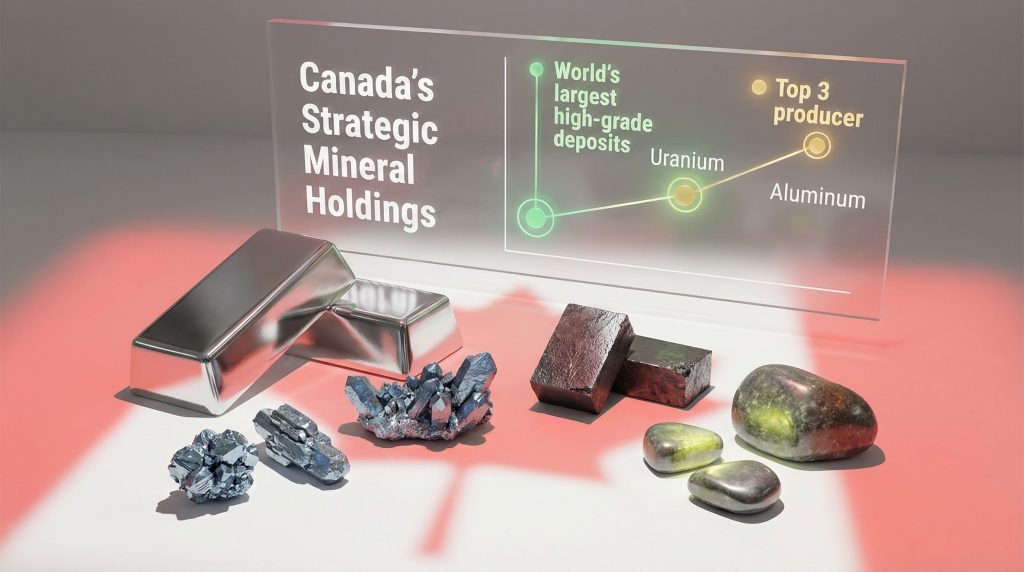
Canada's mineral resource profile encompasses materials essential for both military applications and civilian technologies. The country maintains significant production capabilities across aluminium, graphite, tungsten, and other defence-critical materials, while holding substantial reserves that remain undeveloped. This combination of current production and future potential creates strategic optionality that few other nations possess.
Canada's Strategic Mineral Capabilities:
- Uranium: World-class high-grade deposits supporting nuclear applications
- Aluminium: Established production infrastructure with expansion potential
- Graphite: Significant reserves aligned with battery and electronics demand
- Tungsten: Major deposits suitable for specialised defence applications
- Battery Metals: Comprehensive portfolio supporting energy transition
The geographic distribution of these resources across multiple provinces provides natural risk mitigation against localised disruptions. This dispersed asset base contrasts with more concentrated resource locations in other jurisdictions, enhancing supply chain reliability for strategic partners.
Furthermore, processing capacity represents the critical differentiator between raw material suppliers and strategic resource partners. Canada's emphasis on domestic refining and value-added manufacturing transforms commodity exports into sophisticated materials ready for defence applications. This vertical integration approach reduces dependence on foreign processing while capturing higher-value economic activity, aligning with broader critical minerals & energy security objectives.
Economic Sectors Positioned for Defence-Driven Growth
The convergence of defence requirements with civilian technologies creates unprecedented opportunities for cross-sector synergies. Battery metals required for military communications systems align perfectly with electric vehicle supply chains, generating economies of scale that benefit both applications. This dual-use approach maximises investment efficiency while building resilient industrial capacity.
Manufacturing Renaissance Scenarios:
Concentrated Development Model:
- Major mining regions attract intensive investment flows
- Infrastructure upgrades support multiple industrial applications
- Enhanced regional economic multiplier effects
- Potential risks from over-concentration of defence contracts
Distributed Growth Framework:
- Multiple provinces develop specialised mineral capabilities
- Balanced economic development across geographic regions
- Enhanced system resilience against supply disruptions
- Reduced political risks from regional dependency
The steel and aluminium sectors particularly benefit from defence-oriented investment. These industries face opportunities to move beyond commodity production toward specialised applications requiring precise metallurgical specifications. Military-grade materials command premium pricing while building capabilities applicable to civilian infrastructure projects.
In addition, regional economic impact varies significantly based on existing infrastructure and workforce capabilities. Provinces with established mining operations can leverage existing expertise and supply chains, while regions with underdeveloped resources require more comprehensive development approaches, reflecting broader North American mining trends.
Strategic Investment Framework and Market Dynamics
Government investment in critical minerals represents more than traditional industrial policy; it creates market signals that fundamentally alter investment risk profiles. Long-term procurement commitments provide the demand certainty necessary for major capital expenditures in mining and processing infrastructure.
According to New Economy Canada president Merran Smith, the strategy represents a generational economic opportunity to enhance national security, energy security, and supply chain security. This comprehensive approach recognises that defence investments can accelerate innovative clean technology development while strengthening domestic manufacturing capabilities.
The dual-use framework leverages defence investments to accelerate battery technology and materials innovation. As Smith noted, defence manufacturing relies on the same critical minerals required to scale clean technologies, including battery metals and advanced materials used in electrification and communications infrastructure.
Investment Multiplier Effects:
- Government funding de-risks private capital deployment
- Defence procurement contracts provide long-term demand visibility
- Reduced exposure to volatile commodity price cycles
- Enhanced project economics through demand certainty
Consequently, the strategic approach emphasises domestic sourcing capabilities that reduce vulnerability to global trade disruptions. By aligning defence procurement with Canadian producers of low-carbon steel, aluminium, cement, and critical minerals, the government creates market conditions that support both security objectives and economic development goals.
Alliance Architecture and Strategic Partnership Implications
Canada's critical minerals positioning strengthens NATO's overall resource security while reducing alliance dependence on potentially unreliable suppliers. This strategic value extends beyond pure economics, creating diplomatic leverage and enhancing Canada's influence within international security frameworks.
The Indo-Pacific strategic dimension adds complexity to Canada's resource diplomacy. Supplying allies in this region requires sophisticated logistics capabilities and long-term relationship management. However, the strategic benefits of resource-based partnerships potentially outweigh operational challenges.
Strategic Partnership Benefits:
- Enhanced alliance cohesion through resource security
- Reduced collective vulnerability to supply disruptions
- Strengthened diplomatic relationships with key partners
- Opportunities for technology sharing and joint development
The reliability factor distinguishes Canada from alternative suppliers facing governance challenges or geopolitical tensions. Stable regulatory frameworks, established rule of law, and transparent business practices create confidence among international partners seeking long-term supply relationships.
For instance, resource diplomacy increasingly influences broader strategic relationships. Countries controlling critical minerals gain influence in technology transfer discussions, joint research initiatives, and broader security cooperation frameworks, while considering uranium market trends that impact global nuclear security.
Technology Convergence and Future Demand Drivers
Emerging defence technologies increasingly rely on specialised materials that overlap with civilian applications. Advanced weapons systems, communication equipment, and energy storage solutions often require identical mineral inputs, creating sustained demand growth across multiple sectors.
The convergence between military and clean energy technologies particularly benefits Canadian producers. Electric vehicle batteries, grid storage systems, and military communications equipment utilise similar rare earth elements and specialised metals. This overlap provides market stability through diversified demand sources.
Technology-Driven Demand Categories:
- Advanced electronics requiring rare earth elements
- Battery systems for both military and civilian applications
- Specialised alloys for aerospace and defence equipment
- Communications infrastructure materials
Innovation in extraction and processing technologies creates additional competitive advantages. Companies developing more efficient or environmentally sustainable approaches gain access to government funding while building capabilities applicable across multiple market segments.
How Will Technology Shape Critical Mineral Demand?
The evolution of defence technologies directly correlates with critical mineral requirements. Next-generation weapons systems require increasingly sophisticated materials, while communication technologies demand rare earth elements with specific properties. This technological progression ensures sustained demand growth across multiple applications, supporting the broader mining industry evolution currently underway.
The next major ASX story will hit our subscribers first
Supply Chain Sovereignty and Strategic Risk Management
The domestic procurement strategy trades some cost efficiency for strategic security and supply reliability. This approach reflects growing recognition that supply chain vulnerabilities represent national security risks requiring mitigation through domestic capacity building.
Strategic stockpiling provisions create buffer capacity against supply shocks while providing market stability for domestic producers. This approach balances immediate supply security with long-term market development objectives.
Risk Mitigation Strategies:
- Diversified supplier base across multiple provinces
- Strategic inventory management and stockpiling
- Redundant processing capabilities
- Alternative transportation route development
The sovereignty model recognises that critical mineral access has become essential for maintaining technological competitiveness. Nations without secure access to these materials face constraints on advanced manufacturing capabilities and innovation potential.
Furthermore, Canada's approach to Canada's defence strategy and critical minerals demonstrates how resource security directly impacts technological sovereignty. Countries lacking secure mineral access face limitations in developing advanced manufacturing capabilities and maintaining innovation momentum.
Investment Opportunities Across the Value Chain
Mining sector expansion benefits from reduced project risk through government-backed demand commitments. Established producers gain access to long-term contracts while exploration companies benefit from enhanced project economics and improved financing conditions.
Processing infrastructure development represents particularly attractive opportunities. The emphasis on domestic value-added manufacturing creates demand for new refining facilities, specialised processing equipment, and advanced materials production capabilities.
Investment Categories:
- Mine development and expansion projects
- Processing and refining infrastructure
- Transportation and logistics capabilities
- Technology and innovation applications
Technology companies developing extraction, processing, and application innovations gain access to government funding while building expertise applicable across global markets. These capabilities support both domestic objectives and export opportunities.
However, the integration of civilian and defence applications creates larger addressable markets for specialised producers. Companies serving both sectors benefit from economies of scale while reducing dependency on any single customer segment.
Implementation Challenges and Risk Factors
Infrastructure constraints represent significant implementation challenges, particularly in remote mining locations. Scaling production requires substantial investments in power generation, transportation networks, and workforce development capabilities.
Environmental and regulatory considerations add complexity to project development timelines. Balancing strategic objectives with environmental protection requires sophisticated approaches to permitting, community engagement, and impact mitigation.
Key Implementation Challenges:
- Workforce development and skill requirements
- Infrastructure investment and development timelines
- Environmental compliance and community relations
- Market competition and pricing volatility
Global competition for critical minerals intensifies as other nations implement similar strategies. Canada faces competition from established suppliers and emerging producers, requiring continuous improvement in cost competitiveness and service quality.
Additionally, market volatility remains a concern despite government demand commitments. Commodity price fluctuations can affect project economics and investment returns, requiring sophisticated risk management approaches.
What Are the Primary Obstacles to Implementation?
The most significant challenges include infrastructure development in remote locations, workforce skill gaps, and environmental compliance requirements. According to Canada's official defence strategy documentation, these obstacles require coordinated public-private partnerships and long-term investment commitments to overcome effectively.
Long-Term Competitiveness and Economic Transformation
The integrated value chain approach creates sustainable competitive advantages beyond raw material extraction. Higher-value processing and manufacturing activities generate more employment per unit of resource while reducing exposure to commodity price volatility.
Innovation ecosystem development represents a crucial long-term benefit. Government investment in critical minerals supports broader technological advancement in extraction, processing, and application technologies with applications extending beyond defence requirements.
Competitive Positioning Elements:
- Advanced processing and manufacturing capabilities
- Innovation in extraction and processing technologies
- Integrated supply chain management
- Strategic partnership relationships
The resource-to-influence transformation reflects broader changes in international economic relationships. Countries controlling critical minerals gain leverage in technology transfer negotiations, joint research partnerships, and broader diplomatic engagements.
Consequently, strategic partnership opportunities extend beyond traditional buyer-seller relationships. Resource security partnerships enable deeper cooperation in research and development, technology sharing, and integrated industrial planning.
Future Scenarios and Strategic Implications
Canada's defence strategy and critical minerals represents a comprehensive approach to transforming natural resource advantages into strategic influence and sustained economic opportunity. The success of this transformation depends on execution quality, particularly in processing capacity development, workforce capability building, and environmental stewardship maintenance.
The fundamental strategic logic positions Canada advantageously for emerging challenges in an increasingly uncertain global security environment. By leveraging resource security to enhance both economic prosperity and strategic influence, the country creates optionality across multiple future scenarios.
Implementation success requires sustained commitment across political cycles and continued investment in technological advancement. However, the convergence of security requirements with economic opportunity creates natural alignment between strategic objectives and market incentives.
The transformation from commodity supplier to strategic partner represents more than policy adjustment; it reflects recognition that resource control increasingly determines technological competitiveness and geopolitical influence in the modern global economy. This evolution positions Canada's defence strategy and critical minerals as fundamental pillars of future economic prosperity and strategic autonomy.
Disclaimer: This analysis contains forward-looking assessments and strategic projections that involve inherent uncertainties. Investment decisions should be based on comprehensive due diligence and professional advice. Market conditions, regulatory frameworks, and geopolitical factors may significantly impact outcomes described in this analysis.
Ready to Capitalise on Strategic Resource Opportunities?
Discovery Alert's proprietary Discovery IQ model delivers real-time alerts on significant ASX mineral discoveries, instantly identifying actionable opportunities in critical minerals and strategic resources that align with global defence and clean energy demands. Explore Discovery Alert's historic discoveries to understand how major mineral finds have generated substantial market returns, then begin your 14-day free trial today to position yourself ahead of the market in this transformative sector.