June 24, 2026
The Missing Middle: Why Western Rare Earth Supply Chains Keep Breaking at the Same Point
Decades of investment in rare earth mining outside China have produced a paradox that few outside the industry fully appreciate. Ore bodies exist. End-users exist. What has consistently been absent is the commercially viable processing layer that converts mined concentrate into the separated, specification-grade oxides that automotive manufacturers, defence contractors, and wind turbine producers can actually use. This structural gap, often called the "missing middle," is not a geological problem. It is a commercial architecture problem, and it has allowed China to maintain approximately 85 to 90 percent of global rare earth separation and refining capacity despite producing only around 70 percent of global mine output (International Energy Agency, The Role of Critical Minerals in Clean Energy Transitions, 2021; United States Geological Survey, Mineral Commodity Summaries: Rare Earths, 2024).
The implications of this concentration are not theoretical. In 2010 and 2011, Chinese export quota reductions triggered multi-fold price spikes in neodymium, dysprosium, and terbium, with dysprosium oxide prices briefly exceeding several thousand US dollars per kilogram before eventually retreating (US Congressional Research Service, Rare Earth Elements, various editions). Western end-users discovered that relying on spot market access through a single country's policy decisions was structurally untenable. Yet for more than a decade after those price spikes, the refining bottleneck outside China remained largely unresolved. The broader rare earth supply chains challenge extends well beyond refining capacity alone.
The Iluka rare earths offtake agreement signed in June 2026, covering neodymium, praseodymium, dysprosium, and terbium oxides from the Eneabba refinery in Western Australia, represents one of the most architecturally complete attempts yet made to bridge this gap at a commercial level. Understanding why requires moving beyond the headline numbers and examining what the agreement actually does to the project's economic and strategic structure.
When big ASX news breaks, our subscribers know first
What Magnet Rare Earth Oxides Are and Why All Four Matter Together
NdFeB permanent magnets, which power the electric motors in the majority of high-efficiency EV drivetrains, wind turbine generators, and a wide range of defence systems, require four distinct rare earth inputs in separated oxide form. Neodymium and praseodymium form the primary alloy matrix, with typical loadings of 0.5 to 1.5 kilograms of Nd-Pr oxide per EV, depending on motor design. Dysprosium and terbium serve a different function: they are added in relatively small quantities, often tens of grams per vehicle, to preserve the magnet's coercivity, meaning its resistance to demagnetisation, at elevated operating temperatures (International Energy Agency, 2021; European Commission, Study on the Critical Raw Materials for the EU, 2023).
The distinction between light rare earths (Nd, Pr) and heavy rare earths (Dy, Tb) matters commercially in ways that are not widely understood outside the industry. Heavy rare earths are geologically rarer, more concentrated in Chinese and Myanmar deposit types, and historically far more price-volatile. Furthermore, a supply agreement covering all four oxides simultaneously is considerably more difficult to structure than a single-element agreement, because pricing, geology, and supply dynamics differ substantially across the group.
This is why the scope of the Iluka rare earths offtake agreement carries a strategic premium. By contracting for the complete magnet oxide suite in a single take-or-pay arrangement, the automotive customer has effectively secured a one-stop, non-Chinese source for the entire NdFeB magnet input chain. That type of arrangement is exceptionally rare in current Western rare earth markets, where most non-Chinese producers either lack heavy rare earth production or cannot separate all four oxides to magnet-grade specification.
The IEA projects that demand for neodymium-based permanent magnets in clean energy technologies could rise between threefold and sevenfold by 2040, driven primarily by EV adoption and wind energy expansion (International Energy Agency, 2021). Global NdFeB magnet production is estimated to need to reach 350,000 to 400,000 tonnes annually by 2030 under high electrification pathways, compared to well over 200,000 tonnes in the early 2020s (International Renewable Energy Agency, World Energy Transitions Outlook, 2022). Against that demand trajectory, the critical minerals demand surge makes agreements like the Iluka deal foundational infrastructure decisions rather than peripheral commercial events.
How the Iluka Rare Earths Offtake Agreement Is Structured
Commercial Architecture: Take-or-Pay, Floor Pricing, and Market Linkage
The binding multi-year agreement is structured as a take-or-pay arrangement, meaning the automotive customer commits to either accepting the contracted volumes or compensating Iluka for the revenue equivalent. This structure is preferred by project financiers over volume-flexible agreements because it converts production output into contractual revenue obligations, directly improving debt serviceability modelling.
| Contract Metric | Detail |
|---|---|
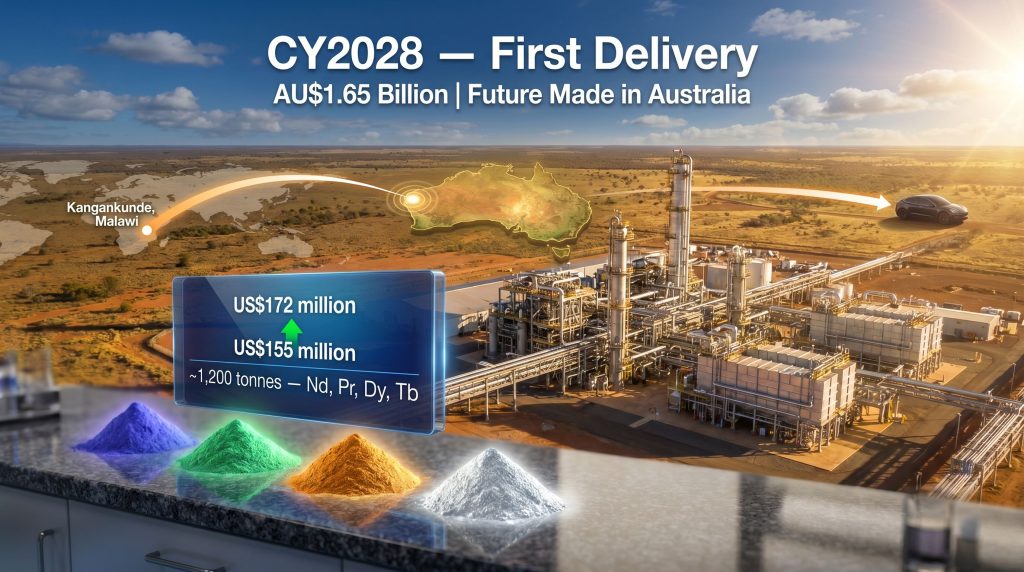
| Offtake Volume | ~1,200 tonnes of Nd, Pr, Dy, Tb oxides |
| Contract Term | 4 years, commencing CY2028 |
| Proportion of Planned Production | ~10% |
| Minimum Guaranteed Revenue | US$155 million |
| Revenue at Industry-Forecast Pricing | US$172 million |
| Pricing Mechanism | Higher of minimum floor or prevailing market rate |
The pricing mechanism is particularly well-designed for the current rare earth market environment. By setting prices at the higher of a pre-agreed minimum floor or market-linked rates, the structure eliminates downside price risk for Iluka while simultaneously ensuring the automotive buyer pays no more than competitive market rates when prices are elevated. Neither party is exposed to the full volatility characteristic of rare earth markets.
Critically, Iluka's managing director confirmed that the minimum prices embedded in this agreement were negotiated between independent commercial parties, without any connection to government-backed pricing support. That distinction matters significantly: commercially negotiated floor prices reflect a customer's genuine assessment of project viability and long-term supply value, rather than a policy instrument. This third-party validation is arguably more durable than government price support as a signal of commercial credibility. For broader context on how such arrangements work in practice, the rare earth offtake agreement secured by Arafura with Traxys offers a useful industry comparison.
Why US$155 Million in Minimum Revenue Is More Than Just a Number
In isolation, US$155 million across a four-year contract term might appear modest relative to the AU$1.65 billion capital structure of the Eneabba refinery. However, its function in project finance is disproportionate to its absolute size. Contracted minimum revenue directly supports debt service coverage ratio calculations, giving lenders confidence that even in a depressed rare earth price environment, a portion of project cash flow is protected by binding commercial obligations.
The AU$1.65 billion non-recourse loan facility provided by Export Finance Australia is structured such that lenders can only make claims against Eneabba's project assets rather than Iluka's broader balance sheet. This structure, while protective for Iluka's corporate credit profile, places additional weight on the project's own revenue visibility. The offtake agreement's minimum revenue floor functions as a bankability anchor within that non-recourse framework.
At industry-forecast pricing, the agreement generates approximately US$172 million, representing an 11 percent uplift above the minimum floor. Should rare earth oxide prices exceed current forecasts due to supply disruptions or accelerating EV adoption, the market-linked pricing mechanism captures full upside with no revenue cap constraining Iluka's returns.
Eneabba Refinery: Construction Progress and What Comes Next
From Groundwork to Commercial Scale
The Eneabba rare earths refinery in Western Australia has surpassed 50 percent construction completion as of mid-2026, with commissioning targeted for calendar year 2027 and commercial production ramp-up extending into 2028. The timeline aligns precisely with the commencement date embedded in the offtake agreement, which is not coincidental. The commercial agreement was structured around the production schedule, ensuring contracted deliveries begin as the refinery exits ramp-up and approaches nameplate capacity.
Civmec has been awarded the structural, mechanical, piping, electrical, and instrumentation works contract, known in the industry as the SMPEI package. This contract category covers some of the most technically demanding and capital-intensive construction components of any hydrometallurgical processing facility. SMPEI works at a rare earth separation refinery involve acid-resistant pipework systems, solvent extraction circuits, and instrumentation capable of managing corrosive chemical environments across multiple processing stages. Indeed, the rare earth processing challenges inherent to facilities of this type make construction execution a critical variable in any project timeline assessment.
Construction Milestone Tracker:
- Refinery completion: more than 50% as of June 2026
- Commissioning target: CY2027
- Commercial production commencement: CY2028
- First offtake deliveries: CY2028, aligned with automotive OEM agreement
Access to the full AU$1.65 billion non-recourse government loan facility was contingent on commercial offtake conditions being satisfied. The signing of this agreement directly fulfilled that financing condition, creating a structural linkage between the commercial and financing announcements. The two milestones are not independent achievements but components of a single enabling framework for the project's completion. Fluor's engineering work on the Eneabba facility further underscores the project's technical credibility, with a globally recognised contractor involved in its design and delivery.
Feedstock Strategy: Why Diverse Inputs Are Central to Eneabba's Design
The Kangankunde Connection and Multi-Source Feed Security
One of the less widely understood aspects of the Eneabba project is its deliberate design around feedstock diversity rather than single-mine dependency. The refinery is engineered to accept concentrate from multiple sources, including Iluka's own mining operations and third-party suppliers. This multi-source architecture reduces the production continuity risk that has undermined previous Western rare earth processing ventures.
The agreement with Lindian Resources (ASX: LIN) for concentrate supply from the Kangankunde project in Malawi is a key component of this external feedstock strategy.
| Feedstock Agreement Parameter | Detail |
|---|---|
| Supplier | Lindian Resources, Kangankunde Project, Malawi |
| Annual Supply Volume | 6,000 dry metric tonnes (±5%) |
| Agreement Duration | ~15 years, extendable to 2038 |
| Share of Eneabba Throughput | ~10% of total refinery capacity |
| Pricing Basis | Linked to Iluka's realised Nd/Pr oxide selling prices, with floor |
| Dy/Tb Payments | Activated above nominated price thresholds |
| Suspension Clause | Triggered if weighted average REO selling price falls below threshold for two consecutive quarters |
Iluka's AU$20 million construction loan to Lindian, structured over a five-year term at SOFR plus 11 percent with interest capitalised for the first two years, functions simultaneously as a financing instrument and a supply security mechanism. By providing development capital to a key concentrate supplier, Iluka effectively embeds itself into the feedstock project's capital structure, aligning commercial incentives across the supply chain.
Geographically, Malawi represents a strategically significant sourcing location. Kangankunde is one of Africa's highest-grade carbonatite-hosted rare earth deposits, and Malawi's political alignment with Western institutional frameworks satisfies the "likeminded nation" sourcing criteria increasingly embedded in automotive OEM procurement policies. The full supply chain from Eneabba's perspective therefore spans Australian mining operations, Malawian concentrate supply, and a Western automotive end-customer, without any node residing within Chinese-controlled processing infrastructure. The strategic partnership agreement with Lindian Resources provides further detail on the terms of this arrangement.
Three Scenarios for Eneabba's Commercial Trajectory
Scenario Analysis: How Different Price Environments Affect Project Outcomes
Scenario 1: Base Case at Industry Forecast Pricing
Revenue from the automotive agreement reaches approximately US$172 million across the four-year term. Additional offtake agreements are secured progressively through 2026 and 2027, covering an increasing share of planned production. Eneabba achieves nameplate capacity by late 2028, and the project's debt service coverage ratios remain within acceptable parameters.
Scenario 2: Downside Case with Floor Price Activation
Rare earth oxide prices soften below current industry forecasts, activating the minimum floor pricing mechanism. Minimum contract revenue of US$155 million is preserved across the term, protecting Iluka's debt service capacity. The suspension clause embedded in the Lindian feedstock agreement may be triggered if Iluka's weighted average rare earth oxide selling price falls below the nominated threshold for two consecutive quarters, consequently reducing input costs in a low-price environment.
Scenario 3: Upside Case with Market Price Surge
Geopolitical supply disruptions, new Chinese export restrictions, or faster-than-projected EV adoption drive Nd, Pr, Dy, and Tb oxide prices above current forecast levels. The market-linked pricing ceiling in the automotive agreement captures full upside, with no revenue cap constraining Iluka's returns. Subsequent offtake agreements are negotiated at elevated market rates, accelerating project payback and improving overall financing metrics.
The suspension and floor mechanisms embedded across both the offtake and feedstock agreements create a self-reinforcing risk mitigation architecture. In a downside price scenario, both the refinery's revenue floor and its input cost structure adjust in the same direction, compressing margin pressure on both sides of the operating ledger simultaneously.
The next major ASX story will hit our subscribers first
How the Iluka Agreement Compares to Global REE Offtake Precedents
Benchmarking Against Industry Norms
| Comparison Dimension | Iluka / Eneabba Model | Typical Industry Precedent |
|---|---|---|
| Oxide Coverage | Full suite: Nd, Pr, Dy, Tb | Often single or dual element |
| Pricing Mechanism | Higher of floor or market-linked | Commonly fixed or purely market-linked |
| Customer Type | Global automotive OEM | Often trading houses or intermediaries |
| Financing Integration | AU$1.65B non-recourse government loan | Typically project finance or equity |
| Feedstock Diversification | Internal plus third-party, multi-country | Usually single-source mine feed |
| Take-or-Pay Structure | Binding, with minimum revenue guarantee | Sometimes volume-flexible |
The customer identity being a direct automotive OEM rather than a trading intermediary is commercially significant in ways that extend beyond the immediate contract. Trading house agreements, while commercially valid, do not provide the same market validation as a direct procurement commitment from an end-use manufacturer. When an automotive company independently assesses a refinery's production capability, supply chain integrity, and price competitiveness, and commits its own procurement budget, the resulting agreement carries a quality of commercial endorsement that downstream broking arrangements cannot replicate.
A globally recognised automotive company conducting independent technical and commercial due diligence on Eneabba, and committing capital on the basis of that assessment, constitutes a form of third-party project validation that no government designation or policy framework can substitute for.
The Geopolitical Dimension: Likeminded Nations and China's Structural Dominance
Why Supply Chain Geography Now Commands a Price Premium
The concept of "likeminded nation" procurement is no longer a policy aspiration. It is increasingly embedded as a mandatory criterion in automotive OEM supply chain frameworks, driven by lessons from the 2010–2011 rare earth price crisis and reinforced by more recent export control actions affecting multiple critical materials. The rare earth geopolitics shaping these procurement decisions are becoming more consequential with each passing year. Approximately 85 to 90 percent of global rare earth separation capacity residing in a single country represents a concentration risk that no major automotive or defence manufacturer can responsibly ignore in its long-term supply planning (IEA, 2021; European Commission, 2023).
What is less commonly discussed is the price premium that likeminded-nation supply is beginning to command over Chinese-origin material. As Western OEMs internalise supply chain security costs into their procurement models, the calculus shifts from pure price minimisation toward a weighted assessment of price, supply certainty, and geopolitical risk. Non-Chinese separated rare earth oxides, produced under transparent regulatory frameworks and delivered through allied-nation logistics channels, may command a durable pricing premium over the medium term as this procurement philosophy matures across the automotive sector.
Iluka's positioning satisfies likeminded-nation criteria across every node of its supply chain: Australian refining operations, Malawian concentrate supply sourced from a country aligned with Western development institutions, and a Western automotive end-customer. This full-chain geographic alignment is genuinely rare among current non-Chinese rare earth producers, most of whom rely on Chinese processing for at least one stage of their value chain.
Frequently Asked Questions: Iluka Rare Earths Offtake Agreement
What rare earth oxides does the Iluka offtake agreement cover?
The agreement covers all four magnet rare earth oxides: neodymium, praseodymium, dysprosium, and terbium. This complete coverage of both light and heavy magnet rare earths distinguishes the agreement from most Western offtake precedents, which typically address only one or two elements.
When does the agreement commence and how long does it run?
Commercial deliveries begin in calendar year 2028 for an initial four-year term, timed to align with the Eneabba refinery's commissioning in 2027 and subsequent production ramp-up.
What revenue will Iluka generate from this agreement?
Minimum guaranteed revenue across the four-year term is US$155 million. At current industry-forecast pricing, total revenue rises to approximately US$172 million, with uncapped upside if market prices exceed forecasts.
Who is the customer?
The customer is a globally recognised automotive company. Iluka has not publicly disclosed the specific identity of the customer.
What is the Eneabba refinery and what makes it strategically significant?
Eneabba is Australia's first integrated rare earths refinery, designed to accept diverse concentrate feedstocks and produce separated light and heavy rare earth oxides to magnet-grade specification. Its vertical integration capability, processing concentrates from multiple geographic sources into finished separated oxides, is a characteristic shared by very few facilities outside China.
How does the AU$1.65 billion government loan relate to the offtake agreement?
Export Finance Australia's confirmation of full access to the AU$1.65 billion non-recourse loan facility was structured around commercial offtake conditions being satisfied. The signing of the automotive agreement directly fulfilled that condition, demonstrating that the financing and commercial milestones are structurally dependent rather than independent achievements.
From Aspiration to Validated Commercial Reality
Three Conditions Met Simultaneously
What makes the current moment genuinely significant for anyone following the Western critical minerals processing story is the simultaneous satisfaction of three enabling conditions that have historically never aligned at the same time for any non-Chinese rare earth refinery:
- Government financing confirmation: Full access to AU$1.65 billion in non-recourse project financing has been confirmed by Export Finance Australia.
- Commercial offtake secured from a direct end-user: A binding take-or-pay agreement has been executed with a global automotive manufacturer, not a trading intermediary.
- Construction progress beyond the halfway threshold: The refinery is more than 50 percent complete, reducing construction execution risk from speculative to manageable.
Each of these conditions individually is insufficient to validate a project of this scale. Together, however, they represent the transition from policy-supported aspiration to commercially evidenced project execution. The Eneabba rare earths refinery has moved from the category of "planned Western processing capacity" into the narrower and far more credible category of "funded, partially built, commercially contracted capacity."
The Compounding Credibility Effect
With discussions with additional prospective customers described as ongoing, and the first agreement representing only approximately 10 percent of planned production, the trajectory of Eneabba's offtake coverage over the next 18 months will be closely watched. Each additional agreement signed will make subsequent negotiations easier, because the project's commercial viability becomes progressively more evidenced with each committed customer.
If Iluka ultimately secures offtake for 60 to 70 percent of planned production at similar commercial terms to the first Iluka rare earths offtake agreement, the project's revenue visibility would substantially de-risk both remaining construction execution and long-term financing obligations. The first agreement is therefore less important as a standalone revenue event than as an accelerant for everything that follows it.
The most durable signal embedded in this agreement may be the simplest: a sophisticated, globally operating automotive company conducted its own independent assessment of Eneabba's production capability, supply chain structure, and pricing competitiveness, and then committed its procurement budget. That act of independent commercial validation is the foundation on which every subsequent customer conversation will be built.
This article is for informational purposes only and does not constitute financial or investment advice. Readers should conduct their own due diligence and consult a qualified financial adviser before making any investment decisions. Forward-looking statements, scenario projections, and revenue forecasts discussed in this article involve inherent uncertainty and should not be relied upon as guarantees of future outcomes.
Want to Track the Next Major Critical Minerals Breakthrough Before the Market Does?
Discovery Alert's proprietary Discovery IQ model scans ASX announcements in real time, instantly identifying significant mineral discoveries across rare earths, critical minerals, and beyond — turning complex data into actionable investment insights for both short-term traders and long-term investors. Explore historic examples of major mineral discoveries and their returns on Discovery Alert's dedicated discoveries page, and begin your 14-day free trial today to position yourself ahead of the broader market.