June 24, 2026
The Midstream Bottleneck That Has Shaped Western Rare Earth Vulnerability
For decades, the conversation around rare earth supply chains has oscillated between two poles: upstream mining capacity and downstream magnet manufacturing. Yet the segment that ultimately determines whether Western supply chains can function independently sits uncomfortably between the two. Chemical separation, the process of isolating individual rare earth elements from mixed concentrates, has remained one of the most technically demanding and geopolitically concentrated steps in the entire critical minerals value chain.
China's rare earth strategy reflects decades of deliberate industrial investment in solvent extraction infrastructure, chemical engineering expertise, and vertically integrated capacity that Western nations largely chose not to replicate. The result is a structural dependency that no amount of upstream mining investment can resolve on its own.
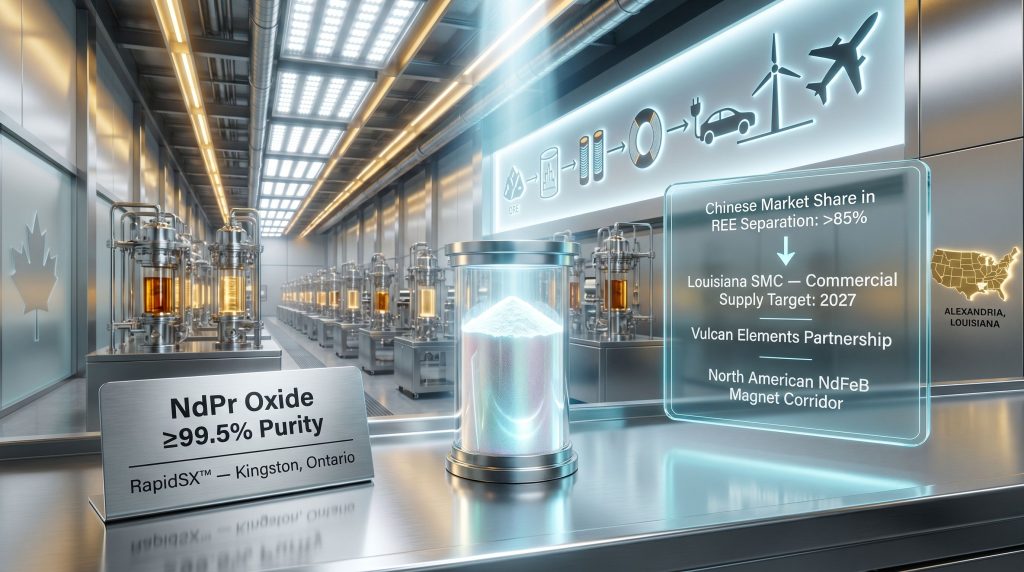
The Ucore NdPr oxide shipment to magnet makers, dispatched from the company's Kingston, Ontario demonstration facility in June 2026, represents one of the most concrete advances in Western rare earth separation to emerge from outside China's processing ecosystem in recent years. Understanding what this shipment means, how it was produced, and what it must achieve to translate into commercial reality requires a closer look at the mechanics of rare earth separation and the qualification process that governs industrial supply relationships.
When big ASX news breaks, our subscribers know first
Why NdPr Oxide Is the Pivotal Input in the Magnet Supply Chain
Neodymium-praseodymium oxide occupies a uniquely consequential position in advanced manufacturing. As the direct chemical precursor to NdFeB (neodymium-iron-boron) metal alloy, it sits at the threshold between raw material processing and functional industrial production. NdFeB permanent magnets are the highest-performance commercial magnets available, and their applications span some of the most strategically important sectors of the modern economy.
These magnets are embedded in:
- Electric vehicle traction motors, where their high magnetic energy density enables compact, high-torque drivetrains
- Direct-drive wind turbine generators, particularly offshore designs that require large-format, high-coercivity magnets
- Precision-guided defense systems, naval propulsion, and drone propulsion units
- Industrial servo motors, robotics, and automation systems where energy efficiency and size constraints are critical
Without a reliable, traceable, non-Chinese source of magnet-grade NdPr oxide, every one of these downstream sectors faces structural supply risk. That risk does not diminish simply because more mines are developed or more magnets are manufactured in Western nations. It persists as long as the chemical separation step remains dependent on Chinese processing infrastructure.
Furthermore, the rare earth processing challenges that have historically concentrated this capability in China are not trivial to overcome. The qualification of NdPr oxide by downstream magnet manufacturers is not a formality. It is the technical and commercial gateway that every prospective non-Chinese separator must pass through before a single tonne of separated oxide can flow into a binding supply agreement.
How RapidSX Works and Why the 52-Stage Design Matters
The Technical Architecture of Conventional Separation vs. RapidSX
Rare earth separation has traditionally relied on large-scale, multi-stage liquid-liquid solvent extraction systems. Because the 17 rare earth elements share nearly identical ionic radii and chemical behaviours, separating them requires dozens to hundreds of sequential extraction stages, each achieving only marginal elemental separation. The accumulated infrastructure requirement is substantial, demanding large physical footprints, significant chemical inventories, and deep process control expertise accumulated over many operational cycles.
RapidSX, Ucore Rare Metals' proprietary solvent extraction platform, is engineered to achieve the same fundamental separation chemistry through a more compact, modular configuration. The platform is designed to reduce the physical footprint and capital intensity associated with conventional rare earth separation while maintaining the purity standards required by downstream industrial customers.
The 52-stage RapidSX Demonstration Plant operating at Ucore's Commercialisation and Demonstration Facility in Kingston, Ontario, is the operational testbed for this technology. Its significance lies not just in the number of extraction stages but in the fact that it processes real mixed rare earth feedstock, specifically a heavy mixed rare earth oxide derived from an ionic clay source, rather than laboratory-prepared or simplified inputs.
From Ionic Clay Feedstock to 99.5%+ NdPr Oxide
| Production Parameter | Specification |
|---|---|
| Demonstration Plant Stages | 52-stage RapidSX system |
| Facility Location | Kingston, Ontario, Canada |
| Feedstock Type | Heavy mixed rare earth oxide from ionic clay source |
| Intermediate Product | High-purity NdPr chloride |
| Final Output | NdPr oxide at greater than or equal to 99.5% purity |
| Qualification Recipients | Major NdFeB magnet manufacturers in North American and European supply chains |
The ionic clay feedstock origin is a detail that carries more significance than it might initially appear. Ionic clay rare earth deposits, found predominantly in southern China but also increasingly identified across Southeast Asia and South America, are characterised by rare earth elements adsorbed onto clay mineral surfaces. These deposits are notable for their relatively elevated proportions of mid-to-heavy rare earth elements, including dysprosium and terbium, which are critical for high-temperature magnet performance.
Processing feedstock from this source type means the Kingston plant is handling a chemically complex, commercially representative input rather than an idealised laboratory mixture. Achieving 99.5% or greater NdPr oxide purity from such a feedstock under real operating conditions is a technically meaningful result. Impurity control in this context involves managing not only non-rare earth contaminants but also adjacent rare earth elements whose chemical similarity makes complete separation inherently challenging.
The Qualification Process: What Magnet Manufacturers Actually Test
Five Dimensions of Downstream Evaluation
Customer qualification of rare earth oxide materials is a structured, multi-phase technical assessment that typically unfolds across several months. For magnet manufacturers, the evaluation framework addresses the following dimensions:
- Chemical purity verification through independent assay work confirming rare earth oxide content and quantifying key impurity concentrations at parts-per-million resolution
- Phase composition analysis confirming oxide crystal structure and phase consistency relevant to downstream alloy conversion processes
- Physical handling characteristics including particle morphology, moisture content, flowability, and packaging compatibility with industrial processing equipment
- Process compatibility testing evaluating the oxide's behaviour during alloy formulation, sintering, and finished magnet manufacturing workflows
- Traceability and quality assurance establishing the documentation protocols, lot consistency records, and chain-of-custody standards increasingly required for Western defense and industrial procurement compliance
The fifth dimension deserves particular attention. As Western governments and defense agencies have moved to tighten supply chain traceability requirements, the ability to demonstrate full feedstock-to-product documentation has become a procurement prerequisite in its own right. For Ucore, producing NdPr oxide from a documented non-Chinese ionic clay feedstock positions the company to meet these emerging compliance standards, which is a commercial advantage that extends beyond pure chemistry.
Why Customer Feedback Feeds Directly Into the Louisiana SMC Design
One of the less commonly appreciated aspects of Ucore's qualification programme is its dual function. While the primary objective is advancing relationships with downstream customers toward offtake agreements, the qualification process simultaneously generates customer-specific technical feedback that informs the design and operational planning of the Louisiana Strategic Metals Complex.
Ucore's Chief Operating Officer Mike Schrider noted that oxide quality encompasses multiple interconnected variables including purity, impurity control, physical form, consistency, conversion performance, and traceability, all of which must be understood before commercial supply can begin. The samples shipped to magnet manufacturers give those potential customers the material needed to evaluate Ucore's rare earth oxides against their own technical and manufacturing requirements.
This iterative approach creates a feedback loop between demonstration-scale production in Kingston and commercial-scale engineering in Louisiana. Product specifications emerging from qualification testing at downstream manufacturers can be incorporated into the Louisiana facility's process design before commissioning, consequently reducing the risk of post-construction process adjustment and shortening the pathway to specification-compliant production from day one.
The Louisiana SMC and the 2027 Commercial Supply Target
From Demonstration to Commercial Scale
The Alexandria, Louisiana Strategic Metals Complex represents the commercial deployment of the RapidSX separation platform. While the Kingston CDF operates as a demonstration and validation environment, the Louisiana facility is designed for the production volumes required to supply industrial customers at commercial scale.
NdPr oxide is expected to form the cornerstone of the Louisiana SMC's product portfolio, complemented by heavy magnet rare earths including dysprosium and terbium. These three materials collectively address the full spectrum of NdFeB magnet composition requirements. Standard NdFeB grades rely primarily on NdPr metal alloy, while high-temperature magnet grades used in EV motors and aerospace applications require dysprosium and terbium additions to maintain coercivity at elevated operating temperatures.
The Vulcan Elements Partnership and a Domestic Oxide-to-Magnet Corridor
Ucore and Vulcan Elements joining forces to build a domestic rare earth magnet supply chain points toward an integrated domestic supply pathway. Vulcan Elements' manufacturing operations in North Carolina, combined with NdPr oxide production from the Louisiana SMC, would establish a geographically concentrated oxide-to-magnet corridor within the United States, a configuration that significantly reduces logistics complexity and supply chain exposure compared to transoceanic sourcing.
The near-term objective involves delivering initial NdPr and dysprosium oxide samples to Vulcan Elements, with the longer-term target of establishing a rare earth supply agreement commencing in 2027. That timeline is ambitious but not implausible given the qualification work already underway and the commercial pressure on downstream magnet manufacturers to secure non-Chinese supply.
Competitive Context: Where Western NdPr Oxide Production Stands
| Strategic Dimension | Context |
|---|---|
| Chinese share in global REE separation | Historically greater than 85% of global processing capacity |
| Primary demand drivers | EV production growth, defense procurement, wind energy expansion |
| Key qualification barrier | No supply agreement is executable without completed customer qualification |
| Ucore's feedstock source | Ionic clay derived heavy mixed rare earth oxide |
| Commercial production target | Louisiana SMC, 2027 commencement discussions underway |
Mining Capacity Is Not the Binding Constraint
A persistent misconception in public discourse is that increasing mining output is the primary lever for supply chain independence. In practice, separated oxide production is the binding constraint. America's rare earth supply chain has advanced considerably in terms of mining projects in recent years, and diverse feedstock sources, including ionic clay deposits, hard rock REE mineralisation, and rare earth recycling streams, mean raw material availability is not the structural barrier it once was.
The true bottleneck lies in the chemical engineering expertise, capital investment, environmental permitting, and extensive process validation required to operate rare earth separation at commercial scale to commercial purity standards. This is precisely why the Ucore NdPr oxide shipment to magnet makers carries significance that extends well beyond a single product sample. It demonstrates that the separation technology works at a meaningful process scale, on a real feedstock, and to a purity level that downstream manufacturers can actually evaluate against their requirements.
Demonstration-scale qualification data from Kingston does not just validate the chemistry. It validates the commercial readiness pathway and reduces the engineering uncertainty that investors and downstream customers must price into any prospective supply relationship.
The next major ASX story will hit our subscribers first
Key Takeaways for Understanding This Development
- The 99.5% purity threshold achieved from a genuine ionic clay mixed feedstock confirms that RapidSX performs under commercially representative conditions, not idealised laboratory inputs
- Customer qualification is the non-negotiable commercial gateway without which no memorandum of understanding can advance toward a binding supply agreement regardless of technology maturity or capital investment
- Heavy magnet rare earths including dysprosium and terbium are expected to complement NdPr oxide in Ucore's product suite, addressing the full compositional requirements of both standard and high-temperature NdFeB magnet grades
- The dual function of the qualification programme, advancing customer relationships while generating design feedback for the Louisiana SMC, creates compounding value from a single technical milestone
- Feedstock traceability from non-Chinese sources is increasingly a procurement requirement, not simply a preference, in Western defense and advanced manufacturing supply chains
- The 2027 commercial supply target tied to discussions with Vulcan Elements represents the near-term commercial horizon that qualification progress must support
Disclaimer: This article contains forward-looking information relating to planned facilities, commercial timelines, and prospective supply agreements. Such information involves assumptions and risks that could cause actual outcomes to differ materially from those described. Readers should not rely on forward-looking statements as predictions of future results. This article does not constitute financial advice.
Ready to Uncover the Next Major Critical Minerals Discovery Before the Market Does?
Discovery Alert's proprietary Discovery IQ model delivers real-time alerts on significant ASX mineral discoveries — transforming complex data across 30+ commodities into clear, actionable insights for investors at every level. Begin your 14-day free trial today and explore why historic mineral discoveries have generated extraordinary returns for those positioned early.