August 21, 2026
The Refining Bottleneck That Defines Modern Rare Earth Investing
Most investors approaching the rare earth sector make the same analytical error: they fixate on deposit size and grade while overlooking the single factor that determines whether a mine can actually generate revenue. Ore in the ground is worth nothing without a credible pathway through processing infrastructure, and for more than a decade, that infrastructure has been almost entirely concentrated in one country.
China currently accounts for roughly 85 to 90 percent of global rare earth refining capacity, according to the United States Geological Survey. Even where mines operate outside Chinese jurisdiction, the majority of their output has historically been shipped to Chinese facilities for separation and processing before re-entering global supply chains. This structural reality means that Western governments and institutional investors are no longer simply asking which deposits are largest; they are asking which projects have secured access to processing capacity that exists outside Beijing's sphere of influence.
Understanding rare earth supply chains is precisely what makes the Malawi Kangankunde rare earth project worth examining in depth, and why recent developments surrounding its downstream processing arrangements carry significant implications for the broader critical minerals investment landscape.
When big ASX news breaks, our subscribers know first
Where Kangankunde Sits: Geography, Geology, and Jurisdiction
The Chilwa Alkaline Province: A Carbonatite System With Exceptional Characteristics
Located approximately 90 kilometres north of Blantyre and 13 kilometres south of Balaka in southern Malawi, the Kangankunde deposit occupies a geological setting that distinguishes it from the majority of rare earth projects currently in development globally.
The deposit is hosted within the Chilwa Alkaline Province, a carbonatite geological complex. Carbonatite-hosted rare earth systems are geologically significant for a reason that is not immediately obvious to most investors: the mineralisation process that creates carbonatite deposits tends to concentrate rare earth elements in relatively simple mineral assemblages, which translates directly into lower processing complexity and, consequently, lower processing costs at the refinery stage.
Several characteristics of the Kangankunde geology stand out:
- The waste-to-ore strip ratio is just 0.2:1, meaning very little waste material must be moved for every tonne of ore extracted. The global average for rare earth open-pit operations sits closer to 1:1 to 4:1, making Kangankunde's ratio genuinely exceptional.
- No pre-stripping of the deposit is required before mining begins, which significantly reduces upfront earthworks expenditure and compresses the capital exposure period.
- Thorium and uranium concentrations within the ore are low enough that the resulting concentrate is classified as non-radioactive for international shipping purposes. This distinction matters enormously in practice: radioactive concentrate classifications trigger complex and costly regulatory frameworks in receiving countries, creating logistical barriers that have hampered several competing projects.
- The project holds Mining License ML0290 alongside Environmental and Social Impact Assessment Certificate No. 2.10.16, meaning it is fully permitted at the pre-production stage.
- Access to hydroelectric power infrastructure in the region provides a cost-stable energy source that reduces operating cost exposure compared with diesel-dependent remote operations.
The non-radioactive classification of Kangankunde concentrate is a detail frequently underestimated by generalist investors. In practical terms, it removes an entire layer of regulatory complexity from the export and import process, reducing shipping costs and expanding the number of facilities globally that can legally receive and process the material.
Who Owns Kangankunde and How Is It Capitalised?
Lindian Resources: Ownership, Funding Architecture, and Capital Efficiency
Lindian Resources, an Australian mining company, holds 100 percent ownership of the Kangankunde project. The Stage 1 development has been structured around a $100 million debt-free financing arrangement, a capital structure that avoids the equity dilution that has historically plagued early-stage mining companies as they attempt to bridge from feasibility to construction.
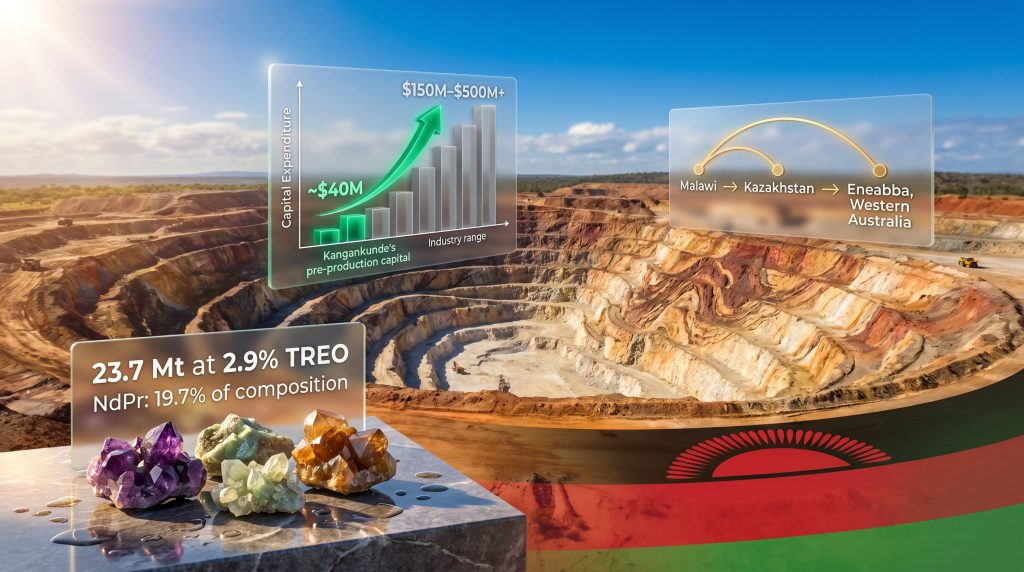
The pre-production capital requirement for Stage 1 stands at approximately $40 million, a figure that is striking when placed in context of its peer group. Rare earth development projects at comparable stages of maturity have routinely required between $150 million and $500 million or more in pre-production capital, often before generating a single tonne of saleable product.
Stage 2 expansion has been structured to be funded entirely from Stage 1 operating cash flows, theoretically eliminating the need for further equity raises to achieve full production capacity. This self-funding expansion model is relatively uncommon in the critical minerals development sector.
Capital Efficiency Comparison: Kangankunde Versus Peers
| Metric | Kangankunde Stage 1 | Typical Rare Earth Peer |
|---|---|---|
| Pre-production capex | ~$40 million | $150M to $500M+ |
| Operating cost | ~$292/kg TREO | $400 to $800+/kg TREO |
| Cost quartile position | Lowest global quartile | Mid-to-upper quartile |
| Waste-to-ore strip ratio | 0.2:1 | 1:1 to 4:1 |
| Stage 1 mine life | 45 years | 15 to 25 years |
The operating cost figure of approximately $292 per kilogram of total rare earth oxide (TREO) places Kangankunde in the lowest cost quartile globally among rare earth development projects. In an environment where NdPr prices can be volatile, lowest-quartile cost positioning provides a margin of resilience that higher-cost peers simply do not have.
The Minerals That Matter: Understanding Kangankunde's Critical Element Profile
Why NdPr Fraction Determines Commercial Value
A common misconception in rare earth investing is that total TREO tonnage is the primary value metric. In practice, the commercial value of a rare earth deposit is determined almost entirely by the proportion of magnet-relevant elements within the total rare earth oxide mix. Furthermore, the critical minerals demand surge driven by electrification makes this distinction more commercially significant than ever.
The four elements driving demand in the current technology cycle are:
- Neodymium (Nd) and Praseodymium (Pr): The foundational inputs for neodymium-iron-boron (NdFeB) permanent magnets, which are used in the traction motors of electric vehicles and the generators of wind turbines. NdFeB magnets are the strongest permanent magnets known to exist and cannot currently be replaced in these applications without significant performance loss.
- Dysprosium (Dy) and Terbium (Tb): Heavy rare earth elements added to NdFeB magnets to maintain magnetic performance at elevated operating temperatures. Without dysprosium and terbium additions, NdFeB magnets begin to demagnetise in the heat generated by EV motors during normal operation. These elements are significantly scarcer and command substantially higher prices than NdPr.
Kangankunde contains 679,000 tonnes of contained NdPr within its probable reserve base, representing 19.7 percent of total rare earth oxide composition. This NdPr fraction is commercially meaningful, and the presence of dysprosium and terbium within the deposit adds further value density that is not always captured in headline tonnage figures.
Not all rare earth deposits are commercially equivalent. A project with 10 million tonnes grading at 5% TREO but containing mostly cerium and lanthanum, which are in chronic oversupply globally, can be worth far less than a smaller deposit with a high NdPr fraction. Kangankunde's mineralogy has been shaped by its carbonatite host geology in ways that favour the magnet-relevant element suite.
Scale, Reserves, and the Exploration Upside Case
What the Reserve Base Actually Tells Us
The Kangankunde probable reserve stands at 23.7 million tonnes grading 2.9% TREO, supporting a Stage 1 mine life of 45 years at planned production rates. For context, most operating rare earth mines globally have mine lives in the 15 to 25-year range, meaning Kangankunde's reserve base already exceeds the operational lifespan of most of its producing peers.
The exploration upside case extends significantly beyond the current reserve:
| Category | Tonnage | Grade (TREO) | Contained NdPr |
|---|---|---|---|
| Probable Reserves | 23.7 Mt | 2.9% | 679,000 t |
| Exploration Target (upside) | Up to 261 Mt | ~2.2% | Up to 1.2 Mt |
If the exploration target at the upper end of the range is confirmed and a Stage 2 expansion proceeds as planned, total mine life could theoretically extend beyond 200 years. This figure should be treated with appropriate caution, as exploration targets carry inherent uncertainty and are not equivalent to measured or indicated resources under standard geological reporting codes. However, even a partial confirmation of the exploration target would represent a material increase in project value.
Production Architecture: How Kangankunde Will Process and Sell Its Output
Stage 1 Processing: Simplicity as a Competitive Advantage
Annual concentrate production in Stage 1 is targeted at approximately 15,300 tonnes per year of high-grade concentrate grading 55% TREO. The processing methodology employs gravity and magnetic separation through a crushing and grinding circuit, deliberately avoiding the hydrometallurgical chemical treatment steps that add cost, complexity, and environmental risk to many competing projects.
The rare earth processing challenges faced by many comparable operations are therefore largely sidestepped by Kangankunde's processing approach. This has two important downstream consequences. First, the resulting concentrate retains its non-radioactive classification, enabling standard international shipping logistics. Second, the concentrate is suitable for acceptance by third-party processing facilities, which underpins Kangankunde's dual processing pathway strategy.
Dual Processing Pathways: Kazakhstan and Eneabba
Kangankunde has secured two distinct routes to market, addressing the processing bottleneck that has constrained comparable projects:
- Pre-Eneabba pathway (near-term): Lindian Resources acquired a controlling stake in a processing facility in Kazakhstan earlier in 2025. This facility will convert Kangankunde concentrate into mixed rare earth carbonate, a higher-value intermediate product that commands a price premium over raw concentrate and can be sold into a broader range of downstream refinery and separation facilities globally.
- Long-term Eneabba pathway: A 15-year supply agreement signed in 2025 commits Kangankunde to delivering approximately 6,000 tonnes of rare earth concentrate annually to Iluka Resources' Eneabba refinery in Western Australia. This volume represents roughly 10 percent of Eneabba's total expected feedstock requirements at full operational capacity.
Kangankunde Development Timeline
| Milestone | Target Date |
|---|---|
| Stage 2 feasibility study initiated | 2024 |
| Construction commencement | Early 2026 |
| First concentrate production | Q4 2026 |
| Eneabba refinery commissioning | 2027 |
| Stage 2 expansion (cash-flow funded) | Post-2026 |
According to recent construction updates, full operational output across both stages is targeted at approximately 20,000 tonnes of concentrate annually, a scale that would position Kangankunde among the largest rare earth producing operations on the African continent.
The next major ASX story will hit our subscribers first
The Eneabba Refinery: Why This Australian Facility Changes Kangankunde's Risk Profile
What Makes Eneabba Strategically Significant
Iluka Resources' Eneabba rare earths refinery in Western Australia is designed to become Australia's first fully integrated facility capable of producing separated light and heavy rare earth oxides. Once operational, it will be one of the very few processing facilities outside China designed to accept feedstock from multiple third-party mines simultaneously, rather than processing only ore from a single captive deposit.
Export Finance Australia confirmed access to the full A$1.65 billion (approximately $1.15 billion) loan facility for the Eneabba project. The refinery is reported as more than 50 percent complete, with commissioning targeted for 2027. The confirmation of full financing removes what was previously a meaningful risk in Kangankunde's downstream market access story.
For Kangankunde specifically, the Eneabba arrangement delivers several risk-reduction outcomes simultaneously:
- A contracted buyer for a defined volume of concentrate over a 15-year term
- Access to a facility capable of producing separated oxides, which command significantly higher prices than unseparated mixed rare earth products
- Alignment with a processing hub that has attracted an end-user binding offtake agreement from an undisclosed global automotive manufacturer
The Automotive Offtake Signal and What It Means for Kangankunde
Iluka disclosed a binding agreement to supply magnet rare earth oxides to a major global automotive company. The four-year agreement is expected to represent approximately 10 percent of Eneabba's planned production during the contract period and generate revenue of between $155 million and $172 million, depending on prevailing market prices.
The significance of this development for Kangankunde is indirect but real. It demonstrates that the end-user demand for ex-China separated rare earth oxides is not hypothetical; it is contracted. For a project whose long-term revenue model depends on Eneabba's commercial success, this automotive agreement validates a critical assumption in the investment case.
Securing both a processing pathway and evidence of downstream end-user demand before a mine begins production is an uncommon combination in critical minerals project development. Most projects at comparable stages are still searching for one or the other.
Malawi's Position Within Africa's Critical Minerals Architecture
From Peripheral Producer to Strategic Supplier
Africa's rare earth sector has historically been viewed through the lens of prospectivity rather than production. The continent hosts significant geological endowment across multiple jurisdictions, but the gap between exploration-stage resource announcements and actual producing mines has been wide and persistent. In addition, the broader context of energy transition mining is accelerating Western appetite for African-sourced critical mineral supply.
Kangankunde's trajectory suggests Malawi is approaching a genuine inflection point. The Malawi Kangankunde rare earth project is expected to become Africa's next producing rare earth mine, joining a short list of producing operations that currently includes South Africa and the Democratic Republic of Congo as the continent's most significant rare earth contributors.
Several structural factors support Africa's growing role in Western-aligned critical mineral supply chains:
- Geological endowment across multiple jurisdictions, with carbonatite provinces in particular offering high-grade, processing-friendly mineralisation
- Growing interest from institutional investors in Africa-sourced critical mineral exposure as part of energy transition portfolio construction
- Increasing engagement from Western governments in African critical mineral sourcing as a component of supply chain diversification strategies
- A regulatory trend in several African jurisdictions toward formalising mining codes in ways that provide clearer frameworks for foreign capital deployment
Furthermore, African mining finance trends in 2025 suggest that capital is increasingly willing to deploy into well-structured projects with clear permitting and downstream offtake in place. Malawi specifically offers a relatively accessible regulatory environment for mining investment, and Kangankunde's fully permitted status reflects years of engagement with the Malawian permitting system.
Frequently Asked Questions: Malawi Kangankunde Rare Earth Project
When will Kangankunde begin production?
First concentrate production is targeted for Q4 2026, following construction commencement in early 2026. The project holds full permitting and confirmed Stage 1 financing.
Who owns the Kangankunde rare earth project?
Australian mining company Lindian Resources holds 100 percent ownership of the Kangankunde project in Malawi.
What rare earth elements does Kangankunde produce?
The primary value minerals are neodymium, praseodymium, dysprosium, and terbium, all of which are critical inputs for permanent magnet manufacturing used in electric vehicles and wind turbines.
How large is the Kangankunde deposit?
Probable reserves stand at 23.7 million tonnes grading 2.9% TREO. Exploration targets indicate potential resources of up to 261 million tonnes, supporting a Stage 1 mine life of 45 years.
How will Kangankunde's output be processed?
In the near term, concentrate will be processed through a Lindian-controlled facility in Kazakhstan into mixed rare earth carbonate. From 2027, output will be supplied under a 15-year agreement to Iluka Resources' Eneabba refinery in Western Australia.
What makes Kangankunde cost-competitive?
Operating costs of approximately $292 per kilogram of TREO, combined with a waste-to-ore strip ratio of just 0.2:1, place Kangankunde in the lowest cost quartile globally among rare earth development projects.
Key Takeaways: Why Kangankunde Stands Apart in the Global Rare Earth Development Pipeline
- Fully funded and fully permitted, with first production targeted for Q4 2026
- Lowest-quartile operating cost structure at approximately $292/kg TREO, providing resilience across rare earth price cycles
- Dual processing pathway secured, combining near-term Kazakhstan intermediate processing with a long-term 15-year Eneabba refinery offtake agreement
- High NdPr fraction of 19.7% aligns the deposit's value profile directly with the fastest-growing segment of rare earth demand
- 45-year Stage 1 mine life based on probable reserves alone, with exploration upside potentially extending beyond 200 years
- Non-radioactive concentrate classification removes a layer of regulatory and logistical complexity that constrains several competing projects
- Downstream demand validated through Iluka's binding automotive offtake agreement, confirming real end-user appetite for ex-China separated rare earth oxides
This article is intended for informational purposes only and does not constitute financial advice. Exploration targets referenced herein are conceptual in nature and carry inherent geological uncertainty. Investors should conduct independent due diligence and consult a licensed financial adviser before making any investment decisions related to mining or critical minerals companies. Forward-looking statements involve assumptions and risks that may cause actual outcomes to differ materially from those described.
Readers seeking additional context on the global rare earth supply chain and Africa's growing role in critical mineral markets can explore related coverage via Business Insider Africa's markets section at africa.businessinsider.com.
Want to Catch the Next Major Mineral Discovery Before the Market Does?
Discovery Alert's proprietary Discovery IQ model scans ASX announcements in real time, instantly identifying high-potential mineral discoveries across rare earths and more than 30 other commodities — converting complex data into clear, actionable investment insights for both short-term traders and long-term investors. Explore how historic discoveries have delivered exceptional returns on Discovery Alert's dedicated discoveries page, and begin your 14-day free trial today to position yourself ahead of the broader market.