June 23, 2026
The Geological Advantage That Most Rare Earth Investors Overlook
Most discussions about the rare earth supply crisis begin and end with China's dominance over processing capacity. What receives far less attention is why certain deposits outside China are structurally better positioned to close that gap than others, and how the underlying geology of a project determines whether it can realistically compete on cost, timeline, and environmental footprint.
Ionic adsorption clay deposits represent a geological category that most Western investors and policymakers have only recently begun to understand. Unlike the carbonatite and monazite-bearing hard-rock formations that define projects such as Lynas's Mount Weld or MP Materials' Mountain Pass, IAC deposits hold rare earth ions loosely attached to clay mineral surfaces rather than locked inside crystalline rock structures. The practical consequence of this distinction is profound.
Extraction requires simple leaching with dilute ammonium sulfate or magnesium sulfate solutions at atmospheric pressure, eliminating the need for high-temperature roasting, acid baking, or the complex cracking circuits that add years and hundreds of millions of dollars to hard-rock project development timelines. Understanding these rare earth processing challenges is essential for evaluating which projects can realistically compete on cost and timeline.
China's Jiangxi province built its rare earth processing dominance largely on the back of IAC deposits. That geological advantage, replicated elsewhere, has the potential to fundamentally alter Western supply chain economics. The Viridis rare earth project in Brazil's Minas Gerais state, known as the Colossus project, is the most significant IAC discovery outside China ever identified, and the scale of what has been delineated over recent years is reshaping how European and Australian institutions think about rare earth supply security.
When big ASX news breaks, our subscribers know first
What the Numbers Actually Mean for Western Supply Chains
The reserve and resource figures associated with Colossus are substantial enough to warrant careful examination rather than simple repetition.
| Attribute | Detail |
|---|---|
| Project Name | Colossus Rare Earth Project |
| Developer | Viridis Mining and Minerals |
| Location | Poços de Caldas Alkaline Complex, Minas Gerais, Brazil |
| Licence Area | 228.6 km² |
| Deposit Type | Ionic Adsorption Clay (IAC) |
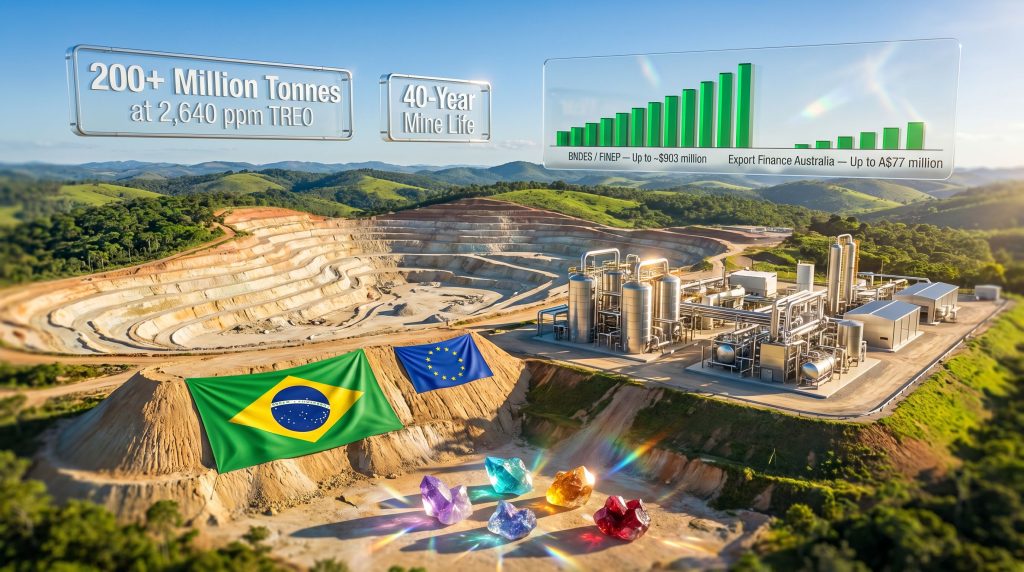
| Reserve Estimate | 200+ million tonnes at 2,640 ppm TREO |
| Contained TREO | ~529,000 tonnes |
| Magnetic REO Grade | 601–740 ppm (NdPr, Dy, Tb) |
| Mine Life | 40 years |
| Mining Method | Shallow open-pit, free-dig |
The reserve figure of more than 200 million tonnes at 2,640 ppm total rare earth oxide (TREO) represents a significant upgrade from an earlier resource base of 98.5 million tonnes that had already supported a 20-year mine life projection. The expansion in scale reflects continued exploration success across the 228.6 km² licence area within the Poços de Caldas alkaline complex, a well-characterised geological setting with existing regional infrastructure and an established mining history in Brazil.
The number that carries the most strategic weight, however, is the magnetic REO (MREO) grade of 601 to 740 ppm, covering neodymium, praseodymium, dysprosium, and terbium. These four elements are the functional inputs for neodymium-iron-boron (NdFeB) permanent magnets, the technology that drives electric vehicle traction motors, direct-drive offshore wind turbine generators, and a wide range of defence and aerospace applications. They are also the rare earth elements facing the most acute supply shortfalls in Western markets through 2030.
The urgency in Western rare earth policy is not simply about mining tonnage. It is about refined magnetic oxides reaching manufacturers with verified, non-Chinese provenance. Any deposit that cannot credibly deliver separated, high-purity MREOs at commercial scale remains strategically incomplete, regardless of its resource size.
Why IAC Processing Changes the Development Equation
For investors and analysts accustomed to evaluating hard-rock rare earth projects, the IAC processing pathway requires a mental model adjustment. The key differences are not marginal — they are structural.
Hard-rock vs. IAC processing comparison:
-
Hard-rock carbonatite deposits require crushing, grinding, flotation concentration, and typically a roasting or acid-baking stage before rare earth separation can begin, generating significant radioactive thorium and uranium by-products that require licensed management
-
Monazite-bearing mineral sand projects face similar radioactive by-product challenges and typically require specialist cracking facilities that only a handful of operators globally have constructed
-
IAC deposits bypass the energy-intensive cracking stage entirely; leachate solutions containing dissolved rare earth ions are processed through solvent extraction circuits to produce mixed or separated rare earth carbonates or oxides
-
The lower radioactive by-product burden of IAC operations simplifies environmental permitting and community engagement, a factor that has delayed or derailed multiple hard-rock rare earth projects in Western jurisdictions
-
Capital expenditure profiles for IAC projects are generally lower than equivalent-scale hard-rock alternatives, and the shallower, free-dig open-pit geometry reduces mining operating costs significantly
The atmospheric-pressure processing advantage is not unlimited, however. Scaling IAC leaching circuits from pilot to commercial throughput introduces engineering execution risk, particularly in optimising leach solution recovery and managing clay waste streams at large volumes. This is a genuine technical challenge that project teams must address during detailed engineering phases.
The EU Commissioner's Visit and What It Actually Signals
On 20 June 2026, EU Commissioner for International Partnerships Jozef Síkela led a delegation to the Colossus project site in Brazil, meeting with Viridis director general Rafael Moreno. Understanding what this type of engagement means in the context of EU critical minerals diplomacy requires some unpacking.
The European Union has been systematically building bilateral resource partnerships with strategic material-rich nations as part of its response to the supply chain vulnerabilities exposed during the post-pandemic period and subsequently amplified by geopolitical tensions. Latin America has emerged as a priority engagement zone, given its reserves of lithium, nickel, copper, and rare earths. Furthermore, Europe's critical minerals supply chain strategy has increasingly positioned Latin American projects as a cornerstone of long-term supply security.
The EU's Critical Raw Materials Act, which came into force in 2024, establishes binding benchmarks for supply chain diversification:
-
10% of annual EU consumption of strategic raw materials must come from domestic extraction by 2030
-
40% of annual consumption must be processed domestically by 2030
-
No single third country should supply more than 65% of the EU's annual consumption of any strategic raw material
-
Rare earths are explicitly listed among the strategic raw materials subject to these targets
What Does a Commissioner-Level Visit Actually Mean?
The visit to Colossus by a Commissioner-level official indicates that the project has moved beyond early-stage introductory discussions into a phase of substantive validation. High-level site visits of this nature typically precede formal engagement frameworks, which may include offtake discussions, concessional financing consideration, or structured partnership agreements.
It would be speculative to characterise the visit as a commitment to any specific support arrangement, but within the architecture of EU critical minerals diplomacy — and the broader context of European critical raw materials policy — it represents a meaningful signal of institutional seriousness.
Brazil's geographic position in the Atlantic Basin provides logistical advantages for European supply chains that Pacific-oriented producers such as Australia's Lynas cannot replicate with equivalent efficiency. Transit times and freight economics matter when competing against subsidised Chinese supply.
How the Financing Architecture Has Been Constructed
The capital structure assembled around the Colossus project reflects a deliberate strategy of layering multiple financing sources with differing strategic motivations, reducing dependence on any single capital provider while building a coalition of institutional backing that reinforces the project's credibility.
| Financing Source | Type | Amount |
|---|---|---|
| ORE & Régia Capital (Brazil) | Equity | ~R$30 million |
| BNDES / FINEP (Brazil) | Government debt/grant pool | Up to ~US$903 million |
| Export Finance Australia | Debt (Letter of Support) | Up to A$77 million |
Brazilian domestic capital from investors ORE and Régia Capital anchors local financial participation, an important credential for navigating Brazil's regulatory and political environment. Local equity participation signals that sophisticated Brazilian institutional investors have conducted their own due diligence and concluded the project is commercially viable.
BNDES and FINEP are Brazil's national development bank and innovation financing agency respectively. Their identification of Colossus as eligible for inclusion within a strategic minerals funding pool of up to approximately US$903 million represents one of the largest pools of development-stage project finance available for critical minerals in Latin America. It is important to note that selection for eligibility is not equivalent to a formal funding commitment, and the path from eligibility to drawn debt involves extensive due diligence, project milestones, and formal approval processes.
Export Finance Australia's Letter of Support for up to A$77 million in debt financing is notable because it reflects Australian government-backed export finance institutions' view that diversifying rare earth supply chains beyond China is a national strategic interest. Australia has been among the most active Western nations in deploying export finance tools to support critical mineral project development in allied jurisdictions.
The Final Investment Decision is targeted for the second half of 2026, with first production scheduled for 2028, contingent on completion of the Installation Licence process and formal financing commitments.
The Viridion Joint Venture: Capturing Refining Value in Brazil
One of the most strategically significant but least-discussed aspects of the Colossus project is the Viridion joint venture, a 50/50 partnership between Viridis Mining and Minerals and Ionic Rare Earths. Viridion holds exclusive rights outside Asia and Uganda to refine individual rare earth oxides and manage recycling technology, representing a substantial geographic scope for commercial operations.
The importance of this arrangement cannot be overstated within the context of Western rare earth supply chain priorities. The critical weakness in non-Chinese rare earth supply chains has historically been the gap between mining and separated oxide production. Most projects outside China that have reached production ship mixed rare earth carbonates or concentrates to third-party processors, frequently in China, for final separation and refinement. This creates a structural dependency that undermines the strategic value of non-Chinese mining.
Viridion's mandate to conduct refining within Brazil eliminates that dependency for Colossus output. Western buyers, particularly European automotive original equipment manufacturers and US defence procurement agencies, are under increasing regulatory and commercial pressure to demonstrate that their rare earth supply chains are transparent, traceable, and free from Chinese processing involvement at any stage. A project that delivers separated, high-purity individual rare earth oxides directly from a Brazilian facility represents a fundamentally different value proposition than one delivering mixed concentrate for offshore processing.
The next major ASX story will hit our subscribers first
Competitive Positioning Against Peer Projects
Colossus does not exist in a vacuum. Several other non-Chinese rare earth projects are progressing toward production, and understanding where Colossus sits in that competitive landscape matters for evaluating its strategic significance.
| Project | Country | Deposit Type | Reserve Scale | Production Status | Key Differentiator |
|---|---|---|---|---|---|
| Colossus (Viridis) | Brazil | IAC | 200M+ tonnes | Target 2028 | Largest undeveloped IAC outside China |
| MP Materials Mountain Pass | USA | Carbonatite | ~1.8B tonnes ore | Operating | Only US producer; lower HREE grade |
| Lynas Mt Weld | Australia | Carbonatite | ~55M tonnes | Operating | World's largest ex-China REE producer |
| Iluka Eneabba | Australia | Monazite | Not disclosed | Target ~2026 | First integrated refinery outside China |
| Pensana Longonjo | Angola | Carbonatite | ~1.2B tonnes | Development | High NdPr grades |
Colossus's IAC geology provides a processing cost structure that carbonatite and monazite-based peers cannot match. The 40-year mine life and approximately 529,000 tonnes of contained TREO represent a resource endowment that exceeds most non-Chinese projects currently in development. The deliberate exclusion of Chinese buyers from Colossus's offtake strategy is also a commercial differentiator, as Western buyers increasingly recognise the premium value of rare earth oxides with verified non-Chinese provenance.
Permitting Progress and Regulatory Context
Colossus received its Preliminary Licence in late 2025, clearing the first major environmental and regulatory hurdle within Brazil's mining permitting framework administered by the Agência Nacional de Mineração (ANM). The Installation Licence application has been submitted, representing the critical approval that authorises physical construction to begin.
Brazil's regulatory environment for large-scale mining in Minas Gerais state is mature and well-established, with the state having hosted major iron ore, bauxite, and other mineral operations for decades. The rare earths sector in Brazil has also benefited from updated regulatory frameworks that reflect the national government's designation of rare earths as strategic minerals, creating a more supportive administrative context for project development.
Key permitting milestones and development timeline:
-
Preliminary Licence approved, late 2025
-
Installation Licence application submitted, currently under review
-
Final Investment Decision targeted for H2 2026
-
Construction commencement subject to FID and licence approval
-
First production targeted for 2028
Demand Fundamentals: Where the Output Goes
The four magnetic rare earth oxides that Colossus is designed to produce align precisely with the materials facing the most acute demand growth and supply shortfalls in Western markets. Consequently, the broader outlook for critical minerals demand through 2030 underpins much of the commercial rationale for projects of this scale.
-
Neodymium and praseodymium (NdPr): The primary functional input for NdFeB permanent magnets; demand is driven by electric vehicle traction motors, with global EV penetration continuing to accelerate toward and beyond 2030 targets
-
Dysprosium (Dy): A heavy rare earth element used in small quantities to enhance NdFeB magnet performance at elevated temperatures, critical for automotive and industrial motor applications; supply is disproportionately concentrated in China's Jiangxi IAC deposits, making non-Chinese sources particularly scarce
-
Terbium (Tb): Used alongside dysprosium for high-temperature magnet performance enhancement; even smaller global supply than dysprosium, with extreme concentration in Chinese sources
-
Wind energy: Direct-drive offshore turbines use large NdFeB permanent magnet generators; European offshore wind expansion programs represent a major sustained demand vector with long contract horizons suitable for large-scale offtake agreements
-
Defence and aerospace: Guided munitions, radar systems, electric aircraft motors, and naval propulsion systems all rely on high-performance rare earth magnets; defence procurement frameworks in the US and Europe increasingly mandate documented supply chain origin
Risk Factors That Investors Must Weigh
A project of Colossus's scale and strategic positioning carries genuine risks that merit direct acknowledgment. Prospective investors should treat forecasts, timelines, and financial projections as indicative rather than guaranteed outcomes.
Primary risk categories:
-
Permitting timeline risk: Brazil's Installation Licence process involves multiple environmental assessment and community consultation stages; delays in large-scale mining permitting are common across all jurisdictions, including Brazil
-
Financing close risk: Letters of Support and program eligibility designations are not formal debt commitments; completing the capital stack to reach FID requires sustained execution across multiple parallel workstreams
-
Rare earth price volatility: NdPr oxide prices have experienced cycles of significant volatility; project economics must be stress-tested across a realistic range of price scenarios, not just current spot or recent peak levels
-
Engineering execution risk: Scaling IAC atmospheric leaching circuits from pilot demonstration to commercial throughput is technically achievable but introduces engineering unknowns that typically manifest during detailed design and early construction phases
-
Policy dependency risk: The project's premium value proposition is partly contingent on Western governments maintaining trade and procurement policies that favour non-Chinese rare earth sourcing; policy environments can shift with changes in government or diplomatic priorities
The same structural forces creating commercial opportunity for Colossus — including US-China trade tensions, EU supply chain legislation, and defence procurement mandates — are simultaneously contingent variables that investors should treat as opportunities with duration risk rather than permanent structural guarantees.
Brazil's Emergence as a Rare Earth Jurisdiction of Global Consequence
The broader significance of the Viridis rare earth project in Brazil extends beyond the specific metrics of any single project. Brazil's geological endowment in rare earths has been systematically underexplored relative to its potential, partly because low commodity prices through much of the 2010s suppressed exploration investment globally, and partly because Brazil's regulatory environment for rare earth projects was less developed than its iron ore and bauxite frameworks.
That context has shifted materially. Brazil holds significant IAC rare earth potential beyond the Poços de Caldas alkaline complex, and the development of Colossus as a flagship project creates infrastructure, expertise, and regulatory precedent that could catalyse broader sector development. For Western governments and industrial consumers seeking to build geographically diversified supply chains, Brazil's Atlantic Basin location, existing port infrastructure, and established trade relationships with both the EU and the United States position it as a rare earth jurisdiction of growing strategic importance.
The EU Commissioner's June 2026 visit to Colossus, viewed through this lens, represents not just engagement with a single project but the beginning of a bilateral rare earth relationship between the European Union and Brazil that could deepen significantly as the Viridis rare earth project in Brazil advances toward production. Whether that relationship translates into formal offtake frameworks, concessional financing arrangements, or broader strategic partnerships will depend on how the project progresses through permitting and financing milestones over the next 12 to 24 months.
The infrastructure of a post-Chinese rare earth order is being constructed incrementally, one project, one partnership, and one regulatory approval at a time. Colossus is among the most consequential bricks in that structure.
This article contains forward-looking statements and projections regarding project timelines, financing outcomes, production targets, and market conditions. These are subject to material risks and uncertainties. Readers should not rely on forward-looking statements as predictions of future outcomes. This article does not constitute financial advice.
Want to Stay Ahead of Significant ASX Mineral Discoveries as They Happen?
Discovery Alert's proprietary Discovery IQ model delivers real-time alerts on major ASX mineral discoveries — instantly translating complex geological and commodity data into actionable investment insights for both short-term traders and long-term investors. Explore historic examples of exceptional discovery returns and begin your 14-day free trial at Discovery Alert to position yourself ahead of the broader market.