June 23, 2026
The Gallium Problem Nobody Wanted to Talk About
For decades, gallium barely registered as a mineral worth tracking. It appeared in no major commodity indices, attracted no speculative fever, and featured in almost no mainstream investment commentary. It was simply a quiet byproduct of aluminium refining, skimmed off as a trace residue from bauxite processing and mostly forgotten by markets focused on copper, gold, and lithium.
Then China imposed export restrictions on it, and everything changed.
The sudden weaponisation of gallium supply exposed a structural vulnerability that Western governments had long ignored: their entire semiconductor, defence electronics, and 5G telecommunications infrastructure rested on a mineral for which they had no meaningful domestic production and almost no allied-nation alternatives. The search for primary gallium resources outside of Chinese-controlled supply chains moved from academic discussion to active policy priority almost overnight.
It is within this context that the NeoTerra Mozambique critical minerals project has attracted growing attention from investors and policymakers alike.
When big ASX news breaks, our subscribers know first
From Single-Commodity Explorer to Diversified Critical Minerals Developer
NeoTerra Group PLC, formerly known as Altona Rare Earths and listed on the London Stock Exchange, recently completed a corporate rebrand that carries more strategic weight than a simple name change might suggest.
In the junior mining sector, rebranding is often dismissed as cosmetic. In this case, it reflects a genuine shift in mandate. The company has moved beyond the narrow framing of rare earth element exploration to pursue a diversified portfolio of critical raw materials across multiple African jurisdictions. The new name signals an expanded addressable market that now encompasses gallium, fluorspar, and copper alongside the rare earth elements that originally defined its identity.
The timing is not coincidental. Western governments have accelerated efforts to build alternative mineral supply chains, and companies capable of offering exposure to multiple strategically sensitive materials simultaneously occupy a structurally different position than single-commodity peers. Furthermore, the critical minerals demand surge underway globally has intensified competition for projects with multi-commodity potential.
The rebrand from Altona Rare Earths to NeoTerra Group PLC reflects a broadened mineral mandate, moving beyond rare earth elements to encompass gallium, fluorspar, and copper across multiple African jurisdictions.
Monte Muambe: The Geological Case for Northwestern Mozambique
Why Location Shapes Everything at the Pre-Feasibility Stage
The flagship asset in NeoTerra's portfolio is the Monte Muambe project, situated in the northwestern region of Mozambique. The geological setting of northwestern Mozambique has drawn increasing interest in recent years, largely because the region sits within a broader tectonic framework associated with carbonatite-hosted mineralisation, the same geological environment responsible for some of the world's most significant rare earth and associated mineral deposits.
Carbonatites, igneous rocks with more than 50% carbonate minerals by composition, are the primary geological hosts for rare earth elements globally. What makes Monte Muambe particularly unusual is the co-occurrence within a single project footprint of not just rare earth elements, but also fluorspar and gallium — three minerals that rarely appear together in economically meaningful concentrations.
This co-occurrence matters for several interconnected reasons:
- It creates the potential for multi-revenue stream economics, where a single mining operation could generate income from three distinct commodity markets with different end users and pricing dynamics.
- It may allow shared infrastructure costs across the processing of multiple mineral types, improving project economics compared to single-mineral operations.
- It positions the project as a potential supplier to a broader range of off-take counterparties, from defence-focused gallium buyers to clean energy-oriented REE consumers.
What Minerals Has Monte Muambe Identified?
| Mineral | Strategic Application | Global Supply Context |
|---|---|---|
| Rare Earth Elements (REEs) | EV motors, wind turbines, defence magnets | Approximately 60% of global processing controlled by China |
| Fluorspar | Steel production, refrigerants, lithium-ion batteries | South Africa and Mexico dominate current supply |
| Gallium | Semiconductors, radar, 5G infrastructure, military electronics | China accounts for over 80% of global primary production |
Mozambique's broader resource base extends well beyond Monte Muambe. The country hosts significant graphite deposits, tantalum occurrences, titanium sands, and rare earth mineralisation across multiple geological terranes. This positions Mozambique as a multi-mineral frontier destination rather than a single-sector investment story, and helps explain why Western governments and major development finance institutions have begun paying closer attention to the country's resource sector. In addition, the Nacala Corridor's mineral supply chains are increasingly seen as a critical enabler for getting resources to export markets efficiently.
Infrastructure remains a material consideration for any development-stage project in landlocked northwestern Mozambique. Rail connections, road access, and port logistics all factor into project feasibility assessments, and investors should expect infrastructure scoping to feature prominently in upcoming technical study work.
Why Gallium Is Now a Geopolitical Asset, Not Just a Mineral
The Chemistry That Made Gallium Indispensable
Gallium's strategic importance derives from its behaviour in compound semiconductor applications. When combined with arsenic to form gallium arsenide (GaAs), or with nitrogen to form gallium nitride (GaN), it produces materials with electronic properties that silicon simply cannot replicate at high frequencies, high temperatures, or high power densities.
These properties make gallium compounds irreplaceable in:
- Military radar and electronic warfare systems, where GaN-based amplifiers enable the power and frequency performance required for modern phased-array radar.
- 5G base station infrastructure, where GaN power amplifiers handle the high-frequency signals that define next-generation telecommunications.
- Satellite communications and aerospace electronics, where performance reliability under thermal stress is non-negotiable.
- High-brightness LEDs and laser diodes, foundational components in optical communications and consumer electronics.
- Electric vehicle power electronics, where GaN is increasingly displacing silicon in high-efficiency inverter designs.
There is no commercially viable substitute for gallium in these compound semiconductor applications. This is precisely what gives China's export restriction policy its strategic leverage. Consequently, gallium critical mineral deposits have moved to the forefront of Western resource policy discussions.
The Byproduct Problem and Why Primary Deposits Are Structurally Rare
One of the least widely understood facts about gallium is that it is almost never mined as a primary product. Global gallium supply is almost entirely dependent on the recovery of trace gallium concentrations from bauxite ore during aluminium refining. This means gallium production is essentially a hostage to aluminium production economics, with no independent supply response mechanism when demand spikes or geopolitical shocks disrupt access.
In most countries, gallium is not mined directly. It is a byproduct of aluminium refining, which means global supply has no independent production mechanism capable of responding to demand shocks or geopolitical disruptions. Projects hosting gallium as a primary mineral resource represent a fundamentally different supply pathway.
Monte Muambe's classification as one of the world's few known primary gallium resources elevates its strategic profile considerably. A primary gallium deposit is one where gallium occurs in concentrations sufficient to be economically extracted as the principal product, rather than as an incidental recovery from another process. This distinction is critical for Western governments seeking supply chain independence, because it means gallium production from such a project would not be contingent on aluminium market dynamics or linked to Chinese aluminium refining capacity.
The $1.875 Million USTDA Grant: What It Means and What It Does Not
Breaking Down the U.S. Government's Technical Commitment
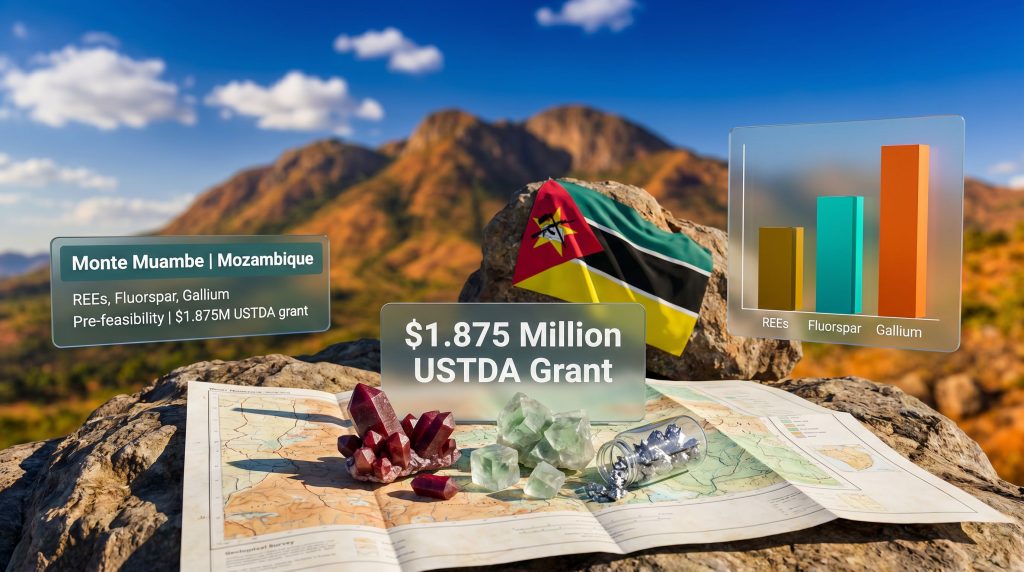
The U.S. Trade and Development Agency awarded $1.875 million to support technical and economic studies at Monte Muambe. Understanding what this grant actually funds, and what it does not, is essential for investors trying to assess its significance accurately.
USTDA grants at this stage of project development typically cover:
- Technical feasibility assessments evaluating metallurgical recovery processes, resource estimation, and extraction methodology.
- Environmental and social impact assessment (ESIA) scoping work required for permitting progress.
- Economic modelling to assess project viability under various commodity price and capital cost scenarios.
- Infrastructure scoping studies examining power, water, transport, and logistics requirements.
What the grant does not represent is a commitment to fund project construction, a guarantee of commercial viability, or an endorsement of any specific production timeline. USTDA grants are instruments of technical de-risking and strategic signalling, not project finance.
That said, the signalling dimension should not be underestimated. When the U.S. government directs a targeted technical grant toward a specific mineral project, it communicates Washington's assessment of that project's strategic relevance to national mineral security objectives. This can meaningfully lower the perceived risk threshold for private capital, development finance institutions, and potential off-take partners evaluating the same project. The USTDA's partnership in Mozambique to diversify rare earth supply chains further underscores this strategic intent.
The Broader Western Policy Context
The European Union's Critical Raw Materials Act (CRMA) establishes benchmarks requiring that, by 2030, at least 10% of the EU's annual consumption of strategic raw materials should be sourced from domestic extraction, 40% from domestic processing, and 15% from recycled materials. Both gallium and rare earth elements appear on the CRMA's list of strategic raw materials. African-hosted projects with European off-take potential benefit from this regulatory framework as a demand-side tailwind, though framework existence does not translate directly into project-specific support or procurement commitments.
The United Kingdom's own critical minerals strategy similarly identifies gallium and REEs as priority materials, providing a policy backdrop relevant to a London Stock Exchange-listed developer operating in African jurisdictions.
Stage-Gate Reality: The Path From Monte Muambe to Commercial Production
The development lifecycle of a mining project is long, capital-intensive, and subject to compounding uncertainties at every stage. Investors in the NeoTerra Mozambique critical minerals project should understand where Monte Muambe currently sits within this progression.
| Development Stage | Key Activities | Typical Timeline |
|---|---|---|
| Exploration | Geological mapping, sampling, initial drilling | Completed (ongoing resource definition) |
| Resource Definition | Mineral resource estimate under JORC/NI 43-101 | In progress |
| Scoping Study | High-level economic assessment, order-of-magnitude costs | Pre-feasibility stage |
| Pre-Feasibility Study (PFS) | Detailed engineering, environmental baseline | USTDA funding supports this phase |
| Definitive Feasibility Study (DFS) | Bankable study, final capital cost estimate | Post-PFS, multiple years ahead |
| Project Financing | Debt, equity, DFI lending, off-take backed finance | Post-DFS |
| Construction | Civil works, plant installation | Post-financing |
| Production | First commercial output | Years from current stage |
The capital requirements for a project of Monte Muambe's scale and mineral complexity are likely to reach into hundreds of millions of dollars at the definitive feasibility and construction stage. However, the $1.875 million USTDA grant covers a small but structurally important portion of the pre-feasibility study work required to advance toward bankability. A definitive feasibility study at this scale demands rigorous technical and economic preparation across multiple disciplines.
Key risks that investors should factor into any assessment include:
- Funding gaps: The distance between current grant funding and eventual project construction capital is substantial.
- Permitting timelines: Mozambique's regulatory environment, while improving, introduces execution uncertainty at the environmental and mining licence stages.
- Security considerations: Parts of northern Mozambique have experienced security challenges in recent years. Northwestern Mozambique, where Monte Muambe is located, sits in a different geographic zone, but regional perception risk remains a factor for some institutional investors.
- Commodity price volatility: Gallium and REE prices are thinly traded and subject to sharp movements driven by policy shifts, Chinese production decisions, and technology adoption cycles.
- Metallurgical complexity: Processing a multi-mineral deposit containing REEs, fluorspar, and gallium simultaneously requires tailored flowsheet design. Metallurgical testwork results will be a critical de-risking milestone.
The next major ASX story will hit our subscribers first
NeoTerra's Multi-Country Portfolio: The Sesana Project in Botswana
Beyond its Mozambique operations, NeoTerra holds the Sesana project in Botswana, providing exposure to copper and silver. Botswana occupies a distinct position among African mining jurisdictions: it maintains a stable regulatory environment, transparent mining code, and institutional governance structures that have historically supported long-term mineral investment.
Copper's role in the energy transition is well-established. Each electric vehicle requires significantly more copper than a conventional internal combustion vehicle, and grid infrastructure buildout for renewable energy generation requires large volumes of copper for cables, transformers, and switching equipment. Silver's dual industrial and precious metal characteristics provide additional portfolio diversification.
NeoTerra's African Asset Summary
| Project | Country | Key Minerals | Development Stage |
|---|---|---|---|
| Monte Muambe | Mozambique | REEs, Fluorspar, Gallium | Pre-feasibility (USTDA-funded studies) |
| Sesana | Botswana | Copper, Silver | Exploration stage |
Africa's Critical Minerals Race: The Competitive Landscape
How Different Powers Are Engaging With African Mineral Resources
The competition for African critical minerals has moved well beyond traditional bilateral aid frameworks. The U.S., EU, UK, and China are each deploying distinct instruments — including targeted technical grants, concessional lending, infrastructure investment, and strategic off-take agreements — to position themselves for preferred access to the continent's mineral wealth.
China's approach, built over two decades through infrastructure-for-resources arrangements and state-backed mining acquisitions, established a significant first-mover advantage. Western engagement has historically lagged but has accelerated sharply since 2022 as the technology trade conflict with China sharpened awareness of supply chain vulnerabilities. Furthermore, African mining finance trends indicate that Western-aligned capital is increasingly targeting the continent's underdeveloped critical mineral deposits.
African Jurisdictions: A Comparative Risk and Opportunity Matrix
| Country | Key Critical Minerals | Western Interest Level | Geopolitical Risk Profile |
|---|---|---|---|
| Mozambique | REEs, Graphite, Gallium, Fluorspar | High (U.S., EU, UK) | Moderate |
| DRC | Cobalt, Copper, Lithium | Very High | High |
| Zambia | Copper | High (U.S., EU) | Low to Moderate |
| Namibia | Uranium, REEs, Lithium | High | Low |
| Tanzania | Graphite, Nickel | Moderate | Low to Moderate |
| Zimbabwe | Lithium | Moderate | High |
| Botswana | Copper, Diamonds, Silver | Moderate to High | Low |
Mozambique's positioning within this landscape is more nuanced than a simple risk score captures. The country holds exposure to multiple minerals on Western critical materials lists simultaneously, which creates a different investment thesis than a single-commodity jurisdiction.
What the NeoTerra Rebrand Signals to Investors
Reading Corporate Strategy Through a Market Psychology Lens
In the junior mining sector, a corporate rebrand accompanied by a mandate expansion functions as a deliberate communication to capital markets. It signals that management believes the original corporate identity is too narrow to capture the full opportunity set the company is pursuing, and that it intends to compete for a broader pool of investor attention and institutional capital.
The shift from Altona Rare Earths to NeoTerra Group PLC follows a pattern seen across the sector as rare earth-focused developers have broadened their narratives to encompass the full spectrum of materials required for the energy transition and digital infrastructure build-out.
Investor Note: NeoTerra's projects remain in early development phases. The $1.875 million USTDA grant represents an indicator of strategic relevance, not a guarantee of commercial viability. Investors should conduct thorough assessment of full project lifecycle funding requirements and associated risks before drawing any conclusions about near-term value realisation.
Key factors that could drive value for investors over the medium term include:
- Positive metallurgical testwork results confirming economically viable recovery of gallium, REEs, and fluorspar from Monte Muambe ore.
- Completion and publication of a pre-feasibility study funded in part by the USTDA grant.
- Progress on off-take discussions with Western manufacturers or government-aligned procurement entities seeking gallium supply security.
- Additional government technical grant support from EU or UK institutions, which would further validate the project's strategic positioning.
Risk factors that warrant careful monitoring include the execution timeline through feasibility stages, the capital funding gap to construction, commodity price movements in thinly traded gallium and REE markets, and the evolving security and regulatory environment across Mozambique. In addition, bismuth export controls demonstrate how quickly supply disruptions in adjacent critical minerals can reshape the broader investment landscape.
Frequently Asked Questions About the NeoTerra Mozambique Critical Minerals Project
What is the NeoTerra Mozambique critical minerals project?
The NeoTerra Mozambique critical minerals project centres on the Monte Muambe project in northwestern Mozambique. Developed by NeoTerra Group PLC, a London Stock Exchange-listed company formerly known as Altona Rare Earths, it hosts rare earth elements, fluorspar, and what has been identified as one of the world's few known primary gallium resources.
What makes Monte Muambe strategically significant?
The combination of REEs, fluorspar, and primary gallium within a single project footprint is geologically unusual and strategically valuable. Gallium's classification as a primary resource rather than a byproduct differentiates Monte Muambe from the overwhelming majority of global gallium supply, which depends on Chinese aluminium refining byproduct recovery.
Has NeoTerra received government funding for Monte Muambe?
The U.S. Trade and Development Agency awarded $1.875 million to support technical and economic feasibility studies at Monte Muambe. This grant supports pre-feasibility study work and signals U.S. strategic interest in the project's mineral output. It does not constitute project construction financing or a guarantee of commercial viability.
Why is gallium so strategically important?
Gallium forms the basis of compound semiconductors, including gallium arsenide and gallium nitride, used across military radar, 5G telecommunications, satellite systems, and electric vehicle power electronics. China controls over 80% of global primary gallium production and has imposed export restrictions, creating urgent demand for Western-aligned alternative sources.
When could Monte Muambe reach production?
Commercial production at Monte Muambe remains multiple years away. The project must progress through pre-feasibility study completion, definitive feasibility study preparation, project financing, and construction before any production is possible. Each stage carries execution risk and capital requirement.
What other assets does NeoTerra hold?
NeoTerra's Sesana project in Botswana provides copper and silver exposure, complementing the REE and gallium focus of Monte Muambe with metals critical to power grid infrastructure and electric vehicle manufacturing.
Key Takeaways: Why Monte Muambe Matters Beyond the Headline Numbers
The NeoTerra Mozambique critical minerals project sits at the intersection of three powerful and converging forces: accelerating Western demand for energy transition minerals, an acute gallium supply crisis driven by Chinese export restrictions, and Africa's emergence as the most significant underdeveloped critical minerals frontier on earth.
Several dimensions of this story deserve to be underscored:
- Monte Muambe's status as a primary gallium deposit, rather than a byproduct recovery candidate, gives it a structural supply chain relevance that most competing projects cannot claim.
- The $1.875 million USTDA technical grant is modest in absolute terms but consequential as a marker of Washington's strategic intent. Government technical grants at this stage of the project lifecycle have historically preceded deeper engagement from development finance institutions and private capital.
- The co-occurrence of REEs, fluorspar, and gallium creates a multi-commodity optionality that single-element projects lack, providing potential resilience against individual commodity price cycles.
- The path to commercial production remains long and capital-intensive, with substantial execution risk at every stage. The strategic tailwinds are real, but they do not compress development timelines or eliminate funding risk.
For investors and policymakers tracking the evolution of Western critical mineral supply chain strategy, the NeoTerra Mozambique critical minerals project represents an early-stage but structurally distinctive node in a much larger global realignment story.
This article is intended for informational purposes only and does not constitute financial or investment advice. Investments in junior mining companies involve significant risk, including the potential loss of capital. Readers should conduct independent research and seek professional advice before making any investment decisions.
Want to Stay Ahead of the Next Major Critical Minerals Discovery?
Discovery Alert's proprietary Discovery IQ model scans ASX announcements in real time, delivering instant alerts on significant mineral discoveries — including critical minerals like gallium and rare earths — so subscribers can identify actionable opportunities before the broader market reacts. Explore historic discoveries and the returns they generated, then start your 14-day free trial at Discovery Alert to position yourself at the forefront of the critical minerals revolution.