June 23, 2026
India's Electronics Manufacturing Ambition Is Entering a New Phase
The global electronics supply chain is undergoing one of its most significant structural shifts in decades. Geopolitical pressure, pandemic-era disruptions, and an accelerating push for supply chain sovereignty have forced governments across Asia to rethink where components are made, not just where finished products are assembled. Within this context, India's Electronic Component Manufacturing Scheme represents one of the most architecturally deliberate industrial policy experiments currently underway in any major economy.
Rather than competing purely on labour costs for final assembly, India is attempting something considerably more ambitious: building the upstream component manufacturing base that turns raw materials into the passive components, magnets, laminates, and precision equipment that underpin every modern electronic device. The next ECMS tranche in India signals that this ambition is intensifying, with rare earth permanent magnets and upstream supply chain inputs now moving to the centre of the programme's priorities.
When big ASX news breaks, our subscribers know first
Understanding the ECMS Architecture: More Than an Incentive Scheme
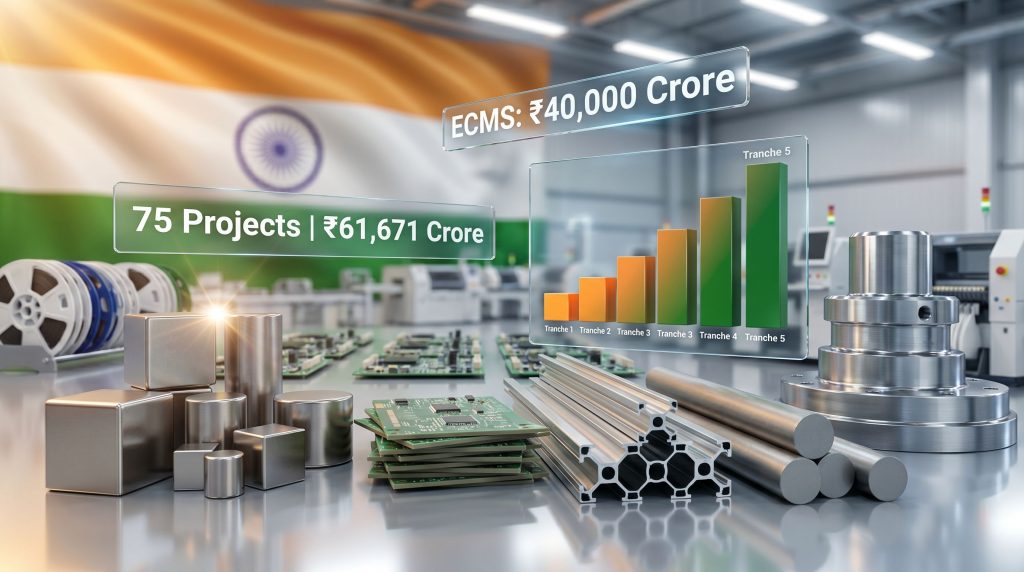
The Electronic Component Manufacturing Scheme was structured with a total outlay of ₹40,000 crore, designed specifically to address the weakest link in India's electronics ecosystem: the near-total import dependency on components. While India has developed meaningful final assembly capacity, particularly in smartphones, the vast majority of the components going into those devices are sourced from overseas, predominantly from China, Taiwan, South Korea, and Japan.
The ECMS targets this gap by organising eligible manufacturing activities into five segments, labelled A through E. These cover progressively different categories of the electronics value chain, from passive components and printed circuit boards through to upstream supply chain inputs and high-precision capital equipment. Segment D, which covers supply chain ecosystem components and capital equipment, carries particular strategic weight given that it remains the only segment still open for applications.
What makes the ECMS architecturally distinct from its predecessor, the Production Linked Incentive scheme for electronics, is its explicit focus on components rather than finished goods. PLI created assembly capacity; ECMS is designed to create the foundations beneath it. This layering of industrial policy represents a more sophisticated approach to manufacturing development than most comparable economies have attempted within a comparable timeframe.
Tranche-by-Tranche Progress: Reading the Investment Trajectory
Four tranches of ECMS approvals have now been completed, and the data reveals a pattern that deserves closer attention than the headline investment figures suggest.
| Tranche | Projects Approved | Total Investment Committed |
|---|---|---|
| Tranche 1 | 7 projects | ₹55.32 billion |
| Tranche 2 | 17 projects | ₹71.72 billion |
| Tranche 3 | 22 projects | ₹41,863 crore |
| Tranche 4 | 29 projects | ₹7,104 crore |
| Cumulative Total | 75 projects | ₹61,671 crore |
The declining investment size per project across tranches is not necessarily a sign of weakening interest. It more likely reflects a transition toward more targeted, specialised component categories where individual project scales are structurally smaller but technological complexity is considerably higher. Passive component manufacturing involves different capital requirements than rare earth magnet production or precision capital equipment.
A particularly significant milestone arrived with Tranche 4, which saw the approval of seven projects including India's first domestic rare earth magnet manufacturing unit under the ECMS framework. This single approval may prove to be one of the most consequential decisions in the programme's history, given the role these materials play across defence, clean energy, and consumer electronics applications.
Earlier tranches unlocked investment in a broad range of component categories, including:
- Surface mount device passives
- Flexible printed circuit boards
- Antennas and heat sinks
- Transducers and inductors
- Metal film resistors
Officials have indicated these categories will continue to be expanded as part of future approvals, suggesting the pipeline for earlier-stage components remains active even as more advanced categories enter the frame.
What the Next ECMS Tranche Will Prioritise
Rare Earth Permanent Magnets: The Strategic Core
Of all the component categories expected to feature prominently in the next ECMS tranche, rare earth permanent magnets carry the highest geopolitical and industrial weight. These magnets, produced from rare earth oxides through a multi-stage processing and sintering process, are essential inputs for electric vehicle motors, wind turbine generators, precision defence guidance systems, industrial robotics, and consumer electronics.
What makes this category particularly sensitive is the extraordinary concentration of global production. China controls an estimated 85 to 90 percent of global rare earth magnet production capacity, and an even higher share of the upstream oxide refining that feeds into magnet manufacturing. This creates a structural vulnerability for any country seeking to develop sovereign capabilities in EVs, defence electronics, or renewable energy hardware.
India's push through ECMS to establish domestic rare earth magnet production is therefore not simply an electronics manufacturing decision. It connects directly to national security considerations, the country's energy transition ambitions, and its broader critical minerals strategy. Furthermore, the complexity of rare earth supply chains means that converting in-ground resources into refined oxides and then into finished magnets involves a multi-stage industrial process that requires years to develop at scale.
Upstream Supply Chain Inputs Under the Microscope
Beyond rare earth magnets, the next tranche is expected to prioritise several foundational upstream materials:
- Laminates: The substrate materials from which printed circuit boards are fabricated. Without domestic laminate production, India's PCB manufacturing remains dependent on imported inputs regardless of how many board assembly facilities are built.
- Metallised films for capacitors: Critical passive components used extensively in power electronics, industrial control systems, and automotive electronics. Film capacitors are particularly valued in high-voltage and high-frequency applications where electrolytic alternatives perform poorly.
- Aluminium extrusions: Used for structural framing and thermal management in electronics hardware, including heat sinks and enclosures for power modules.
- Anode materials: Key inputs for lithium-ion battery cell manufacturing. Their inclusion under ECMS creates a direct policy bridge between the electronics manufacturing programme and India's electric vehicle production ambitions.
High-Precision Capital Equipment: The Multiplier Category
Perhaps the least discussed but most structurally important priority for the next tranche is high-precision capital equipment. The logic here is multiplicative: every domestic capital equipment manufacturer that successfully establishes production creates the potential to reduce import dependency across dozens of downstream component manufacturing lines simultaneously.
India currently imports the majority of the specialised machinery used in electronics component fabrication, from pick-and-place machines for surface mount assembly to deposition equipment for thin-film manufacturing. Developing domestic alternatives, even partial substitutes, would reduce foreign exchange outflows and create a more resilient manufacturing ecosystem. In addition, the growing critical minerals demand feeding into these production lines further underlines the urgency of establishing sovereign manufacturing capacity.
The Design Capability Mandate: A Qualitative Filter for the Scheme's Future
One of the most consequential policy developments shaping the next ECMS tranche in India is the introduction of a design capability requirement as a precondition for prioritised approval and continued disbursement eligibility.
Union Minister Ashwini Vaishnaw has made clear that companies participating in the ECMS without demonstrating a minimum level of investment in design functions will face removal from the scheme, with guideline amendments used to halt disbursals for non-compliant participants. This represents a significant hardening of the programme's compliance framework.
In the context of electronics component manufacturing, design capability encompasses a wide range of technical competencies:
- Schematic and layout development for PCBs and passive components
- Materials characterisation and process engineering for advanced components
- Embedded systems design for intelligent components and modules
- Simulation and modelling capabilities for thermal and electromagnetic performance
- Intellectual property development in component architecture
"The design mandate serves a deeper industrial purpose: it distinguishes between companies that are building genuine manufacturing capability and those seeking incentive disbursals while remaining essentially contract processors of imported inputs. A design-capable component manufacturer is structurally more difficult to displace by lower-cost competitors and creates lasting industrial value beyond the incentive period."
This approach mirrors the industrial development trajectories of Taiwan and South Korea, where government-linked investment in design capability, particularly in semiconductor and component design, ultimately created globally competitive industries. Notably, the importance of critical minerals for semiconductors further reinforces why India's design mandate cannot be separated from its upstream materials strategy.
Application Window Status: Who Can Still Apply
Understanding which segments remain open is critical for any company or investor assessing participation in the next ECMS tranche in India.
| ECMS Segment | Application Status | Deadline |
|---|---|---|
| Segment A | Closed | September 30, 2025 |
| Segment B | Closed | September 30, 2025 |
| Segment C | Closed | September 30, 2025 |
| Segment D (Supply chain and Capital equipment) | Open | April 30, 2027 |
| Segment E | Closed | September 30, 2025 |
Segment D's extended open window through April 2027 reflects the government's recognition that the most strategically sensitive component categories, including rare earth processing, upstream materials, and capital equipment, require longer lead times for project development and investment structuring. Complex manufacturing proposals in these categories cannot be assembled within short application windows.
Government officials have indicated the next beneficiary list could be released as early as August 2026, making the current period a critical window for companies finalising investment proposals and design capability commitments. The ECMS portal provides updated guidance for companies assessing eligibility under Segment D.
The next major ASX story will hit our subscribers first
How India's ECMS Compares to Global Industrial Policy Models
India is not operating in a vacuum. Several competing economies are simultaneously attempting to build electronics component manufacturing capability, and the ECMS design reflects lessons drawn from both successful and unsuccessful precedents.
China's integrated model involved decades of coordinated state investment across the entire electronics value chain simultaneously, from raw material processing through component manufacturing to finished goods assembly. This produced a deeply entrenched, cost-competitive ecosystem that is extraordinarily difficult to replicate through policy instruments alone.
Vietnam's evolution offers a more instructive near-term comparison. Vietnam attracted enormous foreign direct investment in electronics assembly during the 2010s but has since struggled to develop meaningful domestic component manufacturing, meaning most of its export value remains in assembly labour rather than component value-add. India's ECMS is explicitly designed to avoid replicating this assembly-only trap.
Taiwan and South Korea's design-led models are arguably the most relevant templates for where India wants to arrive. Both economies used a combination of targeted incentives, mandatory design investment, and patient capital to build globally competitive component and semiconductor industries. The ECMS design mandate echoes these strategies directly.
The China+1 diversification trend among global electronics OEMs creates a genuine market opportunity for Indian component manufacturers, but capturing that opportunity requires the component supply to exist domestically. Without it, OEMs diversifying away from China will route through Vietnam, Thailand, or Mexico rather than India. However, India's lithium supply strategy demonstrates how the country is increasingly approaching these challenges with long-term sovereign intent — for instance, India's lithium supply strategy signals a recognition that upstream materials security is inseparable from downstream manufacturing ambition.
Economic Implications: Trade Balance, Employment, and Cross-Sectoral Linkages
Electronics Trade Balance and Import Substitution Potential
India's electronics import bill has grown substantially over the past decade, with components representing the dominant share of total electronics import value. If ECMS-backed domestic production reaches meaningful scale across laminates, passives, rare earth magnets, and anode materials, the import substitution effect could materially reduce the foreign exchange outflow associated with electronics manufacturing. Consequently, this would simultaneously lower the cost base for Indian finished electronics exporters competing in global markets.
Connections to India's EV and Renewable Energy Targets
The inclusion of anode materials and rare earth permanent magnets within ECMS creates an important cross-sectoral linkage. Furthermore, the role of direct lithium extraction technologies in accelerating battery-grade material supply adds another dimension to India's industrial planning. These same materials are critical inputs for:
- Electric vehicle traction motors and battery cells
- Wind turbine generators requiring high-performance permanent magnets
- Grid-scale energy storage systems dependent on lithium-ion chemistry
Progress under ECMS in these categories therefore generates supply chain benefits that extend far beyond the electronics sector into India's core energy transition infrastructure.
Skilled Employment and Industrial Clustering
High-precision component manufacturing is a skilled employment generator that differs fundamentally from assembly-line work. Materials scientists, process engineers, quality assurance specialists, and embedded systems designers are the workforce profile that ECMS-backed facilities will require. This creates long-duration, high-value employment that is considerably more difficult to offshore than assembly work.
There is also a well-documented clustering effect in component manufacturing: when a critical mass of component producers establishes operations in a geography, finished goods assemblers follow to reduce logistics costs and improve supply chain responsiveness. ECMS approvals at scale could therefore act as an attractor for broader electronics manufacturing investment that extends well beyond the direct beneficiaries of the scheme itself.
Frequently Asked Questions: Next ECMS Tranche in India
What is the ECMS and how does it work?
The Electronic Component Manufacturing Scheme is a ₹40,000 crore programme providing financial incentives to companies establishing domestic electronics component production across defined target segments, with disbursals linked to verified investment and production milestones.
When will the next ECMS tranche be announced?
Officials have indicated the next round of beneficiary approvals is expected around August 2026, with rare earth magnets, upstream supply chain inputs, and capital equipment as the primary focus areas.
What components will the upcoming tranche prioritise?
The next tranche is expected to cover rare earth permanent magnets, laminates, metallised films for capacitors, aluminium extrusions, and anode materials, all within the Segment D classification.
What happens to companies not investing in design capabilities?
Companies failing to demonstrate a minimum level of investment in design functions face removal from the scheme, with disbursals halted through guideline amendments, as signalled by Minister Ashwini Vaishnaw.
Is the ECMS application window still open?
Segment D remains open for applications until April 30, 2027. All other segments closed on September 30, 2025.
How much has been approved under ECMS across all tranches?
Across four completed tranches, 75 projects have been approved with a cumulative proposed investment of ₹61,671 crore.
Disclaimer: This article is intended for informational purposes only and does not constitute financial or investment advice. Figures and timelines referenced are based on publicly available reporting and government communications as of June 2026. Forward-looking statements regarding programme outcomes, investment projections, and policy implementation involve inherent uncertainty and should not be relied upon for investment decisions.
Want to Track the ASX Mineral Discoveries Powering the Critical Minerals Supply Chain?
As India's ECMS accelerates demand for rare earth magnets, anode materials, and upstream electronics inputs, the ASX companies supplying these critical materials are entering a pivotal period — Discovery Alert's proprietary Discovery IQ model delivers real-time alerts the moment significant mineral discoveries are announced, ensuring subscribers can act before the broader market reacts. Explore historic discoveries and their exceptional returns on Discovery Alert's dedicated discoveries page, and begin your 14-day free trial today to position yourself ahead of the next major find.