June 23, 2026
The Invisible Bottleneck Reshaping Global Automotive Supply Chains
Every electric vehicle sold anywhere in the world carries inside it a quiet dependency that most consumers never consider. Buried within the traction motor sits a permanent magnet, and inside that magnet are four rare earth oxides whose global supply is overwhelmingly controlled by a single nation. For automotive manufacturers racing to electrify their fleets, this concentration represents one of the most structurally significant supply chain vulnerabilities of the modern industrial era.
It is against this backdrop that Iluka Resources' (ASX: ILU) announcement of its Iluka first rare earths customer via a binding rare earth oxide supply agreement carries weight well beyond its headline volume figures. Understanding why requires looking at the full architecture of the rare earth supply chain, the commercial mechanics of the deal itself, and what it signals about Australia's accelerating transition from raw material exporter to value-added processor in critical mineral markets.
When big ASX news breaks, our subscribers know first
The Magnet Rare Earth Supply Problem in Numbers
The rare earth sector is frequently misunderstood because it is discussed as a monolith. In reality, the rare earths that matter most for the clean energy transition are a specific subset of four elements: neodymium (Nd), praseodymium (Pr), dysprosium (Dy), and terbium (Tb). These four oxides are the functional ingredients in neodymium-iron-boron (NdFeB) permanent magnets, the highest-performance permanent magnets commercially available and the dominant magnet technology in EV traction motors.
The scale of China's processing dominance in this space is difficult to overstate:
- China controls approximately 85–90% of global rare earth processing capacity across the full value chain
- For heavy rare earths specifically, including Dy and Tb, Chinese dominance extends to an estimated 90%+ of global production
- China's share of NdFeB magnet manufacturing exceeds 90%, meaning the concentration compounds at each processing stage
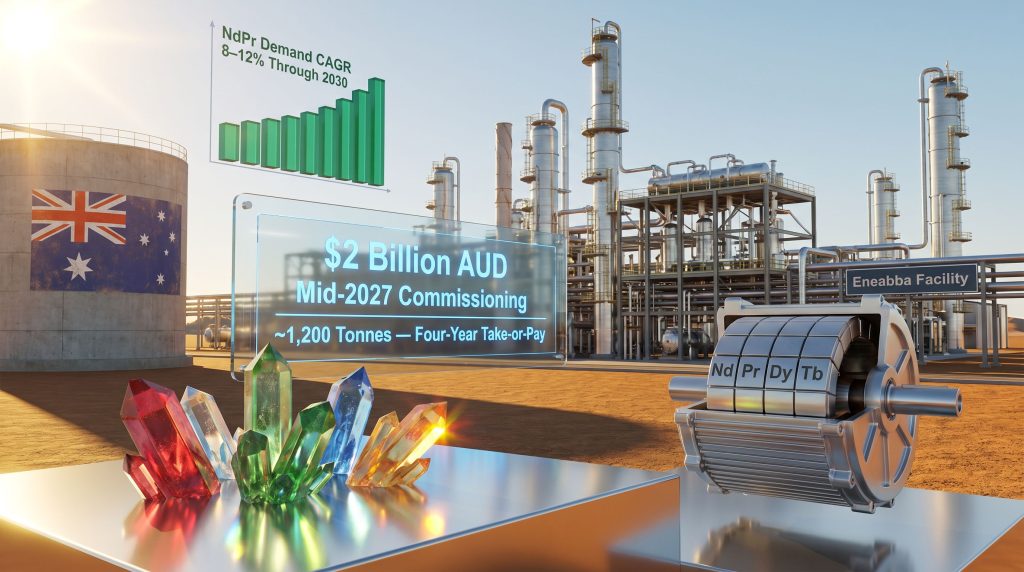
A single EV traction motor requires between 1 and 2 kilograms of NdFeB magnet material, and as vehicle platforms shift toward higher-performance drive units, that figure is trending upward. Global NdPr demand is projected to expand at a compound annual growth rate of approximately 8 to 12% through 2030, driven predominantly by EV adoption curves in Europe, North America, and China itself.
The structural problem facing automotive OEMs is not simply cost or logistics. It is the absence of meaningful alternative supply. When a single geography controls processing at every stage of a critical input chain, supply disruption risk becomes existential rather than manageable.
What the Eneabba Refinery Actually Represents
Iluka's Eneabba Rare Earth Refinery in Western Australia is not simply another mining project. Its significance lies in what it does downstream of mining, which is the step that has historically been ceded entirely to China.
The Separation Gap That Defines Strategic Value
The rare earth processing chain has several stages, and the critical distinction is often poorly understood outside specialist circles:
- Mining – extraction of ore containing rare earth minerals
- Beneficiation – physical processing to produce a mineral concentrate
- Cracking and leaching – chemical dissolution to produce a mixed rare earth carbonate or solution
- Solvent extraction / separation – the stage that isolates individual oxides to specification
- Finishing – production of oxides, metals, or alloys for end-use customers
Most non-Chinese rare earth operations globally operate through steps one to three at most, producing a mixed concentrate or carbonate that is then shipped to China for separation. This is the critical chokepoint. The separation stage, step four, determines which individual oxides a customer actually receives, at what purity, and to what specification.
Eneabba is designed to execute all five stages. This makes it a fully integrated producer, capable of delivering specification-grade Nd, Pr, Dy, and Tb oxides directly to magnet manufacturers and end-use industrial customers without Chinese processing intermediaries.
The refinery represents a capital commitment of approximately $2 billion AUD and is targeting commissioning in mid-2027. When operational, it will be Australia's first facility capable of producing fully separated rare earth oxides at commercial scale.
Why Separation Capability Commands a Commercial Premium
The economics of separation are substantially more attractive than concentrate production. Magnet manufacturers and automotive OEMs require individual oxides to precise chemical specifications, and they pay a significant premium over mixed concentrate pricing to obtain them. A producer who can supply separated, specification-grade NdPr oxide or heavy rare earth oxides directly eliminates a processing cost and supply chain risk for the buyer, which translates directly into pricing leverage for the seller.
This is the commercial logic underpinning the Eneabba business model: capture value at the highest-margin point in the processing chain rather than exporting raw material value to offshore processors.
Anatomy of Iluka's First Rare Earth Oxide Supply Agreement
The binding commercial agreement Iluka has announced represents the Iluka first rare earths customer relationship for the Eneabba facility's output. Its structure reveals a sophisticated commercial approach calibrated for both certainty and flexibility.
Contract Architecture and Commercial Mechanics
| Agreement Parameter | Detail |
|---|---|
| Contract Type | Binding, multi-year take-or-pay |
| Commencement Year | 2028 |
| Contract Duration | Four years |
| Volume Commitment | ~1,200 tonnes of magnet rare earth oxides |
| Share of Planned Production | ~10% of Eneabba's projected output for the period |
| Products Covered | Nd, Pr, Dy, Tb oxides |
| Customer Jurisdiction | Like-minded nation (undisclosed) |
| Customer Sector | Global automotive manufacturing |
The take-or-pay structure deserves specific attention because it is often misread as simply a long-term purchase agreement. In practice, a take-or-pay contract obligates the buyer to either accept the contracted volume or pay a penalty equivalent to the contracted value regardless. This means the revenue commitment is not conditional on the customer's downstream production volumes, market conditions, or strategic changes.
For a project at pre-commissioning stage, this structure provides a revenue floor that directly supports project financing metrics. Furthermore, securing a binding take-or-pay agreement approximately 12 months before commissioning is commercially significant. It signals that a sophisticated automotive customer has conducted sufficient technical and commercial due diligence on the Eneabba project to commit legally binding capital exposure to its output.
The Strategic Logic Behind a 10% Anchor
The volume covered by this first agreement, approximately 1,200 tonnes representing ~10% of planned production, reflects deliberate commercial strategy rather than a limitation. Rare earth project commercialisation follows a well-established sequencing pattern. An anchor customer agreement, even at modest volume share, serves several simultaneous functions:
- It validates product specifications to an independent commercial counterparty
- It establishes a contractual precedent and pricing framework for subsequent negotiations
- It contributes to project financing covenants without constraining the majority of output
- It demonstrates to debt markets that offtake demand exists before full volume is contracted
Retaining approximately 90% of planned production capacity as uncommitted volume preserves Iluka's pricing and counterparty flexibility. As commissioning approaches and product quality is demonstrated, subsequent offtake agreements are typically negotiated from a stronger position. This is because supply risk has been partially de-risked by the initial customer's due diligence commitment. In addition, this mirrors patterns seen in comparable rare earth offtake structures across the sector.
The Identity Question: Who Is the Automotive Customer?
The deliberate non-disclosure of the customer's identity is commercially standard practice, but the available descriptors narrow the field considerably.
Decoding the "Like-Minded Nation" Classification
The phrase "like-minded nation" carries specific meaning in the context of critical mineral supply chain diplomacy. It aligns with the language used across the Minerals Security Partnership (MSP), a multilateral framework involving the US, European Union, Japan, South Korea, Canada, the UK, and Australia, among others. The MSP was established in 2022 to coordinate allied-nation investment in critical mineral supply chains as a counterweight to Chinese resource dominance.
Applying this filter to global automotive manufacturing narrows the plausible customer universe significantly:
- Japan: Home to Toyota, Honda, and Nissan, all with major EV programs and deep institutional awareness of rare earth supply risk following China's 2010 export restrictions
- South Korea: Hyundai-Kia Group is among the world's fastest-scaling EV producers and has publicly committed to supply chain diversification
- Germany / EU: Volkswagen Group, BMW, and Stellantis are subject to EU Critical Raw Materials Act compliance requirements that incentivise non-Chinese sourcing
- United States: Ford, GM, and Tesla have all engaged in rare earth supply chain diversification strategies, with Ford and GM both participating in MSP-aligned procurement initiatives
Japan and South Korea warrant particular analytical attention. Both nations experienced firsthand the consequences of China's rare earth supply disruption when China restricted exports in 2010. Both have since maintained active government and industry programs to develop non-Chinese rare earth supply chains. Japanese automakers in particular have historically been willing to sign long-term, take-or-pay style commitments with non-Chinese rare earth producers precisely because their institutional memory of supply disruption risk is acute.
Why Commercial Confidentiality Does Not Diminish the Agreement
A point sometimes misconstrued in market commentary is whether non-disclosure of a customer identity signals uncertainty about the agreement's validity. In resource project commercialisation, customer confidentiality at the pre-production stage is standard, not exceptional. The contractual binding nature of take-or-pay structures is independent of public disclosure.
Precedent from the lithium sector, where offtake customer identities for Australian producers including Pilbara Minerals and Allkem were disclosed progressively over months or years, confirms that commercial validity and public disclosure operate on different timelines.
The Four Oxides: Technical Context for the Supply Agreement
NdPr: Volume, Performance, and Market Dynamics
Neodymium and praseodymium are typically processed and traded together as NdPr oxide, though they serve slightly different functions in magnet chemistry. NdPr forms the primary matrix of the NdFeB magnet and determines its baseline magnetic performance. The ratio of Nd to Pr in commercial production is approximately 75:25, constrained by the natural geological occurrence ratio in most deposits.
NdFeB magnets produced from NdPr oxide are capable of generating magnetic fields far exceeding those of ferrite or alnico alternatives at comparable mass. This is why they dominate EV traction motor applications where power density per kilogram is the critical design parameter.
A lesser-known commercial dynamic in the NdPr market is the concept of the "magnet rare earth basket." Because Nd and Pr occur together and are extracted as a combined oxide in most processing facilities, pricing for NdPr oxide reflects a blended value rather than individual element pricing. For producers like Eneabba with downstream separation capability, the ability to independently optimise Nd and Pr oxide streams depending on customer demand creates an additional margin management lever not available to concentrate producers.
Dy and Tb: The High-Value Heavy Rare Earths
Dysprosium and terbium occupy a fundamentally different market position to NdPr. They are used in much smaller quantities per magnet, typically as 1 to 5% additions by weight, but their function is critical: they dramatically improve the thermal stability and coercivity of NdFeB magnets, preventing demagnetisation at the elevated operating temperatures common in EV motor applications.
The pricing differential between heavy and light rare earth oxides is substantial. Dy and Tb oxide prices historically command multiples of NdPr oxide pricing, meaning their inclusion in a supply agreement contributes disproportionately to revenue per tonne despite their lower physical volumes.
China's control of global Dy and Tb production exceeds 90%, and the geographical concentration is even more extreme at the deposit level. The majority of global heavy rare earth production originates from ionic clay deposits in southern Chinese provinces, a resource type that does not have well-developed equivalents elsewhere. This makes non-Chinese Dy and Tb supply not merely strategically valuable but genuinely scarce, a distinction with direct implications for the pricing leverage available to Eneabba.
A supply agreement that explicitly includes Dy and Tb, not just NdPr, reflects a customer requirement for a complete magnet oxide suite rather than a partial solution. This suggests the customer is operating at a level of supply chain sophistication consistent with a Tier 1 OEM or direct magnet manufacturer.
The next major ASX story will hit our subscribers first
Australia's Competitive Position in Non-Chinese Rare Earth Processing
The Current Landscape of Non-Chinese Separation Capacity
The global rare earth processing sector outside China remains remarkably thin for a material so widely described as strategically critical. The operational landscape of non-Chinese separation facilities is limited:
| Producer | Location | Stage | Notes |
|---|---|---|---|
| Lynas Rare Earths (ASX: LYC) | Malaysia (primary) | Operational | Largest non-Chinese processor; US facility under development |
| MP Materials | Mountain Pass, California | Operational | North America's only significant rare earth mine and processor |
| Eneabba (Iluka) | Western Australia | Construction | First fully integrated Australian facility; commissioning mid-2027 |
| Energy Fuels | Utah, USA | Partial operations | Mixed RE carbonate production; separation capability developing |
When Eneabba reaches full commercial production, it will meaningfully expand the globally available pool of non-Chinese separated rare earth oxides. Given the limited number of operational facilities, each new entrant with genuine separation capability has an outsized effect on supply availability. Consequently, this also directly affects the pricing leverage that Chinese producers currently exercise in commercial negotiations.
Australia's Structural Advantages
Australia's position as a preferred source geography for non-Chinese rare earths is supported by factors that extend beyond simple geological endowment. Furthermore, the Americas' rare earth supply chain efforts highlight that allied nations are actively competing to fill the same strategic gap:
| Competitive Factor | Australia's Position |
|---|---|
| Geological endowment | World-class rare earth deposits in Western Australia |
| Geopolitical stability | AAA-rated sovereign credit, Five Eyes member |
| Regulatory transparency | Consistent environmental and mining law framework |
| Processing infrastructure | Eneabba represents first-mover advantage in full separation |
| Allied-nation alignment | Active MSP participant with bilateral critical mineral agreements |
| Trade relationships | Established commercial links with Japan, South Korea, EU, USA |
Western Australia's rare earth geology deserves specific mention. The Eneabba project draws on feedstock from Iluka's mineral sands operations, which produce a natural monazite concentrate as a byproduct of titanium and zirconium mining. Monazite is a phosphate mineral that naturally concentrates rare earth elements, particularly the heavier rare earths that are most strategically valuable. The feedstock advantage of processing monazite from an existing mining operation reduces the capital intensity of Eneabba's upstream supply compared to standalone rare earth mining projects.
Investor Framework: Reading the Risk Profile Shift
How an Anchor Offtake Agreement Repositions a Development Asset
For investors evaluating Iluka's rare earth division, this first binding customer agreement represents a categorical change in project risk classification rather than simply a positive news event. Development-stage resource projects carry a risk premium that reflects the uncertainty around whether commercial demand for the planned output will materialise at economics that support the capital structure.
A binding take-or-pay agreement from a credible counterparty directly addresses this uncertainty, at least for the contracted volume. The practical implications for project valuation include:
- Debt serviceability: Contracted revenue provides lenders with a visible cash flow stream against which debt obligations can be mapped
- Refinancing risk: Revenue floor certainty reduces the risk that the project will need to refinance construction debt on unfavourable terms during the commissioning period
- Re-rating catalyst: Institutional investors typically re-rate projects from development-stage to pre-revenue commercial upon first binding offtake, which can compress the discount rate applied to projected cash flows
The Path to Full Commercial Utilisation
With approximately 10% of production contracted, the commercial pathway to full utilisation involves additional offtake negotiations that will now proceed from a demonstrably stronger position. The precedent established by this first agreement, in terms of contract structure, term length, and product scope, creates a template that subsequent counterparties can evaluate against. Each additional agreement negotiated before commissioning further de-risks the asset from an investor perspective.
Disclaimer: This article contains forward-looking statements and financial analysis for informational purposes only. It does not constitute financial advice. Investors should conduct their own due diligence and seek professional advice before making investment decisions. Past performance and project timelines are not reliable indicators of future outcomes.
From Concentrate Exporter to Oxide Supplier: A Structural Shift in Australian Mining
The Eneabba project, and the commercial agreement now anchoring its offtake strategy, represent something that has been discussed in Australian resource policy circles for decades but rarely achieved: genuine downstream value capture in a critical mineral supply chain.
Australia has historically exported the geological value of its mineral endowment while ceding processing economics to offshore operators. In rare earths, this pattern has been particularly pronounced. Australian mineral sands operations have produced monazite for decades, but that monazite has predominantly been exported to offshore processors, including in China, rather than processed domestically to specification-grade oxides.
The commissioning of Eneabba will change this dynamic in a measurable way. The facility will transform Australian rare earth mineral value from a concentrate export commodity into a specification-grade industrial input delivered directly to end-use manufacturers in aligned economies. This is not merely a commercial development. It reflects a structural repositioning of Australia's role in the global critical minerals value chain, one that has implications for trade economics, allied-nation supply security, and the long-term trajectory of Australian industrial capability in advanced materials processing.
The Iluka first rare earths customer agreement for Eneabba's output — modest in volume but landmark in commercial architecture — marks the point at which this repositioning moved from construction ambition to contractual reality.
Want to Stay Ahead of the Next Major Critical Minerals Discovery?
Discovery Alert's proprietary Discovery IQ model delivers real-time alerts on significant ASX mineral discoveries — including in the critical minerals and rare earths space — instantly translating complex geological data into actionable investment insights for both short-term traders and long-term investors. Explore historic discovery returns on Discovery Alert's discoveries page and begin your 14-day free trial to position yourself ahead of the broader market.