August 5, 2026
Canada's Strategic Resource Position in North American Trade
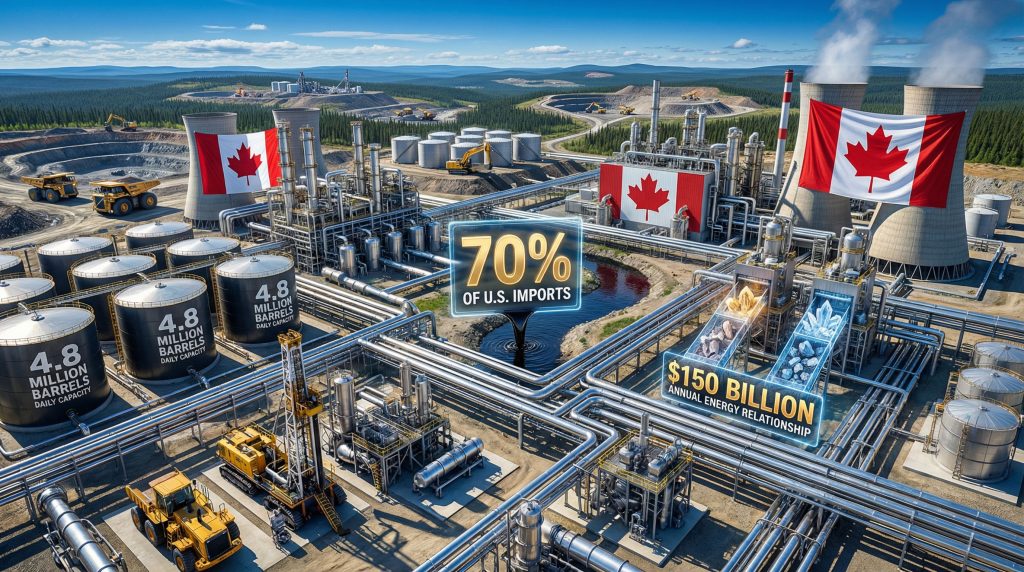
Canada's leverage with oil and critical minerals in U.S. tariff negotiations reflects the country's unique position as North America's primary energy and critical minerals supplier. The country supplies approximately 70% of U.S. crude oil imports, representing a daily flow of nearly 4 million barrels that has become deeply integrated into American refinery infrastructure over several decades.
This integration creates technical switching costs that conventional trade analysis often underestimates. U.S. refineries have invested billions in specialised equipment designed specifically to process Canada's heavier crude oil grades, particularly the bitumen extracted from Alberta's oil sands. These refineries cannot simply switch to lighter crude alternatives without significant capital expenditure and operational downtime.
The energy relationship encompasses more than crude oil. Canada exports substantial volumes of natural gas and electricity to the United States, creating additional layers of infrastructure dependency. Natural gas pipelines and electrical grid connections represent fixed infrastructure that cannot be quickly redirected to alternative markets or suppliers.
Furthermore, the Canada energy transition adds complexity to these relationships. Beyond energy, Canada's critical minerals position offers potentially more powerful leverage mechanisms. Unlike oil markets where price impacts primarily affect producers, restrictions on critical minerals directly constrain manufacturing capabilities in defense and technology sectors where few substitutes exist.
When big ASX news breaks, our subscribers know first
Strategic Value of Canada's Energy Exports
The technical realities of crude oil processing create genuine barriers to supply diversification that extend far beyond market price considerations. Canadian heavy crude requires specialised refining infrastructure that has been developed specifically to handle its unique characteristics, including higher sulfur content and greater density compared to conventional light crude oils.
Key Technical Dependencies:
- Refinery modifications: U.S. facilities processing Canadian crude have invested in coking units and hydrotreating equipment specifically designed for heavy oil processing
- Pipeline infrastructure: Dedicated pipeline systems connect Canadian production directly to U.S. refineries, with limited alternative routing options
- Blending operations: Many U.S. refineries blend Canadian heavy crude with lighter domestic production to optimise processing efficiency
- Storage facilities: Tank farms and storage systems designed for heavy crude specifications
The economic scale of this relationship creates additional switching barriers. With annual trade volumes exceeding $150 billion, the energy relationship represents one of the largest bilateral commodity flows globally. The Trans Mountain Pipeline expansion adds only 150,000 barrels per day of unused capacity for alternative export routes, highlighting Canada's continued dependence on U.S. markets even as it seeks diversification.
Market dynamics during recent trade tensions have demonstrated the practical limitations of political rhetoric versus economic reality. Despite ongoing tariff threats, Canadian oil exports to the United States have actually increased in early 2026, suggesting that market fundamentals may override political positioning when implementation details are considered.
However, US tariffs impact creates additional complexity for Canadian energy exporters. Consumer price sensitivity creates additional constraints on tariff implementation. A 10% tariff on Canadian crude could translate to $3-5 per barrel price increases that ultimately reach U.S. gasoline consumers, creating political pressure in regions dependent on affordable fuel prices.
What Makes Critical Minerals Different as Strategic Leverage?
Canada's critical minerals position offers fundamentally different leverage characteristics compared to energy exports. While oil price impacts primarily affect producer economics, critical minerals security restrictions directly threaten manufacturing capabilities in sectors where rapid substitution is impossible.
The defense applications create particularly acute vulnerabilities. Modern weapon systems require specific rare earth elements, lithium for advanced battery systems, cobalt for aerospace applications, and specialised metals with limited global sourcing options. Canada's position in several of these markets creates potential supply chain chokepoints that cannot be easily circumvented.
Strategic Mineral Dependencies:
| Mineral | Canadian Market Share | Defense Applications | Substitution Difficulty |
|---|---|---|---|
| Cobalt | ~4% global production | Aircraft engines, missiles | Limited alternatives |
| Lithium | ~2% global production | Battery systems, electronics | Growing but constrained |
| Rare earths | ~2% global production | Guidance systems, communications | Highly constrained |
| Nickel | ~10% global production | Armour, submarine hulls | Moderate alternatives |
The processing bottlenecks create additional leverage beyond raw material production. Even where alternative mineral sources exist, the specialised processing facilities required to transform raw materials into defense-grade components are concentrated in relatively few locations globally.
In addition, mining industry evolution plays a crucial role in these supply chain dynamics. Unlike energy markets where strategic reserves provide short-term supply buffers, critical minerals often lack meaningful government stockpiles. The specialised nature of many applications means that generic stockpiling is insufficient; specific grades and purities are required for particular manufacturing processes.
Limitations of Resource-Based Leverage
Despite Canada's dominant market positions, several structural factors limit the effectiveness of resource-based negotiating strategies. Understanding these constraints is essential for realistic assessment of potential outcomes in trade negotiations.
Energy Sector Vulnerabilities
The asymmetric impact of tariffs represents a fundamental constraint on energy leverage. While Canadian producers would bear the direct cost burden of tariffs through reduced netback prices, U.S. consumers experience only indirect effects through gradual price increases. This creates political dynamics that may favour tariff implementation despite economic inefficiency.
Consequently, tariff market pressures create complex dynamics that extend beyond bilateral trade relationships. U.S. Strategic Petroleum Reserve holdings provide additional buffers against short-term supply disruptions. With over 400 million barrels in strategic reserves, the U.S. government can release supplies to moderate price impacts during any temporary supply restrictions, reducing the immediate effectiveness of resource leverage.
Long-term substitution possibilities further constrain Canadian leverage. Increased domestic U.S. shale oil production, potential imports from alternative suppliers, and accelerated renewable energy deployment could gradually reduce dependence on Canadian energy imports over multi-year timeframes.
Critical Minerals Constraints
While critical minerals offer more direct leverage, implementation risks include potential acceleration of U.S. domestic mining development and alternative supplier relationships. Explicit use of critical minerals as trade leverage could justify emergency domestic production measures and strategic partnerships with other allied nations.
The global nature of critical minerals markets creates additional complexity. Unlike the bilateral nature of most Canada-U.S. energy trade, critical minerals often involve complex global supply chains where restrictions by one supplier can be partially offset through increased production elsewhere or recycling initiatives.
How Can Canada Bundle Multiple Leverage Points?
Canada's most sophisticated strategic approach combines multiple leverage mechanisms into integrated negotiating packages that complicate U.S. decision-making processes. This bundling strategy forces American policymakers to evaluate trade restrictions against broader security and economic costs simultaneously.
Integrated Leverage Components:
- Energy security: Oil, natural gas, and electricity exports creating consumer price exposure
- Defence cooperation: NORAD participation, shared intelligence, and integrated defence manufacturing
- Critical minerals access: Supply chain security for defence and technology applications
- Infrastructure integration: Pipeline, electrical grid, and transportation connectivity
The strategic insight underlying this approach recognises that individual leverage mechanisms may have limited effectiveness, but combined pressures create more complex cost-benefit calculations for U.S. policymakers. A tariff policy that simultaneously threatens energy price increases, defence supply chain disruption, and reduced security cooperation faces multiple sources of domestic opposition.
Recent statements from Canadian political leaders reflect this bundling approach. According to Conservative leader Pierre Poilievre, "Canada has the energy and minerals that America needs, and that gives us significant negotiating power in trade discussions." Rather than threatening specific retaliation, the strategy emphasises mutual benefits and the integrated nature of the bilateral relationship.
The defence integration aspect adds particular complexity. Canada's participation in continental defence systems, including missile defence and aerospace manufacturing, creates security interdependencies that extend beyond pure economic calculations. Disrupting these relationships could have implications for broader NATO commitments and allied cooperation frameworks.
Alternative Scenario Analysis
Understanding potential outcomes requires analysing multiple scenarios based on different combinations of political decisions and market responses. Each scenario carries distinct implications for both countries and broader North American economic integration.
Scenario 1: Escalation Pathway
This scenario assumes both countries pursue maximum leverage strategies with limited concern for escalation risks. Canada implements critical minerals export restrictions while the U.S. responds with comprehensive tariff measures across multiple sectors.
Economic impacts: Both countries experience supply chain disruptions, with U.S. manufacturing facing critical minerals shortages while Canadian exports decline sharply. Consumer prices increase in both countries as supply chain inefficiencies compound.
Timeline considerations: Short-term disruptions could persist for 6-12 months while both countries develop alternative supplier relationships and domestic production capabilities.
Strategic implications: This scenario could accelerate long-term economic decoupling between the two countries, potentially reshaping continental trade relationships permanently.
Scenario 2: Negotiated Settlement Framework
This pathway assumes both governments recognise mutual interests in avoiding escalation while achieving face-saving political outcomes. Negotiations focus on selective tariff exemptions and enhanced cooperation agreements.
Potential elements:
- Strategic resource exemptions from tariff frameworks
- Enhanced joint development of critical minerals processing capacity
- Expanded defence cooperation agreements
- Infrastructure investment commitments
Implementation challenges: Success requires careful management of domestic political pressures in both countries while maintaining broader trade policy consistency.
Probability assessment: Market pressures and business community lobbying may favour this approach over extended trade conflict.
Scenario 3: Structural Adaptation
This longer-term scenario envisions gradual adjustment of bilateral trade relationships through market-driven responses to policy changes. Both countries invest in reduced dependency without explicit conflict escalation.
Canadian adaptations:
- Accelerated development of alternative export markets, particularly in Asia
- Investment in domestic processing capacity to capture more value-added export opportunities
- Strategic reserve development to reduce vulnerability to U.S. policy changes
- Enhanced trade relationships with European and Pacific partners
U.S. adaptations:
- Increased domestic energy production and critical minerals mining
- Alternative supplier relationship development
- Strategic stockpile expansion for critical materials
- Accelerated renewable energy deployment to reduce import dependency
The next major ASX story will hit our subscribers first
Market Psychology and Implementation Realities
The gap between political rhetoric and practical implementation often determines actual outcomes in resource-based trade negotiations. Market participants, consumer groups, and integrated businesses create pressure points that may constrain pure political decision-making.
Consumer Price Sensitivity
U.S. gasoline prices represent one of the most politically sensitive metrics in American domestic politics. Any tariff policy that materially increases fuel costs faces immediate pushback from consumer advocacy groups and affected regional constituencies.
Regional variations in impact create additional political complexity. States along the Canadian border that benefit from energy trade relationships may oppose policies that increase costs for local refineries and consumers.
Business Community Integration
Decades of supply chain integration have created powerful business constituencies with interests in maintaining efficient bilateral trade relationships. These groups often have more resources and political access than consumer organisations, potentially creating effective opposition to disruptive trade policies.
The defence contractor community represents a particularly influential constituency regarding critical minerals policy. Companies involved in defence manufacturing have direct financial interests in maintaining reliable supply chains and may lobby against policies that threaten material availability.
Strategic Recommendations for Implementation
Effective use of Canada's leverage with oil and critical minerals in U.S. tariff negotiations requires sophisticated strategy that maximises advantages while managing escalation risks and preserving long-term relationships.
Optimal Leverage Sequencing
Rather than simultaneous deployment of all leverage mechanisms, graduated escalation allows for negotiating flexibility while maintaining credible deterrent effects. Initial emphasis on critical minerals leverage may be more effective than energy threats due to direct manufacturing impacts.
Alliance Coordination
Canada's resource leverage is enhanced when coordinated with other allies facing similar trade pressures. Joint positions with European partners or other resource-exporting nations create broader pressure on U.S. trade policy while reducing Canada's exposure to retaliation.
Domestic Capacity Building
Long-term strategic effectiveness requires reducing Canada's own vulnerabilities through alternative market development and domestic processing capacity expansion. This dual strategy maintains leverage while preparing for potential relationship changes.
Communication Strategy
Framing resource relationships as mutual benefits rather than confrontational leverage creates more favourable political dynamics in the United States. Recent analysis suggests that Canada's secret leverage lies in emphasising consumer benefits, job creation, and security cooperation rather than explicit leverage threats.
Risk Management Considerations
Any strategy based on resource leverage carries implementation risks that require careful management to avoid counterproductive outcomes.
Retaliation Escalation
Explicit use of resource leverage could justify broader U.S. retaliation across multiple sectors, potentially creating economic costs that exceed the benefits of successful leverage deployment. Risk assessment requires modelling potential U.S. response scenarios and their economic impacts.
Market Substitution Acceleration
Aggressive leverage use could accelerate U.S. domestic alternatives development or alternative supplier relationships that permanently reduce Canada's market position. The timing and intensity of leverage deployment must consider these long-term strategic costs.
International Reputation Effects
Canada's global reputation as a reliable trading partner could suffer if resource leverage is perceived as unpredictable or opportunistic. This reputational risk may affect relationships with other trading partners beyond the bilateral U.S. relationship.
Conclusion: Balanced Strategic Implementation
Canada's leverage with oil and critical minerals in U.S. tariff negotiations creates meaningful but constrained opportunities for trade negotiation advantage. The technical integration of energy infrastructure and the strategic importance of critical minerals in defence applications provide genuine negotiating advantages that extend beyond simple market pricing power.
However, effective implementation requires recognising structural limitations and managing escalation risks carefully. Energy leverage faces asymmetric cost distribution that may limit its political effectiveness, while critical minerals leverage, though more direct, carries risks of accelerating U.S. domestic alternatives development.
The bundling strategy that combines resource access with security cooperation represents the most sophisticated approach to maximising Canada's negotiating position while preserving broader bilateral relationship stability. This framework creates complex cost-benefit calculations for U.S. policymakers while positioning Canada as a solution provider rather than an adversary.
Success ultimately depends on sophisticated strategy implementation that emphasises mutual benefits while maintaining credible alternatives. The goal is not to create confrontation but to ensure that Canada's strategic value in North American economic and security relationships is properly recognised in trade policy decisions.
This analysis is based on current market conditions and policy positions as of March 2026. Trade negotiations involve numerous variables and outcomes may differ significantly from scenario projections presented. Readers should consult additional sources and expert analysis when evaluating potential investment or policy implications.
Looking for the Next Big Resource Discovery?
Discovery Alert's proprietary Discovery IQ model delivers real-time alerts on significant ASX mineral discoveries, instantly empowering subscribers to identify actionable opportunities ahead of the broader market. Understand why major mineral discoveries can lead to substantial returns by exploring Discovery Alert's dedicated discoveries page, showcasing historic examples of exceptional outcomes, and begin your 14-day free trial today to position yourself ahead of the market.