
May 21, 2026
Understanding Canada's Strategic Trade Pivot
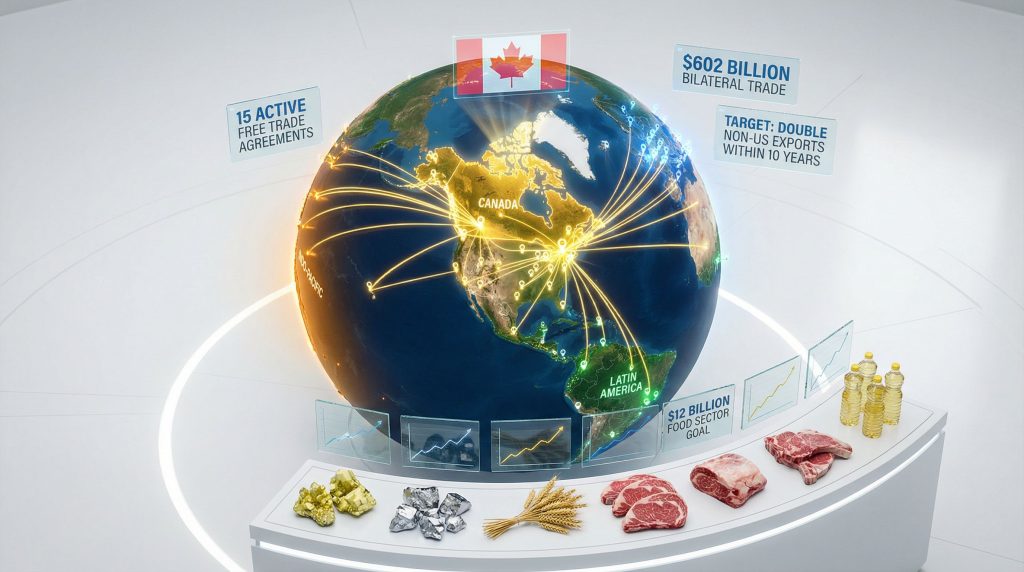
Global economic power structures shift when nations recognise their vulnerabilities and act decisively to address them. Canada's current trade strategy represents such a pivotal moment, as the country systematically reduces its dependence on any single market while expanding access to 15 active free trade agreements spanning 51 countries. This transformation provides access to approximately 1.5 billion consumers globally, fundamentally altering the economic landscape for Canadian exporters.
The scope of this Canada trade diversification strategy extends beyond simple market expansion. Government officials have established ambitious targets, including doubling non-US exports within a decade and redirecting $12 billion in food sector exports, representing 33% of current US agricultural trade. The Trade Commissioner Service has positioned 85% of its personnel outside US markets, demonstrating institutional commitment to this geographic rebalancing.
Recent developments underscore the urgency of this approach. When President Trump threatened 100% tariffs on all Canadian goods in response to Canada's electric vehicle trade arrangements with China, Foreign Minister Anita Anand's response emphasised economic sovereignty. As reported by Bloomberg, she stated that protecting and empowering the Canadian economy through trade diversification remains fundamental to national strategy, noting specific engagement with China and planned expansion into Indian markets.
When big ASX news breaks, our subscribers know first
Economic Vulnerabilities Driving Diversification
Canada's economic exposure centres on bilateral trade flows that reached $602 billion in the first ten months of recent data, according to US Commerce Department figures. The US exported approximately $280 billion to Canada whilst importing $322 billion, creating one of the world's largest bilateral trade relationships. This concentration, whilst beneficial during stable periods, creates systemic vulnerabilities during trade tensions or policy shifts.
The Trump administration's tariff warnings illustrate these risks in real-time. However, this situation also highlights the broader US tariffs impact on Canadian industries that extends beyond bilateral relationships. The threatened 100% tariff scenario would effectively eliminate price competitiveness for most Canadian exports, demonstrating how single-market dependence can undermine economic stability.
Historical precedent from 2018-2019 steel and aluminium tariffs demonstrated Canada's vulnerability to unilateral trade actions. Those episodes resulted in Canadian retaliatory tariffs on US agricultural and consumer goods, highlighting the economic costs of bilateral trade disputes. Furthermore, the current trigger involving Canada's electric vehicle tariff agreement with China shows how third-party relationships can impact primary trading partnerships.
Risk Assessment Framework:
• Geographic distribution across Indo-Pacific, European, and Latin American markets
• Sector-specific diversification targeting critical minerals, energy, and agricultural products
• Enhanced domestic inter-provincial trade integration
• Development of alternative supply chain routes
Markets Offering Greatest Diversification Potential
Indo-Pacific Economic Integration
The Indo-Pacific region represents Canada's second-largest trading bloc, with CPTPP nations demonstrating 39% trade growth since 2018. This multilateral framework involves 11 countries including Australia, Japan, New Zealand, Vietnam, Singapore, Malaysia, Mexico, Chile, Peru, and Brunei, creating diverse market opportunities across multiple time zones and economic development levels.
Canada's engagement with India exemplifies strategic partnership development. Energy Minister Tim Hodgson's participation in the Goa energy conference includes meetings with officials from Prime Minister Narendra Modi's government, focusing on critical minerals, uranium, and liquefied natural gas cooperation. This aligns with India's strategic supply requirements and Canada's resource abundance, creating natural supply-demand complementarity.
India Partnership Opportunities:
• Critical minerals cooperation for energy transition technologies
• Uranium supply agreements supporting nuclear power expansion
• LNG export potential through West Coast facilities
• Technology transfer in clean energy sectors
The strategic value extends beyond commodity trade. India's position as one of the world's fastest-growing major economies, with energy consumption growth estimated at 4-5% annually, creates long-term demand security for Canadian resource exports. Consequently, this relationship reduces single-buyer dependence whilst establishing pricing leverage through competitive demand.
European Market Expansion Through CETA
The Canada-European Union Comprehensive Economic and Trade Agreement (CETA) provides access to sophisticated consumer markets with higher value-added product demand. Implemented provisionally since 2017 with full ratification completed in 2022, CETA eliminates tariffs on the majority of goods between Canada and EU member states.
UK-specific opportunities exceed $47 billion in annual trade, representing significant post-Brexit relationship development potential. The regulatory alignment between Canadian and European standards creates advantages in sectors requiring compliance with stringent environmental and safety regulations.
CETA Market Access Benefits:
• Eliminated tariffs on majority of Canadian exports
• Government procurement opportunities
• Intellectual property protection frameworks
• Investment protection mechanisms
Sector-Specific Diversification Creating Economic Resilience
Critical Minerals Strategy
Canada's mineral wealth positions the country as a strategic supplier during the global energy transition. The country ranks among the world's top uranium producers, historically maintaining #3-4 producer status with #2 proven reserves after Kazakhstan. Significant nickel production from the Sudbury Basin and growing lithium production from recent projects provide diversified mineral portfolio exposure.
Critical Minerals Portfolio:
| Mineral | Primary Applications | Strategic Importance |
|---|---|---|
| Uranium | Nuclear power generation, medical isotopes | Global nuclear capacity expansion |
| Lithium | Battery technology, grid storage | Electric vehicle demand growth |
| Rare Earth Elements | Permanent magnets, electronics | Wind turbine and defence applications |
| Copper | Electrical transmission, renewable systems | Infrastructure electrification |
| Nickel | Battery chemistry, stainless steel | EV battery manufacturing |
The International Energy Agency projects mineral demands will increase 2-4 times by 2040, with lithium demand particularly acute at 6-8 times current levels for EV battery manufacturing. Supply-demand gaps represent critical constraints on energy transition speed, creating pricing power for established producers.
Canada's supply chain advantages include geographic proximity to US manufacturing hubs, established mining infrastructure, and environmental standards alignment with buyers. Political stability relative to competing suppliers adds premium value during uncertain geopolitical periods.
Agricultural Export Transformation
The $12 billion food sector diversification represents strategic reallocation of 33% of current US agricultural exports toward alternative markets. Recent trade agreements have secured canola and beef access through China, demonstrating tangible progress in market access negotiations.
Agricultural Innovation Focus Areas:
• Organic and plant-based protein development for health-conscious markets
• Speciality food products targeting niche premium segments
• Value-added processing capabilities increasing export margins
• Sustainable production methods appealing to environmentally conscious consumers
Market entry strategies emphasise Latin American penetration and European premium positioning, capitalising on Canada's reputation for food safety and environmental stewardship. This approach commands price premiums compared to commodity-level exports whilst building brand recognition in target markets.
Implementation Mechanisms Supporting Strategy
Financial Support Infrastructure
The CanExport SMEs Program allocated $38.3 million for 1,773 small and medium enterprises during 2023-2024, providing direct market entry support for new export destinations. This program reduces financial barriers for companies entering unfamiliar markets whilst providing risk mitigation during initial market development phases.
Program benefits include market research funding, trade mission participation support, and regulatory compliance assistance. The focus on SMEs ensures diversification benefits extend beyond large corporations to smaller enterprises that form the backbone of regional economies.
Diplomatic Trade Architecture
Canada's Trade Commissioner network provides on-ground support across target markets, with 85% positioned outside US territories to facilitate diversification efforts. These commissioners offer local market intelligence, regulatory guidance, and relationship facilitation between Canadian exporters and foreign buyers.
The network's geographic redistribution signals long-term commitment to diversification rather than temporary policy adjustment. Commissioners provide cultural bridge functions, translating business practices and regulatory requirements for Canadian companies entering complex international markets.
Geopolitical Scenarios Affecting Implementation
Accelerated Diversification Scenario
Under increased US trade pressure, Canada may expedite bilateral negotiations with key partners, potentially achieving 50% non-US export targets within 7-8 years rather than the planned decade. This scenario would require enhanced diplomatic engagement and accelerated regulatory approval processes for new trade agreements.
Emergency protocols could include temporary trade agreements and accelerated resource development projects, prioritising speed over comprehensive negotiation coverage. Such acceleration would likely focus on sectors with immediate export capacity rather than long-term development projects. For instance, understanding the broader tariffs impact on investment markets helps inform strategic timing decisions.
Gradual Integration Scenario
In stable trade environments, Canada can pursue methodical market development, building sustainable relationships whilst maintaining US trade volumes at current levels. This approach emphasises quality over speed, ensuring new market relationships develop strong foundations for long-term growth.
Gradual integration allows for comprehensive regulatory alignment, cultural adaptation, and infrastructure development supporting sustainable export growth. This scenario maximises long-term economic benefits whilst minimising disruption to existing trade relationships.
Crisis Response Scenario
Severe trade disruptions could trigger emergency diversification protocols, including temporary trade agreements and accelerated resource development projects. Crisis response would prioritise essential goods and services, ensuring economic continuity during major trade relationship disruptions.
Such scenarios might involve government-backed export financing, expedited regulatory approvals, and direct diplomatic intervention to secure alternative market access. The focus would shift from optimal terms to available alternatives that maintain economic stability, particularly given the broader US‑China trade war impact on global supply chains.
The next major ASX story will hit our subscribers first
Long-Term Economic Outcomes and Success Metrics
Economic Sovereignty Enhancement
Diversification reduces Canada's vulnerability to single-country policy changes whilst creating competitive pressure that benefits Canadian exporters through multiple market options. This competitive dynamic improves negotiating leverage in all trade relationships, including the primary US partnership.
Economic sovereignty extends beyond trade to include supply chain security, technology access, and investment flows. Multiple trading relationships provide alternative sources for critical imports whilst reducing dependence on single suppliers for essential goods and services.
Innovation-Driven Growth
New market requirements drive technological advancement and product innovation, particularly in clean technology, sustainable agriculture, and resource processing sectors. Different regulatory environments and consumer preferences encourage product development that enhances global competitiveness. This is particularly relevant when addressing Canada energy challenges through innovative solutions.
Innovation Catalyst Areas:
• Clean technology development for European environmental standards
• Precision agriculture for diverse climate conditions
• Resource processing efficiency for cost-competitive exports
• Sustainable packaging for environmentally conscious markets
Performance Measurement Framework
Success metrics combine quantitative trade flow data with qualitative indicators of economic resilience and innovation adoption. Key performance indicators include non-US export percentage growth targeting 50% increase over the strategic timeline.
Quantitative Metrics:
• Non-US export value and percentage of total exports
• Number of new bilateral trade agreements implemented
• SME participation rates in international markets
• Regional economic development balance across provinces
Qualitative Indicators:
• Supply chain resilience during global disruptions
• Innovation adoption rates in export sectors
• Cultural and regulatory adaptation success
• Long-term relationship stability with new trading partners
Investment Consideration: The Canada trade diversification strategy creates opportunities for investors in companies positioned to benefit from expanded market access, particularly in critical minerals, agricultural processing, and clean technology sectors. However, implementation timelines and geopolitical developments may affect individual company performance.
The transformation of Canada's trade architecture represents a fundamental shift toward economic resilience through geographic diversification. While maintaining strong relationships with traditional partners, this strategy positions Canada to capitalise on global growth opportunities whilst reducing concentration risk. Success depends on sustained political commitment, private sector adaptation, and continued diplomatic engagement across multiple continents. As outlined by Trade Commissioner Service guidance, systematic market development provides the foundation for sustainable export growth beyond traditional dependencies.
Looking to Capitalise on Global Trade Diversification Opportunities?
Canada's strategic trade pivot towards diversified markets creates significant opportunities for investors in critical minerals, clean technology, and resource sectors. Discovery Alert's proprietary Discovery IQ model delivers real-time alerts on significant ASX mineral discoveries, instantly identifying actionable opportunities as Canadian companies expand into new markets and secure strategic partnerships. Begin your 30-day free trial today to position yourself ahead of the market in this evolving trade landscape.