July 15, 2026
The Strategic Logic Behind Canada's Most Ambitious Infrastructure Gamble
For resource-rich nations, the difference between being a commodity supplier and an energy power often comes down to a single variable: where the pipe goes. Countries that control their export routes control their pricing leverage, their geopolitical options, and ultimately their economic destiny. Canada has understood this arithmetic for decades, yet structural, political, and regulatory friction kept its crude oil tethered to a single customer. That calculation is now being forcibly renegotiated, driven not by long-term planning alone, but by a sharp deterioration in the reliability of the trade relationship that Canada long took for granted.
The Canada West Coast oil pipeline and oil sands expansion framework, formalised through a trilateral agreement between the federal government, the province of Alberta, and the country's five largest oil sands producers, represents the most consequential energy infrastructure commitment in a generation. Understanding what it involves, why it matters, and where it could still unravel requires examining it from multiple angles simultaneously.
When big ASX news breaks, our subscribers know first
Why Sending 90% of Your Oil to One Buyer Is a Structural Vulnerability
Prior to the return of trade hostilities with Washington, Canada exported roughly 90% of its crude oil to the United States. For most of the post-war era, this arrangement was commercially rational. American refineries on the Gulf Coast and in the Midwest were specifically configured to process heavy, high-sulphur crude, the grade that dominates Alberta's oil sands output. The pipeline infrastructure, the pricing relationships, and the regulatory frameworks were all built to serve this bilateral flow.
The problem with optimising entirely around a single customer is that the relationship becomes a single point of failure. When U.S. trade policy shifted, imposing Canadian energy export tariffs and introducing rhetorical threats to Canadian sovereignty, the vulnerability of this arrangement became impossible to ignore. Canada found itself in the position of a commodity exporter with no credible alternative buyer, no alternative routing infrastructure, and no timeline for building either.
The Western Canadian Select (WCS) price differential illustrates the financial cost of this dependency with uncomfortable precision. Because Canadian heavy crude has limited options for reaching global markets, it has historically traded at a $10 to $20 per barrel discount to West Texas Intermediate (WTI). That discount is not a reflection of crude quality in isolation. It is largely a function of geography and infrastructure, meaning it is a problem that pipeline investment can directly address.
What the West Coast Oil Pipeline Actually Is
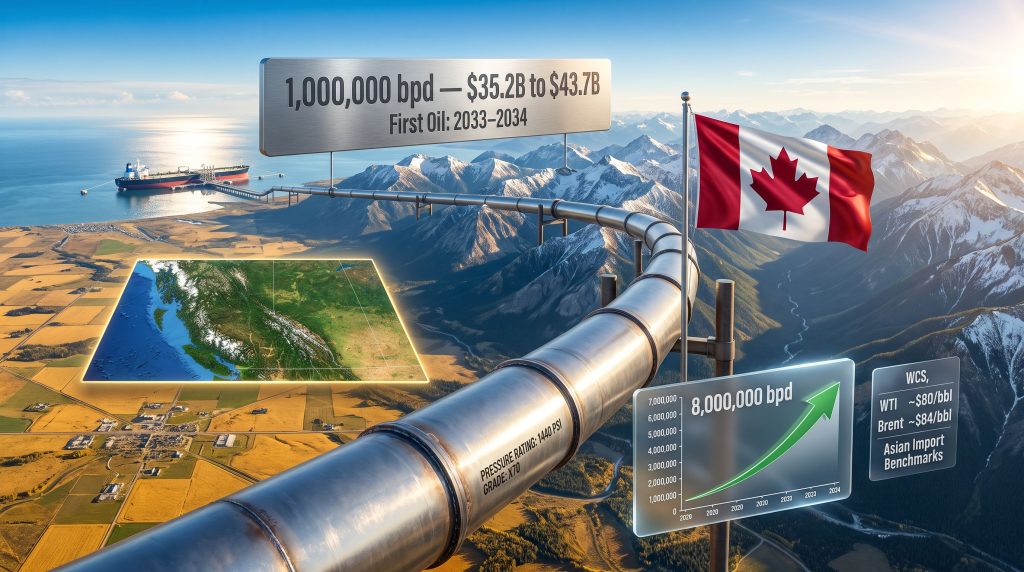
The proposed West Coast Oil Pipeline (WCOP) is a heavy crude corridor running from Edmonton and Bruderheim in Alberta to Roberts Bank on British Columbia's southern coast. At full capacity, it would transport 1,000,000 barrels per day (bpd), making it one of the largest pipeline projects in North American history. The capital cost envelope sits between $35.2 billion and $43.7 billion, including contingencies.
| Feature | Detail |
|---|---|
| Throughput Capacity | 1,000,000 barrels per day |
| Origin Terminal | Edmonton / Bruderheim, Alberta |
| Destination Terminal | Roberts Bank, Southern British Columbia |
| Estimated Capital Cost | $35.2 billion to $43.7 billion |
| Ownership Structure | 90% Crown corporations; 10% Pembina Pipeline Corp (scalable to 20%) |
| Construction Start Target | September 1, 2027 |
| Projected First Oil | 2033 to 2034 |
| Primary Market Target | Asian energy markets |
The ownership structure deserves particular attention. With Crown corporations holding 90% of the equity, this is fundamentally a publicly financed infrastructure project, which simultaneously reduces the commercial barriers to construction and concentrates the downside risk on Canadian taxpayers. Pembina Pipeline Corporation holds the remaining 10% stake, with provisions allowing that interest to scale to 20%, providing a private-sector anchor without diluting public control.
How WCOP Differs From Trans Mountain
The Trans Mountain Expansion (TMX), which entered service in 2024 after years of delays and cost blowouts, provides the closest precedent for what Canada is attempting again. However, the two projects differ in material ways:
- Scale: WCOP's 1,000,000 bpd capacity is roughly double Trans Mountain's expanded throughput of approximately 590,000 bpd.
- Purpose: TMX was primarily an expansion of an existing system. WCOP is a new greenfield corridor.
- Market positioning: WCOP is specifically designed from inception to serve Asian import markets, with terminal infrastructure at Roberts Bank oriented toward Very Large Crude Carrier (VLCC) loading.
- Cost trajectory: TMX's final cost exceeded original estimates by several multiples. WCOP's $35 to $44 billion envelope already incorporates contingency buffers, though the TMX experience suggests even these may prove optimistic.
The lesson from Trans Mountain's cost history is worth internalising. Large, politically complex pipeline projects in Canada have a structural tendency to underestimate total project costs. Furthermore, WCOP's public ownership structure means cost overruns ultimately flow back to the federal and provincial governments rather than private shareholders.
Alberta's Production Ambition and the Infrastructure Bottleneck Problem
Alberta's provincial government has articulated a long-term target of reaching 8,000,000 barrels per day of oil sands production, roughly double current output levels. This is not a near-term operational target; it is a structural vision spanning 10 to 15 years. However, the mechanics of reaching that number are inseparable from the availability of pipeline egress. The Alberta government's west coast pipeline page outlines the province's formal position on this strategic infrastructure priority.
This is the rarely articulated core logic of the entire WCOP framework: pipeline capacity is not a downstream commercial concern for oil sands producers, it is an upstream investment prerequisite. Without a credible timeline for new tidewater access, major producers have limited incentive to commit the multi-billion dollar capital required to expand oil sands operations. The infrastructure decision and the production growth decision are mutually dependent.
One concrete illustration of this dynamic involves a 150,000 bpd expansion scenario that is currently in a holding pattern, contingent on egress resolution. This kind of deferred investment decision is not unique. Across the oil sands sector, large-scale growth phases have been deliberately left in pre-final investment decision (pre-FID) status, awaiting the certainty that a confirmed pipeline corridor would provide. The commercial logic is straightforward: no producer will build extraction capacity they cannot evacuate.
The relationship between pipeline certainty and upstream capital allocation is more direct than most observers appreciate. In the oil sands, where project lead times run five to ten years and capital commitments are measured in tens of billions, infrastructure visibility is not a preference, it is a prerequisite for sanctioning growth.
The Trilateral Agreement: Unpacking the Multi-Party Bargain
The agreement announced in July 2026 is not a simple infrastructure approval. It is better understood as a structured policy bargain in which export capacity, emissions targets, regulatory reform, and investment incentives have been deliberately bundled together. Each party gave something and received something. Consequently, understanding the individual obligations of each party is essential to assessing the deal's durability.
| Party | Key Obligation | Strategic Benefit |
|---|---|---|
| Federal Government | CCS financing, CCUS tax credit reform, regulatory working group, national interest designation pathway | Emissions credibility, energy sovereignty narrative |
| Alberta | Production financial supports, CCS program extension to 2035, 120-day project approvals | Investment attraction, production growth |
| Oil Sands Alliance (5 producers) | Pathways Project milestones, Canadian supply chain priority, production growth coordination | Pipeline access, regulatory certainty |
The five producers in the Oil Sands Alliance are Canadian Natural Resources, Cenovus Energy, ConocoPhillips Canada, Imperial Oil, and Suncor Energy. These companies collectively represent the dominant share of Alberta's oil sands output. Their joint commitment to the Pathways carbon capture and storage (CCS) initiative was a non-negotiable precondition for the federal government's participation in the framework.
Federal Commitments in Detail
The federal government's obligations include:
- Advancing financing mechanisms to support CCS operating costs, including durability provisions within the Clean Fuel Regulations
- Technical review and clarification of the CCUS Investment Tax Credit to address industry concerns
- Establishing a regulatory working group to improve the efficiency of federal statutes governing oil sands development
- Pursuing a pathway toward national interest project designation under the Building Canada Act
Alberta's Obligations
- Implementing financial support mechanisms for oil production growth, with specific instruments yet to be fully defined
- Extending the Carbon Capture Incentive Program through to 2035
- Issuing a Carbon Sequestration Agreement for the Pathways CCS storage complex
- Applying a 120-day approval timeline for qualifying projects
- Establishing a bilateral working group with the Oil Sands Alliance to identify and remove provincial regulatory barriers
The Pathways Project: Why Carbon Capture Is Central to the Deal
The Pathways Alliance CCS project is not a peripheral add-on to the WCOP framework. It is structurally central to the entire agreement. The federal government's willingness to support a new publicly-financed export pipeline is explicitly conditioned on the oil sands sector committing to a credible, large-scale decarbonisation programme.
Pathways is designed as a multi-facility CCS initiative spanning several oil sands operations across the Athabasca region. The project involves capturing carbon dioxide emissions from upgrading and extraction operations and transporting them via pipeline to a geological storage complex in northern Alberta. The storage geology in question involves deep saline aquifers, which Canadian regulators and geoscientists have assessed as having substantial long-term sequestration capacity.
A technically important but underappreciated aspect of the Pathways project is the challenge of achieving consistent capture rates across operations that use different extraction technologies, including Steam-Assisted Gravity Drainage (SAGD) and mining-based extraction. SAGD operations, which use steam injection to mobilise bitumen underground, produce a different emissions profile from surface mining, and CCS integration requires tailored engineering solutions for each facility type.
The 7% Offset Debate
Environmental groups have raised pointed objections to the emissions arithmetic underlying the deal. According to analysis from Greenpeace Canada, the emissions reductions committed under the agreement represent only approximately 7% of current oil sands carbon output. Their argument is that this offset is structurally overwhelmed by the additional emissions that would be enabled by expanding production through a new, publicly financed pipeline corridor.
Proponents counter that the Pathways project represents the largest industrial CCS initiative in Canadian history, and that criticising it for not eliminating 100% of oil sands emissions conflates the purpose of CCS with a demand for production cessation. The debate crystallises a fundamental tension in Canadian climate and energy policy that no trilateral agreement can fully resolve.
The next major ASX story will hit our subscribers first
Regulatory Milestones and the Path to Construction
| Milestone | Date | Status |
|---|---|---|
| Canada-Alberta Implementation Agreement signed | May 15, 2026 | Completed |
| Formal application to Major Projects Office | July 1, 2026 | Completed |
| Trilateral backgrounder document released | July 14, 2026 | Completed |
| National interest project designation targeted | October 1, 2026 | Pending |
| Primary regulatory approval | September 1, 2027 | Pending |
| Construction commencement target | September 1, 2027 | Pending |
| First oil delivery to BC coast | 2033 to 2034 | Projected |
Before construction can begin, several major regulatory gates remain:
- British Columbia must complete its own environmental assessment process, which operates independently of the federal framework
- Indigenous consultation requirements under Section 35 of the Constitution Act must be fulfilled, a legal obligation that has delayed or terminated previous pipeline projects
- Federal regulatory conditions under the Building Canada Act must be satisfied
- Marine terminal approvals at Roberts Bank require separate permitting processes, including assessments of tanker traffic impacts on the Gulf Islands corridor
The BC permitting process is arguably the single most uncertain variable in the entire timeline. British Columbia has historically maintained a cautious position on coastal crude oil infrastructure, and while the political dynamics have shifted under federal pressure, the provincial regulatory process remains an independent track that cannot be accelerated by federal will alone.
The Financial Case: What Pacific Access Does to Canadian Crude Netbacks
The economic justification for WCOP rests fundamentally on the netback improvement that Pacific tidewater access delivers. Canadian heavy crude priced against WCS has historically traded at a $10 to $20 per barrel discount to WTI, a gap driven primarily by pipeline constraints and the absence of alternative routing. This dynamic is well-documented by RBN Energy's analysis of west coast pipeline economics, which highlights the structural drivers behind Alberta's persistent price differential.
| Crude Benchmark | Approximate Reference Range |
|---|---|
| Western Canadian Select (WCS) | Historically $10 to $20/bbl below WTI |
| WTI Crude | Approximately $80/bbl (reference) |
| Brent Crude | Approximately $84/bbl (reference) |
| Asian import benchmarks | Typically at or above Brent levels |
Access to Pacific loading terminals would allow producers to price oil sands volumes against Asian benchmarks rather than against WTI-minus-differential. Depending on market conditions, this could add $15 to $25 per barrel to netback realisations for volumes reaching Roberts Bank. At 1,000,000 bpd of throughput, even a conservative improvement of $15 per barrel equates to annual revenue uplift across the sector of approximately $5.5 billion, providing a meaningful economic return framework against the $35 to $44 billion capital cost.
The upstream investment multiplier effect compounds this logic further. When producers can model stable netbacks against Asian benchmarks, the commercial case for oil sands expansion phases becomes materially stronger, potentially unlocking tens of billions of dollars in deferred upstream capital that is currently sitting in pre-FID status.
Three Scenarios That Will Define Whether WCOP Becomes Reality
Disclaimer: The following scenarios involve speculative analysis based on current information. They do not constitute investment advice. Infrastructure projects of this scale carry substantial execution, regulatory, and political risk.
1. Accelerated Approval Scenario
BC permitting aligns with federal timelines, Indigenous consultation processes reach satisfactory conclusions within projected windows, and construction begins in September 2027 as targeted. First oil reaches the BC coast between 2033 and 2034. This represents the base case assumed by federal and provincial governments.
2. Regulatory Delay Scenario
BC environmental review or Indigenous consultation extends the timeline by two to four years. Construction begins between 2029 and 2031, with first oil delayed to 2036 or beyond. This scenario materially increases the project's financing costs given the public ownership structure, and reduces the net present value of netback improvements for oil sands producers.
3. Project Restructure Scenario
Cost overruns emerge during detailed engineering, political change at the federal or provincial level alters the ownership or financing model, or a significant deterioration in global crude prices undermines the economic rationale. This scenario could trigger a renegotiation of the Crown ownership structure or a partial privatisation of the asset.
Investors and analysts should treat the TMX cost history as a live data point rather than a historical curiosity. The final cost of Trans Mountain's expansion exceeded original estimates by a substantial margin. WCOP's $35 to $44 billion envelope, while it incorporates contingencies, is not immune to the same structural forces that drove TMX costs higher.
What the WCOP Framework Signals for Canada's Energy Position
The Canada West Coast oil pipeline and oil sands expansion agenda represents something more significant than a single infrastructure decision. It reflects a structural recalibration of how Canada positions itself within the global energy system. In addition, it speaks directly to broader questions about Canada oil security and the country's long-term resilience against trade-driven disruptions.
For the first time in decades, the country is making a deliberate, publicly-financed bet on Pacific market access rather than defaulting to the path of least resistance through existing U.S. pipeline systems. This shift is closely aligned with the federal government's broader ambition to position Canada as a Canada energy superpower, a narrative that has gained significant momentum in response to tariff-driven trade disruption and broader concerns about trade wars and supply chains across global commodity markets.
| Metric | Figure |
|---|---|
| Pipeline throughput capacity | 1,000,000 bpd |
| Project cost range | $35.2B to $43.7B |
| Alberta long-term production target | 8,000,000 bpd |
| Crown ownership share | 90% |
| Construction start target | September 2027 |
| First oil projection | 2033 to 2034 |
| Historical U.S. share of Canadian oil exports | Approximately 90% |
Whether that bet pays off depends on execution quality across multiple regulatory jurisdictions, on the trajectory of global crude prices over a decade-long construction and ramp-up period, and on whether the political conditions that created the current sense of urgency persist long enough to see the project through its most challenging phases.
What is certain is that the commercial logic is sound, the geopolitical motivation is real, and the financial architecture, while heavily weighted toward public risk, is sufficiently structured to provide private-sector participants with a credible framework. The gap between sound logic and successful delivery in Canadian pipeline history is well-documented. The Canada West Coast oil pipeline and oil sands expansion project's ultimate significance will be determined by which side of that gap it ends up on.
This article is for informational purposes only and does not constitute financial or investment advice. Forecasts, timelines, and cost projections referenced in this article are speculative and subject to material change. Readers should conduct independent due diligence before making any investment decisions.
Want to Track the ASX Companies Positioned to Benefit From Major Resource Discoveries?
Discovery Alert's proprietary Discovery IQ model delivers real-time alerts the moment significant mineral discoveries are announced on the ASX, instantly cutting through complex data to surface actionable opportunities for both traders and long-term investors. Explore how historic discoveries have generated substantial returns on the Discovery Alert discoveries page, and begin a 14-day free trial to ensure you are positioned ahead of the broader market.