July 15, 2026
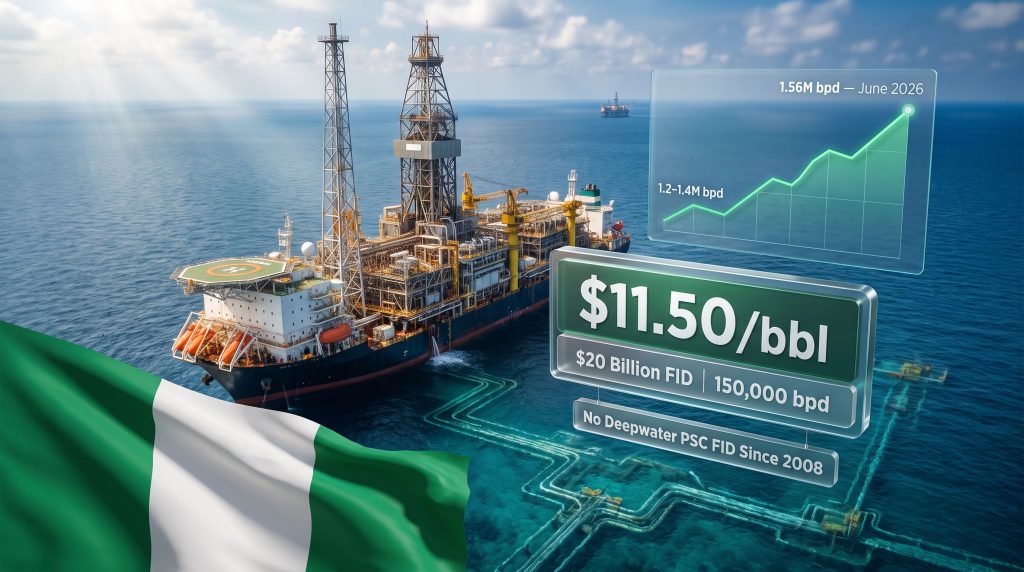
Nigeria's Deepwater Crossroads: Why the $11.50/Barrel Tax Credit for Bonga Southwest Aparo Changes Everything
Global competition for upstream oil and gas capital has never been more intense or more unforgiving. As international oil companies compress their investment portfolios in response to energy transition pressures, capital allocation has become a zero-sum contest between basins. Only jurisdictions that offer a compelling combination of geological prospectivity, fiscal clarity, and operational predictability will win the deals that matter. Against this backdrop, the Nigeria Shell tax incentive for Bonga Southwest Aparo project represents far more than a line item in a fiscal reform agenda. It reflects a fundamental rethinking of how Nigeria intends to compete for deepwater dollars in a world where those dollars are becoming increasingly selective.
When big ASX news breaks, our subscribers know first
The Structural Investment Gap That Made Reform Unavoidable
Nigeria's upstream petroleum sector entered the 2020s carrying the weight of a compounding institutional crisis. Widespread crude theft, persistent pipeline sabotage, deteriorating offshore infrastructure, and an unpredictable regulatory environment had, over the previous decade, steadily dismantled the confidence of international operators. The consequences were tangible and measurable: Nigeria repeatedly failed to meet its OPEC production quotas, not because the geology was deficient, but because the above-ground environment had become structurally hostile to sustained investment.
The most telling indicator of this deterioration was the absence of any new deepwater Production Sharing Contract (PSC) Final Investment Decision since 2008. That near two-decade gap is not simply a statistic. It represents a series of capital allocation decisions made in boardrooms in London, Paris, and Houston, where Nigeria consistently lost out to Angola, Brazil, Guyana, and the Gulf of Mexico. The commercial arithmetic simply did not work under the prevailing fiscal terms.
President Bola Tinubu's administration, which took office in 2023, inherited this structural deficit and moved to address it through a layered reform strategy. Early executive orders introduced production-based tax credits, though their effectiveness was constrained by a 20% annual tax liability cap that industry participants widely regarded as insufficient to bridge the investment gap for large-scale deepwater commitments. The evolution toward project-specific, enhanced fiscal engineering represents the next, more sophisticated phase of that reform.
What Bonga Southwest Aparo Actually Is
It is worth stepping back to understand why this particular project carries such outsized weight in Nigeria's energy narrative.
Bonga Southwest Aparo (BSWA) is a deepwater offshore development situated in the Gulf of Guinea, operated by Shell Nigeria Exploration and Production Company (SNEPCo), a subsidiary of Shell plc, in partnership with NNPC Limited. The project has been in various stages of planning, evaluation, and delay for roughly two decades, making it something of a barometer for the health of Nigeria's entire upstream investment climate.
| Metric | Detail |
|---|---|
| Operator | SNEPCo (Shell subsidiary) |
| Government Partner | NNPC Limited |
| Expected FDI | ~$20 billion |
| Projected Daily Output | ~150,000 barrels per day |
| Contract Structure | Production Sharing Contract (PSC) |
| FID Status | Pending; incentive package designed to unlock decision |
| Last Nigerian Deepwater PSC FID | 2008 |
| Shell Investment in Nigeria Since Incentive Announcement | Over $7 billion |
At 150,000 barrels per day, BSWA would deliver a material and immediate uplift to Nigeria's national production baseline. The $20 billion FDI figure, as confirmed by NNPC Limited, positions it as one of the largest single capital commitments in Sub-Saharan African energy history. For context, this is not a marginal project. It is the kind of anchor investment that reshapes a country's upstream trajectory for a generation.
Dissecting the $11.50 Per Barrel Tax Credit
What a Production Tax Credit Does in Practice
A Production Tax Credit (PTC) in Nigeria's upstream petroleum context operates as a per-barrel fiscal rebate applied against an operator's tax liability. Rather than reducing the headline tax rate, it functions as a direct offset tied to actual production volumes, meaning the government's fiscal cost is incurred only when hydrocarbons are physically extracted. This structure aligns government and operator incentives: both parties benefit from production growth, and neither bears disproportionate fiscal risk on capital deployed during the pre-production development phase.
Key Mechanism: PTCs are fundamentally different from tax holidays or royalty waivers. They are production-conditional, incremental, and self-limiting in their fiscal cost to the government, making them a structurally disciplined form of investment incentive.
Why $11.50/Barrel Was the Number That Mattered
The enhanced PTC of $11.50 per barrel approved for the Nigeria Shell tax incentive for Bonga Southwest Aparo project is more than double the standard tax credit available under existing Nigerian petroleum regulations. According to sources familiar with the matter cited by Bloomberg, the incentive was approved following direct engagement between NNPC Limited, the Nigeria Revenue Service, and Shell plc's chief executive. The negotiation itself is instructive: it reflects the high-level political and commercial attention the project commands.
To understand why this specific figure was necessary, it helps to consider the cost architecture of deepwater PSC developments compared to other hydrocarbon environments. Furthermore, the commodity price impact on investment decisions cannot be overlooked when evaluating why enhanced incentives were essential:
- Deepwater drilling costs are typically 3 to 5 times higher per well than comparable onshore operations
- Subsea tiebacks, floating production storage and offloading (FPSO) vessels, and deepwater pipeline infrastructure involve capital expenditure measured in billions, not millions
- Development timelines extend over many years before first production, creating extended periods of capital at risk without revenue return
- Country risk premiums applied to Nigerian operations have historically elevated the hurdle rate that projects must clear to win internal capital allocation approval
At the standard credit rate, BSWA's internal rate of return almost certainly fell short of Shell's global capital allocation threshold. The enhanced $11.50/barrel credit is calibrated to close that gap and bring the project into competitive alignment with deepwater opportunities Shell evaluates across its global portfolio.
The 2021 Dispute Settlement: The Non-Fiscal Unlock
Alongside the enhanced PTC, the incentive package incorporated the formal resolution of a 2021 commercial dispute between Shell and the Nigerian government. This element deserves equal analytical weight to the tax credit itself. Unresolved legacy disputes represent one of the most persistent and underappreciated categories of IOC hesitation in frontier energy markets.
They introduce legal contingency into financial models, complicate board-level capital approval processes, and signal broader governance risk to institutional investors evaluating a company's exposure to a particular jurisdiction. Clearing this overhang was not merely symbolic. It removed a structural impediment that had clouded Shell's internal project economics and created uncertainty over the contractual foundation on which any future investment would rest.
Comparative Fiscal Architecture: BSWA vs. Standard Nigerian Instruments
| Instrument | Rate / Structure | Applicability | Cap |
|---|---|---|---|
| Standard Production Tax Credit (pre-BSWA) | Below $11.50/bbl | Broad upstream operations | 20% of annual tax liability |
| Enhanced PTC (BSWA-specific) | $11.50/bbl | New deepwater PSC investments | Not publicly specified |
| Executive Order PTC (2023) | Production-based | New and incremental production | 20% annual tax liability cap |
| BSWA Dispute Settlement Component | Non-monetary (legacy resolution) | BSWA project-specific | N/A |
This comparative framing illustrates a deliberate progression in fiscal engineering sophistication. The administration moved from broad-based, capped incentives toward targeted, project-specific instruments designed to address the precise commercial barriers that were preventing FIDs. This approach mirrors successful precedents in Angola, Brazil, and the Gulf of Mexico, where tiered incentive structures have historically been used to unlock stalled deepwater project decisions.
Critically, the BSWA incentive is structured as an investment-conditional mechanism rather than a blanket sector concession. Eligibility is tied to new capital deployment and incremental production volumes, ensuring the government does not forfeit tax revenue on existing or legacy production streams. This design discipline is important for fiscal credibility: it demonstrates that Nigeria can craft sophisticated, commercially aware fiscal instruments rather than offering undifferentiated concessions that erode the sovereign revenue base.
Nigeria's Production Recovery: Early Data Points
The broader reform context provides important supporting evidence that the Tinubu administration's upstream strategy is generating measurable results, not merely policy commitments.
Data from the Nigerian Upstream Petroleum Regulatory Commission (NUPRC) confirms that Nigeria's crude oil production averaged 1.56 million barrels per day in June 2026, representing the country's highest monthly output since April 2020. Consequently, understanding the crude oil price trends alongside this production recovery is essential context for investors evaluating the project's commercial viability.
| Period | Approximate Production Level | Key Driver |
|---|---|---|
| Peak (pre-2015) | ~2.2 million bpd | Stable IOC investment cycle |
| 2020 Low | ~1.2-1.4 million bpd | COVID-19, theft, infrastructure decline |
| June 2026 | ~1.56 million bpd | Tinubu-era reforms, security improvements |
| BSWA Target (post-FID) | +150,000 bpd incremental | Deepwater expansion |
This trajectory matters for investor psychology as much as for the physical oil market. IOCs making capital allocation decisions do not evaluate fiscal incentives in isolation. They assess whether a jurisdiction's underlying trajectory is improving or deteriorating. A six-year production high provides empirical validation that Nigeria's above-ground environment is genuinely changing, not simply being repackaged with new rhetoric.
However, the path from 1.56 million bpd to the pre-2015 peak of approximately 2.2 million bpd remains a substantial one. Closing that gap will require sustained foreign direct investment across multiple asset classes, continued security improvements in the Niger Delta, and accelerated rehabilitation of onshore and offshore infrastructure that has degraded through years of underinvestment.
The next major ASX story will hit our subscribers first
The Precedent Effect: What This Means for Other IOCs
Perhaps the most strategically significant dimension of the BSWA incentive package is not what it means for Shell specifically, but what it signals for the broader Nigerian deepwater pipeline. In addition, the OPEC market influence on Nigeria's production targets adds further urgency to these investment decisions.
Government sources indicate the enhanced PTC framework is expected to be extended to other international oil companies pursuing large-scale deepwater investments. This positions BSWA as a template transaction, a proof-of-concept for a replicable fiscal architecture that could unlock a pipeline of stalled deepwater FIDs across Nigeria's undeveloped PSC acreage.
Nigeria holds significant undeveloped deepwater acreage across multiple blocks, with several major IOCs holding interests in projects that have similarly been stranded at pre-FID stages. A credible, precedent-backed incentive framework could catalyse a broader wave of investment decisions, potentially adding hundreds of thousands of barrels per day to Nigeria's long-term production profile over the next decade.
Investor Consideration: Shell's deployment of over $7 billion in Nigeria since the incentive announcement suggests that the fiscal engineering is translating into tangible capital commitment at the operator level, a critical validation signal for other companies evaluating whether Nigerian fiscal commitments are durable.
Nigeria in the Global Deepwater Capital Competition
The Strategic Window and Its Constraints
Nigeria's deepwater incentive strategy is being executed against an increasingly compressed timeline. Energy transition pressures are causing major IOCs to concentrate upstream capital into fewer, higher-return basins while simultaneously managing portfolio carbon intensity. This creates a narrowing strategic window during which Nigeria can realistically compete for the large-scale deepwater commitments that would structurally transform its production trajectory.
The positive signals are meaningful:
- Enhanced, project-specific fiscal terms that address documented investment barriers
- A production recovery to a six-year high, providing empirical reform validation
- Legacy dispute resolution removing non-fiscal investment impediments
- High-level government engagement with major IOC leadership, signalling political commitment
- Demonstrated capital deployment by Shell as evidence of operational confidence
The persistent risks remain equally real:
- Infrastructure rehabilitation timelines that extend years beyond FID announcements
- Niger Delta security dynamics that continue to introduce operational uncertainty
- Global oil price volatility, which can rapidly alter the IRR calculus for long-cycle deepwater investments
- The long-term trajectory of hydrocarbon demand under accelerating energy transition scenarios
Lessons from Comparable Deepwater Jurisdictions
It is instructive to examine how similar fiscal interventions have performed in comparable environments. The broader geopolitical landscape for energy investment, furthermore, continues to shape how IOCs weigh competing basin opportunities globally. Angola's deepwater fiscal reforms in the early 2000s helped sustain IOC investment through periods of oil price volatility by providing production-linked incentives that maintained project economics across the commodity cycle.
Brazil's pre-salt development relied heavily on contractual stability and fiscal predictability to attract the multi-decade capital commitments that deepwater infrastructure requires. In both cases, the fiscal instrument was a necessary but not sufficient condition. The sufficient condition was demonstrated institutional follow-through over multiple years and multiple administrations. This is the deeper test Nigeria's reform agenda now faces. The Nigeria Shell tax incentive for Bonga Southwest Aparo project represents sophisticated fiscal engineering. Whether it translates into a confirmed FID, and ultimately into first production, will depend on the durability of that commitment through the long development cycle ahead.
Moreover, with the oil market trade war creating additional headwinds for global energy investment, Nigeria's fiscal reforms carry even greater strategic weight in attracting capital that might otherwise flow to more stable jurisdictions.
Frequently Asked Questions: Nigeria Shell Tax Incentive and Bonga Southwest Aparo
What is the Bonga Southwest Aparo project?
Bonga Southwest Aparo (BSWA) is a major deepwater offshore oil development located in Nigeria's Gulf of Guinea, operated by Shell's Nigerian subsidiary SNEPCo in partnership with NNPC Limited. The project is expected to produce approximately 150,000 barrels of crude oil per day and attract around $20 billion in foreign direct investment once a Final Investment Decision is confirmed.
What tax incentive did Nigeria approve for the project?
Nigeria approved an enhanced Production Tax Credit of $11.50 per barrel of crude produced under the BSWA project. This rate is more than double the standard tax credit available under existing Nigerian petroleum regulations and was approved by President Tinubu following negotiations involving Shell and NNPC Limited.
Why was the standard tax credit insufficient?
The standard PTC was capped at 20% of a company's annual tax liability, a ceiling that did not adequately account for the substantially higher capital intensity, longer development timelines, and elevated country risk premiums associated with large-scale deepwater PSC developments in Nigeria.
When was the last deepwater PSC FID in Nigeria?
The last Final Investment Decision on a Nigerian deepwater PSC asset was taken in 2008. A confirmed BSWA FID would end a gap of nearly two decades in deepwater PSC investment commitments.
Will other oil companies receive similar terms?
Government sources indicate the enhanced PTC framework is expected to be extended to other international oil companies pursuing large-scale deepwater investments in Nigeria, with BSWA positioned as the template for future deepwater fiscal negotiations.
What is Nigeria's current crude oil production level?
According to NUPRC data, Nigeria's crude oil production averaged 1.56 million barrels per day in June 2026, the country's highest monthly output since April 2020.
This article contains forward-looking analysis and references to production forecasts, fiscal projections, and investment timelines. These involve inherent uncertainties and should not be construed as financial advice. Readers are encouraged to conduct independent research and consult qualified advisors before making investment decisions.
Want to Track the Next Major Resource Discovery Before the Market Does?
Discovery Alert's proprietary Discovery IQ model delivers real-time alerts on significant ASX mineral discoveries, transforming complex resource data into actionable investment insights — explore the historic returns major discoveries have generated and begin a 14-day free trial at Discovery Alert to position yourself ahead of the broader market.