
June 12, 2026
The global energy landscape faces unprecedented disruption as traditional supply corridors experience systematic breakdown, forcing nations to recalibrate decades-old procurement strategies. Modern economies built around predictable energy flows now confront the reality that geographic concentration of supply sources creates vulnerability that can materialise within hours, not months. Canadian crude oil exports to South Korea exemplify this fundamental shift, representing more than temporary market volatility – it signals a permanent restructuring of how energy security is conceptualised and operationalised across the Pacific Rim.
Strategic Vulnerability in Energy Import Dependencies
Energy security frameworks traditionally assumed that diversified supplier relationships provided adequate protection against supply disruptions. However, recent events demonstrate that geographic bottlenecks can neutralise supplier diversity when multiple sources transit through common chokepoints. The Strait of Hormuz closure following the February 28, 2026 conflict between the US, Israel, and Iran eliminated 20% of global daily oil supply within 72 hours, according to industry analysis.
This disruption exposed the asymmetrical vulnerability of energy-dependent economies. South Korea, identified by Wood Mackenzie as facing the most severe impact from the Hormuz closure, sources approximately 70% of its oil supply from Middle Eastern producers. The cascading effects include potential 74% increases in electricity costs if supply disruptions persist through 2026, while Italy faces 80% cost increases and Japan confronts 41% higher energy expenses.
Current Rationing Response Across Five Nations:
- Sri Lanka: Mandatory fuel purchase limits
- Myanmar: Government-controlled distribution quotas
- Cambodia: Rationing protocols for transport fuel
- Bangladesh: Emergency conservation measures
- Slovenia: Supply allocation restrictions
The speed of market disruption fundamentally challenges traditional energy security planning. Nations implementing rationing measures within weeks of supply interruption indicate that strategic petroleum reserves provide insufficient buffer time for alternative procurement arrangements.
When big ASX news breaks, our subscribers know first
Canada's Pacific Export Infrastructure Revolution
The Trans Mountain Expansion Project represents a paradigm shift in North American energy export capabilities, transforming Canada from a single-customer oil supplier into a diversified Pacific market participant. Completed in May 2024 at a cost of CAD$34 billion, the pipeline expanded capacity from 300,000 to 890,000 barrels per day and established the Westridge Marine Terminal as Canada's primary Pacific gateway.
TMX Infrastructure Specifications:
| Component | Capacity | Investment |
|---|---|---|
| Pipeline Expansion | 890,000 bpd | CAD$34 billion |
| Westridge Terminal | Aframax tanker capability | Integrated facility |
| Geographic Reach | Edmonton to Burnaby | 1,150 kilometers |
Historical infrastructure constraints previously limited Canadian crude exports to north-south pipeline networks serving US Midwest and Gulf Coast refineries. Failed pipeline proposals including Energy East (Alberta to New Brunswick/Quebec) and Northern Gateway (northern Alberta/BC to tidewater) maintained Canada's export dependency on US markets, where 96% of production historically flowed.
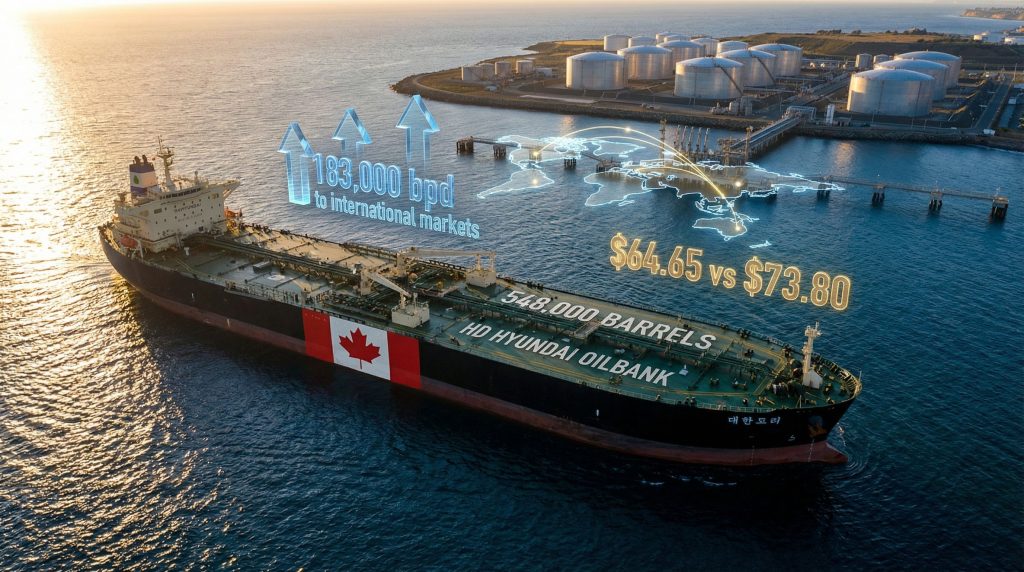
Furthermore, the infrastructure breakthrough enabled immediate market diversification results. In TMX's first operational year, non-US exports increased 60% to approximately 183,000 barrels per day. China displaced the United States as TMX's largest customer, with Japan, India, Brunei, and Taiwan establishing regular delivery schedules.
This transformation occurred despite initial scepticism about TMX's commercial viability. Critics highlighted Vancouver's port limitations to Aframax-class tankers, smaller than the Very Large Crude Carriers typical in Asian markets, as a competitive disadvantage. However, geopolitical disruptions validated the infrastructure investment by creating immediate demand for non-Middle Eastern crude supplies, particularly relating to Canada's energy transition.
Competitive Pricing Dynamics in Asian Markets
Landed Crude Oil Costs in South Korea (2025 Analysis):
| Origin | Price per Barrel | Total Landed Cost |
|---|---|---|
| Canadian WCS | $64.65 | Included |
| US WTI | $73.64 | Included |
| Saudi Light | $73.80 | Included |
Canadian crude oil exports to South Korea demonstrate significant price competitiveness, with Western Canadian Select delivering $8.99 per barrel savings versus US WTI and $9.15 per barrel advantage over Saudi Light crude. These pricing differentials reflect comprehensive landed cost calculations incorporating wellhead prices, pipeline transportation, port handling, shipping costs, and insurance charges.
The pricing advantage represents a compression from historical discounts reaching $20 per barrel that Canadian producers previously accepted due to export infrastructure constraints. Alberta's heavy crude containing sulfur impurities traditionally traded at substantial discounts to benchmark prices, with billions of dollars in value lost annually through constrained market access.
In addition, South Korean refiners evaluated Canadian crude against three critical criteria: price competitiveness, immediate availability, and geopolitical neutrality. Canadian supply satisfied all requirements, with price serving as a decisive differentiator in procurement evaluations conducted under emergency diversification protocols.
Corporate Validation Timeline:
- September 2024: GS Caltex test shipment (300,000 barrels shared with Japan's ENEOS)
- April 2025: HD Hyundai Oil Bank commercial cargo (548,000 barrels)
- Ongoing 2025: SK Energy long-term contract negotiations
HD Hyundai Oil Bank confirmed plans to gradually increase Canadian volumes, while SK Energy and GS Caltex actively pursue supply agreements. This corporate engagement demonstrates confidence in sustained price competitiveness and supply reliability beyond initial emergency procurement.
Heavy Crude Processing and Refinery Compatibility
Western Canadian Select's classification as heavy crude with sulfur content historically required pricing discounts due to increased processing complexity. Heavy crude refining demands more intensive hydrotreating for sulfur removal, greater hydrogen consumption, and additional capital investment in sulfur recovery units compared to light crude processing.
However, South Korean refiners possess heavy crude processing capabilities that enable profitable WCS utilisation despite processing complexity. The $9 per barrel price advantage offsets additional processing costs, creating acceptable refining margins for Korean facilities equipped with appropriate infrastructure.
Technical processing requirements include:
- Enhanced hydrotreating capacity for sulfur removal
- Increased hydrogen production and consumption
- Higher energy input for severe processing conditions
- Advanced sulfur recovery unit operations
The successful integration of Canadian heavy crude into South Korean refinery operations indicates that existing infrastructure accommodates WCS specifications without major modifications. Nevertheless, optimisation opportunities exist for refiners willing to invest in enhanced heavy crude processing capabilities.
Supply Chain Security and Geographic Diversification
Canadian crude oil exports to South Korea provide supply chain advantages through geographic route security compared to traditional Middle Eastern sources. The Pacific shipping route from Westridge Terminal to South Korean ports avoids geopolitical chokepoints that have demonstrated vulnerability to rapid closure.
Transit Security Comparison:
| Route | Chokepoint Risk | Transit Time | Geopolitical Exposure |
|---|---|---|---|
| Canada-South Korea | None | 10-12 days | Minimal |
| Middle East-South Korea | Strait of Hormuz | 12-15 days | High |
| US Gulf Coast-South Korea | Panama Canal | 16-20 days | Moderate |
South Korea's historical 70% dependency on Middle Eastern crude created concentrated vulnerability when the Strait of Hormuz closed. The geographic concentration that previously enabled efficient procurement became a strategic liability requiring immediate diversification response.
Moreover, Canadian supply offers contract flexibility and volume scalability advantages. Unlike traditional long-term contracts with Middle Eastern suppliers that require multi-year commitments, Canadian crude procurement enables more responsive contract structures that adapt to changing market conditions, particularly given Trump tariffs and oil rally dynamics.
Seoul authorised a crude oil swap programme encompassing 20 million barrels of government-held reserves, with 2 million barrels already released to incentivise diversification away from Middle Eastern suppliers. This mechanism provides Korean refiners financial incentives to source non-Middle Eastern crude, positioning Canada as a primary beneficiary of government-subsidised diversification.
Asian Market Penetration and Growth Trajectory
Canadian crude oil exports to South Korea achieved remarkable market penetration speed, growing from $0 in 2023 to CAD$411 million between May 2024 and September 2025. This represents 4.54 million barrels exported over two years, demonstrating rapid commercial acceptance despite starting from zero market presence.
Export Volume Progression:
- 2023: Zero exports to South Korea
- September 2024: First commercial test cargo (300,000 barrels)
- April 2025: Major shipment expansion (548,000 barrels)
- May 2024-September 2025: Cumulative CAD$411 million in exports
While current Canadian supply represents approximately 0.5% of South Korean total imports, the trajectory indicates substantial growth potential. Industry analysis suggests Canada could supply tens of millions of barrels annually within several years as contract relationships mature and infrastructure utilisation increases.
China's emergence as TMX's largest customer in the pipeline's first operational year demonstrates broader Asian market acceptance of Canadian crude. The customer diversification spanning China, Japan, India, Brunei, and Taiwan validates TMX's commercial model beyond emergency procurement scenarios.
Why is market penetration accelerating so rapidly?
The acceleration reflects several converging factors. First, the immediate price competitiveness of Canadian crude versus traditional suppliers creates compelling economic incentives for procurement managers. Second, supply chain disruptions exposed the vulnerability of geographic concentration, prompting strategic diversification initiatives across Asian importers.
Furthermore, the completion of TMX infrastructure coincided with peak demand for alternative supply sources. The timing advantage enabled Canadian crude to establish market presence precisely when Asian refiners actively sought non-Middle Eastern options.
The next major ASX story will hit our subscribers first
North American Energy Export Strategy Evolution
The Trump administration's 10% tariff on Canadian energy imports implemented in early 2025 paradoxically strengthened TMX's strategic value by reducing reliability of US market access. The policy shift demonstrated that guaranteed customer relationships can experience rapid deterioration, validating infrastructure investments in export diversification.
Canadian Export Transformation Metrics:
- Historical US market share: 96% of crude exports
- TMX first-year international exports: 60% increase to 183,000 bpd
- Customer diversification: China displaced US as largest TMX customer
- Revenue diversification: CAD$411 million South Korean exports from zero baseline
Consequently, Canadian government policy alignment shifted toward resource development and export diversification away from US dependency. This represents a strategic reorientation from previous approaches that assumed permanent US market access and pricing relationships.
The policy framework evolution creates supportive conditions for continued TMX utilisation expansion and additional pipeline infrastructure investments. Resource development priorities now explicitly include international market access as a national economic security consideration, particularly considering tariffs impact on investments.
Competitive Positioning Against Traditional Suppliers
Middle Eastern oil suppliers face market share vulnerability in Asian markets as importing nations prioritise supply security over historical relationships. The $9 per barrel price advantage of Canadian crude provides sustained competitive positioning that extends beyond temporary geopolitical disruptions.
Russian crude export disruptions create additional opportunities for Canadian suppliers to establish long-term market relationships. Asian refiners evaluating supply reliability increasingly weight geographic route security alongside price considerations in procurement decisions.
Competitive Advantage Analysis:
- Price competitiveness: Canadian WCS delivered at 12-14% discount to competing crudes
- Supply reliability: No chokepoint transit requirements
- Contract flexibility: Responsive to changing market conditions
- Political stability: Predictable regulatory environment
Traditional Middle Eastern suppliers must compete on price while accepting higher geopolitical risk premiums. The combination of competitive pricing and supply security positions Canadian crude favourably for long-term contract negotiations, especially given US-China trade war effects on global supply chains.
Investment Flow Patterns and Infrastructure Development
The TMX project's CAD$34 billion investment represents a paradigm shift in Canadian energy infrastructure development, moving from purely domestic market focus toward international export capability. The investment validation through rapid market uptake demonstrates commercial viability despite initial scepticism.
Strategic Investment Opportunities:
- Pipeline utilisation rate optimisation through expanded customer base
- Shipping and logistics infrastructure development for Pacific markets
- Refinery modification investments for enhanced heavy crude processing
- Storage and blending facility expansion at Westridge Terminal
Infrastructure utilisation rates remain below maximum capacity, indicating expansion potential as market relationships mature. Current operations at approximately 20% of total pipeline capacity provide substantial growth opportunity without additional infrastructure investment.
For instance, capital allocation patterns in global energy markets increasingly prioritise supply chain resilience over cost minimisation. This shift creates investment opportunities in infrastructure assets that provide geographic diversification and reduced chokepoint exposure.
How does OPEC influence Canadian export competitiveness?
OPEC production impact creates both challenges and opportunities for Canadian crude. OPEC production cuts can reduce global supply, increasing prices for all crude varieties including Canadian WCS. However, OPEC's focus on maintaining Middle Eastern market share in Asia creates competitive pressure on Canadian suppliers.
The cartel's production decisions directly influence the discount differential between Canadian heavy crude and benchmark prices. Wider differentials improve Canadian competitiveness, while narrow spreads reduce the price advantage that drives Asian market penetration.
Policy Framework Development for Energy Security
South Korea's crude oil swap programme authorisation represents innovative policy mechanisms that incentivise supply diversification through financial instruments rather than regulatory mandates. The 20 million barrel swap facility provides refiners economic incentives to source from non-traditional suppliers while maintaining strategic reserve levels.
Policy Innovation Elements:
- Government-subsidised diversification incentives
- Strategic reserve utilisation for market development
- Emergency procurement protocol activation
- Bilateral trade agreement implications for energy sectors
Canadian energy policy evolution toward export diversification requires regulatory framework adaptations that support international market development. This includes streamlined approval processes for export facilities and supportive trade agreement provisions.
Energy security legislation increasingly recognises infrastructure investments as national security priorities. The policy framework evolution creates supportive conditions for continued pipeline development and international market access expansion.
Long-Term Market Outlook and Strategic Implications
Canadian crude oil exports to South Korea represent early evidence of permanent global energy trade pattern restructuring. The combination of competitive pricing, supply reliability, and geographic security positions Canada for sustained market share growth in Asian markets through 2030 and beyond.
Growth Projection Framework:
- South Korean import diversification targets: 20-30% non-Middle Eastern by 2028
- Canadian export potential: 50+ million barrels annually to South Korea
- Regional market expansion: Similar patterns across Japan, India, Taiwan
- Infrastructure capacity: 890,000 bpd available for international markets
Investment strategies should consider the permanent nature of supply chain restructuring rather than temporary market disruptions. The validation of TMX's commercial model creates precedent for additional pipeline infrastructure investments connecting Canadian production to international markets.
Risk Considerations and Mitigation Strategies:
- Shipping cost volatility and tanker availability constraints
- Refinery modification requirements for optimal heavy crude processing
- Competition from alternative suppliers developing Pacific market access
- Currency exchange rate impacts on pricing competitiveness
The strategic scenario modelling indicates that Canadian crude oil exports to South Korea will continue expanding beyond current emergency procurement levels. As Korean refiners optimise processing configurations and contract relationships mature, Canadian supply is positioned to capture significant market share in Asia's fourth-largest oil importing nation.
This analysis is based on publicly available market data and industry reports. Investment decisions should consider comprehensive risk assessments and professional financial guidance. Energy market conditions remain volatile and subject to rapid change based on geopolitical developments.
Ready to Discover the Next Energy Infrastructure Breakthrough?
Discovery Alert's proprietary Discovery IQ model provides instant notifications on significant ASX mineral discoveries, including critical energy transition materials and infrastructure opportunities that drive market transformation. Explore how historic discoveries can generate substantial returns by visiting Discovery Alert's dedicated discoveries page, then begin your 14-day free trial to position yourself ahead of the market.