May 19, 2026
Canadian Energy Infrastructure: The Foundation of Continental Supply Chain Resilience
North American energy markets stand at an inflection point where infrastructure decisions made today will determine continental competitiveness for decades. The convergence of geopolitical uncertainty, technological advancement, and shifting regulatory frameworks has created a strategic window for transformative energy development. Alberta energy security and pipeline expansion initiatives exemplify how regional resource capabilities can address broader supply chain vulnerabilities while supporting long-term economic growth across North America.
Energy security discussions increasingly focus on diversification away from volatile supply regions, with particular attention to building resilient transportation networks that can adapt to changing global conditions. The province's extensive hydrocarbon reserves, coupled with emerging renewable and critical minerals and energy security resources, position it as a cornerstone of continental energy independence strategies. Understanding these dynamics requires examining both current infrastructure constraints and the technological pathways that will shape future energy markets.
When big ASX news breaks, our subscribers know first
Current Pipeline Infrastructure and Market Access Challenges
Alberta's energy infrastructure operates within a complex network of existing pipeline systems that currently handle approximately 5 million barrels per day (MMbpd) of oil production. This production level represents significant growth from the 3.7 MMbpd recorded at the 2023 World Petroleum Congress, demonstrating the province's expanding output capacity within a relatively short timeframe.
The province's strategic resource base includes:
- 177 billion barrels of recoverable oil reserves at current pricing
- 144 trillion cubic feet of recoverable natural gas reserves
- 5-10 billion barrels of natural gas liquids
- Substantial critical mineral deposits, including lithium reserves
Current pipeline capacity constraints represent the primary bottleneck limiting market access for these resources. Historical pipeline development efforts faced significant regulatory and political challenges, with three major projects—Keystone XL, Energy East, and Northern Gateway—failing to reach completion. Had these projects proceeded, they would have provided 2.5 MMbpd of additional export capacity, fundamentally altering North American energy supply dynamics.
Proposed Infrastructure Expansion Framework:
| Route Direction | Proposed Capacity | Strategic Purpose |
|---|---|---|
| West Coast Corridor | 1.5 MMbpd | Pacific market access |
| U.S. Market Access | 1.5 MMbpd | Continental distribution |
| Combined Capacity | 3.0 MMbpd | Diversified export strategy |
The current partnership between South Bow Resources and Bridger Aerospace exemplifies the evolving approach to pipeline development. This project targets initial operations at 450,000 barrels per day with potential expansion to double that capacity, demonstrating how incremental development can build toward larger infrastructure goals.
Cross-border regulatory coordination presents unique challenges, as the majority of approval processes for U.S.-directed pipelines must occur within American regulatory frameworks. However, Alberta's emphasis on new southbound pipelines reflects strategic planning for enhanced market access opportunities.
Provincial Energy Security Strategy and Resource Diversification
Alberta energy security and pipeline expansion initiatives encompass far more than traditional hydrocarbon development. The province maintains 38% renewable energy installed capacity on its electrical grid, with 23% actively generating power. This substantial renewable infrastructure foundation provides a platform for integrating emerging energy technologies while maintaining grid stability.
Furthermore, the ambitious production scaling targets reflect a comprehensive approach to energy security:
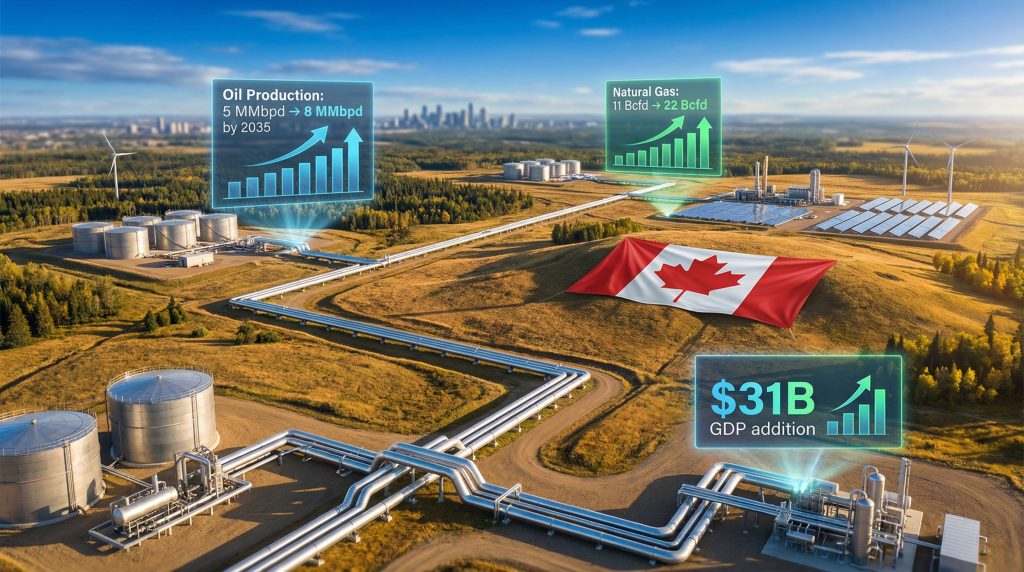
- Oil production expansion: From 5 MMbpd to 8 MMbpd by 2035 (60% increase)
- Natural gas capacity doubling: From 11 billion cubic feet per day to 22 Bcfd (100% expansion)
- Economic impact projection: $31 billion GDP contribution from expanded production
These targets position Alberta to solidify its status as the fourth-largest oil producer globally while maintaining the fourth-largest proven reserves worldwide. The strategy recognises that energy security requires both scale and diversification across multiple energy sources.
Critical Minerals and Strategic Resource Development
The province's energy security framework extends beyond hydrocarbons to encompass critical minerals essential for advanced technology applications. In addition, lithium deposits represent particularly significant potential, given global demand projections for battery storage systems and electric vehicle production. The integration of critical mineral development with traditional energy resources creates opportunities for supply chain synergies and revenue diversification.
Nuclear and geothermal energy development initiatives involve federal-provincial collaboration to establish advanced energy infrastructure. Consequently, these partnerships reflect recognition that long-term energy security requires technological diversification and the ability to adapt to changing global energy demands.
The gap between installed renewable capacity (38%) and actual utilisation (23%) represents approximately 15 percentage points of underutilised infrastructure, suggesting opportunities for optimisation through improved storage solutions and grid management technologies.
Regulatory Framework Evolution and Investment Climate Implications
Recent regulatory adjustments reflect the dynamic nature of energy policy in response to global events and domestic economic pressures. The Russian invasion of Ukraine in February 2022 catalysed policy recalibration across North America, while ongoing Middle East instability has reinforced the strategic value of diversified energy supply chains.
Carbon Pricing Framework Adjustments
Federal policy modifications have included partial repeals of retail carbon taxes, addressing consumer cost pressures that had accumulated across multiple policy layers. These changes reflect recognition that energy affordability directly impacts broader economic competitiveness and public support for energy development initiatives.
The Tier Emission Intensity Regulation (TIER) system creates market mechanisms for carbon credit trading. However, specific trading volumes and pricing data require ongoing monitoring to assess market efficiency and oversupply concerns. The 2026 federal equivalency review timeline places current policy frameworks under scrutiny, with potential implications for long-term investment planning.
Political Consensus Across Jurisdictional Lines
A notable aspect of current energy policy development involves broad consensus across ideologically diverse provincial governments. Socialist New Democratic Party administrations, liberal governments, and conservative governments have aligned on advancing energy development projects, creating unusual political stability for major infrastructure investments.
This consensus contrasts with more polarised energy policy debates in other jurisdictions, potentially providing predictability advantages for long-term capital allocation decisions. Nevertheless, the challenge remains ensuring policy continuity across future electoral cycles and federal-provincial coordination.
Geopolitical Drivers and Continental Energy Independence
Middle East instability has created increased demand for North American energy project opportunities, with political and business leaders actively seeking alternative supply arrangements. This trend reflects broader recognition that geographical diversification reduces supply chain vulnerability to regional conflicts and political instability.
Strategic Timing and Infrastructure Investment
The retrospective assessment of missed pipeline opportunities highlights the strategic value of proactive infrastructure investment. The failure to complete major pipeline projects during more favourable regulatory periods resulted in lost capacity that would have enhanced current market positioning.
For instance, North American energy independence capabilities depend fundamentally on transportation infrastructure that can move resources from production regions to consumption centres and export facilities. The current emphasis on both east-west and north-south pipeline development reflects recognition that multiple transportation corridors provide resilience against single-point-of-failure risks.
Cross-border Partnership Framework
U.S.-Canada energy partnership opportunities encompass shared infrastructure development, technology transfer initiatives, and coordinated emergency response planning. These partnerships leverage complementary capabilities while addressing regulatory complexity through collaborative approaches, particularly concerning US tariffs and Canadian industries considerations.
Strategic petroleum reserve coordination represents another dimension of continental energy security. This ensures adequate emergency supplies while optimising storage utilisation across both countries. The development of shared financing models for major infrastructure projects could accelerate development timelines while distributing risk across multiple stakeholders.
How Will Technology Integration Shape Grid Modernisation?
Digital transformation initiatives across Alberta's energy sector focus on production optimisation through automation, artificial intelligence applications, and advanced data analytics. These technological implementations target both operational efficiency improvements and cost reduction strategies essential for maintaining competitiveness in global markets.
Advanced Recovery Technologies
Enhanced recovery techniques continue expanding the economically accessible resource base, increasing recovery rates from existing reserves while reducing per-unit production costs. Carbon capture and storage technologies represent dual opportunities for emissions reduction and enhanced oil recovery applications.
Hydrogen production development encompasses both blue hydrogen (produced from natural gas with carbon capture) and green hydrogen (produced using renewable electricity) pathways. The province's substantial natural gas reserves provide feedstock for blue hydrogen production, while renewable energy infrastructure supports green hydrogen development as electrolyser technology costs decline.
Grid Reliability and Storage Solutions
Federal investment of $3 million in grid reliability enhancement programmes addresses transmission constraints and stability challenges associated with increased renewable energy integration. These investments target advanced rate structures that can reduce consumer costs while optimising grid utilisation patterns.
Battery storage project development aims to address renewable energy intermittency challenges while creating opportunities for peak demand management and grid stabilisation. Furthermore, the substantial gap between installed and utilised renewable capacity suggests that storage solutions could unlock significant additional clean energy generation without requiring new renewable installations.
The next major ASX story will hit our subscribers first
Investment Opportunities and Market Access Premium Analysis
Infrastructure development investment opportunities span multiple sectors, from traditional pipeline construction to renewable energy project development and critical minerals extraction. The diversified investment landscape reflects the province's multi-resource approach to energy security and economic development.
Pipeline Development Investment Framework
Private sector partnership models for pipeline construction offer risk-sharing opportunities while leveraging specialised expertise in project development and regulatory navigation. The emphasis on partnerships with established American pipeline companies reflects recognition that cross-border projects require specific regulatory and stakeholder management capabilities.
Market access premiums resulting from transportation capacity constraints currently limit producer valuations across the province. In contrast, new pipeline infrastructure could reduce transportation costs and pricing differentials, creating margin improvement opportunities for energy companies while expanding market reach.
Revenue Diversification and Risk Management
Critical minerals extraction represents emerging investment opportunities that could complement traditional energy revenues while supporting technology sector supply chains. The integration of mineral extraction with existing energy infrastructure could create operational synergies and reduce development costs.
International market penetration through expanded pipeline capacity offers revenue diversification benefits that reduce dependence on single markets or transportation routes. Consequently, the ability to access both Pacific and Atlantic markets through different pipeline systems provides pricing flexibility and market optionality.
Technology Adoption and Operational Efficiency Improvements
Automation implementation across production operations targets predictive maintenance systems, reservoir management optimisation, and real-time production monitoring. These technological advances reduce operational costs while improving recovery efficiency and environmental performance.
Data Analytics and Smart Grid Integration
Advanced data analytics applications enable more precise reservoir characterisation, production forecasting, and equipment maintenance scheduling. The integration of artificial intelligence systems with operational data streams creates opportunities for continuous optimisation and predictive problem-solving.
Smart grid technologies facilitate better integration of renewable energy sources while optimising distribution efficiency and reducing transmission losses. Therefore, the substantial renewable energy infrastructure already installed provides a foundation for implementing advanced grid management systems.
Long-term Strategic Positioning and Continental Leadership
The integration of traditional hydrocarbon development with renewable energy expansion and critical mineral extraction creates a comprehensive energy security framework that addresses multiple market demands simultaneously. This portfolio approach reduces revenue volatility while positioning the province to benefit from diverse energy market trends.
Policy framework optimisation focuses on creating predictable regulatory environments that support long-term investment while maintaining environmental standards and community engagement requirements. The current cross-party consensus on energy development provides unusual political stability for major infrastructure investments.
International partnership development, particularly with U.S. energy companies and government agencies, facilitates market access expansion while building strategic relationships that could support future collaborative projects. These partnerships leverage complementary capabilities while addressing regulatory complexity through coordinated approaches.
Economic Resilience Through Energy Infrastructure
The projected $31 billion GDP contribution from expanded energy production represents significant economic impact equivalent to approximately 1% of provincial GDP. This economic multiplier effect extends beyond direct energy sector employment to support manufacturing, transportation, and service sector growth.
Global competitiveness maintenance requires leveraging natural resource advantages while continuously improving operational efficiency and environmental performance. The province's political stability, established regulatory frameworks, and proximity to major North American consumption centres provide competitive advantages relative to emerging market producers.
However, geopolitical uncertainties, including the US‑China trade war impact on global supply chains, emphasise the importance of continental energy security strategies. Additionally, the big pivot in critical minerals development represents a strategic opportunity for diversification.
The successful implementation of Alberta energy security and pipeline expansion initiatives could establish a model for resource-rich regions seeking to optimise infrastructure development while maintaining environmental stewardship and community engagement standards. The comprehensive approach to energy security, encompassing traditional and renewable resources alongside critical minerals, positions the province as a strategic partner for continental energy independence objectives while supporting long-term economic prosperity.
Furthermore, addressing Canada energy transition challenges requires balancing economic growth with environmental commitments. The Canada-Alberta energy policy coordination demonstrates federal-provincial collaboration essential for successful implementation of Alberta energy security and pipeline expansion strategies.
Ready to Capitalise on North American Energy Infrastructure Development?
Discovery Alert's proprietary Discovery IQ model delivers real-time alerts on significant ASX mineral discoveries, instantly empowering subscribers to identify actionable opportunities ahead of the broader market. Begin your 14-day free trial today at Discovery Alert and secure your market-leading advantage.