July 10, 2026
The Canadian mining company Aya Gold & Silver's development of a comprehensive feasibility study for its polymetallic project in Morocco represents a significant advancement in North African mining operations. This sophisticated evaluation will establish the technical and economic framework for extracting multiple metals from a single deposit, incorporating both open-pit and underground mining methodologies. Furthermore, the study addresses the complex regulatory requirements and mining permitting process that govern large-scale mining operations in Morocco's established mining corridor.
Engineering Foundations of Modern Mining Feasibility Analysis
Critical Components of Comprehensive Project Assessment
Mining feasibility studies serve as the definitive technical and economic blueprint for project development, establishing the framework for capital investment decisions and operational parameters. These comprehensive analyses integrate geological modeling, engineering design, environmental impact assessment, and economic projections to create a holistic evaluation of project viability. For polymetallic operations, feasibility studies must address the complex interactions between multiple metal recovery systems and the associated processing challenges.
The regulatory landscape in Morocco requires adherence to specific mining code provisions that govern operational permits, environmental compliance, and community engagement protocols. Mining companies must navigate a structured approval process that typically spans 18-24 months for complex polymetallic projects, with feasibility studies serving as the primary technical documentation supporting permit applications.
The timeline for completion targeting the second half of 2027 reflects industry-standard development schedules for projects of this scale and complexity. This timeframe allows for comprehensive technical validation, regulatory review, and stakeholder consultation processes that are essential for sustainable mining operations in North Africa.
Advanced Engineering Methodologies in Process Design
Modern mining operations employ sophisticated process engineering approaches that optimise metal recovery whilst minimising environmental impact. The integration of open-pit and underground mining methodologies requires specialised engineering expertise to ensure seamless transitions between surface and subsurface operations. This dual approach maximises resource recovery from deposits that extend beyond economical open-pit depths.
Process engineering partnerships with specialised firms enable mining companies to leverage cutting-edge technologies and proven methodologies. The selection of engineering consultants with demonstrated expertise in polymetallic processing ensures that complex metallurgical challenges are addressed through validated technical solutions. These partnerships typically encompass flowsheet development, equipment sizing, and plant layout optimisation.
Capital expenditure refinement represents a critical aspect of feasibility study development, with initial estimates requiring validation through detailed engineering analysis. The iterative process of cost estimation involves multiple levels of technical review, from conceptual design through detailed engineering specifications.
When big ASX news breaks, our subscribers know first
Strategic Positioning in Morocco's Mining Corridor
Infrastructure Advantages in the Errachidia Region
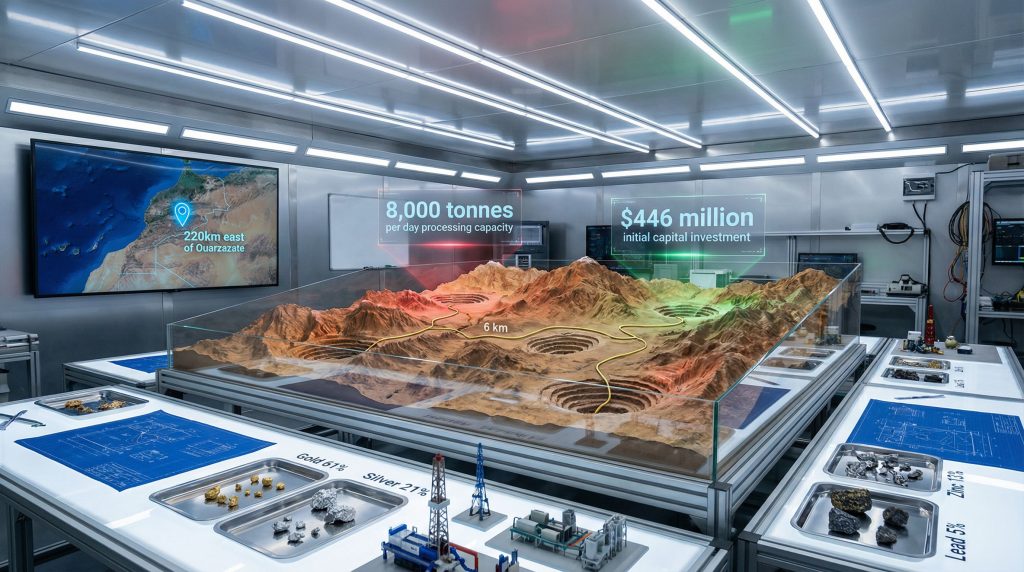
The geographic positioning approximately 220 kilometres east of Ouarzazate places mining operations within Morocco's established mining corridor, providing access to existing transportation networks and support infrastructure. This strategic location offers proximity to major population centres whilst maintaining access to specialised mining services and equipment suppliers that serve the region's extractive industries.
Regional infrastructure development has created favourable conditions for large-scale mining operations, with established road networks, power transmission systems, and telecommunications infrastructure supporting industrial activities. The 32-square-kilometre mining licence coverage provides sufficient operational flexibility for both current development plans and future expansion opportunities.
Transportation logistics play a crucial role in project economics, particularly for polymetallic operations that require efficient movement of concentrates to processing facilities or export terminals. In addition, the regional positioning offers multiple routing options for material transportation, reducing logistical constraints that can impact operational efficiency.
Regulatory Framework and Compliance Structure
Morocco's mining regulatory environment reflects the country's commitment to sustainable resource development and international best practices in mining governance. The regulatory framework encompasses environmental protection requirements, community consultation protocols, and technical standards that ensure responsible mining operations.
Mining licence administration involves multiple government agencies, each with specific oversight responsibilities covering geological compliance, environmental protection, and operational safety. The comprehensive regulatory structure requires mining companies to demonstrate technical competence, financial capacity, and environmental stewardship throughout the project lifecycle.
Environmental permitting processes incorporate international standards for tailings management, water resource protection, and air quality monitoring. These requirements necessitate integration of exploration and resource modeling considerations into all aspects of project design and operational planning.
Multi-Phase Mining Operations and Processing Systems
Integrated Open-Pit and Underground Mining Approach
The combination of six open-pit operations along a 6-kilometre mineralised trend represents an optimised approach to resource extraction that maximises early cash flow whilst establishing infrastructure for longer-term underground operations. This phased development strategy allows for operational experience accumulation and cash flow generation during the initial years of operation.
Processing capacity targets of 8,000 tonnes per day reflect careful balancing of capital investment requirements with production optimisation objectives. This throughput level enables efficient utilisation of processing equipment whilst maintaining flexibility for production adjustments based on market conditions and operational experience.
The 11-year mine life operational planning incorporates both open-pit and underground phases, with underground mining operations typically commencing in year two as surface mining operations progress to deeper elevations. This transition requires sophisticated mine planning and scheduling to ensure continuous material supply to processing facilities.
Advanced Metallurgical Processing for Multiple Metal Recovery
Polymetallic processing presents unique technical challenges that require specialised equipment and process design expertise. The recovery of gold, silver, zinc, and lead from a single ore body demands sophisticated separation technologies that can efficiently partition metals whilst maintaining high recovery rates across all target commodities.
Revenue distribution projections indicate gold comprising 61% of total revenues, with silver contributing 21%, zinc 13%, and lead 5%. This metal distribution profile requires processing circuit optimisation that prioritises gold and silver recovery whilst ensuring economic recovery of base metals that contribute to overall project economics.
Processing methodologies typically involve multi-stage crushing and grinding circuits, followed by flotation separation processes that create distinct concentrates for each metal group. Quality control systems throughout the processing chain ensure consistent product specifications and maximum metal recovery rates.
Specialised Technical Partnerships and Quality Assurance
Engineering Consulting Team Composition
The assembly of specialised consulting firms reflects industry best practices for complex mining project development, with each firm contributing specific technical expertise essential for project success. This multi-disciplinary approach ensures comprehensive technical coverage across all aspects of project development and implementation.
| Technical Specialty | Lead Organisation | Primary Deliverables |
|---|---|---|
| Process Engineering Design | Lycopodium Minerals Canada | Plant configuration and optimisation |
| Geological Resource Modelling | SRK Consulting | Reserve calculations and mine planning |
| Metallurgical Process Validation | SGS Canada | Recovery testing and quality assurance |
| Environmental Waste Management | Epoch Resources | Tailings facility design and monitoring |
| Environmental Impact Assessment | SLR Consulting | Regulatory compliance and permitting |
Technical Validation and Risk Assessment Protocols
Independent technical review processes ensure that feasibility study conclusions are supported by validated engineering analysis and proven methodologies. These review mechanisms typically involve peer evaluation of critical assumptions, sensitivity analysis of key parameters, and verification of technical calculations by independent experts.
Quality assurance procedures encompass all aspects of technical analysis, from geological modelling through process design and economic evaluation. These protocols ensure that feasibility study conclusions meet industry standards for technical accuracy and provide reliable foundations for investment decisions.
Risk assessment methodologies identify potential technical and operational challenges that could impact project performance, with mitigation strategies developed to address identified risks. Consequently, contingency planning for operational challenges ensures operational resilience and performance optimisation under varying conditions.
Economic Performance Metrics and Industry Benchmarking
Capital Investment Analysis and Cost Structure
The initial capital requirement of $446 million represents a substantial investment reflecting the complexity and scale of polymetallic mining operations. This capital intensity translates to approximately $55,750 per tonne of daily processing capacity, positioning the project within industry benchmarks for similar operations.
Capital allocation encompasses mine development infrastructure, processing plant construction, environmental management systems, and supporting facilities required for sustainable operations. The distribution of capital investment across these categories reflects the integrated nature of modern mining operations.
Financing considerations for projects of this scale typically involve combinations of equity investment, debt financing, and potentially strategic partnerships that provide both capital and technical expertise. For instance, capital raising strategies must balance cost of capital with operational flexibility and growth potential.
Revenue Projections and Metal Price Assumptions
Economic projections incorporate conservative metal price assumptions that reflect long-term market fundamentals whilst acknowledging commodity price volatility. The gold price assumption of $2,800 per ounce and silver assumption of $30 per ounce provide reasonable baselines for economic evaluation whilst recognising potential price variability over the project lifecycle.
These projections align with current gold price benchmarks that reflect market expectations for precious metals performance over extended timeframes.
| Metal Commodity | Revenue Contribution | Price Foundation | Market Context |
|---|---|---|---|
| Gold Production | 61% | $2,800 per ounce | Conservative premium pricing |
| Silver Output | 21% | $30 per ounce | Industrial demand baseline |
| Zinc Recovery | 13% | Market-linked pricing | Base metal cycle considerations |
| Lead Production | 5% | Market-dependent rates | Supplementary revenue stream |
The projected post-tax net present value of $1.5 billion and internal rate of return of 47 percent indicate robust project economics that can withstand reasonable variations in metal prices and operating costs. These metrics position the project favourably compared to industry benchmarks for similar polymetallic operations.
Resource Expansion Potential and Geological Upside
Current Resource Classification and Confidence Assessment
The indicated resource base of 74 million silver-equivalent ounces at 448 grammes per tonne provides a foundation of geologically confident material that supports initial mine planning and operational design. This indicated resource category reflects drilling density and geological understanding sufficient for detailed engineering and economic analysis.
Inferred resources totalling 378 million silver-equivalent ounces at 402 grammes per tonne represent significant expansion potential that could extend mine life and enhance project economics through future resource conversion. The substantial inferred resource base indicates considerable geological continuity beyond currently defined indicated resources.
Resource classification improvement through continued drilling programmes offers potential for converting inferred resources to indicated categories, thereby expanding the confident resource base available for mine planning and extending operational timelines.
Exploration Programmes and Discovery Potential
The ongoing 360,000-metre drilling campaign utilising ten drilling rigs demonstrates substantial commitment to resource expansion and geological understanding advancement. This exploration intensity reflects confidence in the geological model and potential for significant resource additions through systematic drilling programmes.
Recent discoveries of high-grade parallel structures indicate potential for resource expansion beyond the currently defined mineralised zones. These discoveries suggest that the geological system may be more extensive than initially understood, offering potential for significant resource growth through continued exploration.
However, exploration upside extends beyond immediate resource expansion to include potential discovery of additional mineralised zones that could support extended mine life or increased production rates. The systematic approach to exploration provides multiple pathways for value creation through geological discovery.
The next major ASX story will hit our subscribers first
Production Targets and Regional Supply Significance
Five-Year Production Profile and Market Positioning
Average annual production projections of 401,000 gold-equivalent ounces during the first five years position the operation as a significant contributor to North African precious metals production. This production level places the project among the larger gold operations in the region whilst contributing meaningfully to global polymetallic supply.
Production ramp-up strategies typically involve gradual capacity increases during initial operational phases, allowing for operational optimisation and workforce development before achieving full production rates. This approach minimises operational risks whilst ensuring sustainable performance achievement.
The strategic importance within Morocco's mining sector reflects the country's broader objectives of developing its mineral resource base and establishing Morocco as a significant player in global metals markets. Polymetallic operations contribute to supply chain diversification and reduced dependence on single-commodity operations.
Global Supply Chain Integration and Technology Transfer
Modern mining operations contribute to local capacity building through technology transfer, skills development, and supply chain integration that benefits regional economic development. The establishment of sophisticated mining operations creates opportunities for local service providers and equipment suppliers to develop capabilities serving the mining industry.
The data-driven mining innovations implemented in this Canadian mining company Aya Gold & Silver feasibility study Morocco polymetallic project represent significant foreign direct investment in Morocco's mining sector, bringing international expertise and capital to support resource development. This investment reflects confidence in Morocco's regulatory environment and geological potential.
Supply chain optimisation involves integration with global metal markets whilst developing local supplier relationships that enhance operational efficiency and community economic benefits. The balance between international standards and local capacity development creates sustainable operational frameworks.
Risk Assessment and Operational Considerations
Technical and Metallurgical Risk Factors
Polymetallic processing inherently involves technical risks related to metallurgical recovery rates, process optimisation, and equipment performance that can impact operational efficiency and economic returns. These risks require comprehensive mitigation strategies and contingency planning to ensure operational resilience.
Underground mining complexity factors include ground stability, ventilation requirements, and material handling systems that become increasingly challenging as operations extend to greater depths. Technical risk management involves continuous monitoring and adaptive operational strategies.
Processing technology selection risks encompass equipment reliability, maintenance requirements, and throughput consistency that directly impact production targets and cost performance. Furthermore, proven technology selection and comprehensive maintenance programmes minimise these operational risks.
Market and Economic Risk Management
Metal price volatility represents the primary market risk affecting project economics, requiring hedging strategies and operational flexibility to maintain economic performance across commodity price cycles. Price risk management typically involves combinations of financial hedging and operational adjustments.
Currency exchange rate exposures affect both capital costs and operating revenues, particularly for Canadian mining company operations in Morocco with revenue streams denominated in US dollars. Exchange rate risk management requires financial strategies that balance cost stability with revenue optimisation.
Inflation effects on capital and operating costs require long-term planning and cost escalation provisions that maintain project economics over extended operational periods. Cost management strategies encompass both operational efficiency improvements and strategic sourcing arrangements.
Corporate Strategy and Portfolio Integration
Development Timeline and Strategic Milestones
The feasibility study completion target for the second half of 2027 establishes a clear development timeline that enables systematic project advancement through regulatory approval, financing arrangement, and construction preparation phases. This timeline reflects realistic development scheduling for projects of comparable scale and complexity.
Integration with existing operations provides opportunities for operational synergies, shared infrastructure utilisation, and administrative efficiency gains that enhance overall portfolio performance. These synergies can include shared processing facilities, combined logistics systems, and integrated management structures.
Stakeholder value creation objectives encompass both financial returns and sustainable development outcomes that benefit local communities, environmental stewardship, and long-term operational success. Balanced stakeholder consideration ensures sustainable operations and social licence maintenance.
Ownership Structure and Partnership Framework
The 85% project ownership position held by the Canadian mining company provides operational control whilst allowing for strategic partnerships that can contribute technical expertise, market access, or additional capital resources. This ownership structure balances control with partnership flexibility.
Joint venture frameworks enable risk sharing and capability combination that can enhance project success through complementary strengths and shared resources. Partnership structures must balance operational efficiency with effective governance and decision-making processes.
Future development opportunities may include strategic partnerships with technology providers, financial institutions, or market participants that can enhance operational capabilities, reduce financing costs, or provide market access advantages. Strategic partnership evaluation involves assessment of capability enhancement and value creation potential.
According to Aya Gold & Silver's recent announcement, the company has formally commenced its comprehensive feasibility study for the Boumadine project. Additionally, detailed analysis from Resource World indicates that this Canadian mining company Aya Gold & Silver feasibility study Morocco polymetallic project represents one of the most significant mining developments currently underway in North Africa.
Investment Disclaimer: This analysis is provided for informational purposes only and does not constitute investment advice. Mining investments involve substantial risks including commodity price volatility, operational challenges, and regulatory changes that can significantly impact returns. Prospective investors should conduct comprehensive due diligence and consult qualified financial advisors before making investment decisions. Future performance may differ materially from projections and estimates contained herein.
Are You Looking for the Next Major Polymetallic Discovery?
Discovery Alert's proprietary Discovery IQ model delivers real-time alerts on significant ASX mineral discoveries, instantly empowering subscribers to identify actionable opportunities ahead of the broader market. Understand why major mineral discoveries can lead to substantial market returns by exploring Discovery Alert's dedicated discoveries page, showcasing historic examples of exceptional outcomes, and begin your 14-day free trial today to position yourself ahead of the market.