
July 22, 2026
Chile's Mining Labor Relations: Understanding the Capstone Copper Strike Context
Labor dynamics across Chile's copper mining sector represent a complex intersection of economic leverage, strategic timing, and supply chain vulnerabilities. The Capstone Copper Chile strike highlights how industrial action at major mining operations can significantly impact both local economies and global commodity markets. Furthermore, examining the potential for labour disputes requires understanding several critical factors that emerge as determinants of union positioning and company response strategies.
The broader Chilean mining landscape encompasses multiple operational scales, from large-scale state-owned enterprises to smaller privately-held facilities. Understanding this context becomes essential when evaluating how individual labor disputes might influence wider industry evolution trends and international commodity markets.
When big ASX news breaks, our subscribers know first
Economic Impact Assessment of Mining Strikes in Chile's Copper Sector
Mining operations in Chile's Atacama region generate substantial revenue streams, making production disruptions economically significant for all stakeholders involved. The scale of potential financial impact depends on several variables including production capacity, commodity pricing cycles, and operational complexity.
Revenue calculations for copper mining operations typically consider current London Metal Exchange pricing, which averaged between $9,500-$10,500 USD per metric ton during late 2024. When applied to nameplate production capacities, these figures provide frameworks for understanding potential strike-related losses.
Key Economic Metrics:
- Monthly revenue exposure estimates can reach $100 million for major operations
- Production disruption costs extend beyond lost revenue to include care-and-maintenance expenses
- Force majeure implications affect downstream buyer relationships and contract obligations
- Commodity futures pricing responds to supply uncertainty announcements
Mantoverde Mine's Strategic Position in Global Copper Supply Chains
The Mantoverde operation represents a significant component within Chile's copper production infrastructure. Located in the Atacama region, this facility contributes to Chile's position as the world's largest copper producer, accounting for approximately 28% of global refined copper output.
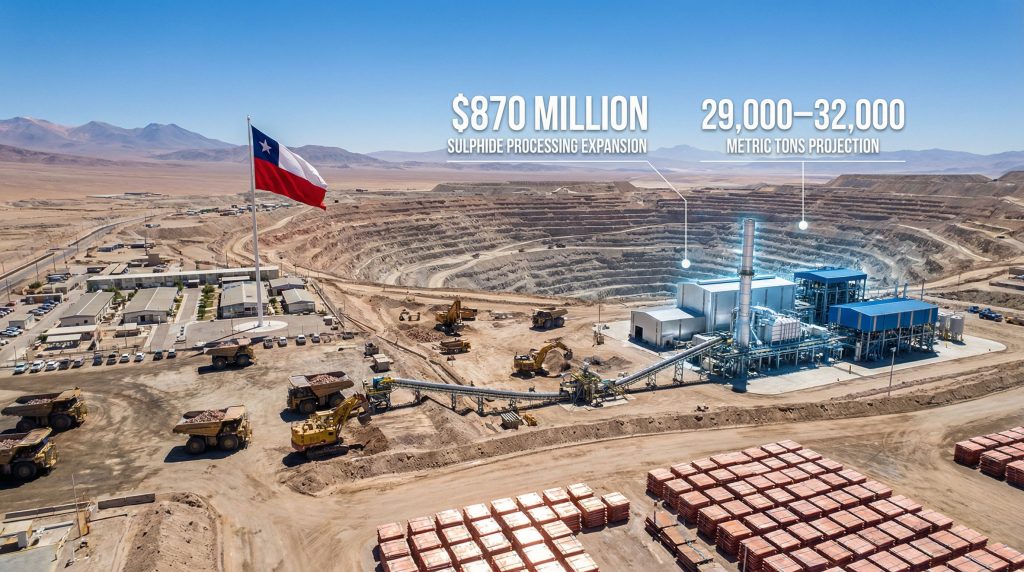
Production projections for 2025 indicate expected output of 29,000-32,000 metric tons of copper cathodes annually. While this represents a relatively modest portion of global production (approximately 0.12-0.14%), the strategic importance lies in the facility's position within Chile's concentrated supply base.
The operation functions under a joint venture structure, with Capstone Copper holding a 70% ownership stake and Mitsubishi Minerals controlling the remaining 30%. This partnership arrangement creates specific joint venture dynamics regarding cost allocation and decision-making authority during potential disruptions.
What Makes Labor Disputes Critical for Copper Market Stability?
Global copper markets demonstrate sensitivity to supply disruptions due to the metal's essential role in infrastructure, renewable energy systems, and electrical applications. Chile's dominant position in world copper production means that labor disputes within its mining sector carry implications extending far beyond local economic considerations.
The concentration of copper production in specific geographic regions creates vulnerability points for international supply chains. When combined with the capital-intensive nature of copper mining operations and the specialized workforce requirements, labor relations become critical factors in maintaining production stability. Consequently, understanding these dynamics becomes crucial for developing effective copper investment strategies.
Revenue Loss Calculations: The $100 Million Monthly Impact Framework
Estimating the financial impact of mining strikes requires sophisticated modelling that considers multiple variables. Union representatives have calculated potential monthly revenue losses of $100 million based on current production capacity and prevailing commodity prices.
This calculation methodology typically incorporates:
- Production capacity: Annual nameplate output divided by operational months
- Market pricing: Current LME copper futures pricing
- Processing costs: Operational expenses that continue during strikes
- Contract obligations: Penalty costs for delivery failures
The $100 million monthly figure suggests sophisticated economic analysis by labour representatives, indicating unions' increased sophistication in understanding operational economics and leveraging financial impact projections during negotiations.
Production Disruption Metrics in Chile's Mining Industry
Chilean copper mining operations face several types of production disruptions beyond labour disputes, including equipment failures, geological challenges, and regulatory compliance issues. Labor-related shutdowns represent one category within a broader spectrum of operational risks.
Historical data from Chile's mining sector indicates that labour disputes typically result in complete production cessation rather than partial operations. This binary outcome reflects safety requirements and operational complexity that make skeleton crew operations impractical during active labour disputes.
Disruption Impact Categories:
- Immediate cessation: Mill operations and cathode production halt completely
- Maintenance costs: Ongoing security, utilities, and equipment preservation
- Restart complexity: Technical requirements for resuming full operations
- Supply chain ripples: Downstream buyer inventory management adjustments
How Do Government Mediation Processes Work in Chilean Mining Disputes?
Chile's legal framework establishes mandatory government mediation as a prerequisite for authorised strike action in the mining sector. This system reflects the strategic importance of mining operations to Chile's national economy and export revenue generation.
The mediation process follows a structured timeline designed to encourage settlement while providing clear procedural steps if negotiations fail. Understanding this framework becomes essential for predicting potential outcomes and timing of industrial action, particularly when examining scenarios similar to the Capstone Copper Chile strike.
Five-Day Initial Mediation Period: Legal Framework and Extensions
Chilean labour law mandates a five-day initial mediation period once formal dispute procedures begin. This timeframe provides opportunity for government mediators to facilitate dialogue between management and union representatives while maintaining production continuity.
The initial five-day period can be extended by an additional five days if both parties consent to continued mediation. This extension mechanism recognises that complex negotiations may require additional time while maintaining pressure for timely resolution.
Mediation Timeline Structure:
- Days 1-5: Initial government-led mediation period
- Extension option: Additional 5 days with mutual agreement
- Maximum duration: 10 days total government involvement
- Strike authorisation: Available after mediation conclusion
If mediation efforts prove unsuccessful, unions receive authorisation to commence strike action. The structured timeline provides predictability for all parties while encouraging settlement within defined timeframes.
Historical Success Rates of Government-Led Mining Negotiations
Government mediation in Chile's mining sector has demonstrated variable success rates depending on dispute complexity, economic conditions, and stakeholder willingness to compromise. Historical analysis suggests that mediation proves most effective when economic pressures encourage both parties toward settlement.
Successful mediations often involve creative solutions addressing both immediate compensation concerns and longer-term operational sustainability. Failed mediations typically result from fundamental disagreements about profit-sharing, working conditions, or employment security that resist compromise.
The effectiveness of government intervention depends partly on mediator expertise and partly on broader economic conditions affecting both company profitability and worker cost-of-living pressures.
Mantoverde Development Project: Infrastructure Investment vs. Labor Relations
Major capital investments create complex dynamics between operational requirements and labour relations. Companies investing substantial resources in facility expansion face heightened pressure to maintain production schedules and achieve return on investment targets.
The relationship between capital investment timing and labour negotiations often creates strategic leverage points for unions, particularly when investments reach critical completion phases requiring operational stability. For instance, recent developments in the Codelco-Adani copper deal demonstrate how investment partnerships can influence labour dynamics.
$870 Million Sulphide Processing Expansion Completion Timeline
Mantoverde's sulphide processing expansion represents a significant $870 million capital commitment designed to enhance production capacity and operational efficiency. The scale of this investment reflects confidence in long-term copper demand fundamentals and the mine's geological potential.
Large-scale mining expansions typically require several years from initial engineering through commissioning and production ramp-up. The timing of labour negotiations relative to expansion completion phases can significantly influence bargaining dynamics.
Capital Investment Implications:
- Sunk cost pressure: Completed investments require operational success
- Production ramp-up: Critical timing for achieving nameplate capacity
- Return on investment: Shareholder expectations for project performance
- Debt service: Financial obligations requiring consistent cash flow generation
Production Capacity Analysis: 29,000-32,000 Metric Tons Projection Impact
The projected annual production of 29,000-32,000 metric tons of copper cathodes represents the operational target following expansion completion. This capacity level positions Mantoverde as a significant contributor to Chile's overall copper output.
Mantoverde Mine Production Metrics
| Metric | 2024 Performance | 2025 Projection | Strategic Significance |
|---|---|---|---|
| Copper Cathodes | Ramp-up Phase | 29,000-32,000 MT | Core Revenue Driver |
| Gold Production | Secondary Output | Supplementary | Value-Add Component |
| Processing Capacity | Full Mill Rates | Optimised Operations | Efficiency Benchmark |
Production projections assume normal operational conditions without extended disruptions. Labour disputes during ramp-up phases can significantly impact the timeline for achieving full nameplate capacity.
Joint Venture Dynamics: Capstone-Mitsubishi Partnership Under Pressure
Joint venture partnerships in mining operations create complex decision-making structures that become particularly challenging during labour disputes. The allocation of costs, risks, and decision-making authority requires careful coordination between partners with potentially different strategic priorities.
The Capstone-Mitsubishi partnership at Mantoverde operates under a 70-30 ownership structure, with cost and revenue allocation following proportional ownership percentages. This arrangement means Capstone bears the majority of both operational costs and potential strike-related losses.
70-30 Ownership Structure Risk Distribution Analysis
Unequal ownership stakes create asymmetric risk exposure that can influence negotiation strategies and settlement authority. Capstone's 70% stake means the company faces approximately $70 million of the projected $100 million monthly strike impact, while Mitsubishi's exposure remains at approximately $30 million.
This risk distribution affects several operational considerations:
- Settlement authority: Majority owner typically leads negotiations
- Financial capacity: Unequal ability to sustain extended disruptions
- Strategic priorities: Different timeline pressures between partners
- Capital allocation: Varying perspectives on additional investment needs
International Stakeholder Response to Labor Disruptions
Mitsubishi's involvement as a Japanese trading and mining company adds international complexity to the labour dispute resolution process. International partners often bring different approaches to labour relations based on their home country operational experience.
The presence of international partners can influence settlement dynamics through:
- Risk tolerance: Different cultural approaches to labour negotiations
- Regulatory requirements: International reporting and compliance obligations
- Stakeholder pressure: Multiple sets of shareholders and regulatory authorities
- Timeline flexibility: Varying pressure for quick resolution
The next major ASX story will hit our subscribers first
Why Are Chilean Copper Workers Increasingly Militant?
Labour militancy in Chile's copper mining sector reflects broader economic and social pressures affecting mining communities. Understanding these underlying factors provides context for evaluating the likelihood of extended industrial action and potential settlement frameworks.
The rejection of contract offers by the 645-member union indicates fundamental disagreements about compensation, working conditions, or employment security that resist easy compromise. Such rejections typically reflect careful consideration by union membership rather than negotiating tactics.
Industry-Wide Cost Pressures and Worker Compensation Trends
Chilean copper miners face cost-of-living pressures common throughout the country's mining regions. These areas often experience elevated living costs due to remote locations, specialised housing requirements, and limited local service availability.
Inflation pressures combined with strong copper prices create expectations for wage increases that reflect both cost-of-living adjustments and profit-sharing arrangements. Workers often view strong commodity prices as justification for enhanced compensation packages, particularly when examining successful developments like the Argentinian copper system.
Economic Pressure Factors:
- Cost of living: Regional inflation in mining areas
- Housing costs: Specialised accommodations in remote locations
- Transportation: Access to services and family connections
- Skill premiums: Specialised technical workforce compensation
Union Negotiation Strategies in High-Value Mining Operations
Modern mining unions employ sophisticated strategies that leverage economic analysis, timing considerations, and operational understanding. The statement regarding preparedness for extended strike action reflects strategic planning rather than emotional response.
Union strategies often include:
- Economic modelling: Understanding company revenue and profit margins
- Timing leverage: Identifying periods of maximum operational pressure
- Strike funds: Financial preparation for extended action
- Public relations: Building community and political support
Key Strike Preparation Indicator
The 645-member union's rejection of contract offers signals broader industry tensions, with workers prepared for extended action that could reshape copper market dynamics across Chile's mining sector.
Supply Chain Vulnerability Assessment for Global Copper Markets
Global copper supply chains demonstrate significant concentration risk due to the geographic clustering of major mining operations. Chile's position as the world's largest producer means that labour disruptions within its mining sector can influence international pricing and availability.
The interconnected nature of modern supply chains means that disruptions at individual mines can create ripple effects extending to manufacturing sectors worldwide. Understanding these vulnerabilities becomes essential for risk assessment and contingency planning, as noted by Kitco's analysis of Chilean mining labor dynamics.
Chile's Position in International Copper Production Rankings
Chile maintains its position as the world's dominant copper producer, contributing approximately 28% of global refined copper output. This concentration creates systemic vulnerabilities for industries dependent on stable copper supplies.
Global Copper Production Distribution:
- Chile: ~28% of global production
- Peru: ~10-11% of global production
- China: ~8-9% of global mine production
- United States: ~6-7% of global production
- Democratic Republic of Congo: ~4-5% of global production
- Other producers: Combined ~40-45%
The concentration of production in Chile means that widespread labour disruptions could significantly impact global copper availability and pricing.
Alternative Supply Source Analysis During Production Disruptions
When Chilean production faces disruptions, global markets rely on several alternative supply mechanisms to maintain balance. These alternatives include increased production from other regions, strategic stockpile releases, and enhanced recycling activities.
Supply Response Mechanisms:
- Secondary production: Recycled copper (35-40% of global supply)
- Strategic reserves: Government and industry stockpiles
- Production acceleration: Capacity increases at other mines
- Substitute materials: Aluminium and composite alternatives
However, these alternatives require time to activate and may not fully compensate for major production losses in the short term.
Investment Risk Mitigation Strategies for Mining Sector Stakeholders
Mining sector investments face multiple risk categories, with labour relations representing one significant factor among geological, regulatory, and market risks. Developing comprehensive risk mitigation strategies requires understanding the interconnected nature of these various factors.
Investors in mining operations must balance the potential for high returns against the volatility inherent in commodity markets and operational disruptions. Labour relations risk management becomes particularly important in jurisdictions with strong union traditions, as reported by Yahoo Finance on Capstone's strategic positioning.
Operational Continuity Planning in Labor-Intensive Mining Operations
Copper mining operations require careful continuity planning that addresses potential labour disruptions while maintaining safety standards and regulatory compliance. Such planning involves both immediate response protocols and longer-term strategic considerations.
Continuity Planning Elements:
- Care and maintenance: Essential systems during shutdowns
- Security arrangements: Asset protection during disruptions
- Restart procedures: Technical requirements for resuming operations
- Alternative workforce: Cross-training and contractor capabilities
Effective continuity planning can minimise the duration and cost of production disruptions while maintaining readiness for rapid operational restart.
Financial Hedging Mechanisms Against Production Shortfalls
Mining companies employ various financial instruments to manage revenue volatility related to production disruptions. These mechanisms can provide partial protection against the financial impact of extended labour disputes.
Risk Management Tools:
- Commodity hedging: Forward sales and options contracts
- Business interruption insurance: Coverage for operational disruptions
- Strike insurance: Specialised coverage for labour-related losses
- Revenue diversification: Multiple operations and commodity exposure
However, these mechanisms typically provide only partial protection and may not cover all costs associated with extended operational disruptions.
Strategic Scenarios: Potential Outcomes and Market Implications
Analysing potential outcomes from the current labour dispute requires considering multiple scenarios ranging from quick resolution through extended industrial action. Each scenario carries different implications for stakeholders and copper markets.
The probability of various outcomes depends on factors including economic pressures on both parties, government mediation effectiveness, and broader industry conditions affecting settlement dynamics. In particular, the Capstone Copper Chile strike scenario demonstrates how individual disputes can influence broader market sentiment.
Successful Mediation: Timeline and Production Recovery Projections
Successful mediation would likely result in operational resumption within days of settlement, assuming normal restart procedures and workforce availability. Production recovery to full nameplate capacity typically requires several weeks depending on operational complexity.
Quick Resolution Scenario:
- Settlement timeline: Within 5-10 day mediation period
- Production restart: 3-7 days post-agreement
- Full capacity recovery: 2-4 weeks
- Market impact: Minimal copper price disruption
This scenario would minimise financial impact for all parties while maintaining Chile's copper production stability.
Extended Strike Scenario: Industry-Wide Ripple Effects Analysis
Extended strike action could create significant market disruptions extending beyond the immediate participants. Such disruptions might influence copper pricing, supply chain planning, and investor sentiment toward Chilean mining investments.
Extended Strike Implications:
- Duration: Potentially several months
- Financial impact: $100+ million monthly revenue loss
- Market effects: Copper price volatility and supply concerns
- Industry precedent: Influence on other Chilean mining negotiations
Extended strikes could establish precedents affecting labour relations throughout Chile's mining sector.
Lessons from Previous Chilean Mining Labor Disputes
Historical analysis of Chilean mining labour disputes provides valuable insights into potential outcomes and effective resolution strategies. Previous disputes offer lessons about negotiation dynamics, government intervention effectiveness, and long-term relationship impacts.
The mining sector's experience with labour disputes varies significantly depending on company approach, union organisation, economic conditions, and government policy frameworks.
Historical Case Studies: BHP, Codelco, and Anglo American Negotiations
Major international mining companies operating in Chile have faced various labour challenges that provide precedents for current situations. These experiences demonstrate both successful resolution strategies and costly prolonged disputes.
Each company's approach to labour relations reflects corporate culture, operational requirements, and strategic priorities that influence negotiation outcomes and long-term workforce relationships.
Best Practice Framework for Future Labor Relations Management
Effective labour relations in mining operations require ongoing attention to workforce concerns, transparent communication, and proactive conflict resolution mechanisms. Best practices emphasise relationship building rather than crisis response.
Relationship Management Elements:
- Regular communication: Ongoing dialogue outside formal negotiations
- Profit-sharing mechanisms: Transparent revenue sharing arrangements
- Safety collaboration: Joint focus on workplace safety improvements
- Career development: Training and advancement opportunities
Proactive labour relations management can reduce the likelihood of disputes while building foundation for constructive negotiations when formal discussions become necessary.
Disclaimer: This analysis contains forward-looking statements and projections based on current information. Actual outcomes may differ materially from projections due to various factors including economic conditions, regulatory changes, and operational developments. Readers should conduct independent research before making investment decisions.
Ready to Capitalise on Chile's Mining Market Volatility?
Discovery Alert's proprietary Discovery IQ model delivers real-time alerts on significant ASX mineral discoveries, transforming complex commodity market dynamics into actionable investment opportunities for both experienced traders and newcomers to the sector. Explore why major mineral discoveries can lead to exceptional returns by visiting Discovery Alert's dedicated discoveries page, then begin your 30-day free trial to secure your market-leading advantage in an increasingly volatile mining landscape.