July 12, 2026
Complex mineral extraction operations across multiple jurisdictions present unique investment characteristics that traditional commodity analysis often overlooks. While most investors focus on immediate production metrics and copper pricing trends, the underlying operational mechanics of scaling throughput while maintaining cost efficiency reveal deeper insights into mining company valuations. Understanding these technical fundamentals becomes crucial when evaluating companies operating in an environment where demand drivers extend beyond cyclical industrial consumption into structural transformation requirements.
The copper mining sector demonstrates how operational leverage creates asymmetric returns when companies successfully optimise their production processes. Rather than simply benefiting from commodity price appreciation, leading operators generate additional value through capacity utilisation improvements and process refinements that compound returns during favourable market conditions. This operational sophistication distinguishes successful mining investments from those that merely track underlying commodity prices.
What Makes Capstone Copper a Compelling Investment Opportunity?
Strategic Asset Portfolio Across the Americas
Capstone Copper shares represent exposure to a strategically diversified mining operation spanning five long-life copper assets across North and South American jurisdictions. This geographic distribution creates meaningful risk mitigation compared to single-country concentrated operations, particularly relevant given historical volatility in individual Latin American mining regulations and political environments.
The company's positioning as what industry analysts identify as one of a limited number of pure play copper names listed on the ASX provides investors with focused commodity exposure rather than the diluted precious metals or iron ore positions found in diversified miners like BHP and Rio Tinto. This specialisation allows for targeted copper investment strategies aligned specifically with copper demand forecasts.
Key Geographic Advantages:
- Operations distributed across stable mining jurisdictions
- Reduced single-country political risk exposure
- Strategic positioning for North American and global market access
- Established infrastructure supporting logistics and distribution networks
Production Growth Trajectory Analysis
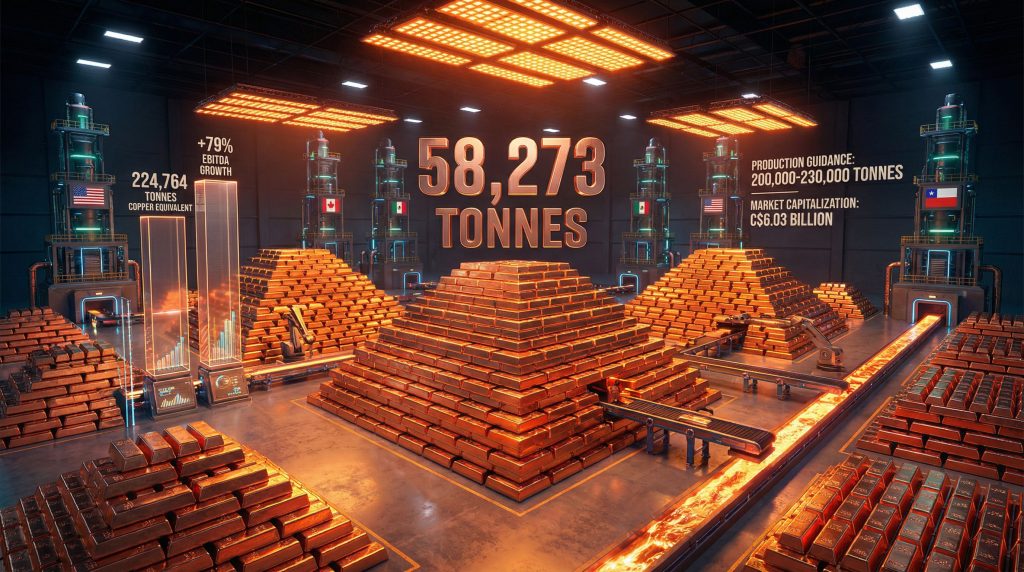
The operational performance metrics demonstrate substantial scaling capabilities that extend beyond typical mining industry growth patterns. Capstone Copper shares benefited from record quarterly copper production of 58,273 tonnes in Q4 2025, representing a 79% increase from the estimated 32,600 tonnes produced in Q4 2024.
Production Performance Summary:
| Metric | Q4 2025 | Q4 2024 | YoY Change |
|---|---|---|---|
| Copper Production (tonnes) | 58,273 | ~32,600 | +79% |
| Annual Production (tonnes) | 224,764 | Not specified | Record high |
| Adjusted EBITDA (millions USD) | $308M | $172M | +79% |
The mathematical correlation between production volume increases and EBITDA expansion indicates operational efficiency improvements rather than merely proportional scaling. When mining operations achieve 79% production growth alongside identical percentage EBITDA growth, this suggests either stable commodity pricing combined with declining per-unit costs, or margin expansion from operational leverage effects.
2026 Production Guidance:
The company provided forward guidance of 200,000 to 230,000 tonnes of copper production for 2026, indicating management confidence in sustaining elevated production levels while maintaining operational efficiency standards.
When big ASX news breaks, our subscribers know first
How Does Capstone's Operational Performance Stack Up?
Financial Metrics and Profitability Indicators
The Q4 2025 financial results reveal operational leverage characteristics that distinguish Capstone Copper shares from typical mining investment profiles. The $308 million adjusted EBITDA represents significant quarterly cash generation, particularly when considered alongside the production scaling achievements.
Cost Structure Analysis:
Industry analysis suggests that achieving 79% production increases while maintaining proportional EBITDA growth requires declining per-unit production costs. This operational dynamic typically results from advanced data-driven mining operations and process optimisations.
Operational Efficiency Indicators:
- Quarterly EBITDA of $308M demonstrates strong cash generation capacity
- Production scaling without proportional cost increases indicates operational leverage
- Record annual production of 224,764 tonnes establishes operational benchmark
- Management guidance suggests sustainable production levels through 2026
Technology Integration and Process Optimisation
The substantial production increases achieved during 2025 suggest successful implementation of enhanced extraction technologies and processing methodologies. While specific technological details were not disclosed, the operational results indicate systematic improvements in mineral recovery rates and processing efficiency.
Technical Performance Factors:
- Enhanced extraction efficiency reducing ore waste
- Processing optimisation improving copper recovery rates
- Integrated systems reducing operational downtime
- Capacity utilisation improvements maximising asset productivity
Why Are Copper Market Fundamentals Supporting Share Price Growth?
Copper Price Performance and Market Dynamics
Capstone Copper shares gained 94.6% over the 12-month period ending April 9, 2026, significantly outpacing the 47% appreciation in copper prices during the same timeframe. This performance differential indicates that operational execution contributed additional value beyond commodity price tailwinds.
Market Performance Context:
- Copper pricing: US$12,709 per tonne (as of April 9, 2026)
- 12-month copper price appreciation: 47%
- Capstone Copper shares 12-month appreciation: 94.6%
- Performance premium: 47.6 percentage points above copper price movement
The mathematical divergence between commodity price appreciation and share price performance suggests investors recognised operational improvements and production scaling capabilities beyond simple commodity exposure benefits. Furthermore, insights from copper-uranium investment insights highlight the strategic importance of North American mining operations.
Electric Vehicle and Energy Transition Demand
The structural copper demand transformation extends beyond traditional industrial applications into multi-decade infrastructure development requirements. These demand drivers represent non-cyclical consumption patterns that support sustained commodity pricing.
Primary Copper Demand Sectors:
-
Electric Vehicle Manufacturing
- Wiring harnesses and electrical systems
- Battery infrastructure components
- Charging station installations
-
Renewable Energy Infrastructure
- Wind turbine electrical systems
- Solar panel wiring and connections
- Grid integration requirements
-
Energy Storage Systems
- Battery facility construction
- Grid modernisation projects
- Smart grid technology deployment
-
Traditional Industrial Applications
- Construction and telecommunications
- General manufacturing requirements
- Infrastructure maintenance and expansion
What Are the Key Investment Risks to Consider?
Market Volatility and Commodity Price Exposure
Capstone Copper shares demonstrated sensitivity to macroeconomic concerns when the stock declined 8.1% on the day of record Q4 2025 results release, coinciding with geopolitical tensions. This market reaction illustrates how external factors can temporarily override operational outperformance in investor decision-making.
Primary Risk Factors:
- Direct correlation with copper commodity price fluctuations
- Economic slowdown impacts on industrial demand
- Geopolitical tensions affecting global trade flows
- Currency exchange rate variations (CAD/USD/AUD conversions)
The market's concern that regional conflicts could disrupt global growth and dampen medium-term copper demand demonstrates how macroeconomic factors can overshadow strong operational performance in short-term trading.
Operational and Regulatory Considerations
Mining operations across multiple jurisdictions create complex regulatory compliance requirements that can impact operational continuity and expansion planning. Environmental regulations, labour relations, and permitting processes represent ongoing operational management considerations.
Operational Risk Management Areas:
- Environmental compliance across five operational locations
- Labour relations and workforce management coordination
- Water usage regulations and environmental impact assessments
- Mining permit renewals and expansion approvals
How Does Capstone Compare to ASX Mining Peers?
Valuation Metrics Analysis
Despite the 94.6% share price appreciation, analyst assessment suggests Capstone Copper shares continue trading at attractive valuation levels. Forward price-earnings ratios of 11.2x for 2026 and 9.35x for 2027 indicate reasonable valuation multiples relative to production growth capabilities.
For comparison with broader copper market performance, investors can review ASX Capstone Copper information and comprehensive investor relations data. These resources provide additional context for evaluating the company's market position relative to industry peers.
Valuation Framework Considerations:
- Market capitalisation: C$6.03 billion (reflecting current scale)
- Forward P/E ratio progression: 11.2x (2026) declining to 9.35x (2027)
- Enterprise value relative to annual production capacity
- Asset replacement cost analysis versus current market valuation
Pure-Play Copper Positioning Advantage
The ASX provides limited pure copper exposure opportunities compared to diversified mining giants that combine copper with iron ore, coal, and precious metals operations. This specialisation creates investment advantages for portfolios seeking targeted commodity exposure.
Competitive Positioning Benefits:
- Focused management expertise in copper extraction and processing
- Specialised operational strategies optimised for copper markets
- Direct correlation with copper demand growth rather than commodity basket exposure
- Concentrated capital allocation toward copper asset development
What Should Investors Expect Going Forward?
Production Expansion Timeline
The combination of near-term brownfield development projects and longer-term greenfield exploration opportunities provides multiple avenues for sustained production growth. The company's track record of operational execution during 2025 establishes credibility for managing expansion initiatives.
Growth Development Pipeline:
- Brownfield capacity expansion projects (near-term implementation)
- Greenfield exploration opportunities (longer development timelines)
- Technology adoption programmes improving recovery efficiency
- Capacity optimisation initiatives across existing five operations
Market Position and Competitive Advantages
Capstone Copper shares benefit from established relationships with copper buyers, proven operational execution capabilities, and financial capacity for strategic growth investments. The company's geographic positioning provides logistics advantages for distribution to both regional and global markets, complementing trends observed in the US copper production overview.
Strategic Competitive Elements:
- Established copper buyer relationships and market access
- Demonstrated operational execution during high-growth periods
- Financial capacity for expansion capital requirements
- Geographic advantages for efficient logistics and distribution
The next major ASX story will hit our subscribers first
Investment Decision Framework for Capstone Copper
Bull Case Scenario Analysis
The convergence of structural copper demand growth, successful operational scaling, and attractive valuation metrics creates potential for continued outperformance. Energy transition infrastructure development represents a multi-decade demand driver that supports sustained commodity pricing.
Positive Scenario Factors:
- Continued copper price strength from renewable energy infrastructure development
- Successful execution of planned capacity expansion projects
- Operational efficiency improvements driving margin expansion beyond commodity benefits
- Market recognition of pure-play copper value proposition versus diversified miners
Risk Management and Portfolio Considerations
Investment Framework Considerations:
- Position sizing relative to overall commodity exposure tolerance in portfolios
- Diversification across multiple mining companies and commodity types
- Regular monitoring of global economic indicators affecting industrial demand
- Systematic assessment of operational performance metrics versus guidance
Monitoring Metrics:
- Quarterly production figures versus annual guidance ranges
- EBITDA margins and cost per tonne extraction efficiency
- Copper price correlation with share price performance
- Capital expenditure requirements for expansion project funding
Investment decisions should consider individual risk tolerance, portfolio diversification requirements, and long-term investment objectives. Commodity-focused investments involve inherent volatility that may not be suitable for all investment strategies.
Note: This analysis is based on publicly available information and should not be considered personalised investment advice. Investors should conduct their own research and consider consulting with qualified financial professionals before making investment decisions.
Want to Discover the Next Copper Investment Opportunity?
Discovery Alert's proprietary Discovery IQ model delivers real-time alerts on significant copper discoveries across the ASX, instantly empowering subscribers to identify actionable opportunities ahead of the broader market. Understand why major mineral discoveries can lead to substantial market returns by exploring Discovery Alert's dedicated discoveries page, showcasing historic examples of exceptional outcomes, and begin your 14-day free trial today to position yourself ahead of the market.