June 5, 2026
Understanding Carbon Border Adjustments Through Regulatory Implementation Architecture
Contemporary climate policy frameworks increasingly rely on sophisticated market mechanisms to address cross-border emissions challenges. The EU Carbon Border Adjustment Mechanism represents a paradigm shift from voluntary climate commitments toward mandatory carbon cost integration across global supply chains. Furthermore, these mechanisms demonstrate how tariff impacts and regulatory frameworks create new compliance structures that fundamentally alter international trade economics.
Industrial decarbonisation efforts face persistent challenges when production simply relocates to jurisdictions with less stringent environmental standards. This phenomenon, known as carbon leakage, undermines both climate objectives and competitive fairness for companies investing in clean technologies. However, regulatory frameworks addressing this challenge must balance environmental effectiveness with trade law compliance, creating complex implementation requirements across multiple sectors simultaneously.
When big ASX news breaks, our subscribers know first
What Is the EU Carbon Border Adjustment Mechanism and Why Does It Matter?
Core Regulatory Architecture
The EU Carbon Border Adjustment Mechanism represents a comprehensive regulatory instrument established through Regulation (EU) 2023/956, formally adopted by the European Parliament and Council on May 10, 2023. This mechanism operates as a climate policy tool designed to address carbon cost disparities between European Union production and imports from jurisdictions lacking equivalent carbon pricing systems.
CBAM functions through direct integration with the European Union Emissions Trading System, which has operated since January 1, 2005, covering approximately 40% of EU greenhouse gas emissions. The mechanism applies carbon charges to imported goods equivalent to those faced by EU producers under domestic emissions trading requirements, creating cost parity across competing products regardless of production location.
The legal framework establishes benchmark emissions intensities representing efficient production standards for covered sectors. Importers must purchase and surrender CBAM certificates to cover embedded emissions exceeding these benchmarks, with certificate prices aligned to EU ETS auction values averaging €73/tCO2 during 2025.
Policy Objectives and Strategic Intent
Carbon leakage prevention forms the primary policy rationale for CBAM implementation. Without border adjustments, EU-based producers face competitive disadvantage against imports from higher-emission facilities in countries lacking carbon pricing mechanisms. The regulation addresses this disparity by applying equivalent carbon costs to imports, maintaining market competitiveness for companies investing in decarbonisation technologies.
Industrial competitiveness protection extends beyond immediate trade effects to long-term investment incentives. The mechanism preserves economic viability of clean production technologies within the EU while encouraging similar investments globally through market access conditions. Consequently, this creates positive incentives for emissions reduction across international supply chains.
Global climate diplomacy implications emerge as CBAM influences third-country policy decisions regarding domestic carbon pricing systems. The regulation provides explicit recognition mechanisms for equivalent carbon costs paid in origin countries, encouraging development of comparable climate policies internationally through market-based incentives.
How Does CBAM's Implementation Timeline Create Compliance Challenges?
Transitional Phase Requirements (2023-2025)
The transitional period commenced January 1, 2023, establishing reporting obligations without financial penalties for a three-year period. This phase requires quarterly submission of import data including product quantities, embedded emissions calculations, and verification documentation. Companies must navigate complex data collection requirements while building compliance infrastructure for the operational phase.
Importers face fundamental choices between using conservative default emissions values or submitting actual facility-specific data through complex verification processes. Default values typically represent high-end emissions estimates, creating financial incentives for detailed emissions documentation despite significant administrative burden and uncertain verification outcomes.
Regulatory uncertainty compounds compliance challenges as implementing regulations continue development throughout the transitional phase. The December 17, 2025 release of provisional benchmarks provides only preliminary guidance, with final benchmarks expected in Q1 2026, creating compressed timeline for operational phase preparation.
Operational Phase Launch (2026 onwards)
Financial obligations commence January 1, 2026, with CBAM certificate purchase and surrender requirements for imports exceeding benchmark emissions levels. The initial CBAM factor of 97.5% applies to average EU ETS auction prices, representing a 2.5% transitional allowance that phases out completely by 2034.
Cost escalation follows a predetermined schedule as free EU ETS allocations decline annually:
- 2026-2029: 97.5% of ETS price (2.5% free allocation retained)
- 2030-2031: 85% of ETS price
- 2032-2033: 70% of ETS price
- 2034-2035: 50% of ETS price
- 2036 onwards: 100% of ETS price (zero free allocations)
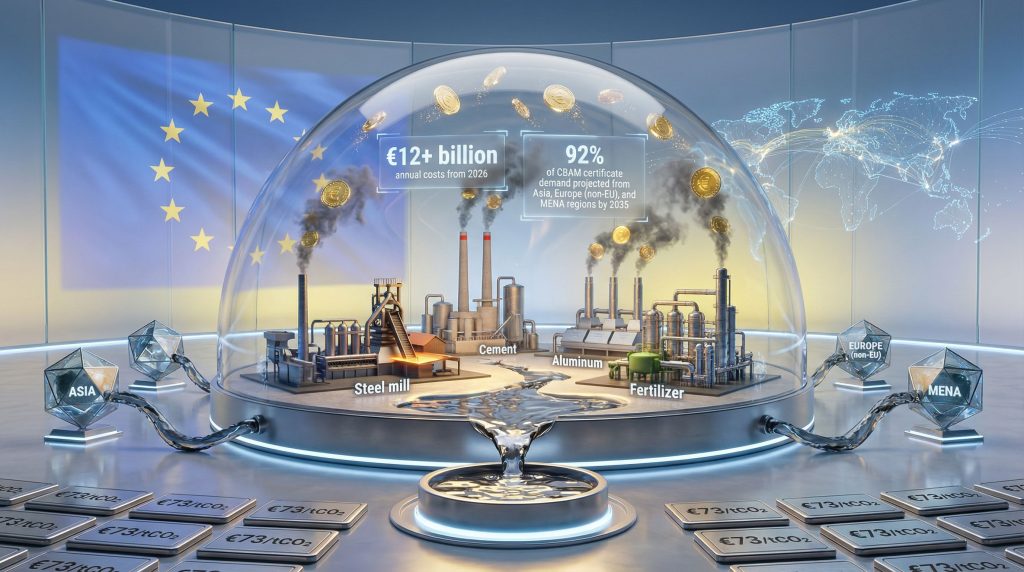
The initial year represents the largest single cost increase, with €12+ billion in new compliance costs despite minimal free allocation removal. This reflects the immediate application of carbon charges to all embedded emissions exceeding benchmark levels from operational phase commencement.
Regulatory Uncertainty Factors
Implementation complexity stems from ongoing development of detailed technical regulations governing emissions calculation methodologies, verification standards, and third-country carbon price recognition criteria. These implementing acts determine practical compliance requirements but remain under development as the operational phase approaches.
Cross-border recognition mechanisms for equivalent carbon pricing systems require bilateral negotiations and technical assessments of foreign climate policies. Documentation requirements for carbon price adjustments create additional administrative complexity while recognition criteria remain subject to interpretation and potential modification.
Verification standard evolution presents ongoing uncertainty as accreditation requirements for third-party verifiers develop alongside emissions calculation methodologies. ISO 14064-2 standards provide baseline requirements, but CBAM-specific verification procedures continue refinement through delegated regulations and technical guidance documents.
Which Industries Face the Highest CBAM Compliance Costs?
Primary Covered Sectors Analysis
| Sector | Annual Cost Projection (2035) | Share of Total Liability | Key Risk Factors |
|---|---|---|---|
| Iron & Steel | €30+ billion | 81% | High import volumes, BF-BOF emissions intensity |
| Cement | €2+ billion | 12-15% | Very high emissions-to-value ratio, thin margins |
| Aluminium | €1+ billion | 7% | Moderate direct emissions, electricity exclusions |
| Fertilizers | €800+ million | 4-5% | Process emissions, agricultural cost transmission |
| Electricity | €400+ million | 2-3% | Variable renewable content, cross-border flows |
Iron and steel products represent over 70% of total CBAM-exposed trade value, making this sector the dominant source of compliance costs and market disruption. Steel production via blast furnace-basic oxygen furnace processes carries emissions intensity of 2.0-2.2 tCO2 per tonne, compared to 0.3-0.6 tCO2 per tonne for electric arc furnace production, creating significant competitive disparities based on production technology.
Cement sector vulnerability stems from fundamental process requirements including limestone calcination, which generates approximately 0.52-0.55 tCO2 per tonne through chemical reaction independent of energy consumption. Combined with energy-related emissions of 0.30-0.40 tCO2 per tonne, total embedded emissions reach 0.85-0.90 tCO2 per tonne cement. With benchmark cement prices ranging €50-95 per tonne, CBAM costs of €62-66 per tonne represent 60-100% of product value.
Downstream Industry Exposure
Automotive manufacturing faces cascading cost increases through steel and aluminium input price escalation. CBAM charges on steel imports translate directly to higher material costs for vehicle production, affecting profit margins unless passed through to consumer pricing. European automotive manufacturers may gain competitive advantage over imports using high-emission steel inputs.
Construction materials experience significant cost transmission effects, particularly affecting precast concrete, structural steel, and building envelope systems. A German concrete manufacturer importing cement from Turkey faces input cost increases of 80-100% compared to 2025 baseline prices, creating pressure for either margin compression or end-customer price increases in competitive construction markets.
Agricultural fertiliser costs cascade through food production systems as ammonia-based fertiliser imports face CBAM charges of €110-180 per tonne depending on production process emissions. These costs ultimately transmit through agricultural commodity pricing, affecting food security considerations alongside climate policy objectives.
What Are the Key Compliance Mechanisms Under CBAM?
Emissions Calculation Methodologies
Direct emissions measurement encompasses fuel consumption during primary production processes including smelting, roasting, and chemical reactions. Calculation methodologies vary by sector, with iron and steel requiring detailed tracking of coking coal, natural gas, and other fuel inputs throughout the production chain from raw materials to finished products.
Indirect emissions from electricity consumption represent a significant component for energy-intensive industries, typically comprising 15-30% of total emissions in blast furnace-basic oxygen furnace steel production. However, the European Commission excluded electricity emissions from aluminium calculations despite primary aluminium smelting requiring 12,000-14,000 kWh per tonne, creating potential competitive distortions.
Default values provide compliance pathway alternatives to facility-specific emissions data submission. These values reflect conservative high-end estimates for each country-sector combination, incentivising actual data submission while ensuring revenue collection through higher default charges. Companies choosing default values avoid verification complexity but face potentially higher costs.
Certificate Trading System Architecture
CBAM certificate pricing aligns with EU ETS auction mechanisms, ensuring cost equivalence between domestic and imported production. Average ETS prices during 2025 reached €73/tCO2, with historical ranges of €60-96/tCO2 creating pricing volatility that directly affects import cost calculations.
Purchase and surrender procedures require importers to acquire certificates covering embedded emissions exceeding benchmark levels, adjusted by the applicable CBAM factor. Certificate transactions occur through designated platforms managed by national authorities, with quarterly reporting and annual surrender requirements creating administrative compliance obligations.
Market liquidity considerations affect certificate pricing and availability, particularly during initial operational phase implementation. Unlike EU ETS allowances with established secondary markets, CBAM certificates represent new financial instruments requiring market development and price discovery mechanisms.
Third-Country Carbon Price Recognition
Recognition criteria for equivalent carbon pricing systems require technical assessment of foreign climate policies including carbon tax rates, emissions trading system coverage, and administrative effectiveness. Documentation requirements include proof of carbon price payment, verification of policy scope, and demonstration of environmental integrity comparable to EU standards.
Bilateral negotiation frameworks provide mechanisms for systematic carbon price coordination between the EU and major trading partners. These negotiations address technical harmonisation of emissions calculation methodologies, mutual recognition of verification standards, and coordination of carbon pricing levels across jurisdictions.
Adjustment calculations reduce CBAM obligations based on verified carbon costs paid in origin countries, creating complex administrative procedures for importers claiming such reductions. Documentation requirements include payment receipts, policy coverage verification, and third-party attestation of carbon price application to specific production facilities.
How Will CBAM Reshape Global Trade Patterns?
Geographic Impact Distribution
Critical Market Intelligence: 92% of CBAM certificate demand projects to originate from Asia, non-EU Europe, and Middle East/North Africa regions by 2035, fundamentally altering traditional trade relationships with the European Union market.
China faces the highest absolute compliance costs, reaching €9.1 billion under high EU ETS price scenarios and €6.0 billion under baseline projections. These costs reflect both substantial export volumes to the EU and relatively high default emissions intensity values, particularly in iron and steel production where blast furnace-basic oxygen furnace technology predominates.
Turkey, India, and Russia encounter significant liability exposure driven by large CBAM-exposed export volumes combined with emissions-intensive production methods. Default emissions factors for these countries reflect industrial infrastructure dependent on coal-fired power generation and conventional production technologies lacking carbon capture or efficiency improvements.
Country-Specific Competitive Positioning
Effective CBAM tariff rates vary dramatically across countries based on emissions intensity profiles and export product mix. Indonesia faces the highest effective rate at 154% of import value, while Egypt encounters 86% rates, compared to Canada and Bahrain experiencing the lowest rates due to cleaner production methods or favourable product specialisation.
Competitive advantage shifts toward low-carbon producers operating efficient technologies or utilising renewable energy sources. Countries with hydroelectric power generation, natural gas-based production, or advanced efficiency technologies gain market share as CBAM implementation proceeds and carbon cost differentials become more pronounced.
Market entry opportunities emerge for producers previously excluded from EU markets due to distance or other cost factors. Clean technology producers in regions like Norway, Canada, or other low-emission jurisdictions may find European market access economically viable as CBAM penalties affect high-emission competitors.
Supply Chain Restructuring Incentives
Procurement pattern modifications become economically necessary as EU importers face direct cost impacts from supplier emissions intensity. Companies develop new supplier qualification criteria incorporating carbon footprint assessment, verification capabilities, and long-term decarbonisation commitments alongside traditional quality and price considerations.
Export market redirection occurs as high-emission producers shift sales toward regions without carbon border adjustments. This trade diversion may increase emissions in non-EU markets while reducing them in European supply chains, creating global climate policy coordination challenges that reflect broader trade war impact on economic relationships.
Investment reallocation accelerates toward clean production technologies as CBAM costs create new financial incentives for emissions reduction. Steel producers evaluate electric arc furnace conversion, cement manufacturers assess alternative fuel adoption, and fertiliser producers consider renewable hydrogen integration based on CBAM cost projections.
The next major ASX story will hit our subscribers first
What Compliance Strategies Should Businesses Adopt?
Data Management and Verification Systems
Emissions monitoring infrastructure requires substantial upgrade for most importers and their suppliers. Companies must establish data collection systems capable of tracking fuel consumption, electricity usage, and process emissions throughout complex supply chains with quarterly reporting granularity and third-party verification capabilities.
Supply chain transparency obligations extend beyond immediate suppliers to encompass upstream production data including energy sources, production processes, and facility-level emissions calculations. This creates new information sharing requirements between companies and their international suppliers, potentially affecting commercial relationships and contract structures.
Third-party verification requirements add administrative complexity and cost while ensuring data integrity for actual emissions submissions. Verifiers must hold accreditation under ISO 14064-2 standards or equivalent, creating new service industry demands and potential capacity constraints during initial implementation phases.
Financial Risk Management Approaches
Carbon cost hedging strategies become essential for importers facing volatile EU ETS price exposure through CBAM certificate requirements. Financial instruments including forward contracts, options, and other derivatives may develop to help companies manage carbon price risk alongside traditional commodity price hedging mechanisms.
Certificate procurement planning requires coordination with import schedules, customs procedures, and cash flow management. Companies must balance certificate purchase timing against price volatility while ensuring adequate inventory for surrender requirements and avoiding penalty exposure from insufficient certificate holdings.
Price volatility mitigation involves portfolio diversification across suppliers with different emissions profiles, contract structuring to share carbon cost risk between buyers and sellers, and operational flexibility to adjust sourcing patterns based on relative carbon cost advantages across different regions or suppliers.
Strategic Supply Chain Optimisation
Low-carbon supplier identification requires development of new assessment criteria incorporating emissions intensity data, verification capabilities, and decarbonisation roadmaps alongside traditional procurement factors. Companies create supplier scorecards integrating carbon performance with quality, cost, and delivery metrics.
Production technology upgrade assessments evaluate capital investment alternatives including electric arc furnace conversion for steel, alternative fuel adoption for cement, and renewable energy integration for various sectors. These assessments balance upfront capital costs against long-term CBAM cost advantages and market positioning benefits, particularly considering energy transition dynamics.
Geographic sourcing diversification strategies balance carbon cost optimisation with supply chain resilience, logistics efficiency, and quality requirements. Companies may establish dual-sourcing arrangements combining low-carbon suppliers for EU markets with conventional suppliers for other regional markets.
What Are the International Trade Law Implications?
WTO Compatibility Assessment
Non-discrimination principles under World Trade Organization agreements require CBAM implementation to treat imported and domestic products equivalently regarding carbon cost application. The mechanism must demonstrate that EU producers face equivalent carbon costs through the domestic emissions trading system, justifying similar charges on imports without creating discriminatory treatment.
Technical barriers to trade considerations examine whether CBAM requirements create unnecessary obstacles to international commerce through complex administrative procedures, excessive documentation requirements, or discriminatory verification standards. Compliance costs and administrative burden must be proportionate to environmental objectives.
Environmental exception provisions under GATT Article XX may provide legal justification for trade-restrictive measures necessary for environmental protection. However, such exceptions require demonstration that CBAM represents the least trade-restrictive means of achieving climate objectives and does not constitute disguised protectionism.
Diplomatic and Retaliatory Risks
Third-country legal challenges may emerge through WTO dispute settlement mechanisms or bilateral diplomatic pressure as affected countries contest CBAM legality or implementation. Major exporters including China, India, and Russia possess significant economic leverage to pursue trade retaliation or seek alternative market arrangements.
Reciprocal border adjustment mechanisms under development by other major economies could create competing carbon border systems with different coverage, methodologies, and recognition standards. This fragmentation may increase compliance complexity for multinational companies while reducing global climate policy effectiveness and contributing to broader tariff policy impact concerns.
Multilateral climate cooperation impacts include potential tension between unilateral trade measures and negotiated international climate frameworks. CBAM implementation may influence Paris Agreement Article 6 negotiations regarding international carbon market mechanisms and recognition of national climate policies.
How Accurate Are Current CBAM Cost Projections?
Methodology Limitations and Assumptions
Default emissions factors represent conservative estimates based on available industry data but may not reflect actual facility performance or recent efficiency improvements. Companies submitting actual emissions data may achieve lower CBAM costs, but verification complexity and uncertainty create barriers to adoption, particularly for smaller importers.
EU ETS price volatility directly affects CBAM certificate costs, creating forecast uncertainty as carbon prices respond to economic conditions, policy changes, and market speculation. Historical ETS price ranges of €60-96/tCO2 during 2025 demonstrate significant volatility that complicates long-term cost planning and investment decisions.
Free allocation phase-out schedules determine cost escalation timing but remain subject to policy review and potential modification based on industrial competitiveness concerns, climate ambition updates, or international negotiation outcomes. These uncertainties affect investment planning and strategic decision-making across affected industries.
Scenario Analysis Framework
Base case projections assume constant import patterns, default emissions factors application, and steady EU ETS price growth averaging €73/tCO2 in 2026 with moderate annual increases. These assumptions generate €12+ billion in annual CBAM costs from 2026, escalating as free allocations decline and carbon prices increase.
High ETS price scenarios with €150+/tCO2 levels create dramatic cost increases exceeding 400% of import value for some products. Such scenarios reflect potential carbon price acceleration under strengthened climate policies but may trigger demand destruction or trade pattern shifts that moderate actual cost impacts.
Low-carbon transition scenarios account for production technology improvements, renewable energy adoption, and supplier substitution effects that reduce emissions intensity over time. These scenarios suggest CBAM costs may decline in real terms as global production methods evolve in response to carbon pricing signals.
What Future Developments Will Shape CBAM Evolution?
Sectoral Scope Expansion Potential
Additional industries under consideration include chemicals, plastics, hydrogen, and downstream manufactured products incorporating significant CBAM-covered material content. Scope expansion decisions depend on carbon leakage risk assessment, administrative feasibility, and trade relationship management with major partners.
Downstream products inclusion faces technical complexity regarding embedded emissions calculation across multiple processing stages and supply chain tiers. Automotive components, machinery, and construction products represent potential expansion candidates but require sophisticated traceability systems and verification methodologies.
Timeline considerations balance administrative capacity constraints against climate policy effectiveness objectives. Rapid scope expansion may overwhelm verification infrastructure and create implementation challenges, while gradual expansion risks limiting environmental benefits and maintaining competitive distortions in excluded sectors.
International Coordination Mechanisms
Article 6 Paris Agreement integration provides framework for international carbon market cooperation and mutual recognition of climate policies. CBAM implementation may accelerate these negotiations by creating economic incentives for carbon price coordination and emissions reduction verification standards.
Bilateral carbon market linking agreements between the EU and major trading partners could reduce CBAM compliance costs while maintaining environmental integrity. Such agreements require technical harmonisation of emissions calculation, verification standards, and carbon price levels across different jurisdictions and policy frameworks.
Global carbon pricing harmonisation represents long-term objective for reducing trade friction while maintaining climate policy effectiveness. International coordination mechanisms through G7, G20, or other multilateral forums may develop common approaches to carbon border adjustment implementation and mutual recognition, potentially influencing EU mining initiatives and resource security strategies.
Technology and Innovation Drivers
Clean production technology adoption accelerates under CBAM cost pressure, driving investment in electric arc furnace steel production, alternative fuel cement manufacturing, renewable hydrogen fertiliser production, and carbon capture utilisation systems. These technological shifts may fundamentally alter industrial competitiveness patterns globally.
Digital monitoring and verification systems development reduces administrative burden while improving emissions data accuracy and transparency. Blockchain applications, satellite monitoring, and automated data collection systems may streamline compliance procedures and reduce verification costs over time.
Carbon capture and utilisation recognition under CBAM calculations requires technical standards development for permanent storage verification, utilisation pathway assessment, and additionality requirements. These technologies may provide compliance pathways for emissions-intensive industries unable to achieve process-based reductions.
Frequently Asked Questions About CBAM Implementation
Registration and Authorization Requirements
Who qualifies as CBAM declarant? Any person or entity importing CBAM-covered goods into the EU customs territory must register as CBAM declarant with the relevant national authority before first import declaration. This includes direct importers, customs agents acting on behalf of importers, and indirect representatives with appropriate authorisation.
What documentation supports import declarations? Importers must provide customs declaration information, embedded emissions calculations or default value applications, verification certificates for actual emissions data, and documentation of any carbon prices paid in origin countries. Quarterly reporting aggregates this information for regulatory compliance.
How are verification bodies accredited? Third-party verifiers must hold accreditation under ISO 14064-2 standards or equivalent national frameworks recognised by EU member states. Accreditation bodies assess technical competence, independence requirements, and quality management systems before authorising CBAM verification activities.
Cost Calculation and Payment Procedures
How are embedded emissions determined? Companies choose between facility-specific actual emissions data verified by accredited third parties or country-sector default values published by the European Commission. Actual data requires complex verification but may reduce costs, while default values provide simplicity with potentially higher charges.
When must certificates be purchased and surrendered? CBAM certificates must be purchased before or concurrent with import customs clearance, with surrender required by May 31 following each calendar year. Companies maintain certificate registries tracking purchases, holdings, and surrender obligations with quarterly reporting to national authorities.
What adjustments apply for origin country carbon pricing? Importers may claim reductions for carbon prices paid in production countries through carbon taxes, emissions trading systems, or equivalent mechanisms. Claims require documentation including payment receipts, policy coverage verification, and third-party attestation of carbon price application to specific facilities.
Dispute Resolution and Appeals Process
Administrative review procedures allow importers to challenge CBAM determinations including benchmark applications, emissions calculations, and certificate surrender requirements through national authority administrative processes. Reviews examine technical accuracy, procedural compliance, and evidence adequacy supporting determinations.
Legal remedies for compliance disputes include administrative court appeals of national authority decisions and potential referral to European Court of Justice for interpretation of EU Carbon Border Adjustment Mechanism regulation provisions. Companies may seek interim relief from enforcement actions pending dispute resolution outcomes.
Cross-border enforcement mechanisms rely on customs cooperation between EU member states and third countries for information sharing, verification coordination, and compliance monitoring. Bilateral agreements may establish specific procedures for dispute resolution and mutual assistance in CBAM implementation, as detailed in the official CBAM framework.
Disclaimer: This analysis is based on provisional benchmarks and regulatory interpretations available as of December 2025. Final implementation details may vary based on forthcoming regulatory guidance, technical standards development, and potential policy modifications. Companies should consult legal and technical advisors for specific compliance strategies and risk assessment tailored to their particular circumstances and supply chain configurations.
Could Your Portfolio Benefit from Discovery-Rich Mining Opportunities?
Whilst CBAM reshapes global trade patterns and creates new competitive dynamics across commodity markets, Australian mining companies positioned in critical minerals and low-carbon production technologies may find unprecedented opportunities emerging. Discovery Alert's proprietary Discovery IQ model delivers instant notifications on significant ASX mineral discoveries, helping investors identify companies that could benefit from these shifting regulatory landscapes and supply chain restructuring trends. Start your 30-day free trial today to stay ahead of market-moving discoveries in this rapidly evolving commodities environment.