August 6, 2026
Global energy systems face unprecedented pressure to simultaneously maintain grid stability while achieving carbon neutrality targets by 2050. This dual challenge requires infrastructure capable of handling massive industrial emissions that cannot be eliminated through renewable energy alone. Process industries including cement manufacturing, steel production, and petrochemicals generate unavoidable CO₂ through chemical reactions rather than combustion, creating a fundamental gap that renewable deployment cannot address.
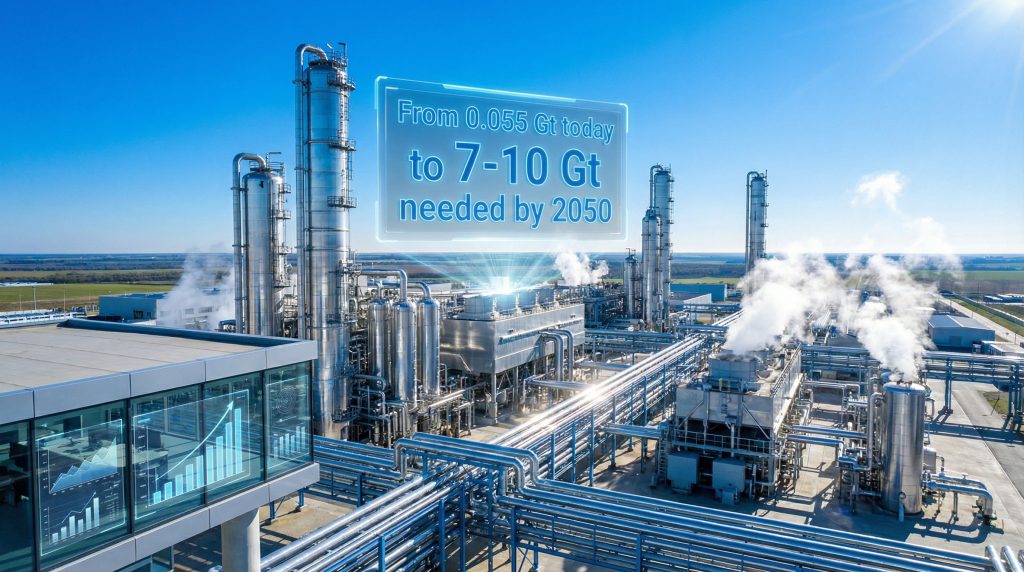
The mathematics reveal the scale of transformation required. Current capture infrastructure handles merely 55 million tonnes of CO₂ annually while climate scenarios demand 7 to 10 gigatonnes by 2050. This represents a scaling requirement of 127 to 182 times current capacity within 24 years, making carbon capture and storage in energy transition one of the most ambitious technological deployments in human history.
What Makes Carbon Capture Technology Essential for Global Decarbonisation Goals?
The 7-10 Gigaton Challenge by 2050
Current global capacity for carbon capture and storage in energy transition operates at approximately 55 million tonnes CO₂ annually as of 2024, according to International Energy Agency assessments. This baseline represents less than 0.8% of the 7 to 10 gigatonne annual requirement projected for net-zero pathways by 2050.
The scaling mathematics present extraordinary challenges. Achieving the lower bound of 7 gigatonnes annually requires a 127-fold increase from current operations. The upper projection of 10 gigatonnes demands 182 times current capacity, necessitating deployment rates exceeding any previous industrial infrastructure expansion.
International Energy Agency projections suggest CCS capacity could double to 110-120 million tonnes annually by 2030 under existing investment trajectories. However, this growth trajectory remains insufficient by orders of magnitude, highlighting the urgent need for accelerated policy frameworks and technological deployment strategies.
Strategic positioning emphasises carbon capture as complementary technology rather than standalone solution. Direct electrification and renewable energy deployment maintain priority for power generation and transport sectors, while CCS addresses residual emissions from hard-to-abate industrial processes.
Hard-to-Abate Sectors Where CCS Becomes Critical
Process Emissions by Industrial Sector
| Industry | Annual CO₂ Emissions | CCS Viability | Alternative Solutions |
|---|---|---|---|
| Cement Production | 2.4-2.9 Gt globally | High – process emissions unavoidable | Limited alternatives |
| Steel Manufacturing | 1.8-2.6 Gt globally | Medium – hydrogen integration possible | Green hydrogen costly |
| Petrochemicals | 1.5-1.8 Gt globally | High – feedstock dependency | Bio-based alternatives emerging |
| Power Generation | ~10 Gt globally | High – bridge technology | Renewable + storage |
Cement production generates approximately 50% of emissions through calcination, where limestone decomposition releases CO₂ as a chemical byproduct rather than combustion. This process emission characteristic makes electrification insufficient for complete decarbonisation. HeidelbergCement's Lägerdalen pilot project in Sweden demonstrates commercial-scale application, capturing 5,000 tonnes CO₂ annually at 95% efficiency.
Steel manufacturing depends heavily on carbon reduction processes in blast furnace operations. While hydrogen integration offers potential pathways, infrastructure transformation costs reach $200-300 billion globally. The Swedish LKAB/Hybrit project combines blue hydrogen production with CCS integration, providing operational proof-of-concept for steel decarbonisation.
Petrochemical industries face feedstock dependency challenges where naphtha contains embedded carbon essential for chemical processes. Bio-based alternatives remain under development while battery recycling breakthroughs address immediate emissions reduction requirements across existing facilities.
When big ASX news breaks, our subscribers know first
How Do Leading CCS Projects Demonstrate Commercial Viability?
Operational Benchmarks: Quest vs. Baytown Performance Analysis
Shell's Quest facility in Alberta represents the most comprehensive operational benchmark for large-scale carbon capture and storage in energy transition. Commissioned in January 2015, the facility has maintained continuous operation through 2026, capturing over 6 million tonnes of CO₂ cumulatively.
Quest operates above design specifications, achieving 110-115% of nameplate capacity through operational optimisation. The facility captures 1 million tonnes CO₂ annually from hydrogen production units using amine-based post-combustion capture technology. Captured CO₂ achieves pipeline-grade purity exceeding 99.5% before injection into the Beaverhill Lake Formation, a Devonian saline aquifer 1,000 meters underground.
ExxonMobil's Baytown CCS initiative integrates capture capabilities within existing refinery infrastructure. The facility combines hydrogen production via steam methane reforming with CCS, demonstrating industrial symbiosis approaches. Estimated capacity reaches 0.5-1.0 million tonnes CO₂ annually, though specific performance data remains proprietary.
Cost trajectories show significant improvement through operational experience. Quest facility costs declined from initial estimates of $300 per tonne CO₂ in 2012 to approximately $60 per tonne by 2024, representing 80% cost reduction through learning curve effects and operational refinement.
Infrastructure Reuse Strategy: Maximising Existing Assets
Depleted oil and gas fields provide proven geological storage at 30-50% lower cost compared to greenfield storage development. These formations demonstrate 100+ million year storage permanence through historical hydrocarbon retention, eliminating geological uncertainty risks.
Pipeline network adaptation reduces transport capital expenditure by 40-60% versus new construction. Existing pipeline systems require modifications for CO₂ transport specifications but maintain fundamental infrastructure value for rapid deployment.
Enhanced oil recovery integration generates $25-40 per tonne revenue offset against capture costs. This utilisation pathway provides immediate economic benefits while developing permanent storage capabilities, creating transitional business models supporting CCS expansion.
"Current CCS projects operate at $50-100 per tonne CO₂ captured, while carbon pricing mechanisms in most jurisdictions remain below $30 per tonne, creating a fundamental viability gap that requires policy intervention or technological breakthroughs."
The Sleipner project in the Norwegian North Sea provides 30-year operational validation. Since 1996, the facility has stored 1 million tonnes CO₂ annually with zero reported leakage, demonstrating long-term storage permanence through continuous monitoring and verification protocols.
Why Are Energy Majors Recalibrating Their Carbon Strategies in 2026?
Capital Allocation Shifts: From Diversification to Core Strengthening
BP's strategic transformation illustrates sector-wide recalibration patterns. The company reduced low-carbon venture spending from peak levels of $5 billion annually in 2022 to $3-4 billion in 2025-2026. This 20-40% reduction reflects capital discipline responses to market uncertainty and project viability assessments.
BP deferred 2-3 major renewable projects during 2024-2025 while maintaining commitments to carbon capture and storage in energy transition initiatives. The appointment of Meg O'Neill as CEO effective March 2026 signals continued strategic evolution toward balanced energy portfolios.
Shell's portfolio optimisation targets 2-3 GW renewable capacity by 2030, revised downward from earlier 5 GW guidance. The company maintains hydrogen strategy focus while emphasising blue hydrogen pathways with CCS integration rather than pure renewable development.
ExxonMobil allocated $17-18 billion capital expenditure across traditional oil and gas development in 2024-2025. Furthermore, the Low-Carbon Solutions subsidiary targets $20+ billion EBITDA by 2027, demonstrating integrated approach balancing conventional operations with transition technologies.
Market Forces Driving Strategic Recalibration
Rising capital costs increased renewable project expenses by 10% between 2022-2024, reversing a decade-long trend of declining costs and prompting energy companies to prioritise CCS over renewable diversification.
BloombergNEF analysis confirms onshore wind costs rose 9-10% between 2022-2024 while utility-scale solar experienced 8-10% increases. However, supply chain inflation, equipment costs, and labour constraints contributed to cost pressure alongside interest rate impacts on project financing.
Energy security concerns heightened by geopolitical disruptions drove renewed hydrocarbon reliance. International Energy Agency data shows oil demand reached 102 million barrels per day in 2024, underscoring continued fossil fuel dependency despite decarbonisation initiatives.
Grid-scale energy storage limitations constrain renewable integration capacity. Global installed energy storage reached approximately 85 GW in 2025, representing a fraction of capacity required for fully renewable grid systems, creating infrastructure gaps supporting continued hydrocarbon utilisation.
What Technical Pathways Offer the Greatest CCS Scaling Potential?
Capture Technology Comparison Matrix
CCS Technology Readiness and Scalability
| Technology Type | Maturity Level | Cost Range ($/tonne) | Scalability Rating | Energy Penalty |
|---|---|---|---|---|
| Post-combustion (Amine) | Commercial | $40-80 | High | 15-30% |
| Pre-combustion | Demonstration | $30-60 | Medium | 10-25% |
| Oxy-fuel | Pilot | $60-100 | Medium | 20-35% |
| Direct Air Capture | Early Commercial | $150-600 | Low | 35-50% |
| Membrane Separation | R&D | $25-50 | High | 5-15% |
Post-combustion capture using amine-based solvents represents the most mature technology pathway for carbon capture and storage in energy transition applications. Commercial operations demonstrate 90-95% capture efficiency with established supply chains and engineering expertise.
Membrane separation technologies offer significant potential for reduced energy penalties, operating at 5-15% additional energy requirements compared to 15-30% for amine systems. Consequently, research and development programmes focus on membrane material improvements and process integration optimisation.
Direct air capture operates at commercial scale but faces substantial cost challenges. Current facilities achieve $200-600 per tonne CO₂, requiring 70-85% cost reductions for widespread deployment viability.
Transport and Storage Infrastructure Requirements
Pipeline network density requirements vary significantly by regional industrial clustering. Concentrated industrial zones require 0.5-1.0 km pipeline per square kilometer for effective CO₂ collection, while distributed sources demand extensive transport infrastructure development.
Currently, approximately 3,000 kilometers of dedicated CO₂ pipelines operate globally, concentrated primarily in North American enhanced oil recovery applications. Moreover, expansion to 50,000+ kilometers supports projected 2030 capacity targets across multiple regions.
Geological storage capacity assessments indicate sufficient global potential exceeding 10,000 gigatonnes CO₂. However, regional distribution mismatches create transport challenges, particularly for industrial centres lacking proximate storage formations.
Cross-border CO₂ transport regulatory frameworks remain underdeveloped. European initiatives including the Acorn project demonstrate international collaboration models, while shipping-based transport offers solutions for island nations and regions lacking pipeline connectivity.
How Does CCS Integration Support Hydrogen Economy Development?
Blue Hydrogen Production Pathway Analysis
Blue hydrogen production combines steam methane reforming with carbon capture, creating low-carbon hydrogen at costs competitive with renewable-based alternatives. In addition, current blue hydrogen production costs range $1.50-2.50 per kilogram compared to $3-6 for green hydrogen depending on renewable energy availability.
Infrastructure synergies between carbon capture and storage in energy transition and hydrogen transport reduce deployment costs for both technologies. Shared pipeline networks, storage facilities, and industrial clustering maximise capital efficiency across integrated energy systems.
Industrial demand centres require both hydrogen and CCS capabilities for comprehensive decarbonisation. For instance, steel manufacturing, chemical processing, and refining operations benefit from co-located hydrogen supply and carbon capture infrastructure, creating industrial ecosystem optimisation opportunities.
BECCS and Direct Air Capture: Negative Emissions Potential
Bioenergy with carbon capture and storage offers pathways for negative emissions at industrial scale. BECCS facilities capture CO₂ from biomass combustion, removing atmospheric carbon while generating useful energy or industrial heat.
Direct air capture facilities require strategic location optimisation near renewable energy sources to minimise costs and grid impacts. Concentrated solar power integration provides both electricity and process heat, improving overall system efficiency for DAC operations.
Carbon credit market development supports negative emissions technologies through premium pricing for permanent CO₂ removal. Early markets price negative emissions at $100-300 per tonne, providing revenue support for BECCS and DAC deployment.
Hypothetical Integration Scenario:
An integrated industrial hub combines blue hydrogen production, steel manufacturing with CCS, and DAC facilities powered by dedicated renewable energy. This configuration creates net-negative emissions industrial cluster while maintaining economic competitiveness through process integration, shared infrastructure, and optimised energy flows across multiple applications.
What Policy Frameworks Accelerate CCS Deployment at Scale?
Carbon Pricing Mechanisms and CCS Economics
European Emissions Trading System integration provides CCS project revenue through carbon credit allocation. Current ETS prices near €80-85 per tonne approach CCS operational cost thresholds, creating near-term viability for efficient projects.
US 45Q tax credits offer $180 per tonne for permanent geological storage through 2032, providing substantial project support exceeding operational costs. Credit availability includes capture from industrial sources and direct air capture applications.
Border carbon adjustments create CCS investment incentives for export-oriented industries. Manufacturing sectors facing carbon tariffs on exports gain competitive advantage through carbon capture implementation, particularly for steel, cement, and chemical products.
International Collaboration Models
Norway's Acorn Project demonstrates cross-border CCS coordination frameworks. The initiative connects UK industrial emissions with Norwegian offshore storage, establishing precedent for international CO₂ transport and storage agreements.
Shipping-based CO₂ transport enables island nations and regions lacking pipeline infrastructure to access geological storage. Specialised vessels transport liquefied CO₂ between emission sources and storage locations, expanding geographic deployment possibilities.
Technology transfer mechanisms support developing economy CCS deployment through financing partnerships and knowledge sharing agreements. International climate finance increasingly targets CCS infrastructure as essential transition technology alongside critical minerals energy transition initiatives.
The next major ASX story will hit our subscribers first
Where Will CCS Capacity Growth Occur Through 2030?
Regional Deployment Scenarios
Projected CCS Capacity by Region (2030)
| Region | Current Capacity (Mt CO₂/year) | 2030 Projection | Key Drivers |
|---|---|---|---|
| North America | 25 | 80-120 | Industrial clusters, policy support |
| Europe | 15 | 60-90 | Green Deal, cross-border projects |
| Asia-Pacific | 10 | 40-70 | Industrial decarbonisation |
| Middle East | 5 | 20-30 | Oil sector integration |
North American deployment benefits from established oil and gas infrastructure, supportive policy frameworks, and concentrated industrial clusters. The US Gulf Coast, Alberta oil sands, and North Dakota regions offer optimal combinations of emission sources, storage capacity, and transport infrastructure.
European carbon capture and storage in energy transition development emphasises cross-border collaboration and industrial hub integration. The North Sea provides extensive offshore storage capacity while industrial clusters in Netherlands, Belgium, and UK create concentrated emission sources.
Asia-Pacific growth focuses on heavy industry decarbonisation across China, Japan, and South Korea. Coal-fired power generation with CCS provides transition pathway while steel and chemical industries drive industrial carbon capture development.
Middle East deployment leverages existing oil sector expertise and enhanced oil recovery applications. Integration with ongoing hydrocarbon operations provides revenue support while developing permanent storage capabilities.
Manufacturing Sector Transformation Timeline
Cement industry CCS adoption follows regulatory pressure and carbon pricing implementation. Early adopters in Europe and California demonstrate commercial viability while global expansion depends on policy framework development across major production regions.
Steel sector integration with hydrogen pathways requires coordinated infrastructure investment across multiple technologies. Blue hydrogen production, direct reduced iron processes, and carbon capture create integrated decarbonisation strategies requiring 5-10 year deployment timelines.
Chemical industry process modification focuses on high-volume, high-emission facilities first. Petrochemical complexes offer concentrated emission sources suitable for large-scale carbon capture implementation with existing infrastructure advantages alongside mining decarbonisation benefits.
What Are the Critical Success Factors for CCS in Energy Transition?
Technology Integration Requirements
Carbon capture and storage in energy transition compatibility with renewable energy systems creates operational optimisation opportunities. Variable renewable generation can power flexible CCS operations during peak production periods, improving overall system efficiency.
Grid-scale energy storage coordination enables CCS facilities to provide grid services through demand response capabilities. CCS operations can reduce power consumption during peak demand periods while maintaining capture rates through process optimisation.
Industrial symbiosis opportunities between sectors maximise infrastructure utilisation and reduce deployment costs. Shared CO₂ transport networks, storage facilities, and utility systems create economies of scale across multiple industries supporting mining industry evolution.
Investment and Risk Management Strategies
Public-private partnership models distribute risks between technology providers, operators, and government entities. Successful PPP structures allocate technical risks to experienced operators while governments provide regulatory certainty and long-term storage liability frameworks.
Risk allocation strategies address technology performance, storage permanence, and regulatory changes through comprehensive contractual arrangements. Insurance instruments and financial guarantees protect against operational and geological risks.
Long-term storage liability frameworks establish government oversight for post-closure monitoring while transferring operational risks to private sector entities. Stewardship costs estimated at $1-5 per tonne annually require sustainable funding mechanisms.
Frequently Asked Questions:
Can CCS technology scale fast enough to meet 2050 climate targets?
Current deployment rates require acceleration by 100-200x to reach 7-10 Gt annual capacity by 2050, demanding unprecedented investment coordination and policy support.
How does CCS compare to renewable energy in cost-effectiveness?
CCS addresses different emission sources than renewables, particularly industrial process emissions where alternatives don't exist, making direct cost comparison less relevant than complementary deployment.
Strategic Positioning for CCS Success
Integration Roadmap for Energy Transition
Phased deployment prioritising highest-impact applications maximises early emission reductions while building operational experience. Industrial clusters with concentrated emissions and existing infrastructure provide optimal starting points for large-scale carbon capture and storage in energy transition implementation.
Cross-sector coordination requirements include synchronised policy frameworks, shared infrastructure development, and integrated financing mechanisms. Success depends on alignment between electricity markets, industrial policy, and climate regulations across multiple jurisdictions alongside green metals leadership initiatives.
Policy alignment across jurisdictions enables cross-border CO₂ transport and storage while preventing regulatory arbitrage. International standards for monitoring, verification, and liability allocation support global market development.
Long-term Outlook: Beyond 2030
Technology cost reduction trajectories project 50-70% capture cost decreases through 2035 based on learning curve analysis and technological innovation. Advanced materials, process optimisation, and economies of scale drive continued cost improvements.
Storage capacity development requires systematic geological assessment and infrastructure preparation across all major regions. Early storage development focuses on depleted hydrocarbon reservoirs while saline aquifer development provides long-term expansion capacity.
Global supply chain implications include specialised equipment manufacturing, skilled workforce development, and materials supply security for large-scale deployment. According to the Energy Transitions Commission, carbon capture and storage in energy transition success requires industrial ecosystem development supporting sustained capacity growth through 2050 and beyond.
Exploring opportunities in carbon capture and storage companies?
Discovery Alert's proprietary Discovery IQ model delivers real-time alerts on significant industrial and energy discoveries across the ASX, instantly empowering subscribers to identify actionable opportunities in companies developing carbon capture technologies and energy transition solutions ahead of the broader market. Begin your 30-day free trial today at Discovery Alert and secure your market-leading advantage.