May 21, 2026
Carbon capture and storage in Georgia continues evolving rapidly across multiple technical pathways, with geological mineralisation emerging as a particularly promising approach for permanent CO₂ sequestration. Unlike traditional storage methods that rely on physical trapping mechanisms within rock formations, mineralisation converts injected carbon dioxide directly into solid carbonate minerals through geochemical reactions. This fundamental difference eliminates long-term monitoring concerns associated with conventional approaches while providing verifiable permanence that addresses climate policy requirements and carbon credit market demands.
The geological diversity found in certain regions enables multiple storage strategies to operate simultaneously, creating robust carbon management infrastructure capable of handling various emission sources. Recent technological advances have demonstrated that mineralisation can occur significantly faster than previously understood, with some formations showing complete conversion within months rather than decades. These developments represent a paradigm shift in how the energy industry approaches permanent carbon storage solutions.
Understanding Georgia's Geological Advantages for Carbon Storage
Georgia's subsurface geology presents unique characteristics that make it exceptionally well-suited for carbon capture and storage operations. The Middle Eocene reservoir formations demonstrate remarkable capacity for rapid CO₂ mineralisation, offering both technical advantages and commercial viability for permanent storage projects.
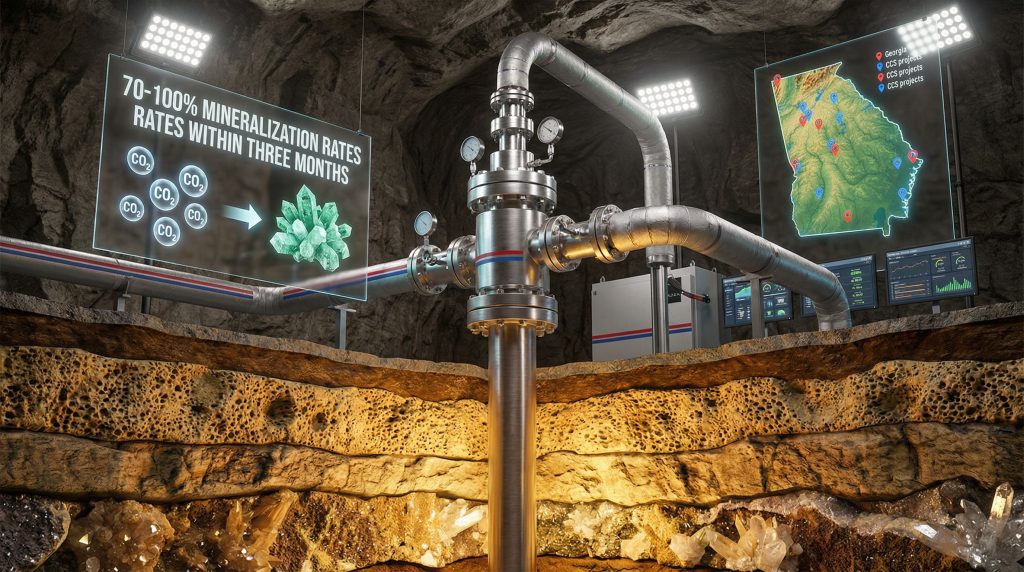
Recent pilot operations have revealed that Georgia's geological formations can achieve 70-100% mineralisation rates within three months of CO₂ injection, representing a significant advancement over traditional storage timelines. Block Energy's pilot project at the Patardzeuli field injected 13.6 tons of CO₂ through the PAT-49 well during August 2025, with subsequent monitoring across four connected wells confirming rapid conversion to solid carbonate minerals.
The Middle Eocene reservoir's natural depth and pressure conditions create an optimal environment for geochemical reactions that convert dissolved CO₂ into permanent mineral form. Formation water chemistry plays a crucial role in this process, with specific ionic compositions facilitating carbonate precipitation reactions that lock carbon away permanently within the rock matrix.
Technical Mechanisms Behind Rapid Mineralisation
The mineralisation process begins when CO₂ dissolves into formation water, creating carbonic acid that subsequently reacts with available minerals to form stable carbonate compounds. Georgia's formations contain mineral assemblages that readily participate in these reactions, enabling the rapid conversion rates observed in recent testing.
Independent laboratory analysis conducted in Azerbaijan examined formation water samples to verify mineralisation products and measure dissolved CO₂ concentrations. Results showed dramatic reductions in dissolved CO₂ levels alongside increased carbonate mineral content, providing geochemical proof of permanent conversion occurring in-situ.
Tracer compounds injected alongside CO₂ enabled researchers to track subsurface migration patterns and confirm that carbon remained within the target formation rather than escaping to overlying layers or the surface. Furthermore, exploring carbon capture and storage fundamentals provides essential context for understanding Georgia's mineralisation advantages. Critically, no gaseous CO₂ was detected at surface monitoring points, demonstrating containment integrity throughout the pilot phase.
Comparative Storage Method Analysis
| Storage Method | Permanence Level | Timeline | Monitoring Requirements |
|---|---|---|---|
| Geological Trapping | Medium-term | Decades to centuries | Continuous seismic monitoring |
| Mineralisation | Permanent | 3-12 months | Initial verification only |
| Enhanced Oil Recovery | Temporary | Variable | Production-dependent monitoring |
| Saline Aquifer Storage | Long-term | Decades | Periodic pressure monitoring |
This comparison reveals mineralisation's advantages in both permanence and reduced monitoring requirements. Traditional geological storage relies on caprock integrity and structural trapping, requiring decades of monitoring to ensure CO₂ remains contained. In addition, mineralisation eliminates these concerns by converting CO₂ into solid form immediately upon injection.
When big ASX news breaks, our subscribers know first
Technical Implementation of CO₂ Mineralisation Systems
The practical deployment of carbon capture and storage in Georgia involves sophisticated injection and monitoring protocols designed to optimise mineralisation rates while ensuring environmental safety. Block Energy's pilot demonstrated these technical capabilities through systematic pre-injection preparation, controlled injection parameters, and comprehensive post-injection verification.
Pre-injection activities included detailed formation characterisation to identify optimal injection zones and predict mineralisation kinetics. CO₂ preparation involved dissolution in formation water to enhance reactivity upon injection, while tracer compound integration enabled subsurface tracking throughout the storage process.
Injection and Monitoring Operations
The pilot project utilised the existing PAT-49 well infrastructure, injecting 13.6 tons of CO₂ with integrated tracer compounds over a controlled timeframe during August 2025. Four connected monitoring wells provided real-time data on subsurface conditions, pressure responses, and geochemical changes occurring within the formation.
Formation water sampling occurred at regular intervals across the monitoring network, with samples analysed for dissolved CO₂ concentrations, tracer compound levels, and carbonate mineral content. This comprehensive approach provided multiple lines of evidence confirming successful mineralisation.
Surface monitoring protocols included atmospheric CO₂ detection systems positioned around wellheads and injection facilities. The absence of detectable CO₂ emissions confirmed that injected carbon remained in subsurface storage rather than escaping to the atmosphere.
Laboratory Verification Standards
Independent third-party analysis followed international carbon and mineralisation standards, ensuring results met rigorous scientific and commercial verification requirements. Laboratory techniques included:
• Geochemical analysis of formation water samples to quantify dissolved CO₂ levels
• Mineral composition assessment to identify carbonate precipitation products
• Tracer compound measurement to track CO₂ migration patterns
• Surface gas detection protocols to verify containment integrity
Results demonstrated 70% to 100% mineralisation within three months, with low dissolved CO₂ levels and increased tracer concentrations in monitoring wells confirming successful carbon conversion and subsurface distribution. Consequently, these findings support the potential for renewable energy integration with CCS operations to create sustainable carbon-negative energy cycles.
The rapid mineralisation achieved in Georgia's pilot represents a breakthrough in permanent carbon storage technology, demonstrating conversion rates significantly faster than traditional geological storage methods.
Diverse Carbon Storage Approaches Across Georgia
Georgia's carbon capture and storage landscape encompasses multiple technological approaches, each addressing different emission sources and storage requirements. Underground mineralisation projects lead current development activity, supported by innovative deep mine storage concepts and utility-scale exploration initiatives.
Underground Mineralisation Project Scale
Early assessments suggest Georgia's Middle Eocene reservoir could accommodate up to 151.5 million metric tons of CO₂ through mineralisation under mid-case development scenarios. This substantial capacity represents significant potential for regional and national carbon management infrastructure.
The storage potential calculation incorporates formation thickness, porosity, and mineralisation capacity based on pilot results. Existing well infrastructure provides cost advantages for project development, while proximity to industrial emission sources reduces transportation requirements and overall project economics.
Integration opportunities include connections with renewable energy systems to power injection operations, creating carbon-negative energy cycles that enhance overall environmental benefits. Hydroelectric resources in Georgia could provide clean power for CO₂ compression and injection systems.
Commercial Development Pathways
Block Energy's Phase 2 development plans focus on refining storage capacity estimates, advancing independent certification of permanent storage, and evaluating commercialisation pathways for third-party storage services. These activities build toward commercial-scale operations capable of serving multiple industrial customers.
Joint venture partnerships with Indorama Corporation through its subsidiary Rustavi Azot provide industrial customer integration opportunities and access to significant CO₂ emission sources. This corporate partnership structure demonstrates private sector confidence in mineralisation technology viability.
Commercial carbon credit generation represents a key revenue stream for project economics, with permanent mineralisation providing premium pricing advantages over traditional geological storage credits. Verification protocols established during pilot phases support market acceptance and regulatory compliance.
Regional Infrastructure Development
Infrastructure advantages in Georgia include existing well networks, industrial facilities, and transportation systems that reduce capital requirements for large-scale deployment. Non-potable water recycling capabilities enable sustainable operations without competing for freshwater resources.
Pipeline network potential connects major industrial emission sources with storage sites, creating integrated carbon management systems serving multiple customers across the region. Transportation cost optimisation through strategic site selection enhances project economics and market competitiveness.
Private Sector Leadership in Georgia's CCS Development
Carbon capture and storage in Georgia development relies heavily on private sector innovation and investment, with companies like Block Energy demonstrating technical capabilities while building commercial partnerships for scaled deployment.
Block Energy's Pioneering Role
Block Energy plc emerged as the primary documented leader in Georgia's CCS development through its successful pilot project at Patardzeuli field. The company's technical achievement of 70-100% mineralisation within three months established proof-of-concept for commercial-scale development.
CEO Paul Haywood characterised the pilot results as providing permanent storage without reliance on long-term trapping mechanisms, highlighting mineralisation's fundamental advantages over conventional approaches. This technical differentiation supports premium market positioning and commercial viability.
The company's Phase 2 development strategy includes storage capacity refinement, independent certification advancement, and commercialisation pathway evaluation. These systematic development phases demonstrate structured progress toward commercial operations. Moreover, understanding broader industry innovation trends provides context for CCS advancement within Georgia's evolving energy landscape.
Strategic Corporate Partnerships
Indorama Corporation's involvement through Group Director Prakash Kejriwal brings multinational corporate resources and industrial customer access to Georgia's CCS development. The partnership with Rustavi Azot, Indorama's local subsidiary, provides direct connections to significant industrial CO₂ emission sources.
This corporate partnership structure creates vertical integration opportunities spanning from emission capture through permanent storage, optimising project economics and operational efficiency. Large industrial customers provide stable, long-term demand for storage services.
Technical advisory services from specialised firms like OPC provide independent validation of mineralisation results and support regulatory compliance requirements. Third-party technical verification enhances market credibility and investor confidence.
Investment and Development Trends
Private sector investment in Georgia's CCS projects reflects growing confidence in mineralisation technology and regulatory support for carbon management infrastructure. Project financing structures accommodate both development capital and operational cash flow requirements.
Risk mitigation through phased development approaches allows companies to validate technical assumptions while scaling operations gradually. Recent developments highlight the importance of CO2 injection success in validating technological approaches. Pilot success rates directly influence subsequent investment decisions and expansion timelines.
Market positioning strategies emphasise permanent storage advantages and reduced monitoring costs compared to conventional geological storage alternatives. These competitive differentiators support premium pricing and customer acquisition strategies.
Georgia's Position in National Carbon Storage Markets
The southeastern United States represents a rapidly expanding region for carbon capture and storage development, with Georgia emerging as a technical leader in permanent mineralisation approaches. Regional storage potential, federal incentive structures, and geological diversity create favourable conditions for industry growth.
Regional Development Context
Georgia's CCS projects operate within a broader southeastern development corridor that includes major initiatives across multiple states. While specific comparative data requires additional research beyond available sources, Georgia's mineralisation focus provides technological differentiation within regional markets.
The state's geological formations offer advantages in storage permanence and reduced monitoring requirements compared to traditional geological storage approaches deployed in neighbouring regions. These technical advantages support market positioning and regulatory approval processes.
Infrastructure connectivity between Georgia and other southeastern states creates opportunities for interstate carbon transportation and storage networks. Regional cooperation enhances overall market development and cost optimisation opportunities. Furthermore, accessing decarbonisation benefits demonstrates the economic value of integrated carbon management approaches.
Federal Policy and Incentive Framework
Federal carbon capture incentive structures, including 45Q tax credits, provide financial support for CCS project development nationwide. While specific credit rates require verification from current regulatory sources, federal support mechanisms significantly impact project economics and investment decisions.
Direct air capture incentives create additional market opportunities for enhanced CO₂ removal projects that combine atmospheric capture with permanent geological storage. These premium incentive structures support advanced technology deployment and commercial viability.
Permit application trends across southern states indicate growing industry interest in carbon storage infrastructure development. Regulatory streamlining efforts at federal and state levels support accelerated project timelines and reduced development costs.
Competitive Technology Positioning
Georgia's mineralisation approach offers distinct advantages over conventional geological storage methods deployed in other regions. Permanent conversion to solid minerals eliminates long-term liability concerns and reduces monitoring costs compared to structural trapping approaches.
Technical differentiation through rapid mineralisation rates creates market positioning advantages and supports premium pricing for storage services. Customer preference for permanent storage solutions drives demand for Georgia's mineralisation capabilities.
Research and development activities in Georgia contribute to broader industry knowledge while maintaining competitive technological advantages. Academic partnerships and industry collaboration support continued innovation and market leadership.
Economic and Environmental Impact Assessment
Carbon capture and storage in Georgia creates substantial economic development opportunities while delivering measurable environmental benefits through permanent CO₂ removal from the atmosphere. Project economics integrate capital investment, operational revenues, and long-term value creation across multiple stakeholder groups.
Economic Development Potential
Large-scale CCS infrastructure development generates significant employment opportunities spanning construction, operations, maintenance, and support services. Technical positions require specialised training and skills development, creating high-value career pathways within local communities.
Industrial facility integration creates supply chain development opportunities for equipment manufacturing, transportation services, and technical consulting. Local procurement preferences enhance regional economic multiplier effects and community support for project development.
Revenue generation through carbon credit sales, storage service fees, and industrial partnerships provides long-term economic benefits extending beyond initial construction phases. Permanent storage verification enables premium pricing in voluntary and compliance carbon markets.
Environmental Benefits Analysis
Permanent mineralisation eliminates concerns about long-term CO₂ leakage that affect traditional geological storage approaches. Solid carbonate minerals provide geologically stable carbon storage lasting thousands of years without active monitoring requirements.
Integration with renewable energy sources for injection operations creates carbon-negative energy cycles that enhance overall environmental performance. Hydroelectric power utilisation in Georgia supports sustainable CCS operations without additional fossil fuel consumption.
Surface environmental impacts remain minimal due to utilisation of existing well infrastructure and subsurface storage locations. Land use requirements focus on wellhead facilities and monitoring equipment rather than large surface installations.
Water resource management incorporates non-potable formation water recycling, avoiding competition with municipal or agricultural water supplies. Sustainable operations protocols ensure environmental protection while maintaining commercial viability.
Long-term Value Creation
Permanent storage capabilities create enduring value through verified carbon removal that supports corporate sustainability goals and regulatory compliance requirements. Long-term contracts with industrial customers provide stable revenue foundations for project financing.
Technology leadership in mineralisation approaches positions Georgia as a preferred location for advanced CCS development, attracting additional investment and industry partnerships. Knowledge economy benefits include research opportunities and technical expertise development.
Infrastructure development creates foundation assets supporting expanded carbon management capabilities and related industrial development. Strategic positioning within national carbon transportation networks enhances long-term growth potential. Additionally, exploring energy transition insights reveals the critical role CCS plays in broader energy transformation strategies.
The next major ASX story will hit our subscribers first
Technical Challenges and Commercial Opportunities
The advancement of carbon capture and storage in Georgia faces several technical scaling considerations while presenting substantial commercial opportunities for industry leaders and regional stakeholders. Successfully addressing these challenges will determine the pace and scale of statewide CCS deployment.
Storage Capacity Assessment Refinement
Detailed geological characterisation across Georgia's formations requires extensive technical assessment to refine storage capacity estimates beyond initial pilot results. Formation heterogeneity, pressure management, and injection rate optimisation represent key technical variables affecting commercial viability.
Independent certification processes for permanent storage must establish standardised protocols that satisfy regulatory requirements while supporting carbon credit market acceptance. Verification methodologies need development to address mineralisation-specific storage mechanisms.
Commercialisation pathway development involves creating scalable business models that serve diverse customer requirements while maintaining operational efficiency. Storage service pricing, contract structures, and risk allocation mechanisms require careful design to support market growth.
Regulatory Framework Development
State oversight through Georgia's Department of Energy and Natural Resources provides regulatory foundation for CCS project development, though specific permitting procedures continue evolving as technology advances. Coordination between state and federal regulatory authorities ensures comprehensive compliance frameworks.
Environmental impact assessment procedures must address mineralisation-specific considerations while streamlining approval processes for low-risk permanent storage operations. Community stakeholder engagement protocols support public acceptance and regulatory approval processes.
Federal compliance requirements integrate with state regulations to create comprehensive oversight systems balancing environmental protection with commercial development objectives. Regulatory certainty supports investment decisions and project financing arrangements.
Market Integration Strategies
Voluntary carbon market integration requires establishing mineralisation storage credits within existing market frameworks while demonstrating permanence advantages over traditional geological storage alternatives. Premium pricing strategies reflect enhanced environmental integrity and reduced monitoring requirements.
Mandatory compliance market preparation addresses potential federal carbon pricing mechanisms and state-level carbon reduction requirements. Regulatory credit recognition supports long-term market viability and customer demand development.
Industrial customer acquisition strategies focus on large emission sources seeking permanent storage solutions with verified environmental benefits. Partnership development with manufacturing, power generation, and chemical industry customers creates stable demand foundations.
Future Outlook for Georgia's Carbon Storage Industry
Georgia's strategic position in carbon capture and storage development reflects several converging advantages that support continued industry growth and technological leadership. Geological diversity, existing infrastructure, federal incentive alignment, and private sector innovation create favourable conditions for sustained expansion.
Strategic Competitive Advantages
Geological formations enabling multiple storage approaches provide operational flexibility and risk diversification compared to regions dependent on single storage mechanisms. Mineralisation capabilities offer permanent storage solutions that address growing market demand for verified carbon removal.
Existing infrastructure reduces capital requirements for project development while existing industrial facilities provide proximate CO₂ emission sources. Transportation cost advantages and operational synergies enhance overall project economics and market competitiveness.
Federal incentive structures support project viability through tax credits and research funding opportunities. State-level support for energy innovation and economic development creates additional advantages for industry growth and technology advancement.
Technology Development Trajectory
Regional leadership in permanent storage technology development positions Georgia as a preferred location for advanced CCS research and commercial deployment. Academic partnerships and industry collaboration support continued innovation and market differentiation.
Scaling from pilot operations to commercial deployment requires systematic capacity expansion, operational optimisation, and cost reduction initiatives. Technology maturation supports broader market adoption and increased customer acceptance.
Integration with complementary technologies including direct air capture, industrial carbon utilisation, and renewable energy systems creates comprehensive carbon management capabilities addressing diverse market requirements. Furthermore, staying informed through innovation expo updates provides valuable insights into emerging CCS technologies and market trends.
Market Development Prospects
Growing corporate demand for permanent carbon removal solutions drives market expansion for Georgia's mineralisation capabilities. ESG investment requirements and supply chain decarbonisation initiatives create sustained customer demand growth.
Carbon credit market evolution toward permanence verification and environmental integrity standards supports premium pricing for mineralisation storage services. Market differentiation advantages strengthen competitive positioning and revenue potential.
Regional carbon transportation network development connects Georgia's storage capabilities with emission sources across the Southeast, expanding market reach and operational scale opportunities. Interstate collaboration enhances overall market development and infrastructure optimisation.
Georgia's emergence as a leader in carbon capture and storage technology reflects successful integration of geological advantages, technological innovation, and strategic industry partnerships. The state's progress in permanent mineralisation storage demonstrates significant potential for addressing climate policy requirements while creating substantial economic development opportunities. As federal incentives continue supporting industry growth and carbon markets evolve toward permanence verification, Georgia's technical capabilities position it for sustained leadership in next-generation carbon management solutions.
Looking to Invest in Companies Leading Georgia's Carbon Revolution?
Discovery Alert's proprietary Discovery IQ model delivers real-time notifications on significant ASX mineral discoveries, including companies advancing carbon capture technologies and sustainable mining operations. Stay ahead of market movements by exploring Discovery Alert's discoveries page to see how historic breakthroughs have generated substantial returns, then begin your 30-day free trial to position yourself at the forefront of the energy transition.